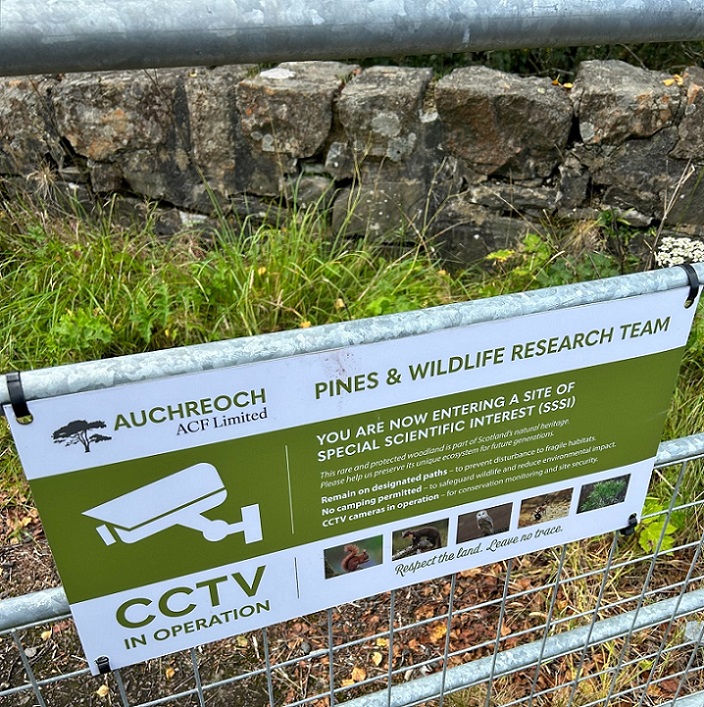
A few weeks ago a reader alerted me that there were new unlawful access signs on the Auchreoch Estate, which changed ownership in January 2025, and that they had seen sheep grazing in the Coille Coire Chuilc. Two land-management failures in one! Unfortunately the reader sent no photos – if you see bad stuff, please record it! I was then contacted quite separately by Harry Barnes alerting me to the sign which, besides being contrary to access rights is one of the most misleading and hypocritical I have seen.
“You are now entering a Site of Special Scientific Interest”
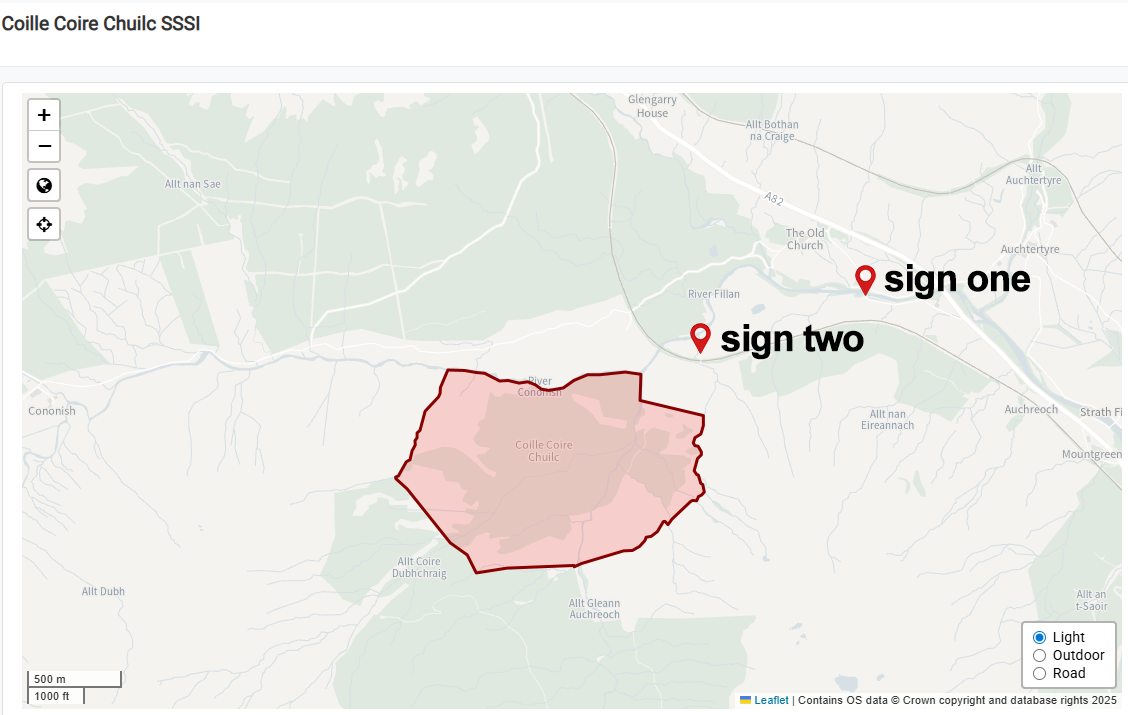
Much as I would like to see SSSIs extended to create large natural regeneration zones around all the surviving fragments of Caledonian Pinewood to enable them to recover, that has never has been the case in Scotland. The two signs Harry saw are located well outside the SSSI. Perhaps whoever erected the signs did not know where the SSSI actually was?.
“Pine and Wildlife Research Team”
Coille Coire Chuilc is still in trouble after decades of failed attempts at conservation (see here) so if the new owner of Auchreoch has created a “Pines and Wildlife Research Team” that would be brilliant, so long as the people employed have appropriate expertise. Unfortunately, I can find no information about the Team or even how to contact the new estate on the internet (apart from the contact address of the new owner which is registered on companies house).
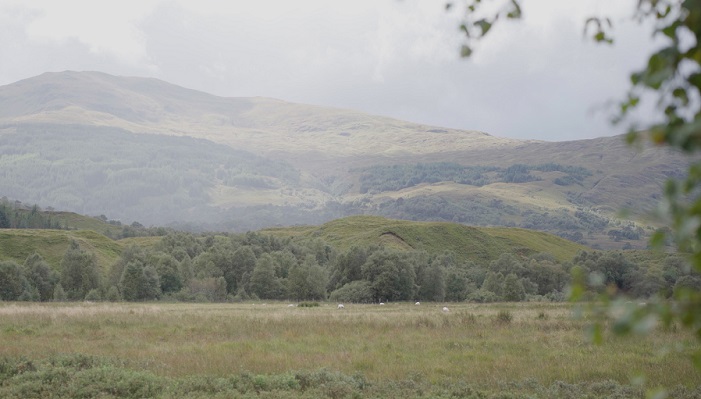
I asked Harry Barnes, who makes films under the name of Cridhe, if he had seen any sheep INSIDE the fence that surrounds Coille Coire Chuilc and marks the boundary of the SSSI. He hadn’t. But he had seen sheep grazing on the land outside the boundary fence, on ground which Auchreoch’s sign claims is protected, including the well drained moraines where the Caledonian Forest would extend if given half a chance.
Fences never hold out sheep and deer for long as is illustrated by the Loch Lomond and Trossachs National Park Authority (LLTNPA)’s plan (see here) to use £10k from the Cononish goldmine and a further £20k in public grants to erect a new fence around Coille Coire Chuilc. That plan thankfully fell through when the previous owner of Auchreoch, Mr Lewis, put the estate on the market in 2023. A small piece of useful information that emerged at the LLTNPA board meeting on Monday (see here) was that the new owners of the Cononish goldmine have settled all debts but this means there now appears a real danger that that stupid plan is resurrected. The answer to failed fences is not to erect new fences alongside them but is to control where sheep graze (as they do in Italy) and reduce deer numbers. The £30k would be much better spent on that.
“Remain on designated paths”
Under access rights people have a right to roam over the whole of the Auchreoch Estate and the command to “remain” on “designated paths” is unlawful, whatever the Pines and Wildlife Research Team mean by “designated”. The claimed justification for this, “to prevent disturbance of fragile habitats”, is also nonsense. Anything “fragile” at Auchreoch has long disappeared because of the numbers of sheep and deer, which trample the ground far more than visitors and graze as they go.
But confirmation of this is provided by the Site Management Statement for the SSSI, prepared by NatureScot back in 2010 (see here), which clearly states “The most significant factor thought to be inhibiting regeneration is grazing pressure”: At the end, under other factors this statement says:
“A path through the site is the main access route to the nearby Munros, Ben Oss and Beinn Dubhchraig. Heavy usage of this path has caused localised poaching. This looks unsightly but does not appear to affect the regeneration of pine trees”
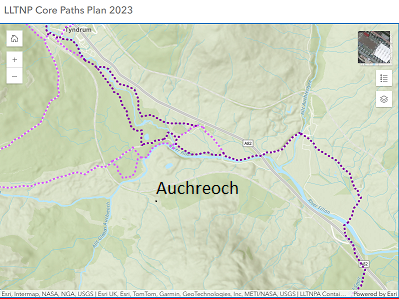
Under the Land Reform (Scotland) Act 2003.designated paths mean the “core paths” created as part of access rights. These were intended as a means of enabling more people to enjoy access rights There are no core paths on the Auchreoch Estate so the sign telling people to keep to designated paths should be properly understood as meaning “Don’t go anywhere on this estate”.
This helps illustrate why we need far more core paths in our National Parks, as I argued recently in respect to the Cairngorms core paths consultation (see here) . Core paths are not an alternative to the right to roam, they are a means of reinforcing it. A new core path to Coille Choire Chuilc – its far from obvious how to get there partly because of the rivers blocking access – might enable people other than hillwalkers (who find out where to go through guidebikes and sites like Walk Highland) to enjoy it. More people might also help keep sheep and deer on the move reducing the damage they are doing to the pinewood..
“No camping permitted – to safeguard wildlife and reduce environmental impact”
Camping is an activity included under access rights and no landowner has no power therefore to say camping is not permitted. We have a right to camp except where camping has been excluded from access rights through byelaws passed by public authorities. The Strathfillan area is not included in the LLTNPA’s camping management byelaws. The sign is therefore unlawful and the LLTNPA’s Access Team should ensure it is removed as soon as possible.
Besides a site management statement, every SSSI also has a list of Operations Requiring Consent (ORC). These are effectively a list of damaging activities. In the case of Coille Coire Chuilc most of these relate to overgrazing and farming related activities:
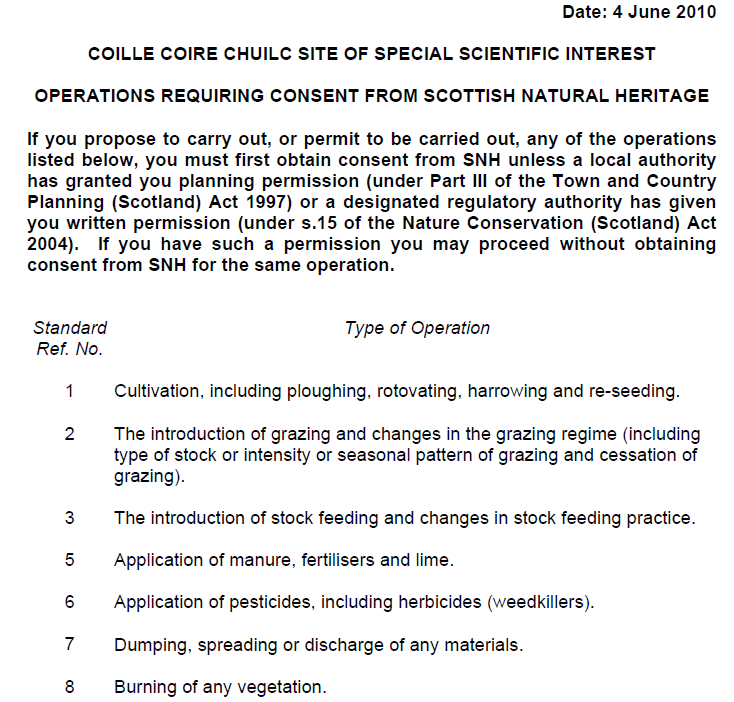
Near the end of the list is the following ORC:
“Recreational activities other than those carried out responsibly in keeping with the Scottish Outdoor Access Code.”
This provision is primarily intended to prevent or control any damaging recreational activities that require a landowners consent, such as quad biking. The exception for activities carried out “in keeping to the Scottish Outdoor Access Code” tells you though that NatureScot sees no need to restrict recreational activities that come under access rights, including camping, in the SSSI. In other words Auchreoch’s justification that no camping should be allowed to protect wildlife and the environment is bunkum.
The only people likely choose to camp within Coille Coire Chuilc are researchers and others with a deep interest in the natural environment who wish, for example, to experience or monitor the wildlife within the SSSI at night. They are unlikely to get much sleep as the ground is simply too rough and either too vegetated or else too boggy to be any good for camping. The only places that the general public are likely to want to camp at Auchreoch are flatter and grassier than Coille Choire Chuilc, such as areas along the river banks. These are the very places that the Auchreoch sign claims is within the SSSI but aren’t!. The reasonable conclusion is that this sign has nothing to do with protecting the natural environment but is simply a deliberate attempt to restrict access rights.
“CCTV”
As for the site security camera, the main threat to the security of the SSSI and surrounding area comes from the way it is being managed. This appears designed to intimidate since anyone who is not confident of their rights might think there would be consequences if they were filmed walking off path and deterred from doing so. But at least, if there really is CCTV on site, the Auchreoch Estate cannot claim they don’t know about the sheep that are preventing the Caledonian Pinewood from regenerating.
The new owner of Auchreoch
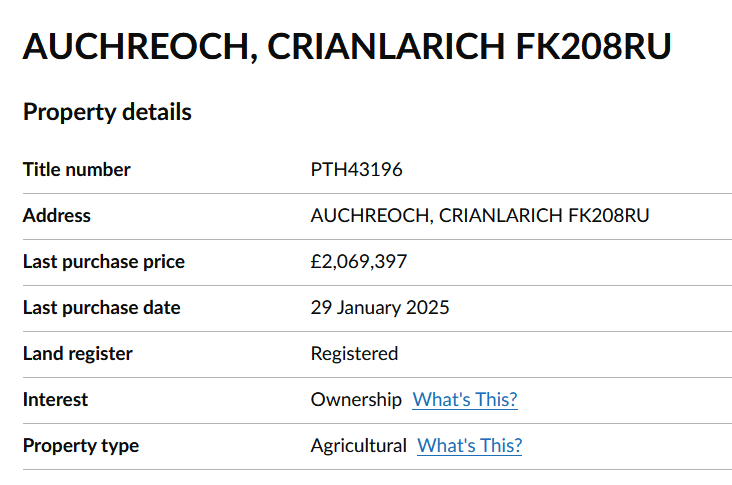
Auchreoch was sold in January this year for £500k less than its asking price:
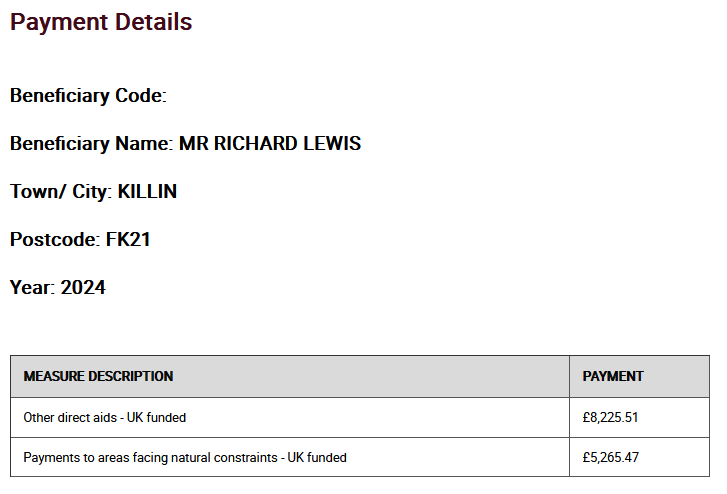
But not before the previous owner, Richard Lewis, had been paid a further £13 490.98 in rural subsidy for last year:
 Why the Scottish Government continue to reward landowners who appear to have done nothing to protect the Pinewoods for which they are the nominal custodians is a moot question which remains unanswered.
Auchreoch ACF Ltd was incorporated with a share capital of £100 just two weeks before becoming legal owner of the property . It is controlled by an Alasdair John Campbell, born in 1977, who is also its only Director. While the data linking people to companies on the Companies House website is not good, a search came up with the following information which appears to relate to the same Mr Campbell:
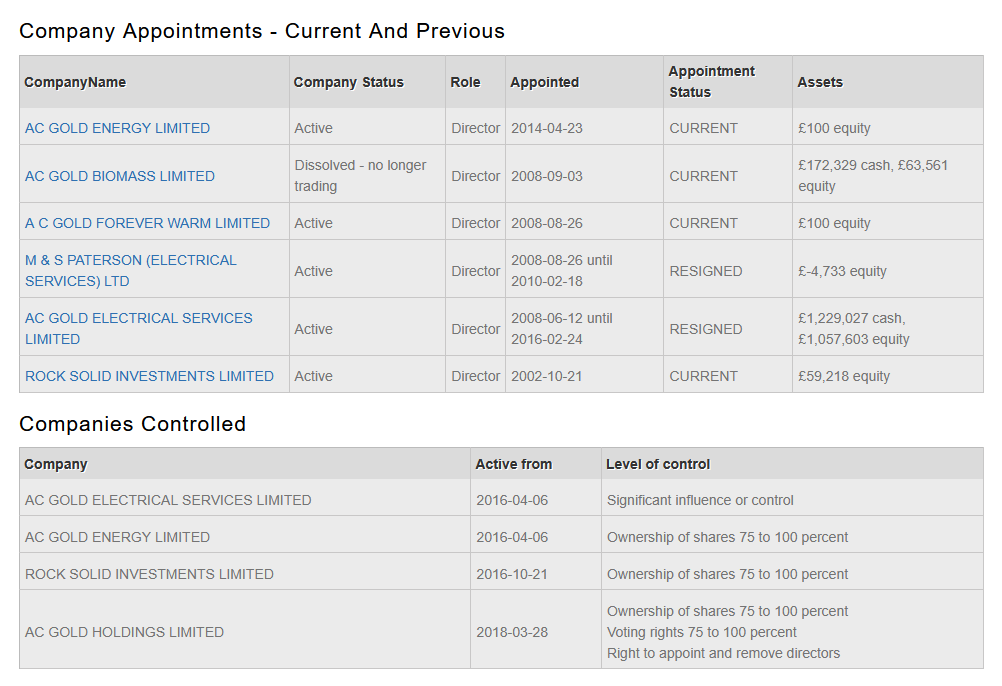
With the goldmine next door, I was led down a rabbit hole looking for a connection between it and Mr Campbell but I cannot find any. He appears to run electrical and related businesses in the Stirling area which incorporate the world gold in their names. That is always a good way to dazzle people. One of those companies is called AC Gold Holdings which has assets over £5m and through which he controls some of the other companies.
I have not been able to find out whether Mr Campbell has any knowledge or experience that might qualify him for becoming custodian for Coille Coire Chuilc, although the information on the sign suggests otherwise.
The important point here is the Land Reform (Scotland) Bill currently being considered by the Scottish Parliament does not even include measures to vet people wanting to buy large chunks of land like Auchreoch, even when they are in National Parks, even when they include fragments of the Caledonian Forest and even when those fragments have been in poor condition for years because of the way they have been managed (Coille Coire Chuilc was last assessed in 2009 as being in poor condition but the LLTNPA would never have proposed spending £30k fencing it if that had changed).
Until we start to control who owns land nothing will change. The starting point for land reform should be that people who are not prepared to do things like take appropriate action to restore nature or respect access rights in places like Auchreoch should not be allowed to buy the land. The new signs on Auchreoch suggest that Mr Campbell fits that category of person but I would be happy to be proved wrong. A public apology for the egregious sign, removal of the sheep and a commitment to restore Coille Coire Chuilc by reducing deer numbers and without new fencing would be a start. It would also be in accordance with the professed wishes of the company on the sign that it is motivated by a wish to protect wildlife.
Were Mr Campbell to commit to that, I would even support the £30k the LLTNPA has allocated to fencing being used to help him employ an experience deer stalker full-time to reduce deer numbers to less than 2 per square km. Conversely, if Mr Campbell continues to allow Auchreoch to be managed the way it is, there is no way the estate should be given any more public money. More specifically, the LLTNPA Board Meeting on Monday were told of a potential £15m bid to the National Heritage Lottery for “nature restoration” which Gordon Watson, the Chief Executive, stated would include Strath Fillan and Glen Falloch. I am submitting a number of Information Requests on this bid including whether the Auchreoch Estate are one of the partners in the bid but they should not receive a penny of lottery money until the way the estate is being managed is fundamentally changed for the better.
For a great explanation of many of the conservation challenges facing Coille Coire Chuilc and the Pinewood in Glen Falloch, I highly recommend Harry Barnes’ video which is just out (see here). It has some wonderful aerial footage of the two pinewoods, some great phrases – “we need to help the Caledonian Pinewoods escape their cages” – and some great ideas (although I would have liked it to be more openly critical of the idea that planting of native trees should have any part in restoring the Caledonian Pinewoods).

For a while post 2007, CCC was a site that I advised on in my capacity as an advisor with Scottish Native Woods. At the time, it was tricky to know what to do because, to the west of the Allt Auchreoch, there was a cohort of birch developing, and a healthy % of Scots Pine within it. At that time, it seemed foolish to fence, given things might come away by itself, and the previous fenced enclosure only managed to regenerate 6 pine trees in 30 years. For two years, it seemed to be developing fine (west of the watercourse). As that side had an older age profile, and was the priority to get right (the eastern side is actually much younger), we did not want to do anything on the east that might deflect more grazing pressure to the west. It worked OK until the really bad winter of 2010-11. That seemed to change the deer dynamic totally, and we basically lost 90% of the pine seedlings that winter. It was a massive blow. The following year, SNW disappeared, and my input came to an end. I went back this spring for a look. What I am seeing now is a very extensive pulse of birch through most of the western side, with much of that 6ft and over, so fully secured. (Broadleaved trees in a pinewood are important too). There are now more pine seedlings than there were in 2007, having lost them almost entirely then. Most of these are unbrowsed, but the problem is that, as in 2007, they are only growing 2-5 cms a year. Almost certainly, this is because most of these are growing on extremely wet ground conditions, unsuited to Scots Pine. The drier morainic knolls mostly have a full canopy, and seedlings find it difficult to get going there. The problem with trees only growing 2-5 cms a year, is that they will take 50 years or more to get to a safe height, and are vulnerable throughout all this time. There were no seedlings whatsoever on the eastern side in 2007, and I dont think that will have changed. However, what I think is that the birch in the west, is very well established now, and it will give cover for at least some of the pine to get away. If it can get another 10 years without another mishap, then I think there will be a good result there, and attention can be switched to the east. It has not deteriorated much since 2007, because it is largely younger than the west. If you are curious how I can say this, I spent 3 weeks in April 2007 GPS-ing and giving a life class score to every single tree in the pinewood, and noting which had regen and which had not. The east is much drier and much more fertile, and my instinct is that that side will need to be fenced at some point to make anything off it. I dont think that sheep use the western side that much, certainly not in the spring, because ground conditions are very wet, and there is also a lot of ticks/ midges in there. It is a wet sticky hollow, hence the Gaelic name. The east of more up to the wind, and animals use it a lot more. I came away this year feeling a lot more positive about CCC. It had grown out of the massive shock it received in 2010-11, and in another 10 years or so, I think the west will be secure. At that point, something significant can be done in the east. My instinct is not to push that too quickly, for fear of harming the west, or taking on unnecessary cost in the east. Importantly, there is no funding mechanism/ strategy for dealing with a site of that type, and until there is, there is little point in blaming the owners (who I dont know) for being slow to do anything. We will just have to be patient with CCC. If anyone from Parkswatch wants a “walk & talk” with me as an unofficial guide, I am happy to do that. Another perspective is always useful. (works both ways).