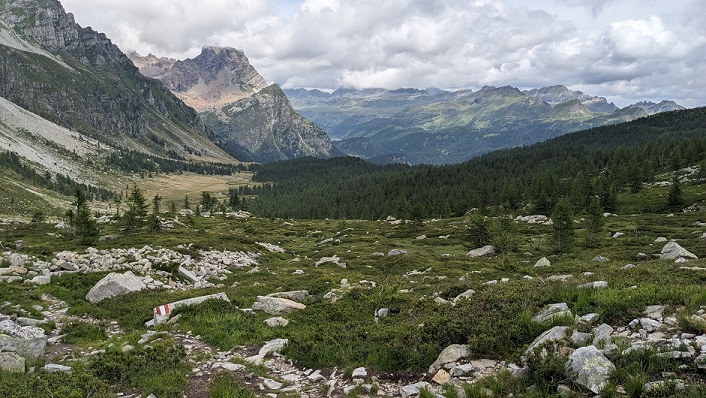
For my first few days walking the Grande Traversata dell Alpe (GTA) – I started from the Nufenenpass on 24th July – it was cloudy, windy and periodically wet, the forests were predominantly composed of conifers and the mountain flowers still out
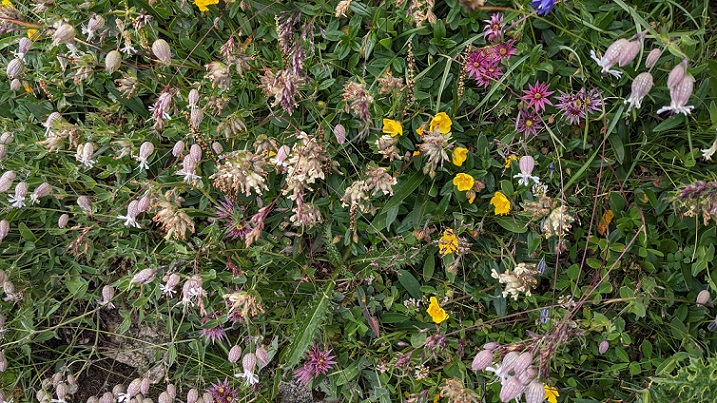
While some flowers were past their best others were in full bloom.
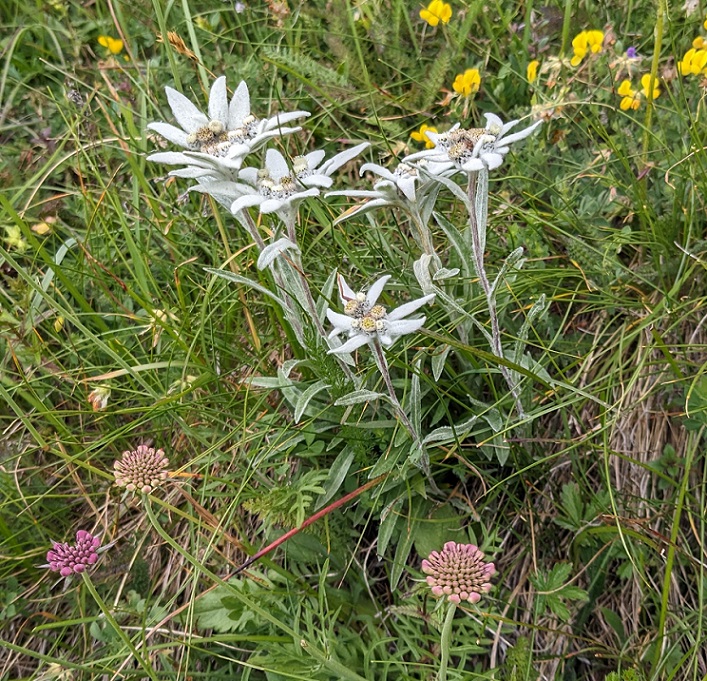
As a consequence, I did not really appreciate how dry it had been despite some warning signs:
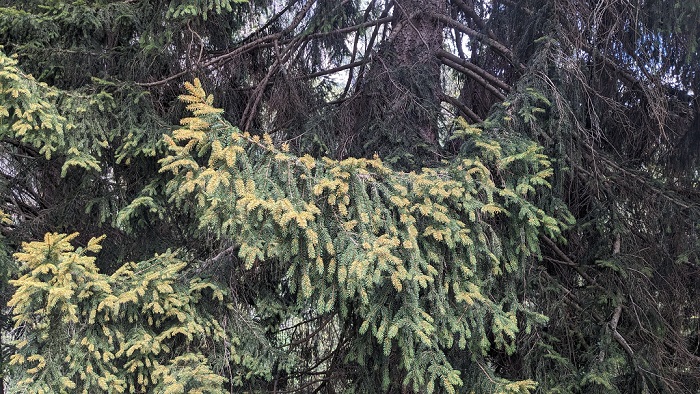
The impact of heat and drought
After a few days, however, I began to notice and appreciate the major differences in dryness between north and south facing slopes.
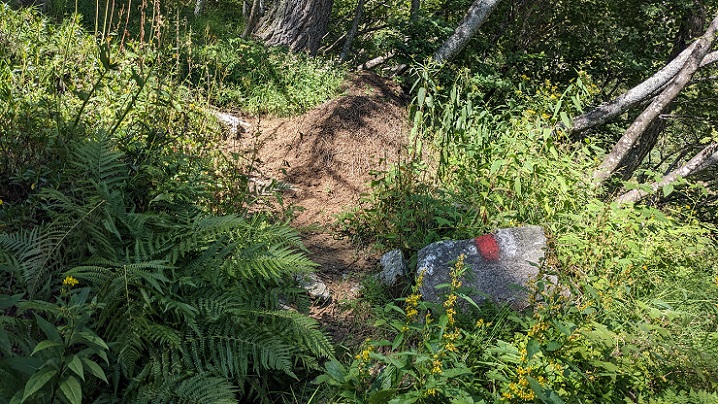
On the 1700m ascent from Varzo, most of it through forest, the ground vegetation was so lush that in many places I would have lost the path without the paintmarks. That took me by surprise because the Cicerone guidebook has warned about the lack of water sources on this north facing slope where I did not see so much as a trickle.
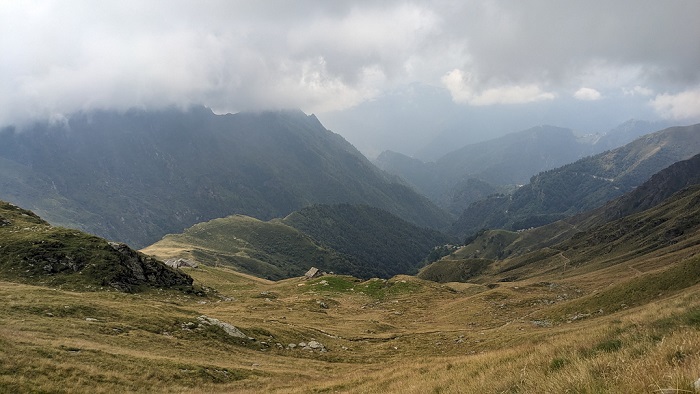
In much of the Italian Alps the impact of the sun is mitigated by warm moist air from the River Po and its tributaries which rises through the day and becoming trapped against the main spine of the Alps forming clouds in the afternoon. Despite this, on slopes that had been exposed to the full strength of the sun for even part of each day the flowers were over.
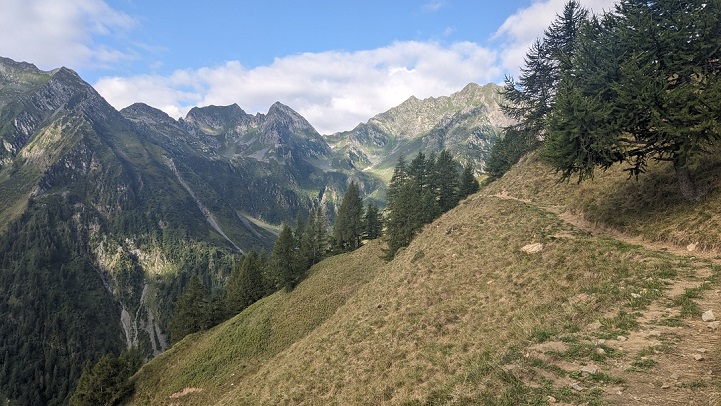
In French (my Italian is paltry) there are completely different words for north facing (ubac) and south facing slopes (adret) so profound are the differences in ecology. These differences start with climate, determine the distribution of plant and animal species and go all the way through to how the land is used by humans.
The weather remained cloudy and cool for the first ten days or so of my walk, although there was little rain before the second heatwave of the summer, which caused such destruction in north west Spain and South West France. That also enveloped the Piedmont Alps. People I talked to in the villages said they had never experienced such a hot summer in the mountains. While early starts up through forests helped, it was tough in the sun with temperatures approaching 30C at 2000m. Drenched with sweat, it was difficult not to think about the impact of the heat on the landscape.
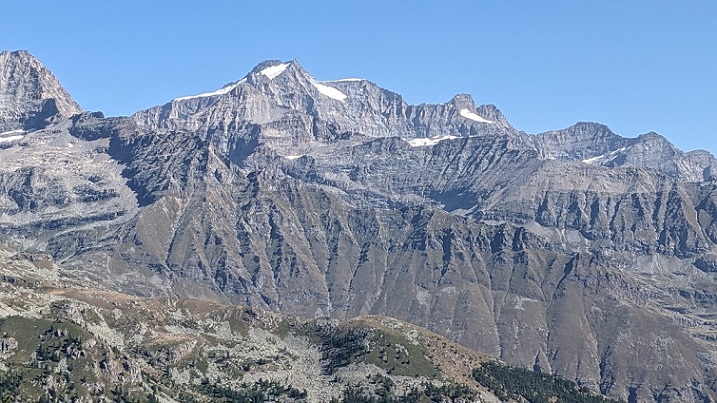
On south facing slopes the glaciers are rapidly disappearing from even the highest mountains along with the snow patches which used to survive the summer (while away Iain Cameron reported that the north-facing snow patch on Aonach Beag had melted two weeks earlier than ever previously recorded and just this week that the last snow patch to survive this year did the same).
Melting ice and snow plays a far more important role in the Italian Alps than Scotland and used to mitigate the impact of drought in summer, from the high pastures above the tree line down to the plain of the River Po. Scotland too, however, is being affected by the same heat, with our summer the hottest ever recorded and water restrictions imposed this week in the north east.
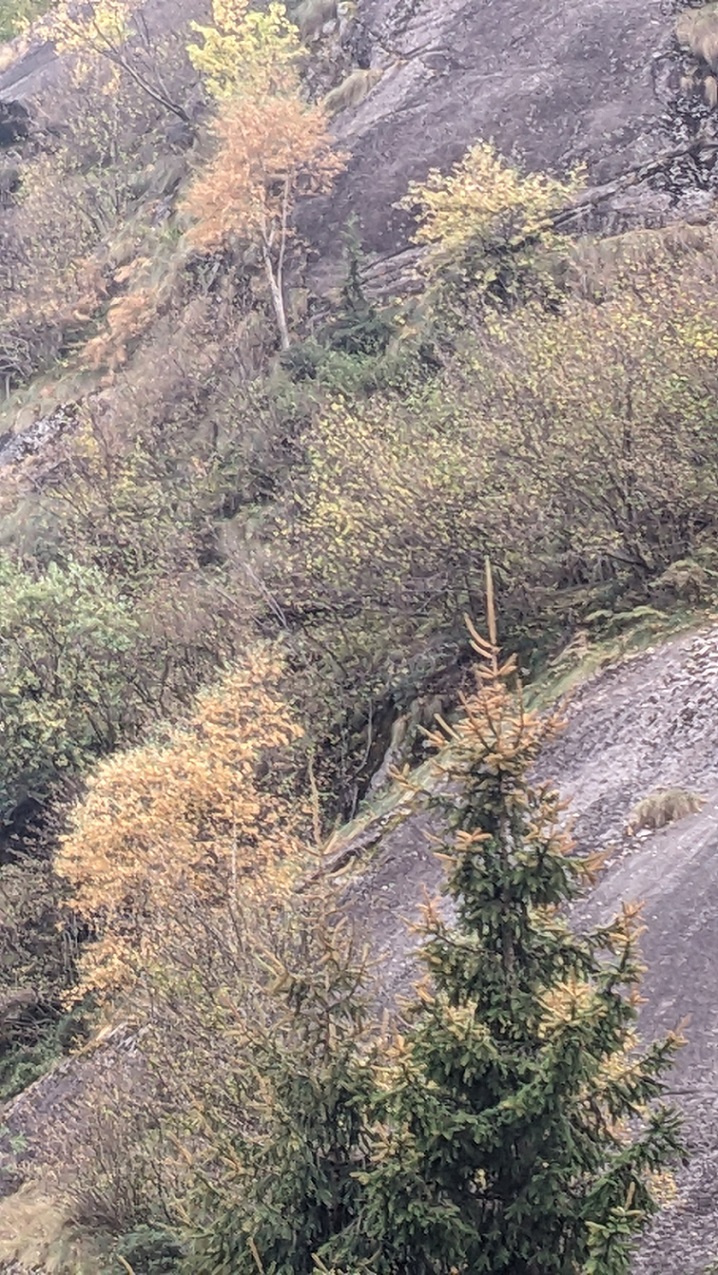
Meantime the extreme heat was desiccating vegetation exposed to the sun, killing off flowers, causing deciduous trees to drop their leaves and starting to kill off conifers. Rocky well drained slopes, such as those in the photo above were most affected. The impact varied from valley to valley and ridge to ridge as a result of local differences in the weather, rock, topography and land-use. Even in the greener areas, however, it was not difficult to spot trees wilting as a result of heat and lack of water:
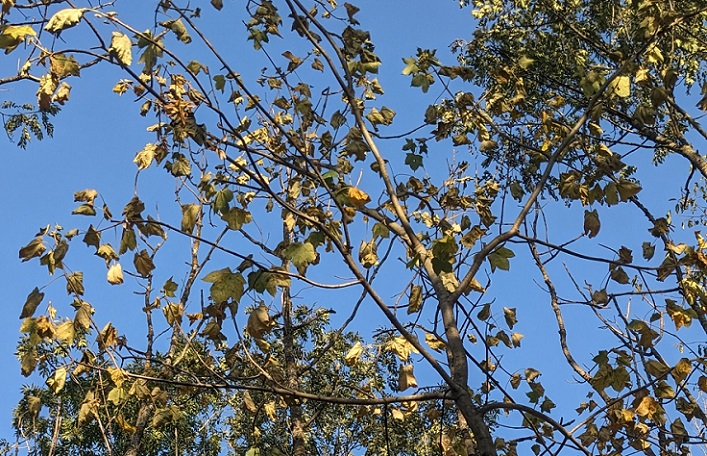
Without water and with nothing to eat, the traditional patterns of grazing in the Alps (which will be subject of my next post) face collapse and along with that rural livelihoods and culture.
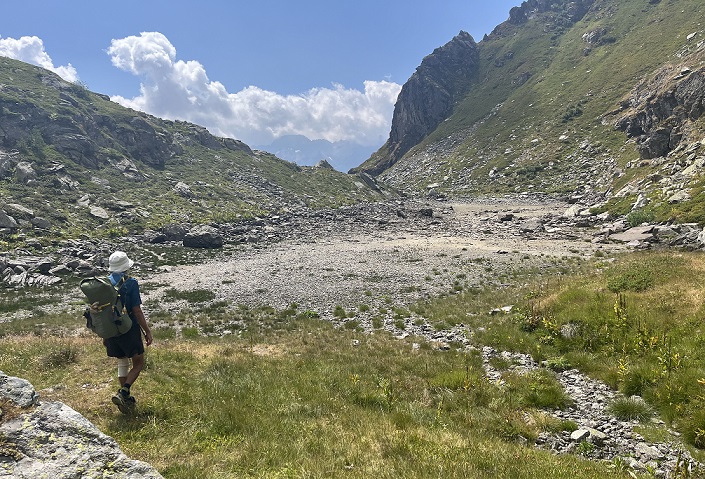
Walking by this dried up lake, which would have been fed by water from all sides if there were any, evidence suggested it had been drying out over the course of several years, with vegetation reclaiming what was once water and a new path developing below the former shore-line. Five hundred metres below it we passed a farmer with a bundle of electric fencing under his arm who asked us if there was any water in it.
Without water, farmers can no longer take their livestock up to the high pastures, as they used to do in July and August. That has serious implications for the system of transhumance which has been practised in the Alps for hundreds of years. The consequences for the much larger population which lives on the plain if the Po dries out, because there is no longer sufficient snow and ice to feed it through the year and the clouds which currently shade the mountains on many afternoons no longer form, will be even more serious.
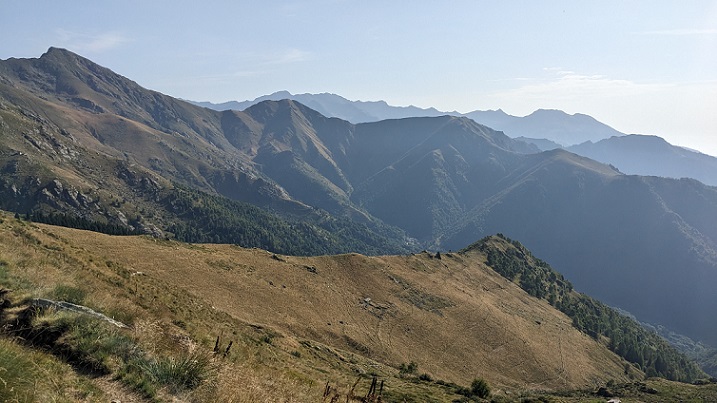
The implications for further global warming and wildlife are as serious. Growing seasons cut short mean trees and other plants absorb less carbon dioxide from the atmosphere than they would have otherwise have done increasing the greenhouse effect. All the wild animals that depend on plants for food, from deer to butterflies, face significant changes to their food supply at what is a critical time of year for many before winter. I could not help wondering how many of the thousands of butterflies brought out by the heat would reproduce with so few sources of nectar left. (The buddleia which was still in bloom when most else had died is likely to play a crucial role for some species in that respect)
As always when considering the impact of climate change, nothing is simple. For example, wetter springs could compensate reduced vegetation growth later on. This happened in Spain this year, where an abnormally wet spring (a contrast to Scotland’s very dry Spring) promoted very rapid growth. Unfortunately, all that new growth then died off in the heat creating a massive “fuel load” making wildfires far more difficult to control. While from what I saw the forests in the Italian Alps are still at present helping mitigate the impacts of climate change, keeping the landscape cooler and damper, that could all change if more trees shed their leaves early, lose their needles or die off as a result of the repeated impact of heat and drought.
While Scotland is different in significant respects, my take is we need to start thinking far more seriously about what type of forest and woodland will be most resilient to climate change. The response from the Cairngorms National Park in their fire management plan, approved earlier in the summer, has been limited to recommending firebreaks should be “built into” into new native woodland plantations to contain any fires that break out. Maybe the Italians have got it badly wrong but I don’t think I saw a single fire break in the Alps despite all the forest. There appears far less need because continuous cover forestry, as practised in most of the Alps, involves no draining of soils and results in mixed woodland of varying ages which is far less likely to burn.
Disease and pestilence
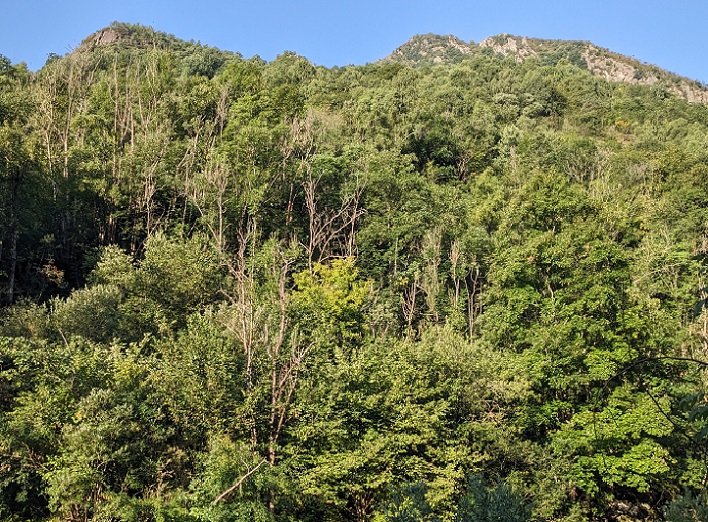
More obvious and omni-present than effect of heat and drought on trees in general was the impact of ash dieback (chalara), caused by a fungus (Hymenoscyphus Fraxineus). This was brought in from Asia with Chinese and Manchurian ash and has then spread across Europe and over to the Outer Hebrides. Ash imports were banned from Britain in 2012, too late to stop chalara, but its spread to the Outer Hebrides and other remote areas suggests its spores can spread much further on the wind than the ten miles Forest Research suggests (see here). It probably would have crossed the Channel anyway.
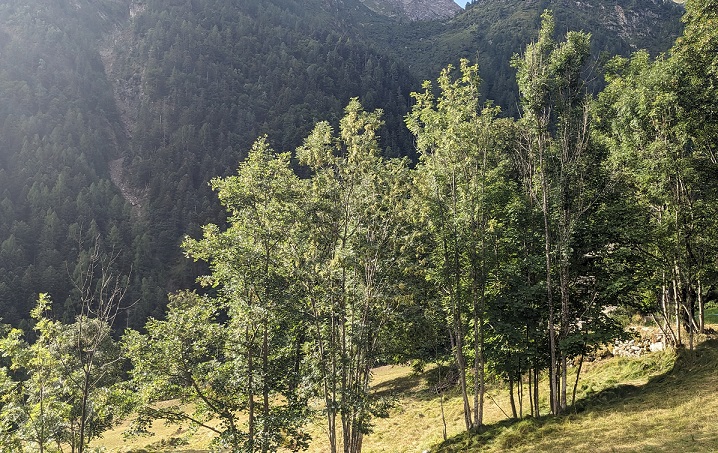
The impact of ash dieback on woodland in the Italian Alps is already far more severe than in Scotland because there are many more ash trees there: a large proportion of the forests I walked through after the first few days consisted of deciduous trees and many of them were ash. However, I also saw reasons to be hopeful with apparently healthy trees standing in-between ones that were dying.
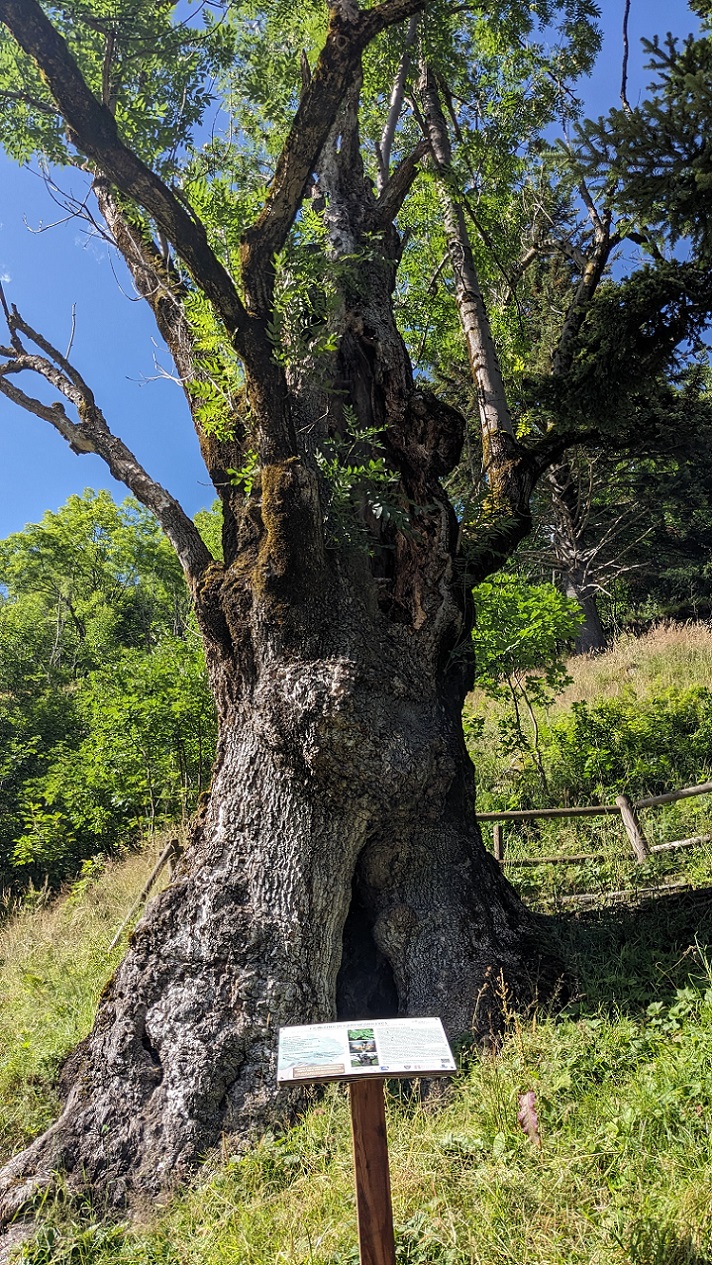
While I saw a few ash trees that had been planted in and around villages or along field margins, most appeared to seeded naturally. In that lies hope for the survival of the ash in Italy. As seed from the ash trees with natural resistance to the fungus spreads, those trees will start to predominate reducing the impact to the fungus (as presumably happened centuries ago with the Chinese and Manchurian ash). While the Woodland Trust estimates 1-5% of ash in the UK may tolerate the disease (see here) from what I observed it may be significantly higher than that.
Unlike Italy, however, there is very little natural regeneration of native woodland in Scotland because of burning and overgrazing. That is likely to greatly increase the time it takes ash tree here to evolve through natural selection and resist ash dieback. While that might be used by the native tree planters to justify yet more planting, it would be far better would be to enable existing ash woodland to regenerate naturally by culling deer and controlling grazing by livestock – something where our National Parks should be taking a lead. (I do see some hope for Scotland along the railway line through Pollokshields in Glasgow where young ash are sprouting everywhere and many still look healthy).
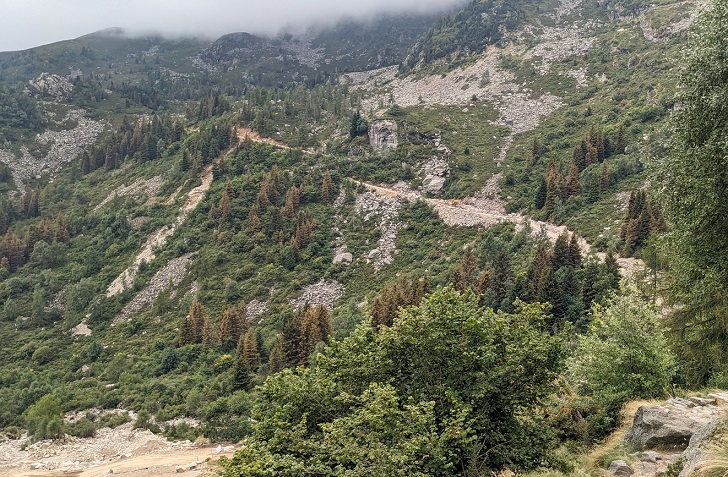
Global warming is generally increasing the incidence of disease and pests, with trees affected by heat and drought for example more susceptible to both. At first I thought that the reason so many Norwegian Spruce needles were turning brown might be linked to the Spruce Beetle, Ips Typographus, which is native to mainland Europe but is now rampant and has crossed over into southern England where our forest authorities are trying to contain it (see here). I am no expert in tree diseases or pests but having checked the symptoms I am fairly certain the browning needles were the result of lack of water.
The main explanation for the spread of the beetle, however, is linked to climate change (see here). Interesting research from 2022 in the southern Italian Alps found a large beetle outbreak there was linked to drought over the three previous years AND windblown trees caused by unusually high winds (see here). Dead trees of course eventually fall over and that dead wood provides a breeding ground not just for Ips but other bugs regarded as pests by the forestry industry.
Windblow is a far greater problem in Scotland than the Alps, in large part because we plant trees in rows in plantations with hard edges instead of enabling mixed forests to evolve naturally. Consequently, our forestry plantations are likely to provide the ideal breeding ground for pests like Ips Typographus. The risks are then increased further because of the failure of Forest and Land Scotland and others in the forest industry to remove windblow timeously and make use of the timber, sometimes justifying this with claims that all dead wood is good for the natural environment.
Spruce beetle may be causing huge problems for forestry all over Europe but when it gets into Sitka moncultures here, which seems highly likely, the impact is likely to be far worse and our forestry industry could self-destruct. All the more reason why fundamental reform of Scottish Forestry and the regulatory and grants system it operates, which promotes monocultures vulnerable to disease and pests, is needed now.
A wee reminder of how the environmental crisis affects us all
Five days into my walk, after arriving at one of the excellent Bivaccio Huts managed by the Italian Alpine Club, I found two ticks on my legs, the first I had ever had in forty years of visiting the Alps. While the incidence of ticks in Scotland has increased greatly as a result of our warmer winters (frost limits their population), I had not realised until talking to others in the hut that this was a continental phenomenon. The consequences in Europe are also more serious because ticks there carry a wider range of diseases, including tick-borne encephalitis.
Stupidly, I did not then start to check myself as carefully as I do now each time I go out in Scotland. Two weeks later I noticed the distinctive rash of Lyme’s disease at the top of my right leg:
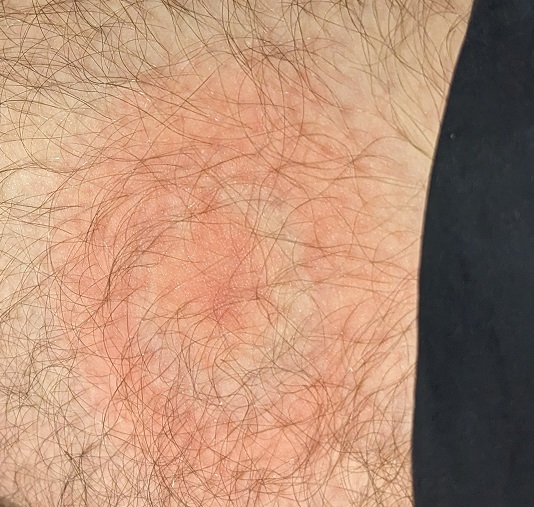
It took three days to reach Susa where the excellent accident and emergency department confirmed I was in the right place and where a doctor immediately diagnosed Lyme’s and prescribed me a 10 day course of antibiotics. I was quite surprised only to have to pay for the antibiotics. My GP surgery then extended that prescription to 21 days, the recommended treatment under the NHS. A great service from both.
I just felt lucky that I was one of the 80% of people infected with the disease who got the symptomatic rash and that I had not got something worse, like one of the mosquito borne diseases which are now spreading through Europe as a result of climate change (see here) having afflicted people in Africa for centuries.
I think there are two lessons from this. Sooner or later all of us are going to experience the effects of the environmental crisis directly. We should take it personally. The second is that as the world heats up and new diseases spread, we are going to need universal and accessible health services as never before. While this is an environmental blog, defending the NHS is just as important.

1 Comment on “Lessons from the Italian Alps (2) – the environmental crisis continental in scale”