I have not blogged for almost a month because I have been away in Italy walking the northern half of the Grande Traversata delle Alpi, the Italian equivalent of the GR5 in France – which I wrote about a couple of year ago (see here), (here), and (here) – but longer. Apart from my partner who joined me at Quincinetto in the Aosta Valley, I did not meet or hear anyone from the British Isle.from the Nufenen Pass in Switzerland to the Roman town of Susa. That is despite two guidebooks being available in English.
Part of the explanation for this was the low number of people walking the GTA from any country. It is not like the Tour de Mont Blanc or West Highland Way which are generally mobbed. There were days when I/we saw no-one in 8 hours of walking. It was difficult to know how far this was due to the economic crisis and the increasing poverty across Europe, which has significant implications for rural and mountain tourism, how much due to fashion among those who can afford to go on holiday and how much due to outdoor recreational culture in Italy. On the higher ground I saw more Italian trail runners than walkers.
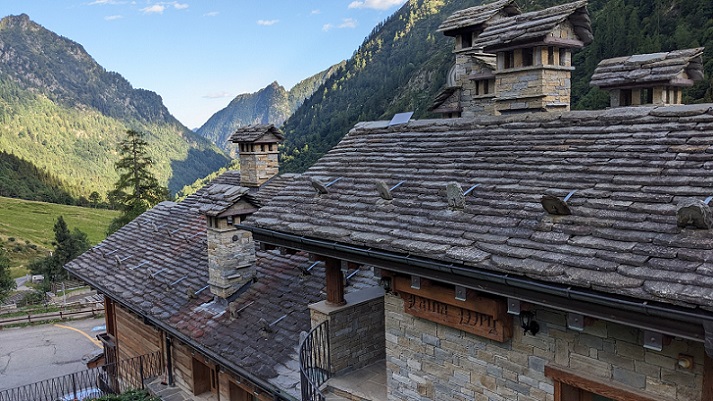
The sole occupant of a posta tappa in Rima, I wandered around the beautifully preserved Walser village a few times, was struck by the chimneys on this new building and went to have a closer look:
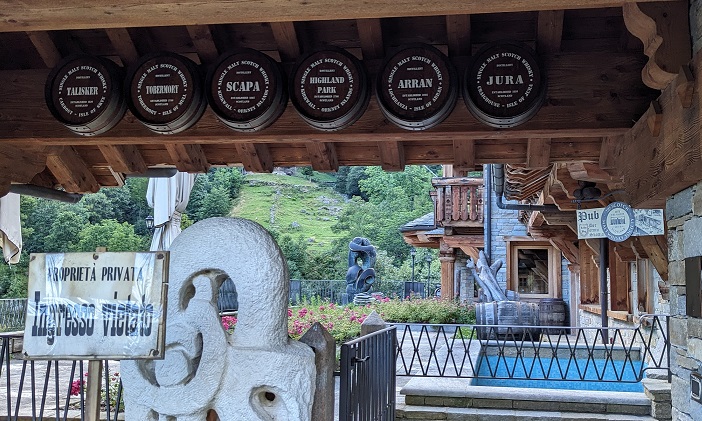
Much to my surprise the building turned out to be a former Scotch Whisky centre. This had gone bust about eight years ago and was now a private residence for people from South Korea. There is now apparently a new whisky centre somewhere on the Italian coast.
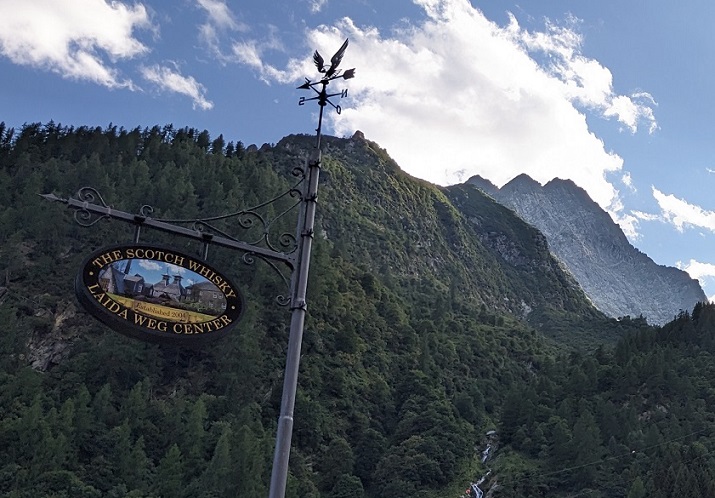
It was interesting that some entrepreneur had thought that people would come to a remote mountain village to taste whisky, the Italian equivalent to attracting visitors to Tomintoul in the Cairngorms National Park.
By contrast I saw little evidence of the Italians trying to market their own food and drink. While I mostly camped for the first half of the walk in the villages along the GTA, I ate some of the best food I have ever had and it was neither pasta nor pizza. This included a memorable six course vegan meal in the Albergho Fontana in Rimella, run by five sisters. “Vegano” – “no problem”!
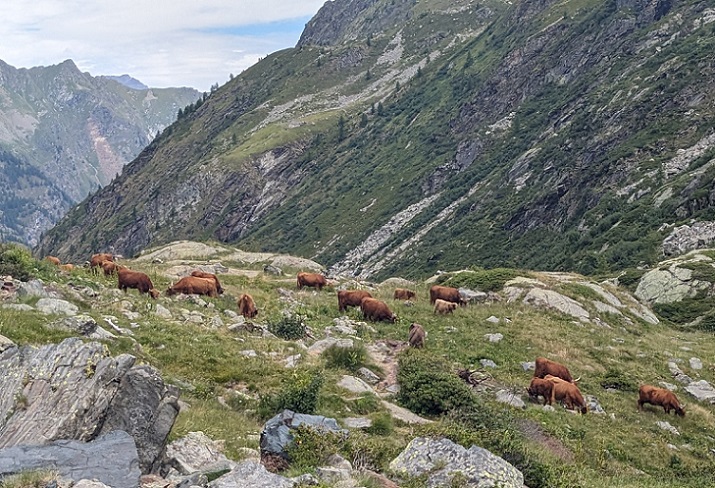
I was equally surprised to walk through the herd of Highland Cattle in the wild upper reaches of the Valle Vogna (top photo). There was a sign on a nearby hut explaining why their presence:
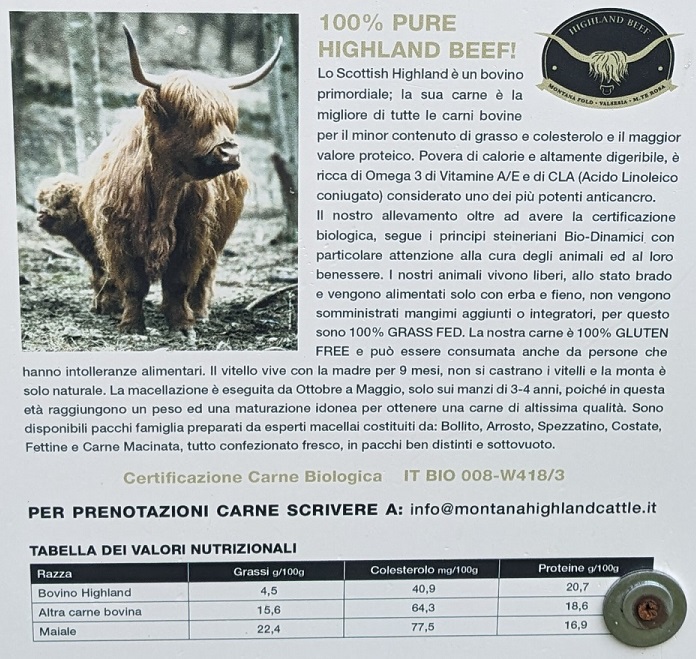
Whether true or not, what struck me is the role that Scotland currently plays in the European imagination. While few people from Scotland may be exploring the remoter parts of northern Italy or contributing to its economy, a significant proportion of people I talked to had either visited Scotland or wanted to do so.
That is a enormous economic and cultural asset, an asset which the Scottish Government is in the process of destroying through its free market approach to renewable energy developments which is plastering Scotland’s landscape with wind turbines, electricity pylons, enormous pumped storage schemes etc etc.
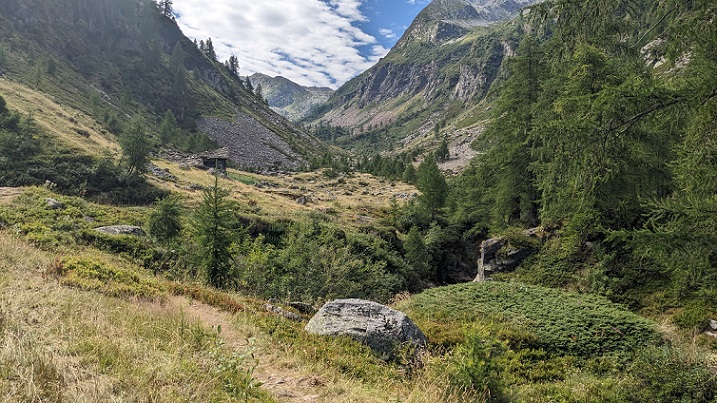
This brings me to the primary purpose of this series of posts. Apart from the pleasure of walking through mountains, my main interest in walking the GTA was not to discover what others think of Scotland but to think about what Scotland and its National Parks could learn from the Italian Alps. Where better to start than red deer?
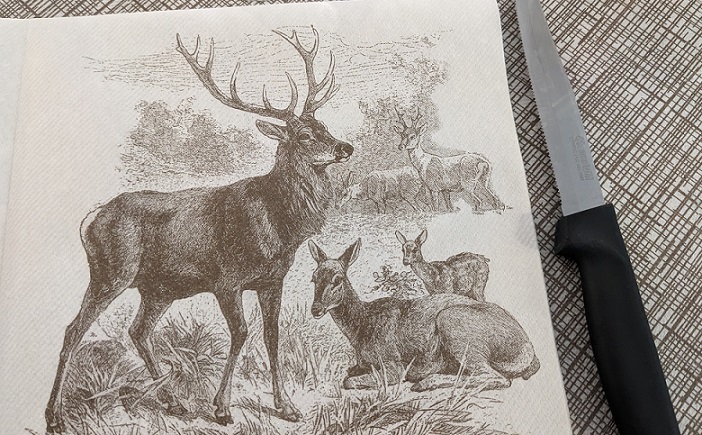
Red deer are iconic enough to feature on table mats in Alpine eateries and clearly valued by the Italians but these were the ONLY deer I saw in 24 days of walking. What a contrast to Scotland where red deer of everywhere. Part of the explanation, of course, is that red deer in Italy live in forests and therefore are very hard to see but those forests have only survived and expanded because red deer numbers are so low.
The primary explanation for this is that hunting laws in Italy are very different to Scotland, with a right to hunt on other people’s land (see here) akin to our Right to Roam. In Scotland such hunting is illegal. How the Italian hunting law works in practice is complicated, varying from region to region and area to area, but there are 800,000 registered hunters in Italy and that is what keeps deer numbers way below those in Scotland where deer stalking is the preserve of an elite.
The Italian right to hunt eables a completely different approach to forestry – there is little need to plant trees as they regenerate without human interference – but also allows people living in mountain villages to cultivate their vegetable patches without deer fencing:
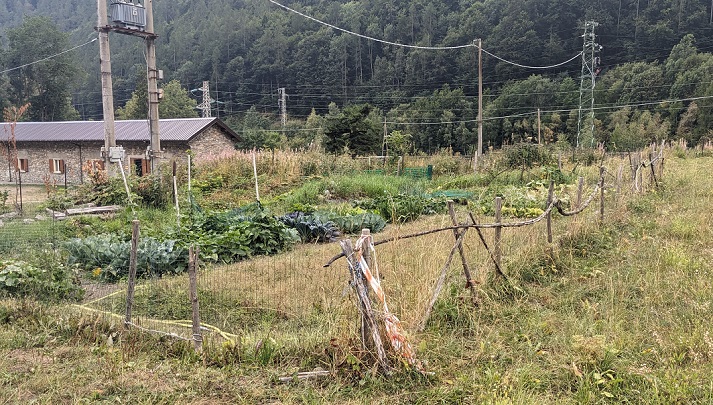
The anaemic Land Reform Bill still being considered by the Scottish Parliament never contained any proposals to reform hunting laws in Scotland. That would be the single most effective measure we could take to restore nature following centuries on overgrazing. Instead of learning from other countries like Italy, Scottish Ministers and the entire apparatus of government acts as though there is no alternative to the current system of sporting estates. Nothing is allowed to get in the way of the landowners whose interests lie in maintaining the population of red deer at levels which impoverishes the natural environment and imposes huge economic costs on everyone else (e.g deer fencing to protect trees and gardens, car accidents, the lost opportunities from being able to use the land in more productive ways).
The secondary and more recent explanation for low deer numbers in Italy is the wolf. This has re-colonised the whole of the Italian Alps and Dolomites since being protected, i.e exempted from the right to hunt, along with various other species. Their main prey are red deer, roe deer and wild boar and research suggests these are generally preferred to domesticated livestock (see here). The wildlife highlight of my trip was standing outside the Bivaccio Marigonda one morning and hearing a pack of wolves howling to each other for a couple of minutes on the hillside opposite.
Instead of the frenzy which accompanies any mention of the re-introduction of the wolf to Scotland, we should learn from the extensive research that has taken place in countries like Italy, why people in rural communities there are generally so much more relaxed about living among wolves and how conflicts between wolves and humans – which are increasing as the wolf population increases – can be managed (see here).
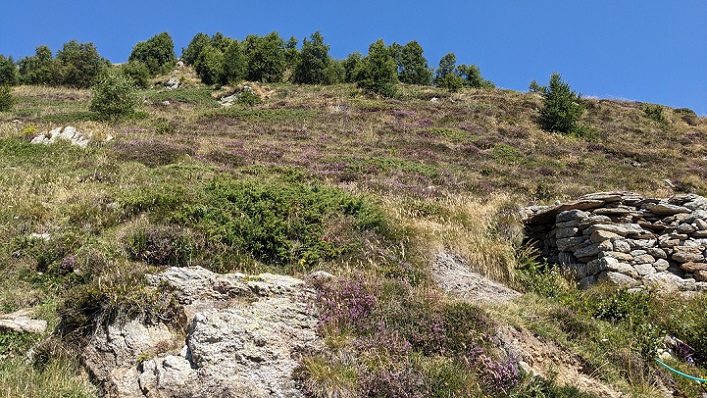
I do not recall seeing as much common heather in the Alps before as I saw along the GTA. Some of that may be due to the underlying geology and the altitude of the walk as well as my own perceptions. The resulting habitat, however, looks very different to grouse moors in Scotland. The heather forms part of a much wider plant assemblage which is evolving naturally, a contrast to Scotland where heather is promoted in favour of other species of plant through burning designed to to increase numbers of red grouse. In the photo above the heather is likely to be replaced in due course by woodland, a contrast to Scotland where, as a result of human interference, it forms an impoverished monoculture over vast areas of hillside, including a large proportion of the Cairngorms National Park.
If we banned muirburn in Scotland we too could have hillsides like this. Instead last year the Scottish Parliament passed a useless bit of legislation, the Wildlife Management and Muirburn (Scotland) Act 2024, while the Scottish Government pays sporting estate landowners and voluntary organisations to plant native woodland in enclosures, using environmentally destructive forest practices such as mounding and tree tubes. In 24 days of walking the GTA I saw not one case of the land being burned – unlike the GR5 in France where there was some burning in the south – not a single deer fence, not one example of soil being mounded to plant trees and not one plastic tree tube.
Instead of listening to the vested interests in Scotland, who far from restoring nature or helping to offset carbon are destroying it further, Scottish Ministers and other policy makers should start visiting other mountainous countries like Italy – that would be a good use of “taxpayer’s” money – and learn from how land is managed there.

Thank you for this thought provoking piece.
Call us the “lucky generation” if you like. Those who have entered retirement age these past decade or two have lived through an extraordinary period. A period where the state enabled ever wider access to higher education and also provided student grants and bursaries to those eligible. This now-older generation took time off after study years to travel widely. Some may have taken leave time jobs on Gites and in Kibbutz , explored far-away lands. Others were transported to far away places during miltary service. Many more will have traveled very cheaply on public transport or by hitching lifts around the globe. They would have been staying with local people and learning their customs. On return to the Uk the experience they returned with hugely enriched their outlook . A real first-hand knowledge of life in other lands, transfered into whatever line of work they followed. (many from that period have continued to travel widely well on into their retirement years 1/2 a century later)
Contrast this with the situation today. Lower standards now apply for today’s students to gain entry to many higher educational establishments – places once more properly termed – ‘Colleges of higher education’. Yet along with the real “University” courses, even the more practical ‘Technical college’ courses now require students to obtain funding or take out loans. Today’s students cannot save much, accomodation costs are too high, and when they leave… with or without qualification ….they will be required to repay their study loan + accrued interest, sooner or later. Most do not have the resources to travel for long periods at all freely anymore. Local regulations and visa rules may mean they now cannot gain temporary employment aboard so simply. Their parents still in work cannot easily subsidise their journeys either, being under increasing financial stress themselves. The international over-burdening tiers of Rules and regulations see to that.
Those young people who do venture overseas at all, will frequent purpose-built resorts on cheap Package deals. Most do not meet or interact much with the people within the nations they visit. Their brief stays in a tourist hot-spot will hardly allow much interaction or comparitive sharing of working life and lifestyles at all.
This move to super regulation and financial ‘confinement’ of young people, often under modern severe financial burdens their parents and grandparents never had to endure as students must have a consequence.
The financial stress we are all under now has led to impacts on the way of life, high up in these European backwaters> The young from these valleys left for study, and stayed on in the cities. A lack of casual seasonal workers – such as students on holiday – surely will have reduced the viablity of the long established mountain communities through which Nick has travelled. And now the “loan generation” are themselves entered into influential positions in which their lack of a broad world-based outlook has its own impact. An absence of Perspectives gained through first-hand slow paced travel among other cultures, will cloud every decision they may be required to make.
Much of this is a lovely piece, about a beautiful area, although some conclusions drawn could be debated. Important facts;
– The Aosta suffers from significant rural depopulation
– Communities are falling apart as there are too few economic opportunities, number of farms has fallen by half in last 25 years. Italian gov is now paying people to move to mountains eg in Trentino to try to sustain communities
– Farms in Aosta are mainly dairy, producing cheese, we have sold highland cattle to Swiss and Italian buyers and they do quite well there and couldn’t agree more with what they say about the beef, but they are a small part of the local economy there.
– Heather in Italian Alps is generally not same variety as in Cairngorms, also different soil and mountain types, ecology, age of mountains etc all make it difficult to take conclusions from Italian Alps and transfer to Scottish Hills – perhaps the Aosta valley wines got to you!!
– Italian hunters are well known for shooting everything that lives and especially damaging small bird populations and birds of prey. Wealthier Italian hunters come to Scotland and spend big money because our game shooting is better organised and regulated than Italian Wild West.
– Deer stalking, and shooting in Scotland sustain communities, bring in income and create jobs. Italian practices can’t sustain this so they come here and help sustain our communities
– I have just spent two weeks walking in the Cairngorms and our heather clad mountains are undoubtedly the most beautiful in the world, and certainly don’t need to be covered in trees (an area we almost agree on).
BUT we must have strong sustainable communities and farming, and sporting/fishing are essential to this
So, some conclusions drawn in the article around Italian land management or ‘non-management’ are too simplistic and not transferable to Scotland . Good to visit other places and observe what they do but like the Aostan wine, best drunk there and not transferred home.
Hi Colin, I hope that some of my further posts will pick up on these points, some of which I agree with, including farming in the Italian Alps, which is in crisis but is done very differently to Scotland and has a lot to teach us. It was, however, Calluna Vulgaris or ling heather I saw and not another species of heather (I saw neither bell heather or cross leaved heath the other two species common in Scotland). Ling is found across Europe and into Asia and, as I found out through my walk and research afterwardsm is common in north central Italy where it has several common names Brughiera, Scopetti, Grecchia and Brentol https://antropocene.it/en/2023/01/10/calluna-vulgaris-2/ Nick
I think you got to the heart of one of the main problems with our Scottish Government – they do not learn from what other countries do to manage their upland areas. They will sometimes make a pretence of researching good practice, but all too often the SG has made its mind up beforehand. Additionally this problem is not just limited to environmental practices but is almost endemic in the Scottish Government’s culture.