
On 22nd July the Strathy reported (see here) the Spey Catchment Initiative (SCI) is planning to consult the local community before using “ecological engineering” techniques to restore the eroded banks of the Allt Mhor above Kingussie. The project is described as being “in partnership” with the Pitmain and Glen Banchor Estate, with funding – the amount as yet to be decided – from the Scottish Government’s Nature Restoration Fund administered by NatureScot. The SCI has not yet published any further information about the project on its website, perhaps because their recent project to plant 30,000 trees in Coire na Ciste, which they falsely claimed was treeless, was so ridiculous (see here). This latest project plumbs new depths for conservation in the Cairngorms National Park
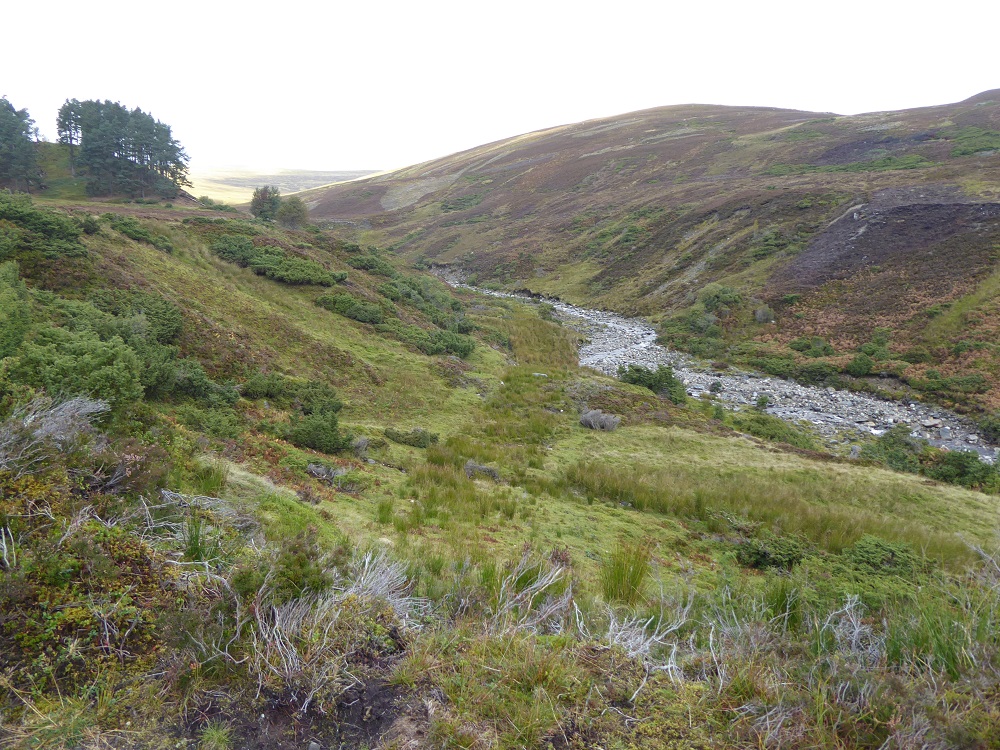
The photo published in the Strathy illustrates why. The base of the glen is covered in glacial till through which the Allt Mhor (big river) has eroded a course and redeposited material since the ice retreated. Over time that glacial debris has been colonised by vegetation which helped stabilise the banks of the river and reduce the rate by which it eroded. That vegetation will have been affected by the way humans used the land here over centuries. But moving to the present two things are very clear. First, that grazing pressure has been low enough to enable juniper (the green bushes) to colonise significant areas along the banks, including the steeper slopes. Second, that muirburn has taken place along these banks destroying the juniper and other vegetation that was helping to hold these banks together.

While the SCI has said very little about what it is proposing to do to help stabilise the eroded areas, it appears likely that some of this will involve planting trees since that they is what they do. If the juniper had not been burned, it would have provided protection and shelter for other species of trees. It would also have attracted birds like thrushes which distribute species like rowan all over Scotland (only for the consequent seedlings to get gobbled up by herbivores or burned). In other words, without the muirburn and so long as grazing levels were kept low enough, natural processes would have and would still serve to reduce the rate of erosion along the Allt Mhor.

Eroded bank on Allt Mhor October 2017. The way the Allt Mhor has meandered along this section of steep bank made the erosion almost certainly inevitable, even though it has not been burned recently and even if more juniper and other trees had colonised it. At the same time that meandering has saved the bank downstream of the eroded section from being eroded.
Some erosion is perfectly natural and where a river like the Allt Mhor erodes a deep course through thick glacial debris inevitable. There is no justification for stopping such erosion through engineering, ecological or otherwise, unless it poses a threat to human. From an ecological perspective therefore what the SCI, NatureScot and the Cairngorms National Park Authority need is do is to get estates like Pitmain and Glen Banchor to end muirburn. While the provisions of the Wildlife Management and Muirburn (Scotland) Act 2024 allow muirburn to be used for six purposes, primarily managing habitats for grazing or grouse, the only provision they contain to restrict where muirburn takes place is on peat 40cms or more deep. As a consequence NatureScot has no power to restrict muirburn in other places where it is responsible for considerable damage,such as along rivers like the Allt Mhor.
This re-inforces the arguments I have made in previous post (see here.for example ) that the Wildlife Management and Muirburn (Scotland) Act 2024 is one of the most useless pieces of legislation ever passed by the Scottish Parliament. Every decent MSP should now be asking how and why they were led up the garden path.
Meantime, there is absolutely no justification for NatureScot to offer any funding for conservation projects designed to rectify the consequences of damaging land management practices in small areas while all around those damaging land management practices continue.
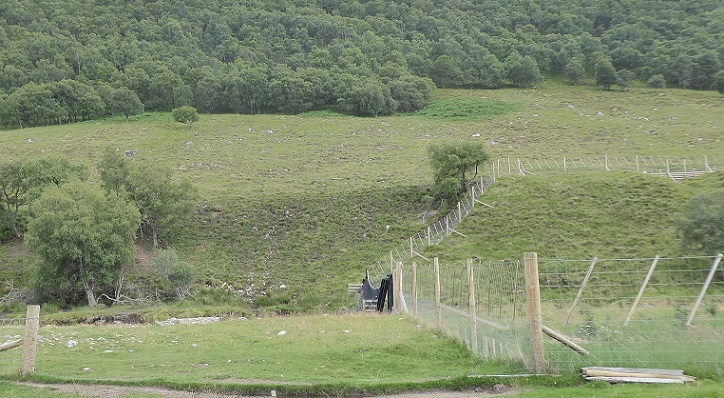
This is the same conservation failure as the woodland planting in the Glen Banchor part of the estate where the public have effectively paid for sections of the River Calder to be fenced while all around high deer numbers wreak destruction. Often the best grazing is on river floodplains, because they are regularly fertilised by floods (as in the left foreground) and although these are the areas where “riverwoods” would be least likely to develop naturally they have now been planted (trees visible on right behind fence).-
Returning to the Allt Mhor, where it disappears from the photo downstream, it becomes known as the River Gynack. Just below that is the start of River Gynack overflow channel. This was another botched attempt at river engineering, designed to reduce flood risk in the village of Kingussie (see here), when attention should have first been paid to the extensive muirburn that was and still is taking place in its catchment.
That muirburn speeds the rate at which water runs off the hill and therefore flood levels and with that the erosive power of the Allt Mhor. It is why the CNPA and NatureScot should be calling for muirburn to stop across the whole estate and not just along the steep banks very vulnerable to erosion.
Until the Cairngorms National Park Authority takes a landscape scale approach to conservation, instead of supporting organisations like the SCI which tinker, it will never be a National Park which deserves the name. And if it is unable to do that without tackling land-ownship in the Cairngorms, it needs to start supporting the case for radical land reform. Its time the public stopped paying large rich landowners to patch up the wounds for which they are in large part responsible.

I of course mainly agree with the gist and detail of this article in that if the inimical grazing/burning regime in what I’ve coined the term the ‘VED’ (Victorian-Edwardian Dystopia) in the surrounding landscape was ceased, then natural regeneration would restore riparian woodland in due course and probably quicker than at first we might think. However one caveat I would raise is that planting of Aspen( Populus tremula) would be justified as natural seeding of this highly palatable species is very unlikely because of past removal of mature trees and the infrequency of viable seed production in our climate.
Once established of course, the natural vegetative suckering of Aspen would assist its expansion and that suckering ( a kind of living, self repairing ‘gabion system’) would enhance bank stability.
The Pitmain and adjacent Glenbanchor estates occupy most of the land to the north west of Kingussie and Newtonmore, covering 12,000 acres ((nearly 5,000 hectares). Both appear to be owned by Majid Jafar and managed by the estate agents Savills. Mr Jafar was educated at Eton, Cambridge and London Universities and Harvard Business School. He is one of the Middle East’s most prominent business people and is CEO of Crescent Petroleum, one of the world’s largest privately owned fossil fuel companies. With advice from Savills these properties appear to be managed primarily for sporting purposes. They are characterised by some of the worst out of control muirburn and overgrazing by excessively large populations of red deer to be found in the Cairngorms National Park. Given the intellectual and financial resources available to Mr Jafar it would appear to be entirely reasonable to expect him to take the necessary corrective measures to solve these land use problems on his estates without the Spey Catchment Initiative wasting large amounts of Scottish public funds in trying to solve these problems with sticking plaster solutions.
Spot on!
https://www.theguardian.com/environment/2025/jul/16/dartmoor-is-dying-how-the-uks-national-parks-turned-into-biodiversity-deserts
I don’t know if the Grauniad would be interested in anything coming from Scotland – but this piece is saying some of what Ron has been saying for a long, long time.
The essence of the Guardian article is that the upland vegetation of the UK is being degraded and losing its biodiversity value by a combination of excessive burning and overgrazing. This is due to a failure of government regulation and inappropriate financial incentives, over many decades. We are all paying for much of this destruction through our taxes. Last week the International Court of Justice, indicated in its advisory opinion on climate change, that inappropriate land uses have to be changed. This pushes open a very wide door to a whole raft of legal actions against the UK government and the devolved administrations to stop the excessive burning and overgrazing of our uplands