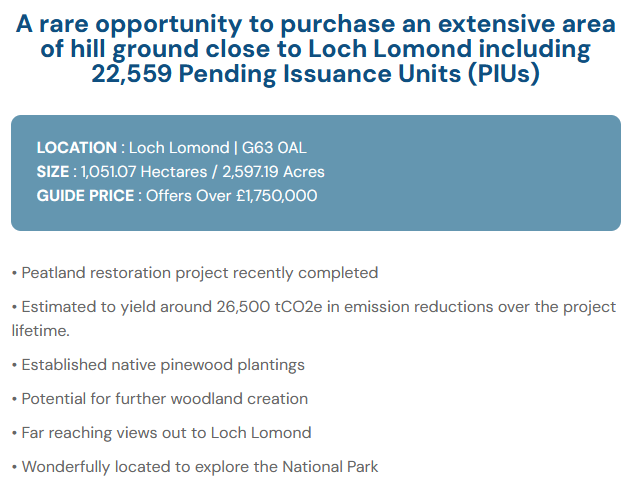
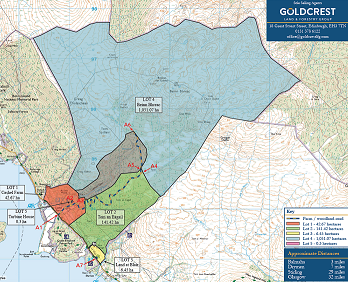
On 27th May Goldcrest Land and Forestry Group misleadingly announced a new property was for sale, “Beinn Bhreac Hill” (see here). In fact Goldcrest had marketed Beinn Bhreac a year ago as Lot 4 in the Royal Scottish Forestry’s Society (RFSF)’s attempt to sell off their “forest for a thousand years” at Cashel (see here).
The size of Lot 4 (2597 acres) is exactly the same size as the “new property” but the asking price for the land has dropped from £2,250,000 to £1,750,000 while the number of Pending Issuance Units (see below) has dropped from a potential 28,000 to 22,559.
Goldcrest has also been remarketing Cashel Farmhouse, 3.43 acres of accompanying land and outbuildings for offers over £645k (see here – I have downloaded a copy of the brochure for when the link ceases to work).

Last year Cashel Farmhouse formed by part of Lot 1, Cashel Farm, which included 42.67 acres of land and was up for sale at offers over £725,000.
RSFS’ new “plans” for Cashel
There is no information about what is going on on the website of the Cashel Forest Trust (see here), which ostensibly manages the property, but its trustees have issued an announcement (undated) on the website of the RSFS, their parent body (see here). This states Goldcrest would be remarketing Beinn Bhreac and the Farmhouse and explains that Blair Field (which formed Lot 2 and comprised 6.45 of land in the original sales brochure) was sold last year and the proceeds “have been invested and will help provide a revenue stream to cover the running costs at Cashel”.
The amount of the proceeds net of Goldcrest’s fees is not stated and there is as yet no information about the sale on the Registers of Scotland but this represents a change in plan which is then explained as follows:
“based on advice on likely interest and what fits best with the Cashel Forest Trust objectives, the Cashel Board has decided to retain the woodlands and the orchard……………….by offering these two areas for sale, Cashel Forest Trust will be able to concentrate on its forest estate consisting of Ardyle Wood, an ancient semi-natural oak wood and the early 21st century planting of native species now reaching early thinning stage. CFT will also retain the carpark and paths network and the right to access over any roads sold. Cashel Forest will continue to be open to the public and those who wish to use it for education and research purposes.”
In effect this means that the trustees of the Cashel Trust and RSFS have decided that instead of selling off all their land at Cashel and spending the proceeds on purposes they have never declared, they are now hoping to sell most of it and that the proceeds will be sufficient to finance the management of the “core” forest area.
This change in plan represents a partial victory for the members of RSFS and the wider public who objected to the sale. The Cashel Trustees have not yet publicly admitted to any mistake and are still to explain why their new plan will work. The rest of this post explains why at best the new plan is likely to be a short term solution, effectively selling the family silver to meet short-term funding requirements, and is devoid of any vision of what the RSFS could contribute to woodland conservation and the National Park.
Peatland restoration on Beinn Bhreac and the Pending Issuance Units scam
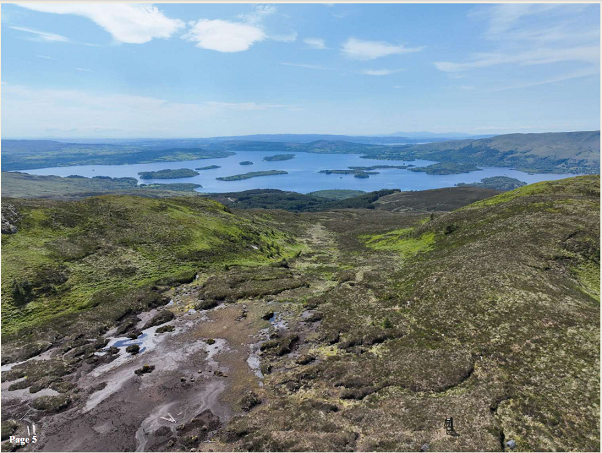
Last year I explained how instead of questioning the RSFS’ plans to dispose of Cashel the Loch Lomond and Trossachs National Park Authority (LLTNPA) appeared to push through Phase 2 of the peatland restoration work on Beinn Bhreac to help facilitate the sale (see here). Goldcrest’s current sales brochure reports that “Phase 2 – 140 hectares have now been completed as of March 2025 sales brochure”. One hopes that the photos in the new brochure provide an illustration of Goldcrest’s (in)competence rather than how the eroded peatland now looks! (Marketing Beinn Bhreac as Beinn Bhreac Hill is cultural vandalism equivalent to saying Loch Lomond Lake).
The Peatland Restoration work on Beinn Bhreac has been registered under the Peatland Carbon Code and the Pending Issuance Unit (PIU)s – a means of selling and trading carbon units before they have been realised – validated in an office based assessment by the Soil Association. The documentation on the Registry (see here) is very informative and shows the figure of 22,559 Pending Issuance Units was calculated on 21st August 2024 six weeks after Goldcrest had marketed it for 28,000 – an indication of how claims about PIUs and Carbon Units can inflate land prices..
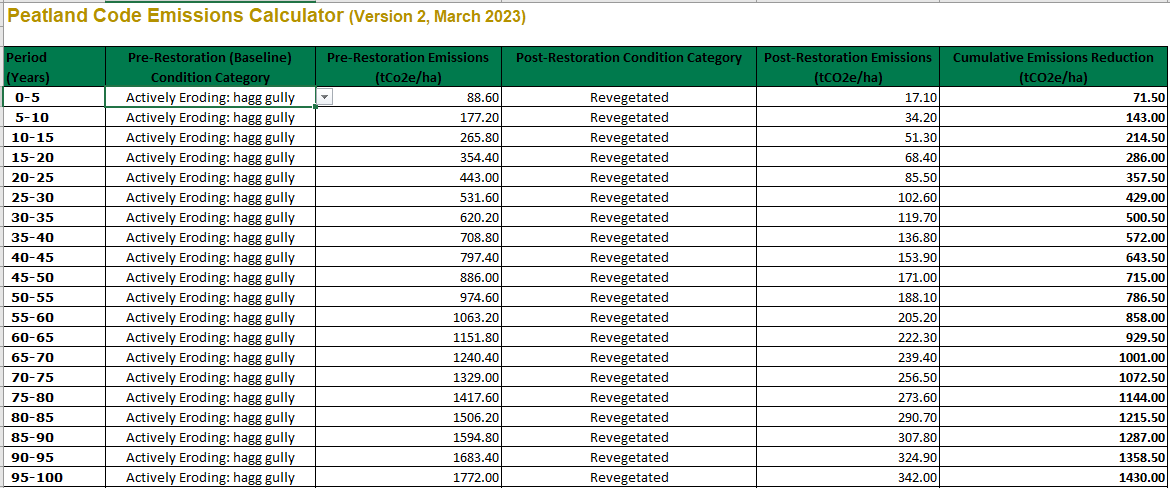
While enabling peatland to grow is a far surer means of taking carbon out of the atmosphere than growing trees bizarrely the assumptions in the Peatland Carbon Code (PCC) calculator are far more cautious than those in the Woodland Carbon Code (WCC) calculator. As a consequence, while the calculations for Beinn Bhreac (example above) show a significant drop in CO2 emissions between “pre-restoration” and “post-restoration”, it shows some emissions will continue and does not show any net reduction of CO2 in the atmosphere from the peatland restoration. By contrast, the assumptions in the WCC normally show tree planting result in carbon being absorbed from the atmosphere after about 15 years (as I explained with BrewDog’s Lost Forest see here).
The truth is more likely the other way round but the assumptions in the PCC as applied to Cashel help show how the peatland carbon market is driven by financial rather than conservation interests. The public pays for the restoration (the contract for Cashel Phase 2 was advertised at £90k) and then the landowner can, at little or no cost to themselves, start selling PIUs or, in the case of the RSFS, sell the land for an inflated price on the promise of future sales.
The £500k reduction in the asking price for Beinn Bhreac suggests that potential buyers are now becoming more aware of the long-term risks. Meantime, however, RSFS are still effectively gambling on the carbon markets, reassured no doubt by the continued presence of Peter Phillips, Head of Natural Capital Land Management Policy at the Scottish Government, on the board of the Cashel Trust.
The red deer problem at Cashel
The Cashel Peatland Restoration Project Design document from the UK Carbon Registry provides an excellent description of the red deer problem at Cashel but underestimates the risks:
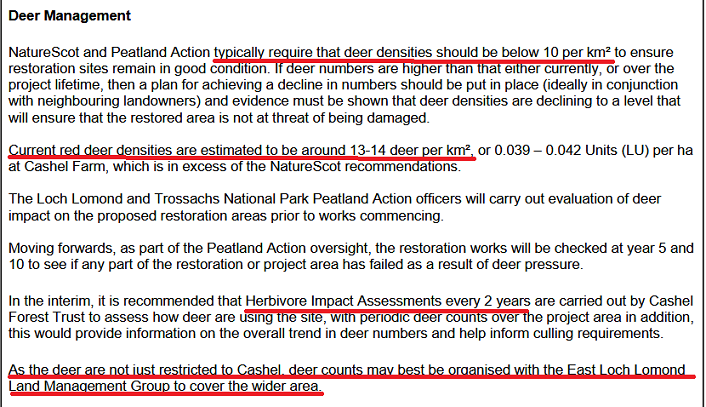
NatureScot’s target of 10 deer per square km was plucked out of thin air to appease sporting interests when its own staff have stated deer need to be no more than 6 per square km for woodland to regenerate and the evidence shows it needs to be less than two (see here). There is nothing explicit about what the LLTNPA, who administer peatland restoration projects in the National Park, require but their National Park Partnership Plan (see here) adopts the current national target of a maximum 10 deer per square km on the open hill – madness (see here). Both NatureScot and the LLTNPA have ignored the paper for Scottish Environment Link which reports that grazing and particularly trampling starts to cause erosion and therefore carbon emissions when deer density exceeds 7-8 per sq km (see here).
The truth is deer density would need to be significantly lower than that if peatland is to fulfil its potential as a means of absorbing carbon from the atmosphere. This is because every bit of plant that is eaten represents one less piece of vegetation that might have been preserved as peat. Indeed, the very high deer numbers across Scotland mean that peatland restoration projects in places like Cashel are not predicted to result in any carbon being absorbed from the atmosphere, only in reduced emissions from less damage.
But at Cashel there are 13-14 deer per square km! This is partly an indictment of RSFS’ management up until now (the document reveals they lease the hunting rights to a sporting tenant). Unless deer density has been halved in the last few months it is likely the recent restoration work will have already been damaged. The wider problem is that unless deer density is reduced across the whole area, the costs to any new owner of keeping deer density even to 7- 8 per sq km on Beinn Bhreac are likely to be considerable. While a new owner could buy the land with the intention of using the money from the sale of PIUs to fund deer control, rather than for speculative financial purposes, the risks would be considerable so long as there is no effective system for controlling red deer numbers in Scotland and, in terms of protecting peatland restoration sites, the only strategy is regular monitoring through herbivore impact assessments (see above) to check whether sites are being damaged or not (the Natural Environment Bill currently being consider by the Scottish Parliament might or might not change that).
Meanwhile, the evidence on the ground (see here for example) is that many peatland action projects are unravelling because of the failure to reduce deer numbers and that much of the £250m the Scottish Government has allocated to peatland restoration is likely to a waste of public money
The continuation of a deer density of 10 per square km on Beinn Bhreac is also likely to make the task of managing the woodland RSFS propose to retain far more challenging, add significantly to the costs and reduce its conservation value.
Peatland v woodland – RSFS’ failure to challenge an incoherent approach to conservation
Goldcrest’s sales brochure for Beinn Bhreac also reports that the area includes “some montane tree planting”. If the Cashel Trustees had any real interest in conservation forestry it is difficult to understand why they are still try to sell off these areas.
The Peatland Design document shows that as part of the peatland restoration the Cashel Trust had committed to:
“monitor natural woodland regeneration around and on the project site post restoration, and they will take necessary actions to manage the regeneration to also ensure it does not negatively impact the project site. It is proposed that the Trust will use their volunteer programme to help manage the natural regeneration but if necessary, they will seek additional external support from contractors”.
On the one hand public funds are being given to organisations, including the RSFS, to plant trees on peaty soils, on the other they are being funded to restore peat so long as they weed out any naturally regenerating trees! We would be far better leaving it to nature but that would require deer numbers to be reduced to under 2 per square kilometre. If that was achieved most peatbogs, which evolved naturally, would restore themselves naturally – there would still be a case for removing artificial drains – and woodland would do so too. This would probably result in some areas of planted native woodland reverting to bog (as is happening in parts of Western Scotland) and some peatland evolving into woodland.
The original intention of RSFS when it purchased Cashel was to use it to demonstrate best forestry practice but instead, captured by corporate interests rather than real conservationists, all it has done for almost 30 years is follow the money. What is could and should have been doing was to use its experience at Cashel to challenge the Scottish Government to reform the Scottish Forestry grants system (see here), abandon its doomed attempts to create carbon markets and tackle the deer problem. After that lamentable record in one sense the RSFS deserves to fail. But Cashel is land bought with public money for the benefit of the public and we need an alternative.
Disposal of Cashel Farmhouse – the asset most likely to generate income

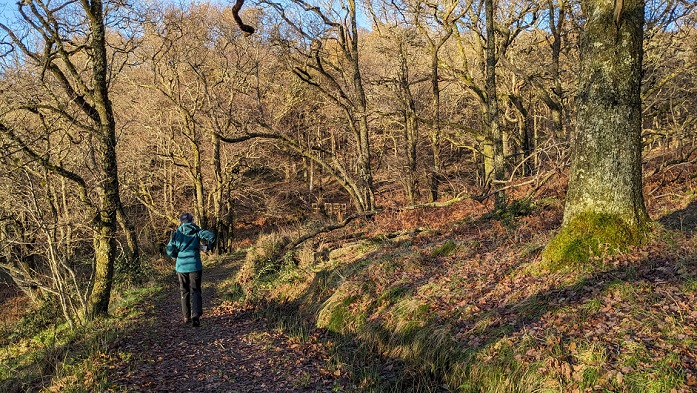
A couple of weeks ago I took relatives from England for a walk at Cashel before stopping off at Balmaha for lunch. The contrast between Cashel, which was deserted, and Balmaha which was thronged was striking. Regular readers will also know how difficult it is for the public to enjoy the east shores of Loch Lomond as a result of actions by the LLTNPA (see here). Instead of being marketed for sale, Cashel should have been marketed as the place to go.
The disposal of the farmhouse buildings is going to make that far more difficult to achieve in future. With a bit of entrepreneurship the Cashel buildings and fields around about could have been making as much money as the Oak Tree Inn and associated accommodation in Balmaha or Forest and Land Scotland’s campsite at Cashel now outsourced to a night club operation (see here). Instead, a sizeable chunk of those assets are likely to be sold today. The asking price, o/o £645k indicates they are indeed an asset, not a liability.
The sale of the farmhouse also means that there will be nowhere to accommodate either permanent or seasonal staff in future. That will make management of the Cashel Trust’s remaining assets much harder and less effective.
Once the Cashel Trustees have used up the proceeds of the land sales they will be in an even worse position that they are now.
Where now for what remains of the forest for a thousand years?
To my knowledge the board of the LLTNPA has never discussed RSFS’s plans to dispose of Cashel and left its future as an operational issue to be decided by staff. That is wrong. Landownership is a strategic issue and who owns the land is of critical importance if our National Parks are to achieve their statutory objectives. While there could well be better custodians of the land at Cashel than the RSFS, if Beinn Breac is sold to financial speculators the potential for conservation management could become even more difficult or disappear completely. The LLTNPA Board therefore should have been working with the trustees of the the Cashel Trust and RSFS to develop alternative options which maintained the public interest.
The best option now would be for the RSFS to agree to transfer the land at Cashel which has not yet been sold – i.e including Beinn Bhreac – to the National Trust for Scotland for a nominal amount. The RSFS should also endow the transfer with the proceeds from the sale they have sold. The NTS own Ben Lomond, just up the road, and transferring the land to them would help re-unify land originally purchased by the National Land Fund but then sold off by Margaret Thatcher as Andy Wightman, explained on his blog Land Matters (see here), before being bought with public money once more. The public should not allow assets purchased with public money to be flogged off again. The NTS have resident staff at Rowardennan who have the experience to take on Cashel and have also shown they are capable – at Mar Lodge – of radically reducing deer numbers which is so desperately needed on east Loch Lomond..

Along with Flamingo Land, why doesn’t LL&TNP go the full hog and create another attraction?
Something like, ‘Tartan Land’ with an interactive thrill-ride through fake Black houses, performers wandering around the site with dressed in pseudo Tartanesque costumes (red hair wigs etc.), a few drunken ‘Hey, yuse Jimmy’ drunks to annoy the visitors, food outlets selling fried shortbread suppers, a try-your-hand at gralloching stall and a few statues with parking cones dotted around ? …and just for good measure, create a story about the Loch Lomond Flamingo-eating monster that lives on the hillside and sell fluffy toy versions in the over-priced shop.