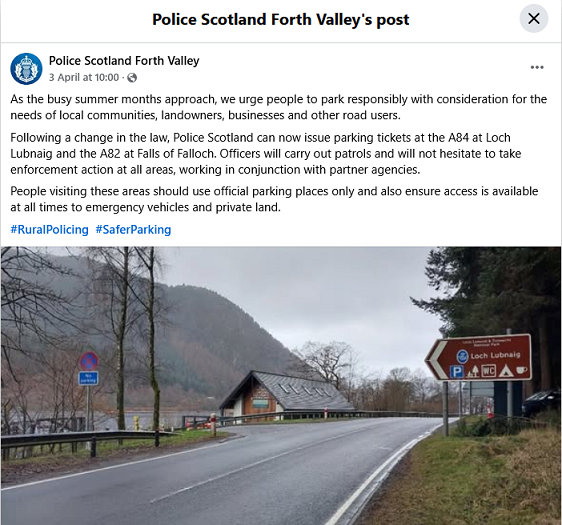
On Tuesday I took advantage of the nice day and went for a walk in Glen Lochay past Killin. Driving back along the A84 we passed Loch Lubnaig at about 5.30pm. Both the Loch Lomond and Trossachs National Park Authority (LLTNPA) car parks were locked. Across the A84 from the cafe and main car park a number of vehicles had pulled off into a small space in the woods. I half thought of stopping to take photos of the parked cars and the locked gate but there was nowhere safe to do so. My friends then had to endure a rant about how Scotland’s first National Park treats the public. Yesterday a reader sent me this post from Police Scotland about how they are going to start issuing parking fines on this section of the A84 at Loch Lubnaig and on the A82 by the Falls of Falloch.
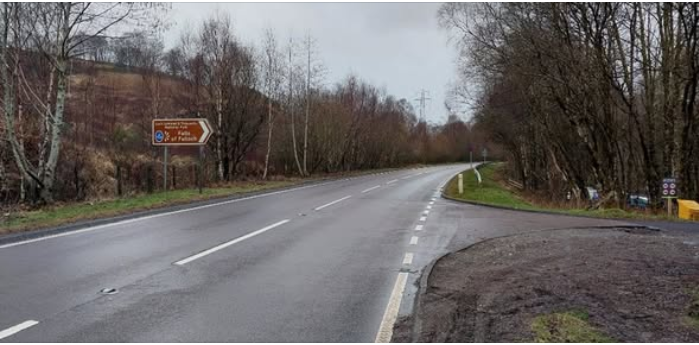
Before issuing parking tickets to anyone at Loch Lubnaig Forth Valley Police should check to see if the LLTNPA car parks are open and if not formally request they do so. It would be wrong for the police to punish people when there are two perfectly good car parks, paid for by the public, which are kept locked most of the time.
Our rights of access exist 24 hour a day and for many places there is no choice but to go by car if you wish to enjoy them. In order to support access rights therefore car parks should be open 24 hours a day as they are in most of Scotland. The issue is the LLTNPA has long viewed anglers as a problem and doesn’t want anyone to fish overnight – those views were a primary reason why the camping byelaws also include a ban on fishing shelters – and didn’t want campers or campervans either. When the LLTNPA realised they could not apply the byelaws to campervans, because vehicles can legally stop off by the side of the road overnight, they started to lock their car parks and persuade local authorities and Transport Scotland to create clearways. Hence what is happening at Loch Lubnaig.
Whatever you think of vehicles being able to stop off overnight, locking the gates at 5.30pm when there are three hours of daylight left means anyone wanting to enjoy Loch Lubnaig after work cannot do so. Instead of issuing parking fines Police Scotland should be tackling the reasons people are forced to park in dangerous places, the LLTNPA.
Last month the LLTNPA announced that the Falls of Falloch car park would be closed from 30th March for approximately 10-12 weeks (see here) . The news release asks people ‘to avoid the site both on foot and by vehicle and to explore alternative nearby locations with parking, including Tarbet, Inveruglas and the Dalrigh car park in Tyndrum’. None of those sites offers anything comparable to the Falls of Falloch, especially since the LLTNPA allowed the scenic viewing tower at Inveruglas to collapse (see here). The advice reveals a fundamental misunderstanding of one of the primary reasons people come to visit the National Park, spectacular sights. That helps explain why the LLTNPA has failed to suggest much better local alternatives, such as the nearby Eagle Falls or the West Highland Way which passes on the other side of the River Falloch which overlooks several spectacular glacier meltwater channels. With such alternatives, people will still try and stop and view the Falls of Falloch. Hence, it appears, why Police Scotland have been drawn in.
The LLTNPA has, since Covid, produced a Joint Response Visitor Management Plan each year with Police Scotland, Forest and Land Scotland, Transport Scotland and the four local authorities that whose boundaries lie within the National Park. The 2026 Plan was presented to the LLTNPA meeting in March (see here) and, as usual, is as significant for what it didn’t say as for what it does.
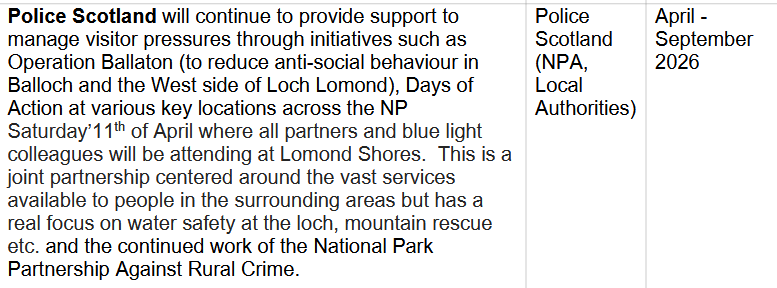
There is no mention anywhere in this of Police Scotland starting to issue parking tickets on the A82 or A84. Nor, in the section on new infrastructure, is there any mention on the ban on motorhomes at the Falls of Falloch car park which was announced in the news release:
‘When the site reopens, new arrangements will help ensure the area remains carefully managed, protected and enjoyable for everyone. To support this aim, motorhomes, caravans and vehicles over six metres in length will no longer be permitted on site, helping to improve vehicle flow and safeguard the surrounding environment.’
The issue here is not that the LLTNPA has decided to stop motorhomes and other vehicles over 6m long from entering the Falls of Falloch car park. It is a very tight space. The issue is that this apology for a National Park is not offering any other alternatives. Working with one of their other Joint Visitor Response partners, Transport Scotland, it shouldn’t be difficult to create a layby on the other side of the A82 from the Falls which was reserved for motorhomes and larger vehicles such as coaches. That would provide access for all.
LLTNPA senior management and board members are, however, more interested in banning whole sections of the population rather than providing infrastructure to cater for a wide range of visitors. As they see it, it makes their job easier. Its not why we employ them. First they came for the anglers. Then they came for the campers. Now its the campervanners and motorhomers. Who will be next?Be warned!

A whole mindset needs to change across Scotland if we are ever to cope with the pressures imposed by Campervans.
Yesterday in Fort William it was raining. Each public car park we looked at around midday held a minimum of 10 camper vans parked up. Many carparks had more than this. Their occupants presumably were having a day in town instead of a wet, windy day out in the mud and wilds.
The casual spend turnover these people brought into the town, yesterday alone, cannot easily be determined. But this was a single day. The 2026 ‘season’ has barely begun.
If you think of all those vans driving about searching for somewhere to park up, the scale of the issue becomes acute. Hundreds of hard standing “parking spots” are necessary.
If the vans cannot find a place they will carry on, driving about clogging roads, unintentionally creating nuisance, and probably then park on some roadside verge, forestry of field entrance somewhere anyway, creating more mess.
We need to see the month’s batch of aspiring politicians taking this matter in hand. Not just appeasing their local electorate by proffering ‘sound bites’, but actually contributing intentions if elected to develop incentives for land owners. Regiobns need to open hard standing areas and proper community disposal locations so those who come to Scotland … with bulging wallets ? can do so tidily.
More spaces everywhere…not fewer , with blockades, and barriers . A sense of the nation being open for business and welcoming, not begrudging .
Nothing I have written here is new. But what do those aspiring to offices on their campaign trails this month have to say.?
PLEASE no more sound bites…Scotland’s visitors many of whom fly in and hire vans or buy camping equipment here ( to save on excess airline baggage) want to feel welcomed to spend their money during free roaming holidays here.
The tide of international mobility is not going to turn by blocking access in every concievable stopping place and hoping to shift the problem of sleeping van use further “down the road”.
Do they even think about what they write or is it deliberate?
How can you ensure the area is enjoyable for “everyone” by preventing some of them from accessing it?
well Niall and Tom, as you know our ‘natural’ environment has an infinite capacity to absorb visitors and the concrete/ tarmac infrastructure they require. Of course a national park should be a combo of business park, carpark with trees and retiral homes complexes for the urban bourgeoisie. Stuff all that wildlife crap, leave that kind of nonsense for those primitive foreign-Johnny countries you see in those David Attenborough documentaries.
Remind me, what is it that all those visitors are coming to see?
I suspect you miss the point which I considered was well put, and probably perfectly obvious. Quite Along with too many of those seeking entry to mainstream Scottish politics in the upcoming elections – you miss the main point quite deliberately.
This is Not – as you put it – about concreting over National Parks. At present the crazy outcome is muddied verges, part blocked rural arterial roads, and some major highways until emergency vehicles can no longer move along. This despoils so many formerly beatiful places.
We also see authorities festooning roadsides near scenic and other historical attractions with double yelllow lines. Teams are employed to extract fines from those unfortunate “miscreants” who may never have understood why. During their ‘trip of a lifetime’ they may well conclude that many Scots authorities would rather fine them – to fund bloated local services tourists do not in fact need or use- than provide parking spaces for them to use.
The main point remains … making Scotland a welcoming place for visitors by facilitating the creation of suitable hard standing spots with simple waste disposal facilities (where appropriate) all across Scotland.
The grudging attitude toward those who might choose Scotland as their ” Bucket -list”? holiday destination must change.
Tourism …whatever we may think or believe.. is always going to remain one of the main bringers of weath to the Highlands and Islands.
Instead always looking for new methods to fleece hospitality providers, by imposing tier upon tier of fresh certification and petty regulation, and tourist taxes ! Scottish Politicians could actually nurture the “Goose that lays such golden eggs” Why-ever not? Encourage more provision of hardstanding places with appropriate facilities? ..and then fully account for the bonus of VAT brough into Scotland by international visitors for use of hospitality, eateries and purchase of souveniers during their stay. ?
The access prohibitions now being imposed within Scotland’s 2 National Parks, (and in too many places elsewhere) do not only shift the problem of camper vans and their bulging holiday spending wallets? to some other place in Scotland. The barricade mentality also risks discouraging an incease of visitors from abroad, who then go to spend holiday funds elsewhere instead.
Fortunate, then, that there isn’t an infinite demand but one which is perfectly possible to meet without any such scenario. The vast majority of the LLTPA area is effectively inaccessible to humans and will remain so, but they are determined to reduce access to the tiny fraction of it which is and has always been accessible to people.
No doubt you would prefer the current strategy of less visitors with more money, the ordinary person can watch it on TV presented by the “right” sort of people who can afford to live and visit there.
None of which has anything to do with my point which was that they could just be honest about it and drop the Orwellian doublethink language that pervades their communications. This is a restriction. You can argue about whether or not it’s necessary or desirable but it is not “ensuring the area is enjoyable for everyone” as “everyone” includes those who are being prevented from enjoying it at all.
I have not missed the point at all. Are you saying that our natural environment and its wildlife does have an infinite capacity to sustain development pressures, which will only increase with more promulgation of and facilities for vehicle based.tourism? What is it the visitors are coming to see in the first place–anything to do with ‘unspoiled scenery'( hee haw) and open green spaces with minimal industrial/urban development? Do you think a national park should have anything to do with protecting the ecosystem and its wildlife from development and disturbance? Do you think we can eat our environmental cake and still have it?
As it happens my home lies in a remote but highy conserved area of the Highlands ..a place of special scientific significance. The community recently resoundingly rejected ill-thought-through plans to create yet another National park here. The locale has many scenic attractions and much history that people with ancestry will travel a long way around the globe to access.
The local community “tolerates” the seasonal surges in sleeping vans in spite of congestion and great frustration for those who must earn their living through work via our single track road network.
Touring vans bring footfall to local shops, frequent local events, help fund a local distillery. Many who find peace within this area blend very successfully, if they allow themselves time to relax and slow down. Yet those who arrive at airports need to get here too, and the LLTNP is on one main route north. Holidaymakers would expect to be able to pause in their hire vans there too.
Some Crofts locally have already diversified by creating drained hard standing across under-utilised in-bye land…the hard won fields that at one time sustained life here.
But crofters are today required to negotiate through full planning consents to add much extra value, by equipping the places they provide with enhanced permanent facilities, such as communal shower blocks or kitchens and “hurdling” the wall of myrad regulations.
Travellers can find such simply equipped places for tour vans dotted all over Australia, New Zealand and other lands including France.
In fact today in Scotland most crofters do find there is no longer adequate reward in renting out the 3 static caravans they were permitted to deploy by right. Few today negotiate the costs of the annual certification processes to casualy rent out bothies any more..the Visit Scotland inspired certfication ‘charade’ is all pervasive …far too costly and time consuming to engage with.
So I do suspect those who do not live in the Highlands, but wax lyrical about what tourists hope to find in Scotland, may not actually understand much at all. Those who sit and create “rules” really need to come and see what remains of the residential holidaying places that for decades supported those who managed to live here year-round.
Since 2005 burgeoning regulation, planning constraints and annual licence compliance expense has been imposed. So many who whose parents once offered accomodation and B&B have closed up over the past 10 years. So much lifeblood income potential for youth just “sucked away” to conform with heavy bureaucracy imposed by those idealists who occupy so many plush offices in cities far away.
Would-be political representatives at the upcoming Scottish election do need to get out to see. They need to understand why so many sleeping vans are being hired out..many funded by huge multinational financiers. They need to take account of how the recent extension of the stranglehold of petty regulation has caused all this..when all todays overseas visitors really hope to find/ ask for across Scotland is flat hard-standing spots to linger on Turning places and hard standing timber handling places exist all along most forest tracks..many forests lie within land already owned by the general public, but unfortunately today Holyrood has decreed that access rights may be totally dominated by faceless Quango management, by strangers many hundreds of miles distant..
Never said that there is an infinite demand, but can the natural environment sustain the demands already being put upon it and subsequently the increase you’re suggesting? Your self-assumed telepathic capacity is also erroneous in determining what my attitude is in regard to whom should and should not visit and live in a national park. The view that the Highlands are a wasteland ripe for development ( a Highland councillor once said that) still pervades the mindset of the political class, the NGO-Quangocracy and some on this site. The Highlands are a wasted land ready for rehabilitation and that rehab will not occur as long as the mentality that produced the industrial sheep farming, cellulose factory forestry and tourist industry of the past and present that wasted them persists.
‘apology for a national park’–great quote, Nick and so is the Cairngorm one, but of course they were never really true national parks in the first place.
Good call out here Nick. Both National Parks should be required to introduce alternatives if they decide to deny rights to people. How many new parking areas have been created to compensate for closure – my guess none. Likewise with the ban on fires for campers, has the CNP created more camping sites where fires can be lit and monitored safely? My guess none! I suspect the next policy change will require all staff to ditch their cuddly fleese and wear some nice stiff collared military style shirts with matching shorts, complete with whistle, pepper spray and trunchon.
Well, there’s lessons to be learned from real national parks( as opposed to our ersatz ones) in Canada, USA, Fennoscandia and Continental Europe in regard to the function of a National Parks SERVICE with full time professional rangers and wardens replete in uniforms and policing powers to protect the public and wildlife from moronic behaviour.
Just another ill thought out rant, I can only assume you have not actuallly seen how people park around Loch Lubnic, it’s not about the four cars that fit on the old forestry road enterance, but about the other hundred+ that park on the road around the blind bends on that stretch. I came very close to a head on collision on that road last year because of that, and all I could think of is where are the polis? The news that parking violations will be dealt with in this area is most welcome. In any case, people park outside of the carparks even when they are open, because they don’t want to pay. Right of access gives nobody the right, neither legal nor moral, to drive to a place, never mind to do so with disregard for the Highway Code. The simple truth is that if the volume of cars in these places were to be accommodated, great many large carparks would have to be built in the Trossachs, and this blog would the first one to campaign against that; after all the Falls of Falloch car park has been in a dire need of repair for years, but when it’s happening, you are already complaining how your entitlement to park where you wish to park is being trampled on by it’s 12 week closure.
Tomas, why not open the car parks 24 hours and remove all parking charges? Wouldn’t that solve the problems you describe? And wouldn’t the public money being spent on paying the police to patrol this road not be better spent on maintaining the car parks? On the Falls of Falloch car park I was not complaining about it being upgraded, rather on the LLTNPA failing to make any alternative provision for large vehicles. To reduce cars we need far more people to go by bus/coach but if there is nowhere for those vehicles to park then people who can will just go by car.
Replying to Tom’s post of 11th April:
First of all Tom, I myself live in a so-called national park and I’ve had the privilege of working in real ones,(as opposed to the pathetic ersatz ones we have), in Alaska, California,Oregon,Canada, Sweden, Norway and Ireland. All have their faults, but none are the sheer utter administrative mess like ours. Strangely one of the better examples, though not strictly a national park, was one in Maine called Baxter State Park and I suggest you google it at baxterstatepark,org and see how they run it.
I was opposed to the national park concept for Scotland, and more especially the unworkable model proposed, since before inception. Likewise environmental journalist Jim Crumley in a Scotsman article in 1992, where he pointed out why it wouldn’t work—and he has been proved correct.
I share your detestation of the NGO-Quangocracy and have long argued that they should be replaced by democratically accountable SERVICE organisations. I think the time for national parks is over and we need a different approach. I outlined such in a deliberately polemic and inflammatory style in an article for this site in April 2016( see the archives). If we are going to have national parks then they should be real ones and they would be a national project and not a local one.
This debate cannot be separated from the need for wider land reform, local government reform, and the rewilding debate, wherein the conflation between a rewilding landscape and a rehabilitating cultural landscape has to cease.
Absolutely sickened to be asked to leave before 5.30pm by somebody (no idea if they’re to blame), at Loch Lubnaig car park recently, after a long day’s travelling, with plans to pass by L.Lubnaig for a nice dip in a wild beauty spot I’ve frequented often over the years. Felt like it was out of bounds and now inaccessible. Hadn’t long parked up and a little car shot down the road and said we’re to leave. What is happening? It’s ridiculous. Penalise parking in dangerous places. If somewhere is too full or too busy, then that’s fine. Outright denying people reasonable access to the wilderness is just shy of something a lot worse. I’m extremely disappointed in whoever has successfully campaigned and put in place these measures. Heartbreaking to see Scotland be so out of bounds.