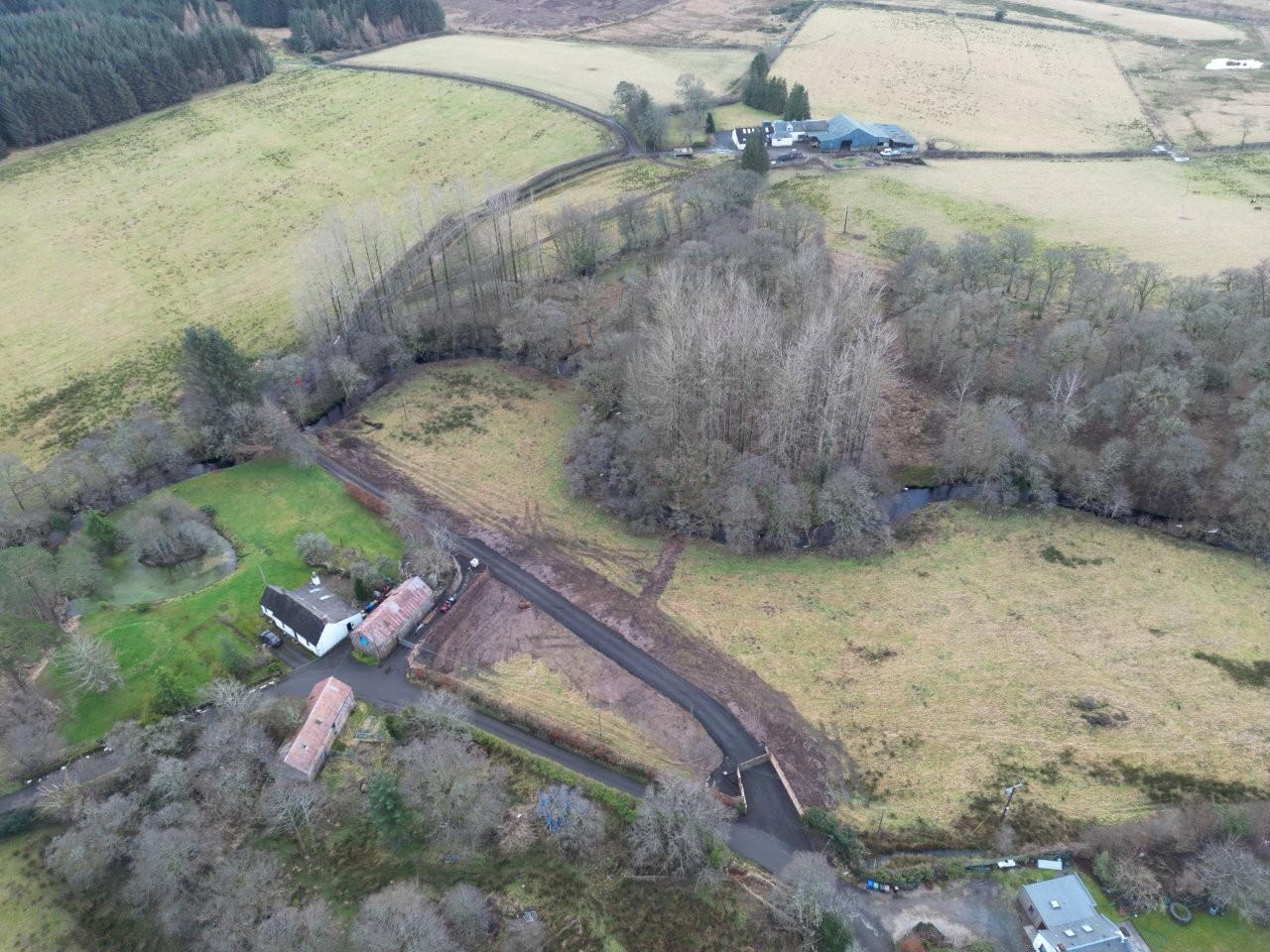
At the start of this year I was alerted to the construction of the new access road to what was until recently called Conachra farm. The new road, which is west of Croftamie, lies within the Loch Lomond and Trossachs National Park and is their responsibility for planning purposes. The farm itself lies within the Stirling Council planning area, the boundary between the two planning authorities running along the Catter burn.
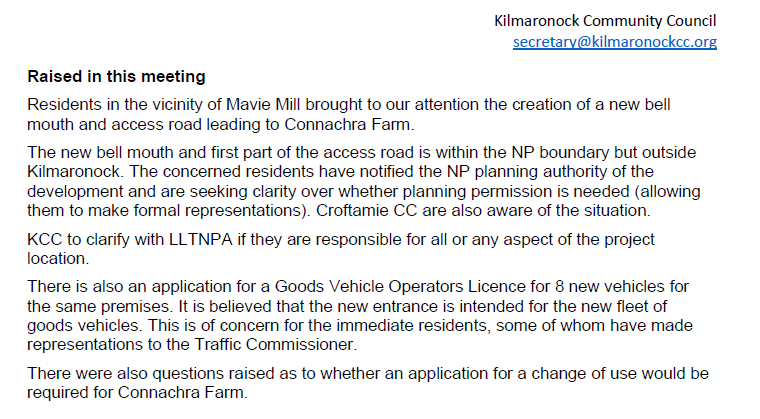
The new road had not had planning permission. Instead of using their powers to stop the development until they had investigated what was going on, the Loch Lomond and Trossachs National Park Authority (LLTNPA) allowed the developer to complete the works:
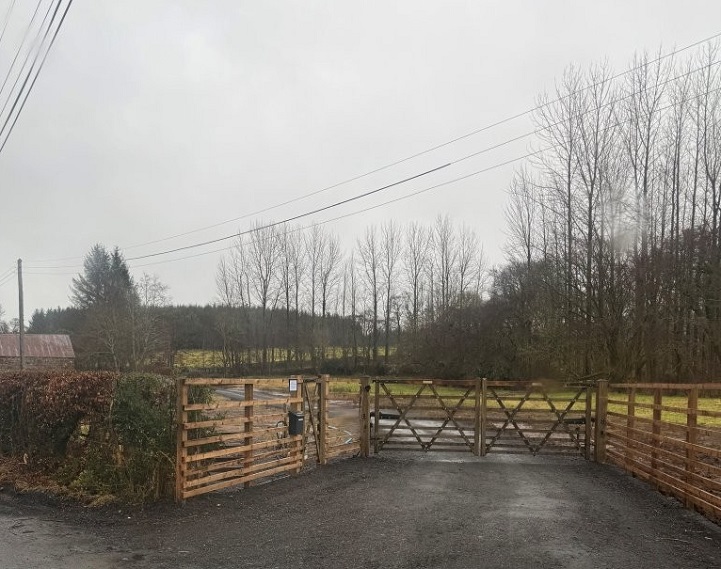
While new agricultural roads don’t require full planning permission if notified to the planning authority beforehand, where a farm fails to do this a full planning application is required. The LLTNPA therefore had every reason to intervene. It has taken a lot of pressure from local residents before a retrospective planning application (see here) was submitted to the LLTNPA after the works were completed:

The application was on behalf of a Mr Sam Newall for ‘Land at Honeypot Farm (was Conachra Farm)’. The Registers of Scotland shows the previous owners of Conachra Farm had bought the land on which the new road has been built in December for £62,500
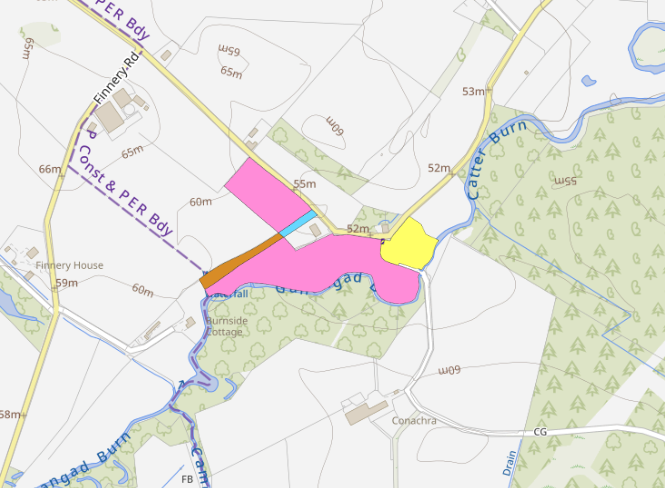
They then put Conachra Farm, the land at Mavie Mill and another property called Collalis on the market last summer at offers over £1,375,000 or in two lots (see here). It appears that Sam Newall bought Lot 2, which included Conachra Farm and the land at Mavie Mill, but details of the sale have yet to be published on the Registers of Scotland.
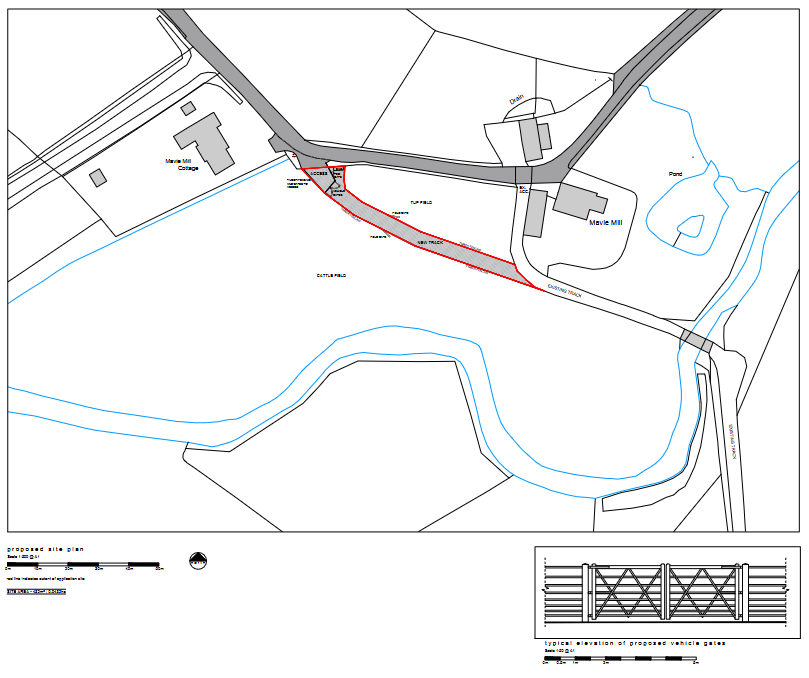
Apart from the application form, the only documentation submitted by the applicant to date are three general plans, all of which show more or less the same thing except one wrongly shows suggests that there had previously been a gate into the field at the site of the new entrance. The agent acting on behalf of Mr Newall claimed on the application form that no further information was required:
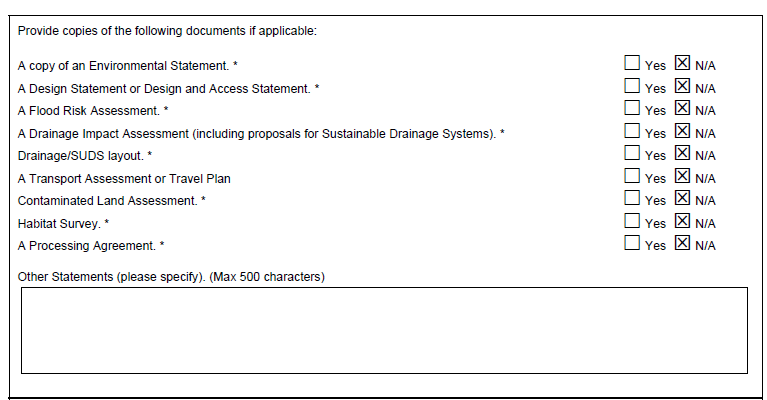
The LLTNPA’s planning staff must know this is wrong. There are, for example, rules about creating new access points off public roads which would normally be addressed through a Design and Access Statement. And among the constraints listed on the LLTNPA’s planning portal for the land at Mavie Mill is that it is at “medium risk of flooding”.
The planning application therefore is not fit for purpose. Despite this the LLTNPA validated it on the 26th March giving the public three weeks to respond.
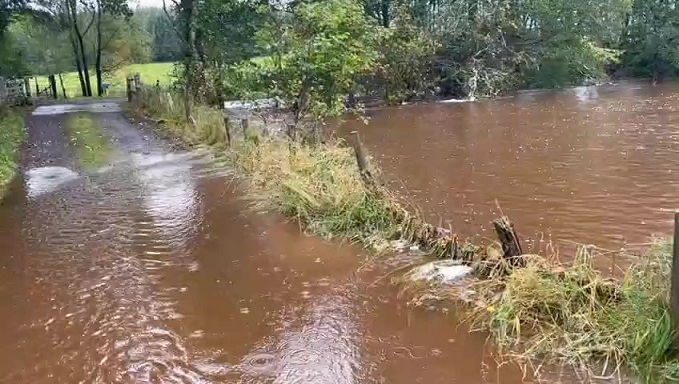
The Stirling Council Flood Prevention Team responded almost by return on 30th March saying they had no records of flooding at this site. Their response was “based on the accuracy and completeness of information supplied by the applicant or those working on their behalf”. That information was clearly incomplete as the screenshot above and video (see here) shows. SEPA’s Flood Risk Planning Advice to Planning Authorities advised that “Applicants should demonstrate they understand the flood risk at the site to an appropriate level of detail relative to the proposed development” and that a Flood Risk Assessment may be required. To date it does not appear that the LLTNPA has required the applicant to do any of that.
The wider issues at stake here are that neither the purpose of this new road has been explained and none of the potential issues surrounding it have been considered.
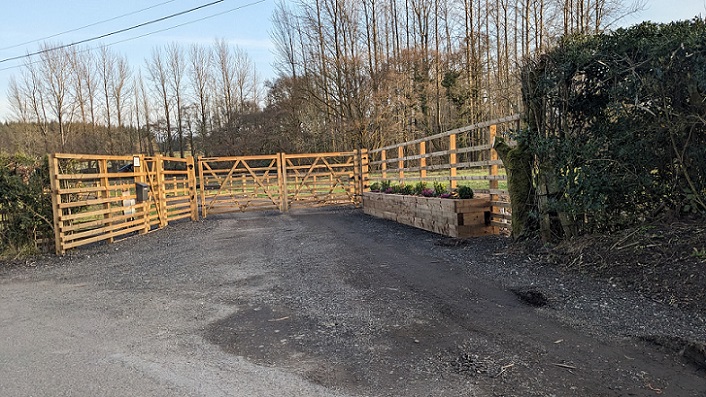
I visited the site on 20th March before before the planning application had appeared on the planning portal to see for myself what had been going on. The road from Croftamie, the C118 known as the Back Road, is very narrow, lacks parking places, is a designated national cycle route (NCR7) and clearly unsuitable for regular use by lorries. It was also surprisingly busy.
A major concern is whether this new access is safe and meets the required standards for junctions onto public roads including visibility splays. Local residents have produced an excellent video (see here) showing how a hump in the road over the former railway means that horses,cyclists and vehicles all disappear out of sight within 40 metres of the entrance, contrary to current standards.
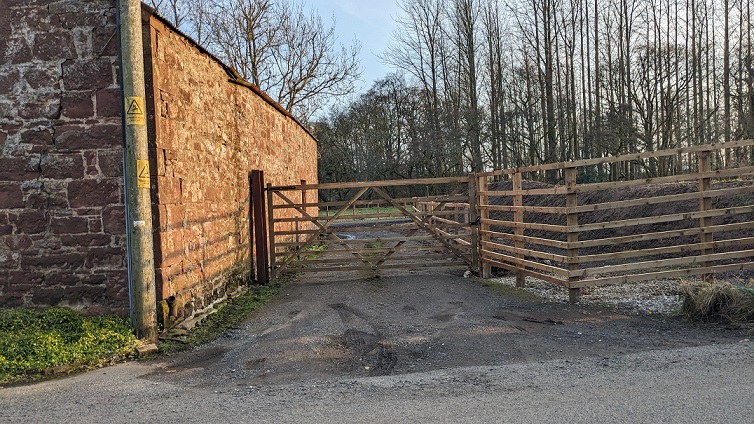
The original entrance to Conachra Farm was by Mavie Mill and appears to have served its purpose for many years. . That begs the questions why change it and what are the implications?
The purpose of the new road
On acquiring Conachra Farm, Sam Newall apparently applied for three separate licenses to operate goods vehicles from the site which were withdrawn after objections were lodged – that is referred to in the Kilmaronock Community Council minutes.
Mr Newall is sole director and has significant control of a company called NWL Honeywagon Ltd (see here). Its registered address is 90-96 North Street, Alexandria and passers by will know it is used to store mobile toilets. The company’s website (see here) suggests it provides a range of other services:
The Company’s most recent accounts also show it invested £2,382,014 in new plant and machinery in the financial year until 31st October 2025. It seems possible that Mr Newall needed somewhere to store that plant and machinery and the renaming of Conachra Farm as Honeypot Farm may be significant. This would not be the first connection between the company and local farms in the Gartocharn area. A previous director of the company was a John Mark Nicholas Newall, who resigned in 2019 but whose address was given as Spittal Farm, Gartocharn.
There is strong evidence to suggest therefore that Mr Newall constructed this new access road with a view to facilitating access to the farm by goods vehicles. Whatever the road safety issues with the new entrance to the farm, these are likely to increase significantly if it is being used by larger vehicles.
As important, however, are the implications for local residents and other users, including those on the National Cycle Route, if large vehicles were to start regularly using a minor road which was never intended for that purpose. Given the issues, it seems extraordinary that the LLTNPA has not asked the Walk/Wheel/Cycle Trust (the new name for Sustrans), which is responsible for National Cycle Routes, to respond to the planning application.
The intended purpose of the new road should have a significant bearing on how the LLTNPA approaches this planning application. Unfortunately, the LLTNPA’s record on dealing with unlawful new access points to public roads is not good, as is shown by how they handled a similar case at Tarbet (see here).
The LLTNPA’s conflicts of interest in this case and what next?
Among those using NWL Honeywagon Ltd’s services is the LLTNPA. In June 2023 they awarded the company a £134,248 contract for mobile toilets (see here). While it is good that the LLTNPA is hiring local contractors, because those contractors may also have other dealings with the National Park, in particular through the planning system, it is important they are squeaky clean. The LLTNPA’s handling of the application to date raises concerns about this.
In financial terms, by asking for a retrospective planning application rather than taking enforcement action, the LLTNPA has spared NWL Honeywagon Ltd significant one-off costs. If it approves the application it could also open up the possibility of the farm being used for cheap storage. Both potentially would help reduce the cost of any services the LLTNPA purchases from Honeywagon in future. There are therefore financial conflicts of interest in this case.
Those conflicts, the failures of planning staff to respond appropriately to the unlawful construction work and the lax way the retrospective planning application has been handled to date provide every reason why this planning application should be determined by the Planning Committee rather than by staff, as is usually the case.
Normally, the LLTNPA’s Planning Committee only decides applications when sufficient numbers of people object. Thankfully the objection from the Croftamie Community Council, a statutory consultee. and the fifteen individual objections to date should be sufficient to force them to do this.
If you wish to comment on this retrospective planning application – you can do so here.

Presumably this ‘toileteer’ changed the name from Conachra farm to Honeypot farm as a cheap attempt to get this done under agricultural regulations?
But he is not a farmer – he provides toilet services to the National Park – presumable cleaning up the mess they leave behind.
Truly awful that in this day and age some bloke can change a traditional name to a convenience name for his ‘enterprise’. What next ….. SPAR farm?
As someone who has lived both within the LLTNP and urban Glasgow, I see a pattern emerging. Well-resourced people will just do what they want, build what they want, see if anyone notices, and only if ‘caught’ will they apply for retrospective planning permission.
For them it is win-win. Save on the planning fees and hassle if no one complains. If forced to apply retrospectively they stand a good chance of having what they have already done being accepted by the planning authority.
The people who ‘lose’ from this ruse are everyone else and nature: The local people who are subject to changes to their amenity and environment which they have not been given their lawful, democratic right to comment upon. Local civic, democratic bodies like Community Councils are also losers as they are not given their due authority and are then placed in the invidious position of having to ‘take sides’ between opposing residents in an issue that often becomes heated and personal.
There should not exist a two-tier planning system which favours people with the arrogance and resources to complete works without considering their neighbours, community and natural environment. Their should be an assumption of refusal against such unauthorised works unless a strong case for the public good can be made, especially where the ‘applicant’ is a person who is well aware that planning regulations exist and apply to their activities.
The honey wagon as everyone knows is the sludge lorry that memories and collects the waste from sepic tanks and cess pits. And of course portaloo type toilets need emptied.
So where does Honeywagon Ltd empty its waste. Maybe they are as clean as the mountain stream and reports of vehicles with toilets are inaccurate. But its a question that demands an answer to reassure folks that everything is in order. The Catter Burn demands no less.
Increased heavy commercial vehicular traffic is an absolute no no for these narrow back roads.
Such traffic is an anathema to what the National Park Authority is supposed to be about.
Of course the old adage of money talking is something that always needs to be borne in mind. Not saying that this is the case here but the authority needs to explain what has been going on here.
I think personally it looks better than a plain old hedge, brings a bit of life into the area and not entirely sure what the fuss is about. Surly better than a Airbnb bringing weekend warriors and drunken folk out, good on that man and I’m all for any further revival they may bring,
Revival of what John Haudwillie.
Who needs permission. Commercial development with no strings anywhere any time.. Do what ypu want, when you want. Thats the ticket – eh?
It’s an interesting concept and it reminds me of a quarry man who once quiped that the rock on which Dumbarton Castle sits would be an ideal source of quarry rock.
But was such a quip just that because only just over a mile away a similar volcanic plug like Dumbarton Castle is being demolished for quarry rock. And concommitantly there is a big waste depository. Revival, now that’s Revival!
.
What many local residents are struggling with is not simply this individual application, but the principle of fairness and consistency in how rules are applied.
Planning policies, road safety standards and environmental protections exist for a reason, and residents expect them to be applied equally to everyone. If certain visibility standards, flood risk requirements or access conditions are considered necessary for one applicant, then the same standards should apply to others in comparable situations.
Most people on the Back Road understand that development and agriculture are part of rural life. The concern is whether established rules and safeguards are being applied consistently, transparently and fairly for the protection of all road users, neighbouring properties and the wider community.
Absence of consistent enforcement risks undermining public confidence in the planning system itself.