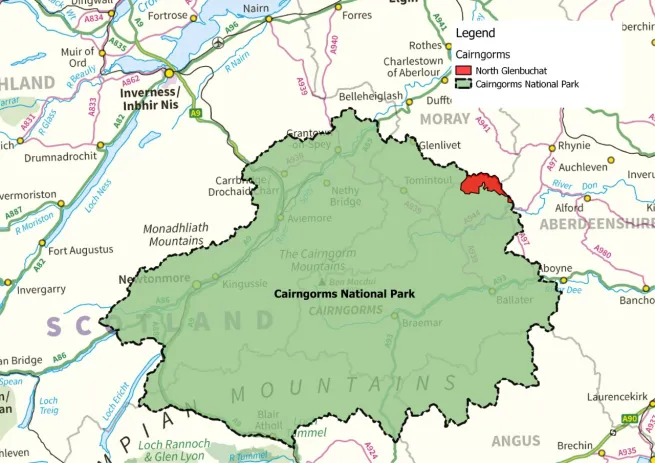
On 1st April 2022 a new Land Register, the Register of Persons Holding a Controlled Interest in Land (RCI), was created under The Land Reform (Scotland) Act 2016. Its intention was to cut through all the off-shore companies, trusts etc, which are often used to own and manage land, and enable the “real” owners and decision-makers to be identified. Such owners were required by law to register their “Controlled Interest” by April 2024
After yet another raptor persecution incident in the north east of the Cairngorms National Park (see here), the land reform campaigner Andy Wightman checked the RCI. He discovered that no-one had completed an entry for North Glen Estates Ltd, the company which formally owns the land and is registered in the Turks and Caicon Islands (see here). As Andy pointed out, without having that information, there was no way for public authorities to hold the landowner to account: under the Wildlife and Countryside Act 1981 landowners may, in certain circumstances, be held vicariously responsible for wildlife crimes that take place on their land.
This week Andy Wightman reported that after nine months of effort by campaigners Police Scotland have now lodged a report with the Crown Office and Procurator Fiscal Service. Also, that in January 2026 North Glen Estates Ltd made a declaration on the RCI, although there is a question whether this information is correct (see here). So far, so good. But Andy also wrote he has “dozens of other offences under the RCI regulations to report and will proceed to do so.” Prosecuting North Glen Estates for the late filing of information under the RCI might incentivise other landowners to co-operate with the Register more.
This all begs the question, however, why should it depend on campaigners like Andy and Alan Brown (see here) to report and get the police to take action against these offences?
What is the Cairngorms National Park Authority doing to identify the real owners of land?
The Cairngorms National Park Authority (CNPA) is committed in its National Park Partnership Plan to reducing incidents of wildlife persecution in the National Park. Given the history of concerns of the North Glenbuchat Estate (see here), one would have thought it would be a priority for the CNPA to use the RCI to identify who the real owners were, so they and other public authorities could negotiate with them directly and take action, if necessary, under the Wildlife and Countryside Act.
Besides raptor persecution, there are many other practical reasons our National Park Authorities (NPAs) need to know who owns the land. How can they know, for example, whether the large sums of public money the are currently giving landowners for nature and peatland restoration is being well spent if they have no idea of what the long-term intentions of those landowners are?
There is also a principled reason why our National Parks needs to know who the real landowners are. If Scotland’s NPAs are to deliver their four statutory aims (conservation, public enjoyment of the area, wise use of resources and sustainable development of local communities), those owning land within the National Park also need to manage it according to those four aims. So have the owners of North Glen Estates Ltd ever signed up to the aims of the CNPA or its National Park Partnership Plan?
The CNPA used to recognise the pivotal role landowners had in delivering its aims. It published an interactive estate map, showing all the main landholdings in the National Park, which included statements of how the land was to be managed:
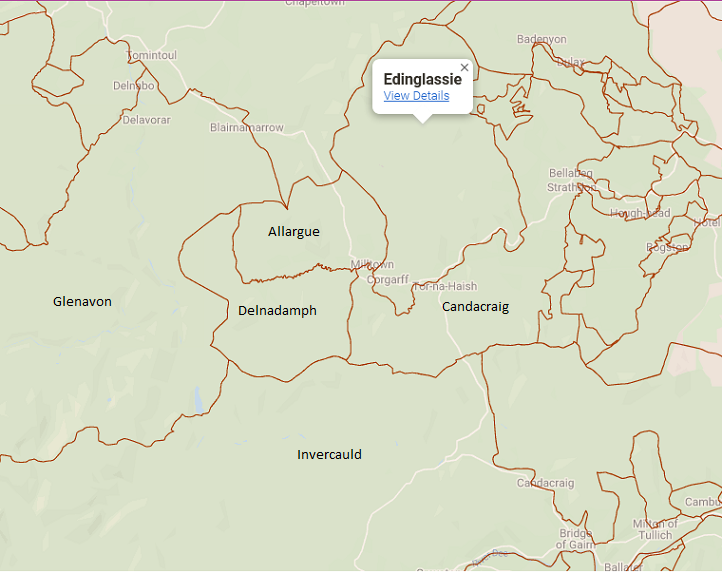
Sometime last year, I believe, that estate map and the accompanying estate management statements disappeared completely. The information can no longer be found on the CNPA website. The public database only ever included management statements from about half of all landholdings, perhaps because the CNPA did not know who the real owners of many of the others were? Of the statements that were provided, many raised more questions than they answered, and I cannot recall any which were revised over time. There were lots of failings therefore but the RCI provided an opportunity to address these and increase transparency. Instead, the CNPA appears to be moving in the opposite direction and publishing less and less information about landownership and associated issues.
In my view if the CNPA was fit for purpose it would have been going through all the information it has on landholdings in the National Park, identifying those that had not registered on the RCI and reporting those to the police. I am fairly certain they will have done nothing to support land reform campaigners in getting the RCI properly implemented but will submit a Freedom of Information request to establish the facts and who, if anyone, from the North Glenbuchat Estate they have ever contacted about Raptor Persecution.

the sheer utter inanity of a national park that isn’t owned by the nation and is therefor NOT a national park
Does Mr Greer now suggest that all land within Scotland’s two National Park should now be fully owned by the “people”? Does he postulate that the responsibility to run them should rest with those…. untrained in land management ….the transient but well remunerated individuals who ‘inhabit’ Committee rooms at Holyrood?
How would that be any better than a company boardroom.?
The CNPA has, for at least the past 8 years, adopted changed policy towards large sporting estates within its boundaries. The CNPA and sporting estates are now vert close allies on all matters concerning land. In CNPA world, land reform does not exist, nor does deer control legislation. Given that other parts of Scotland are significantly better managed for nature, biodiversity, landscape and communities, one truly wonders what the point of the CNPA actually is.
This article further brings into sharp focus the failure of the National Parks and the legislative provisions that are supposed to underpin and support good land management.
But instead bloated quangos and inadequate land management. Truly the dead hand of compromised troughing public sector interest aligned with bigger commercial. Interests
This blog does an excellent job of exposing the ubiquitous examples of this grim state of affairs and really just a reflection of the rotten burghs that so pervade our country.