This post explains how the Code of Conduct for public life in Scotland, as applied to local authorities and quangos, has developed in the last 20 years and is now being used to do the opposite of what the Nolan ethical principles intended.
The Nolan Principles and the Codes of Conduct in Scotland
As a result of the cash for questions scandal in the 1990s (see here) the then Prime Minister, John Major, set up an an advisory Committee to report on ethical standards in public life with Lord Nolan as its first chair The Committee produced a Code of Conduct, based on a set of seven principles, known as the Nolan principles, for those involved in public life: Selflessness, Integrity, Objectivity, Accountability, Openness, Honesty and Leadership.
In Scotland, one of the first pieces legislation passed by the Scottish Parliament was the Ethical Standards in Public Life (Scotland) Act 2000 (see here). This created a legal obligation on Scottish Ministers to issue a Code of Conduct for local authority Councillors and board members of non-departmental public bodies (NDPBs). It also created a new office to investigate breaches of those rules, known as the Ethical Standards Commissioner, and a separate tribunal to judge alleged breaches, known as the Standards Commission. (Both organisations have other functions but these are secondary to their main function).
The Scottish Executive, as it was then known, and new Scottish Parliament decided to add two further principles to Nolan’s seven, ‘Public Service’ (now known as ‘Duty’) and ‘Respect’. While the Codes of Conduct for Councillors and board members include these nine Principles they are also accompanied by a set of rules. The most important point about the Codes of Conduct is the Principles themselves are not enforceable, only the rules are. This is acknowledged in the current model code of conduct (see here), adopted by the Loch Loch Lomond and Trossachs National Park Authority (LLTNPA) in June 2024 at the meeting before they decided the Flamingo Land application:
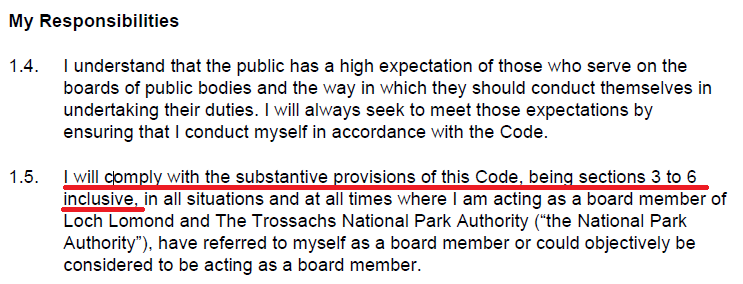
The Principles are set out in Section 2 of the Code of Conduct. They are therefore not regarded as “substantive”. This means board members have no obligation to comply with them unless there is an accompanying Rule.
The original Nolan Principles (see here) have also in some cases been developed. For example the Nolan Principle on ‘Honesty’ was simple and to the point, “Holders of public office should be truthful”. Compare that to the latest version adopted in Scotland which reads:

Note how the emphasis has changed from being truthful to a subset of that, declaring private interests. While there are several pages of rules about registering and declaring interests, there is not a single rule requiring councillors or board members to tell the truth. They are free to lie without consequence unless it is about particular matters, like declaring their personal financial interests.
This means when boards or councils made poor or even disastrous spending decisions – a not uncommon occurrence in Scotland – there is no obligation on board members to be honest about what happened or what went wrong. While in this example the Accountability Principle, now renamed “Accountability and Stewardship”, should in theory help, there are no accompanying rules to ensure board members are “accountable for their actions”. The principle therefore has no force.
While both the Principles and the Rules in the Codes of Conduct have been changed over time, the changes to the latter (which was first published in 2002) have been far more significant and, as I hope I have explained, are what really matter.
Rules relating to “Respect”
The 2014 versions of the model codes, which all councils and boards are expected to adopt, contained two paragraphs relating to the Respect Principle under the heading “General Conduct”:
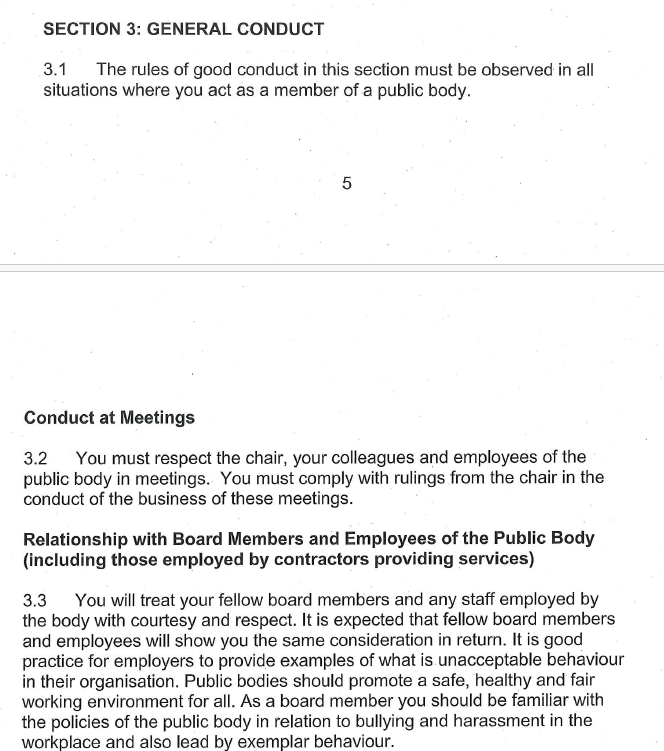 A decade later the rules on Respect in Code had their own separate sub-heading, Respect and Courtesy, and had been expanded to eleven paragraphs.
As a result of six emails Sid Perrie sent raising concerns about the planning Flamingo Land planning process between 26th and 28th August 2024 (see here), (here), (here), and (here), the Ethical Standards Commissioner decided to investigate five issues under no less than 8 out of 11 of these rules. Under the first issue alone, Sid Perrie has been investigated for alleged breach of five of these rules:

 One could justifiably ask how a 75 year old pensioner, elected to represent the people of Balloch but who has no other power, could possibly bully other board members?
But, for demanding that Heather Reid, the Convener, and other Board Members address the fundamental flaws in the Flamingo Land Planning process – which he rightly called “a planning farce” – and stating they would be “guilty of misconduct in public office”, Sid Perrie has been hauled over the coals for showing lack of “respect” under the LLTNPA’s Code of Conduct.
The Standards Commission have now confirmed in writing (Alannah Maurer and I have been trying to represent Sid Perrie’s interests while he has been ill) that they have no interest in whether Sid was justified in writing those emails nor in what Heather Reid did afterwards (e.g immediately forwarding Sid’s first email raising concerns about staff to those staff). All they are interested in is whether Sid’s emails complied with the rules in the Code by being respectful in tone and that he copied some of those emails into MSPs and Scottish Ministers.
The expansion of the rules on Courtesy and Respect also introduced a number of constraints on the ability of councillors or board members to question what was going on in their authority and hold staff to account.
 This rule gives enormous power to the Chief Executive, who can cherry pick what board members become involved in. It prevents board members from looking into the many botched projects in the National Park (see here for a recent example). It means that locally elected members don’t even have the right to be involved in local consultations – an operational matter – it their areas (it was used to prevent Sid Perrie attending a consultation on the Pierhead). More broadly, it helps explains why, when members of local communities ask councillors to address serious operational failings, increasingly happens is those councillors write to staff for their response and then pass that on (my experience in Glasgow).
This “rule” is now being used to prevent any public criticism of senior management whatever they have done. For example, after Fiona Higgins, a teacher and Glasgow City councillor, alleged that the GCC Finance Director had “wilfully and cynically mislead councillors and the public” about education cuts, he complained that she had been “disrespectful, discourteous and public criticism of a Council Officer” (see here). While the official concerned, Mr Booth now appears to have retired without consequence, Cllr Higgins is also due up before the Standards Commission this month for breaching the “respect” rules.
In Sid Perrie’s case he was investigated under Clause 3.8. for criticising staff in public even though his emails were private and addressed to fellow Board Members, MSPs and Scottish Ministers.
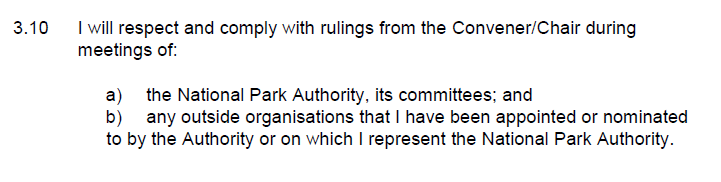
While the 2014 version of the Code required people to comply with rulings of the chair, the more recent versions have extended that. This rule gives chairs/conveners of meetings enormous power. As worded, whatever the ruling and however bad, it must be respected. The LLTNPA Convener Heather Reid has used this on several occasions to prevent Sid Perrie raising serious issues at Board meetings. Unfortunately, few of the public have ever witnessed this because the LLTNPA refuses to make recordings of meetings available to the public to view afterwards (see here).
 Effectively, this means however bad a decision, under the rules every board member is required to support it. .It makes it very hard for any board or council to reverse decisions once they are made. (One could contrast that with the Scottish and UK Governments which frequently make U-turns).
In the case of the LLTNPA, all board members except Sid Perrie voted to approve the National Park Partnership Plan 2024-25 which, under “Strategic Development Needs” committed “to improve Balloch as a main visitor and transport interchange hub for the National Park”. Earlier versions of the NPPP had been even more explicit, committing to deliver one last major development in the National Park – a clear reference to Flamingo Land and the Riverside Site at Balloch. Having made the decision, the Board were stuck with it and all except Sid Perrie therefore had a conflict of interest when it came to deciding the Flamingo Land planning application. Yet for trying to raise this point and get it discussed – which would have resulted in the collapse of the Flamingo Land planning application – it has been Sid Perrie who has been investigated under the Code of Conduct.
Discussion
Until I started try to understand how what is supposed to be an ethical Code of Conduct for those involved in public life was being used against Sid Perrie, I had no idea of how the “respect” rules have been developed in the last decade. Their effect has been to transfer power in both local authorities and NDPBs from board members and councillors to Chief Executives and, to a lesser extent, Conveners. The have made criticism, an essential component of democracy, almost impossible. While purporting to improve governance, they have in fact undermined it.
It is incredible that there is so little awareness about this power grab but those responsible do not want the public to understand what is happening.
Instead of promoting and safeguarding ethical standards in public life, the Ethical Standards Commissioner and Standards Commission, have taken a narrow view of their responsibility and are only interested in the rules. In fact it is the wider Principles and the ethical issues that arise from them which are what matter. What matters more, that Sid Perrie sent some emails, which some might regard as disrespectful in tone, or that the Chief Executive of the LLTNPA has covered up and denied his staff’s involvement in the appointment of Flamingo Land to develop the Riverside Site?
Why should Sid Perrie, Fiona Higgins or any other councillor trying to question staff on behalf of the people who elect them (see here here for a great example of a Councillor from the Highlands doing just that) be respectful of people who deserve no respect? The idea that Peter Mandelson, after all he has done – his life appears to have been one big consistent breach of the seven Nolan Principles – should be treated with respect is laughable. So why in Scotland does the Scottish Government expect councillors and board members always to act respectfully to each other and to staff?.
What is missing from the Code of Conduct is that respect needs to be deserved and that uncovering wrongdoing and acting on behalf of constituents is, ethically, far more important. The Code of Conduct for Public Life needs to be amended to say that and all the clauses designed to shut down criticism and holding staff to account need to be removed.
In my view too the Standards Commission, in its current form, also needs to be replaced by a citizens panel, randomly selected, to decide on complaints. If the complaints against Sid Perrie and Fiona Higgins were to heard by such a panel, I don’t think the complaints about them – designed to shut them up – would have ever got off the ground. The general public knows what matters and should be the people who decide whether or not those elected to represent them or appointed to the boards of quangos have acted in the public interest.
Postscript
After publishing this post I came across an excellent article by Cllr Fiona Higgins which was published in the Herald today about how government processes are being mired in legal and quasi-legal proceedings (see here). It appear that as a consequence of what has happened to her, she is thinking more widely about the state of governance in Scotland. If nothing else, the cost of the bureaucracy being used to address these issues and control people is extraordinary.

The CEO & SO of the CNPA hate any form of challenge from the Board, and have actively used the Code of Conduct to discipline challenge, deter scrutiny and shield senior officers from uncomfortable questioning.
This is surely a clear example of how governance frameworks can be weaponised to maintain control, undermine board independence and erode trust in public decision-making.