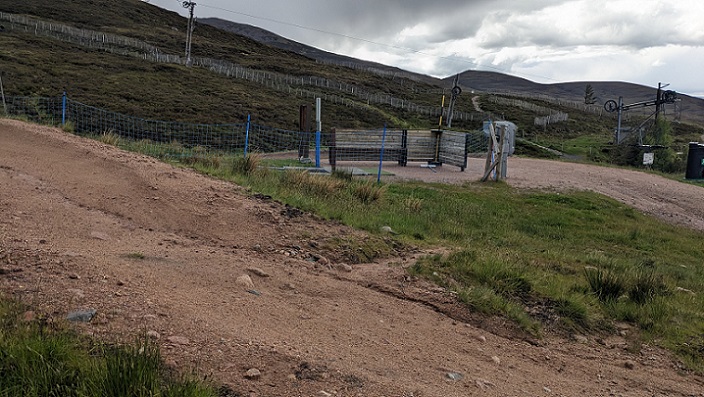
The recommendation from the Cairngorms National Park Authority (CNPA)’s planning officer to approve the planning application for a coaster at Cairngorm Mountain was entirely predictable, the unanimous approval by their board on Friday 13th November slightly less so (see here for papers and video recording of meeting).
The main issue with the coaster, misleadingly described as a toboggan run – it has nothing to do with snow – is not the impact that the structure itself will have on the landscape or environment at Cairngorm, but the new access track that goes with it (see here). That track is allegedly required to enable Cairngorm Mountain Scotland Ltd (CMSL) staff get to the top station and for safety reasons, although the Aviemore Community Council representative also claimed at the meeting it would be useful to fight future wildfires in Glenmore..
The problem with the track is that to reduce the landscape impact and destruction of peat it has been designed to take a straight line up the hillside at an average angle of c 20 degrees. That is far too steep. At such angles, hill tracks rapidly erode which is why Scottish Natural Heritage’s guidance of hill tracks (see here) recommends a maximum angle of 14 degrees. While staff acknowledged that erosion could be a problem they recommended in their Committee Report that the track be approved subject to the provision of satisfactory design details.
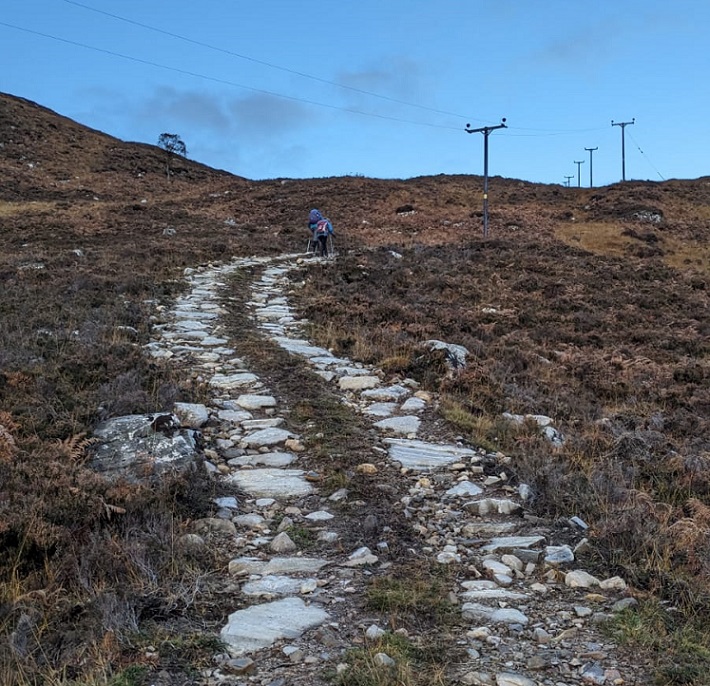
A number of board members, including Eleanor Mackintosh and Steve Micklewright, tried to raise questions about the angle and design of the track at the meeting, including whether staff were compromising on likely erosion to reduce visual impact. Ms Mackintosh also asked whether, if the track couldn’t be designed to prevent erosion, staff would come back to the board for a decision. The reply to this question was a firm ‘no’. That was not a surprise as planning officials have over the last 15 years abrogated more and more decisions to themselves, as democratic decision-making is an impediment to getting developments approved. It appeared for a moment this power-grab might scupper the application or at least prompt some board members to vote against it..
However, the head of planning and development, Gavin Miles, then stepped in and claimed this track at Cairn Gorm was different to other hill tracks because CMSL intended to use vehicles with low pressure tyres and he was confident there would be technical solutions to the problems. No board member then thought to question why, if low pressure tyres make such a difference, SNH had not amended their guidance on maximum gradients to take accounts of this. Nor did board members ask, given these vehicles with low pressure tyres are already in use at Cairn Gorm, why there is such widespread erosion of existing tracks on the mountain (see link to my June post above). Unfortunately Mr Miles’ intervention effectively closed the discussion.
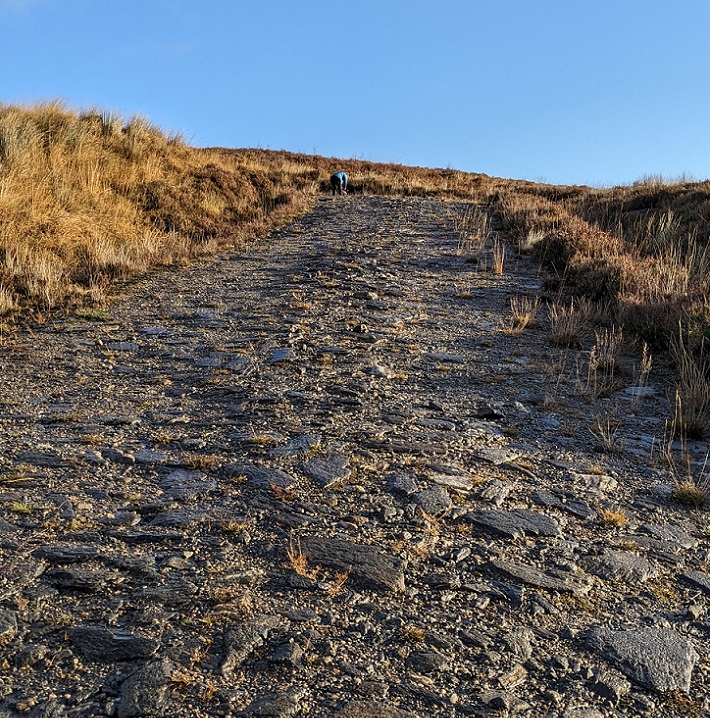
Mr Miles did not refer to the evidence on which his claim was based but I am fairly certain there isn’t any. He did some say hill paths are steeper but that, as any hillwalker will know, illustrates my point. If not properly constructed and paved with stone, such paths quickly erode. This is due to natural erosive processes. In this case, however well compacted the surface and however many water bars, the dust track will get damp and then be subject to the erosive processes of frost heave and freeze thaw. Once the surface has broken, water flowing straight down the track will rapidly speed up the erosive process.
The problem with the CNPA board approving the planning application subject to CMSL providing a satisfactory final design for the track is that there is no satisfactory final design. Either the track needs to take a far less steep winding course up the hillside or it needs to be paved. Both would significantly increase the visual impact. Given that the CNPA board approved the application on the basis that the landscape impact would be negligible those changes should require board approval.
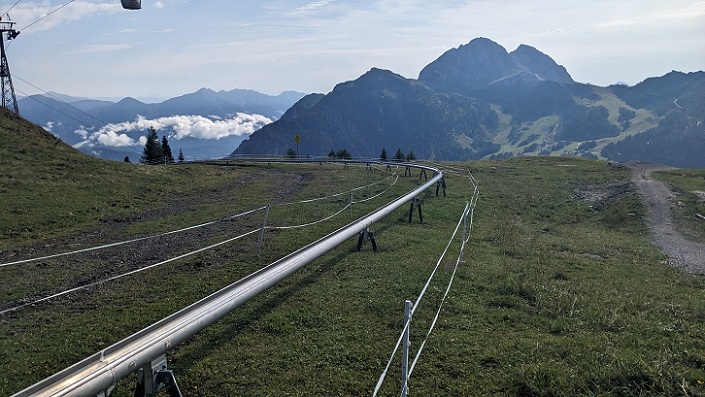
While it will be interesting to see how planning staff and CMSL wriggle out of that one, there is a solution to these issues as I realised when traversing the Carnic Alps in the summer. I came across a mountain coaster above Nassfeld that is downhill only, with the carts/bogies transported uphill on the gondola (see here for photos of the carts emerging from the top station). Information from sunkid (see here), which supplies many coasters, shows that their light carts could also be transported uphill by a chairlift.
The solution, therefore, to the erosion problems would be to replace the Day Lodge tow, which is now hardly ever used for lack of snow, with a chairlift. This would have a similar visual impact and greatly benefit snow sports as it would facilitate access to the West Wall lift. The chairlift could then be used to transport staff, users and carts up the hill. That would remove the need for both the access track and the coaster uplift and reduce the scale and the impact of the coaster development considerably.
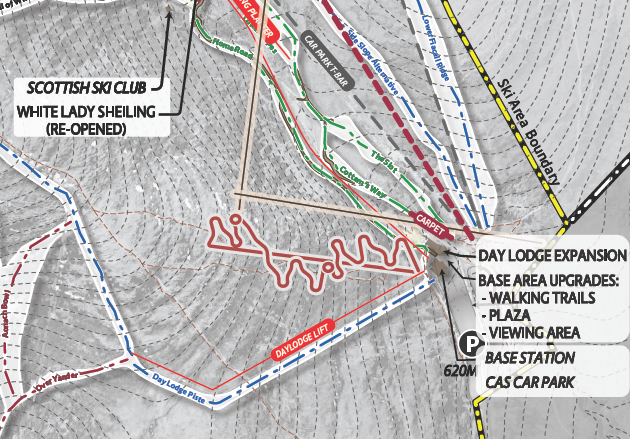
Replacing the Day Lodge tow was not part of the SE Group’s proposals in 2018. Nor was it in Highland and Island Enterprise (HIE)’s masterplan that they eventually produced at the behest of the CNPA in 2021. While planning staff claimed the coaster proposal was in accordance with the masterplan for Cairn Gorm, that plan made no mention of a coaster, is conceptual in nature and does not count as a plan in planning terms. That is why it was never approved by the board, only noted for information (see here). There is therefore no planning reason why HIE could not have proposed to build a chairlift at the same time as the coaster and, given the claims at the meeting that coaster would make at least £570k profit a year and this was a very cautious estimate, this option would clearly have been financial viable. Given these figures HIE could have repaid the cost of a new chairlift and coaster in about ten years and choosing that option would have done far less damage to the environment in the heart of what is supposed to be a National Park.
While HIE is a law unto itself, the CNPA could have used its planning powers to force them to adopt this alternative or move the coaster elsewhere simply by sticking to SNH’s well established guidance on the construction of hill tracks. CNPA planning staff could have backed this up with the examples I have shown of the erosion that is still taking place all over Cairn Gorm – do they never visit sites and look at what is going on? – and also asked CSML to take remedial action in respect of that erosion. Had staff adopted this approach, instead of spending six months considering other details, HIE/CSML would have had time to produce plans for a new chairlift by now. That would have been far better not just for the mountain environment but also for the local people CMSL claimed in their presentation would benefit from this application.
