
Todrig was once, as the photo of the main house shows, a wealthy hill farm in the Borders whose more recent decline is part of a decline in sheep farming more generally. It was acquired by Gresham House Forest Growth and Sustainability Fund LP (GH Fund) in 2022, in which the Scottish National Investment Bank (SNIB) has invested £50m of public money, for commercial forestry and carbon offsetting purposes. As Monday’s post (see here) demonstrated, as more is uncovered about Gresham’s proposals, the more the questions. In May I went to have a look at their potential impact on the ground.

I drove, taking a circuitous route from Innerleithen, past the John Muir Trust’s property at Glen Lude, before approaching Todrig from the south. That route enabled me to observe some of the issues at stake:

Important as it is to rectify past mistakes, as JMT are trying to do at Glen Lude, it would be better to avoid them in the work place. JMT’s restoration project, while offering hope and providing opportunities for learning how to restore land that has been subject to industrial forestry, is a tiny island in an area that is rapidly becoming a sea of Sitka.

Along our route we saw various places where broadleaved trees had been planted, mainly on the lower ground, using thousands of plastic tree tubes which will pollute the land and the watercourses. Such planting is likely to result in even aged plantations of limited value for wildlife. The contrast between the strip of broadleaved trees in the foreground in the view above and what we saw further on was striking:

While the replacement of hill-farming by forestry has enabled native woodland to start to develop through natural regeneration, once the Sitka started to produce seed (at 20-25 years) they rapidly spread into the new native woodland and, because they grown faster, threaten to replace what is currently mixed woodland with more Sitka dominated forest.

Approaching Todrig, we took a look at Whitslaid, the farm immediately to the south. It has been bought by Eskdalemuir Forestry Ltd (see here), who own a number of other former hill farms in the area which are now being primarily used to grow Sitka. What I saw on the journey to Todrig heightened my appreciation that any impact that Gresham’s proposals will have on landscape and wildlife there should not be seen in isolation. They are part of an economic process that is bringing massive landscape change to the Scottish Borders, converting hill farms and moorland into large forestry plantations (and windfarms) and removing people from the land:

Besides the main farm house, we saw two other ruined houses at Todrig which appear to have been once lived in by farm workers. Gresham’s proposals for Todrig, submitted by their agents Euroforest Silviculture to Scottish Forestry in 2024to get an opinion on whether an Environmental Impact Assessment (EIA) was needed, said nothing about the future of these buildings and it appears no staff will be employed locally. In effect every large new forestry plantation represents further clearances of people from the land.
The impact that this has on local communities, as the remaining population is spread more thinly, is massive: neighbours are lost; the demand and justification for local facilities reduces. It is no wonder that the local Lilliesleaf, Ashkirk and Midlem Community Council called for a halt to the proposals in April 2025 after Scottish Forestry had failed to consult them (see here). In many of the upland regions of Europe they practice a different model of forestry, which helps maintain local populations: instead of planting trees all in one go behind fences and then leaving them, local foresters are employed to manage the woodland on an ongoing basis and local sawmills process the timber.
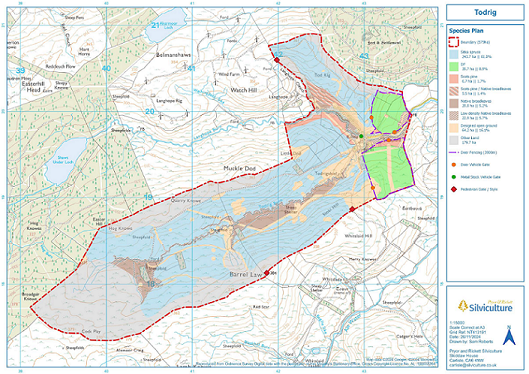
Todrig is 579 hectares, not a large property, which is why the £12.2 Gresham’s paid for it – aided by the Scottish National Investment Bank’s decision to ‘invest’ £50m of public money in the fund – is so extraordinary (see here) The former hill farm – there are still a few sheep – comprises, according to ecology reports commissioned by the agents, calcareous grasslands, acidic grasslands, species-rich riparian grassland, open moorland and peat bog. A farm like this in Yorkshire might be expected to realise about £1.5m.

Calcareous grassland is a valuable habitat and rare in the Borders – planting on it would not normally be allowed in England. Although Gresham’s planting map shows some of this grassland remaining as ‘designed open ground’ (pale brown on the map), it also shows they were proposing to plant:
- the slopes beyond the “open ground” and part of the floor of the small valley drained by the Langhope burn with mixed broadleaves and Scots pine (hashed area on map) despite the fact that the slopes are now covered with naturally generating scrub;
- the heather moorland along the ridge above (‘Tod rig’, which gave its name to the farm) with Sitka (light blue on map);
- the floor of the small valley west of the Langhope Burn with Scots Pine (pink on map); and,
- the slopes to the east of the ruined cottage with Douglas Fir (bright green on map).
While ostensibly claiming to protect part of the calcareous grassland, Gresham’s proposals will do the opposite:
- although overgrazed in the past, the area of calcareous grassland will require continued grazing for its flowers and associated invertebrates to survive. Gresham’s proposed open area is, however, far too small to support sheep or cattle on its own and with all the other land along the Langhope burn being planted, there will be nowhere else to support livestock;
- as soon as the Sitka proposed for Tod rig mature, they will shed seed down the slopes below, which is likely to destroy not just the grassland but the native broadleaves that Greshams wants to plant.

Regenerating woodland and calcareous grassland
It was obvious on my visit was there was a plentiful seed source all along the slope to the east of the Langhope burn and that the northern part was already re-generating very nicely. Moderate grazing by sheep or cattle in the whole of this area (including the heather moorland above) would allow those processes to continue and enable the wonderful old ash trees to produce saplings, while maintaining the value of the grassland which is important for wildflowers and butterflies including the rare Scottish Biodiversity listed Northern brown argus.
Instead, Gresham House is proposing to plant some of this area with native broadleaved trees mixed with commercial Scots pine. Their motivation for doing this appears to be because of Scottish Forestry requirements that a maximum of 65% of any new forestry scheme, which includes open space, can consist of a single species. Planting this area in this way therefore enables Gresham House to plant more Sitka elsewhere on Todrig but it seems unlikely the Scots pine can be harvested without damaging the other woodland and grassland..
Whether this planting would receive carbon credits under Woodland Carbon Code (WCC) or Verra, as the previous post explained, is unclear.
The added scandal is that an FOI response on 13th August 2025 revealed that Scottish Forestry has provisionally decided to award Gresham House a total of £1.33m towards the cost of planting trees, including in areas where woodland has been establishing naturally:

While most of Todrig remains open ground, the slopes by the Langhope burn were not the only ones that were recovering naturally. Most of the property lies along the meandering Todrig burn and the slopes on either side. As we walked up the glen we started to see naturally regenerated broadleaved trees, including rowan, hawthorn and willow and, unfortunately Sitka spruce.

If current conditions continued, the area in this photo could naturally develop into woodland over the next 50 years, Gresham’s plan, however, is to convert almost all the grassland and moorland in the glen to Sitka, with the exception of the immediate areas by the burns where conifer planting is not allowed under the UK Forestry Standard. Unfortunately, Scottish Forestry is so preoccupied with meeting the Scottish Government’s tree planting projects that it has little interest in natural regeneration over time, even though this is the cheapest and least damaging way for woodland to develop (no fences, no mounding, no plastic tree tubes).
Scottish Forestry’s FOI response also shows they were considering whether to award Gresham House £150k towards the cost of c85,000 plastic tree shelters and vole guards

Just over a kilometre from the farm house we came across an area of more extensive regenerating ‘scrub’ and heather on the banks of the river and former flood plain. The extent of the area is best shown by this aerial photo:

The planting map shows Gresham House is hoping to plant most of this low lying area, with broadleaves in the areas closest to the burn where they would not be allowed to plant conifers, again a means of maximising carbon credits and the amount of Sitka they could plant elsewhere, and nearly all the rest Sitka. The likely consequences in the medium term is the open areas and the areas planted with broadleaves will be colonised with Sitka. To address this issue Gresham House were proposing to remove self-seeded Sitka once every five years but for such undertakings to become enforceable Scottish Foresty would need to start requiring 50-100 year contracts.
The wider point is that the semi-natural habitats along the Todrig burn, whether grassland, moorland or scrub/evolving woodland have significant value for biodiversity and that is increasing as grazing has reduced. This biodiversity could be enhanced and maintained over the longer term with regular cattle grazing. After my visit I was told by a bird expert that Todrig had once been identified as a place that could support wood sandpipers, a very rare breeding bird in Scotland, but none had been found. Unfortunately, much of the Southern Uplands in the Scottish Borders lacks legal protection (such as Sites of Scientific Interest) – a legacy of the impact of very high numbers of sheep in the past. However, Scottish Borders Council did recognise the importance of these areas back in 2013 when an update to its woodland strategy developed in 2005 identified many upland areas as being suitable for ‘native woodland opportunities only’:

While at one time there was an attempt to develop a more coherent approach to land-use in the Borders, this appears to have changed after Scottish Forestry replaced Forestry Commission. Todrig provides just one example of how Scottish Forestry is now riding roughshod over the value of semi-natural habitats.

Further west, as the land rises, the valley emerged into a large area of moor and bog. A survey undertaken on behalf of Euroforest Silviculture by Bowland Ecology (dated 26/7/23 and described as draft) showed much of this area was covered with peat, a significant amount of which is more than 50cm deep, the threshold over which tree planting has been prohibited in Scotland (its 30cm in England).

Much of this peatland is shown as “Other Ground” on the planting map and forms the main area that will not be planted. It seems that the only policy barrier to the planting of Sitka at present is deep peat.

Unfortunately, Sitka from neighbouring plantations is in the process of colonising the areas of peat bog and will be serving to release some of the stored carbon. Gresham House has had four years to remove these trees but is under no obligation to do so.
Discussion
On account of the importance of organic soils compared to trees for storing carbon (see here), there is a strong case for restricting tree planting, as the UK’s Climate Change Committee recommended, to mineral soils. Yet mineral soils are also valuable from both a biodiversity and food production perspective and how these competing interests and values should be balanced or reconciled has as yet been subject to almost no public discussion.
From what I saw at Todrig, to move from blanket afforestation of upland areas with peaty soils to blanket afforestation of areas with mineral soils, which support a variety of natural habitats, would simply replace one disaster with another. The underlying problem is how commercial forestry is practised in upland Britain compared to much of upland Europe: blanket monocultures with little room for nature or people.
From a forestry perspective, any plan which proposes that 73% of all the trees by planted area should consist of one species (Sitka) is foolhardy to the extreme. It flies in the face of the evidence about windthrow, tree diseases (Dutch elm, Ash dieback, Phytopthera Ramorum) and pests (Pine beauty moth). With the Forestry Commission currently taking action to stop the spread of Spruce Beetle from southern England, hoping to plant most of Todrig with Sitka spruce looks like complete and utter madness even before one starts to take account the other negative impacts.
Todrig could have provided an opportunity to demonstrate how to grow some trees for timber while maintaining some farming, enhance other habitats, restore rural buildings and maintain the local population. The SNIB could have played a key role in developing an alternative and more sustainable vision for the land. However, as a comment on Monday’s post stated, the lack of knowledge or interest shown by SNIB staff in Gresham House’s plans for Todrig is staggering. This is probably not their fault but that of the leadership at the SNIB which has just recorded a £138m loss (see here).
The only explanation for why forestry schemes like Todrig are being promoted is that investors like Gresham House and the SNIB believe they can make a quick buck before it all goes bang and, conversely, if it all goes bang before they make a buck, that government will step in to bail them out at the public’s expense. That Scottish Forestry is still aiding and abetting this madness through lax environmental regulations and dubious carbon calculation defies belief but it indicates that Scottish Ministers, to whom they are accountable,have very little understanding of thenegative impacts of many new woodland creation schemes.

The ministers in this and recent Scottish Governments have no idea what damage is being done to our land and local communities by these crazy financial incentives provided through forestry grants, tax incentives and the carbon credit scam. In the near future the best solution would be to suspend all payment of forestry grants across the whole of Scotland and to abolish Scottish Forestry as part of the forthcoming public body reforms. If we want more trees to grow in our uplands the most urgent task is to reduce/better control sheep grazing in the Borders and to get NatureScot to use its compulsory deer control powers to reduce widespread overgrazing in the Highlands. And they should start on Balmoral estate which, along with its neighbouring estates, is the worst area in Scotland for deer overgrazing. the Scottish Government were told this, six years ago, in the report of the Deer Working Group which they themselves commissioned. When are ministers and their officials going to wake up and do something about these financial incentives and the appalling example set by Balmoral and its ilk?
Would appear to be something like a racket
If it looks like a duck, walks like a duck and quacks like a duck….
I think it is now time to change the taxation regime on forestry – the way it impacts on land use decisions is unscrutinised: you get the tax breaks regardless of woodland establishment issues, poor management and violations of EIAs.
With respect to the Woodland Grant Scheme, when I led the project team looking at developing the Orbost estate for the local community on Skye, one of my main recommendations was that woodland planting be staggered over a number of years to enable the work to be carried out by a local workforce, not a small army of outside contractors there only for 3 weeks. Slowing woodland creation down also opens the door to natural regeneration which has to be a good thing?