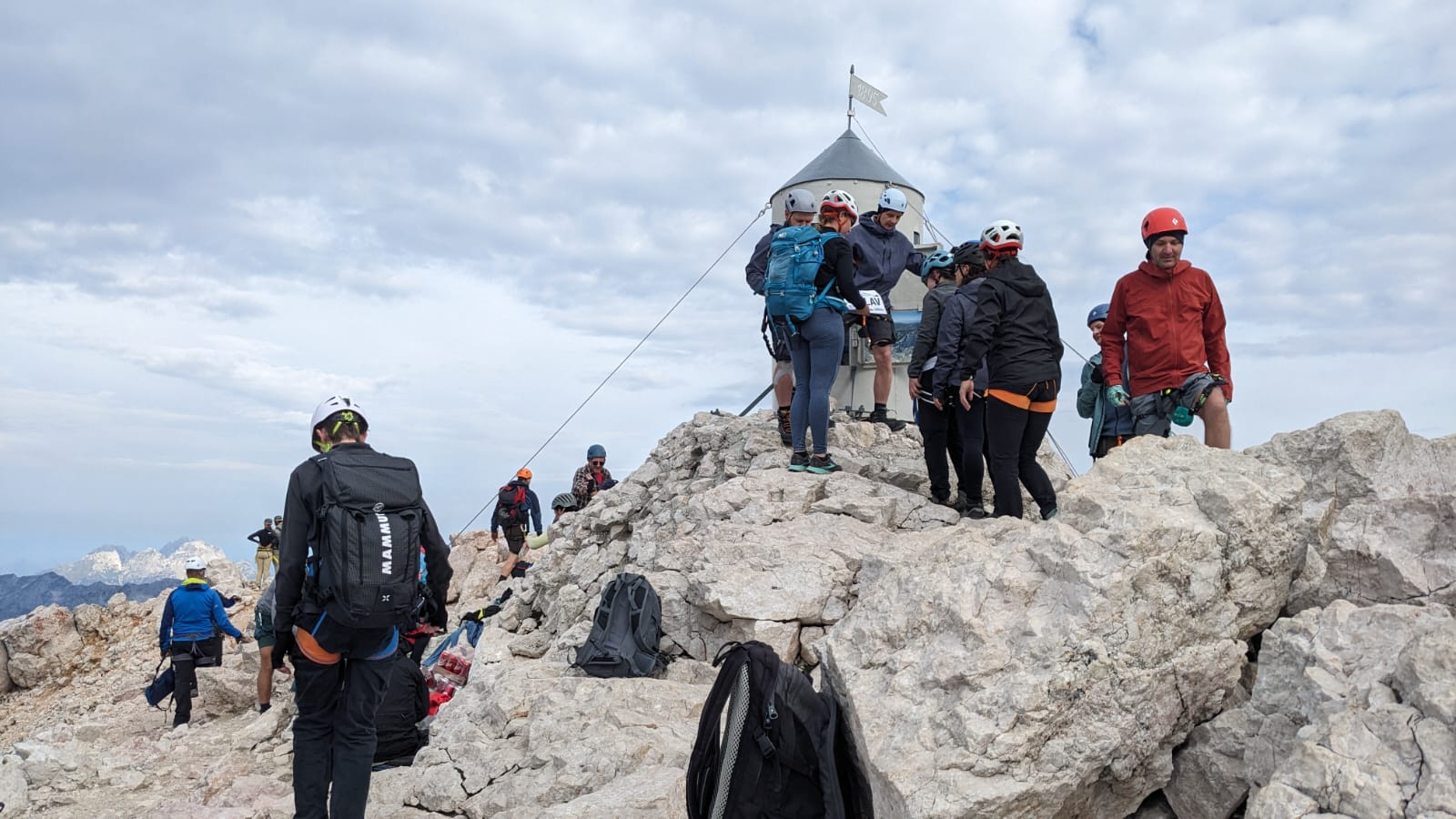
I had wanted to climb Triglav, the highest mountain in Slovenia, ever since meeting some Slovenian climbers on a Mountaineering Council of Scotland meet many years ago. My interest was fanned by Mike Newbury, a stalwart of MCifS’ access and conservation committee, who went on holiday to Slovenia each year and whose privately published guide I had used in my only previous visit to the country.
From a personal mountaineering perspective the ascent turned out to be disappointing. Whereas once I might have tried a climbing route, we took the popular east route onto the north ridge. This was protected by cables more or less the whole way and instead of an airy walk along a ridge that is only a couple of feet wide in places there was a handrail and queues. It was only when we left the crowds and descended a different and less well protected route down that I started to enjoy the day from a mountaineering perspective.
And yet I would not have missed the queues for anything: When I first heard about Triglav I was told every Slovenian wanted to ascend it at some point in their lives. Talking to Slovenians they told me that generally that is still the case. Part of reason for this is related to the symbolic role Triglav has played in the country’s history. Mike Newbury’s guide recounts some of that. In 1872, the Austro-Hungarian empire prevented a Friends of Triglav from being formed believing it would become a vehicle to promote national rights. In October 1944 partizans proclaimed the liberation of Belgrade from the Nazisfrom the summit. On 25th June 1991, the day Slovenia proclaimed it’s independence from Yugoslavia, the Slovenian flag was unfurled from the summit. There is much more.
Although Scotland is as mountainous a country as Slovenia and lots of people ascend Ben Nevis, we are far from every resident wanting to ascend our highest mountain and it plays a very small role in national consciousness.
The significance Slovenians attribute to Triglav has also played an important role in conservation.. In the 19th century the German-Austrian Alpine Association wanted to develop the mountain by building a cog railway up from Bohinj (almost a days walk to the south) and constructing a viewpoint on top.. The priest and mountaineer Jakob Aljaz defeated this proposal by buying the summit of Triglav from the local commune. Triglav was subsequently central to the various conservation arrangements that preceded the National Park and is now core to it.
The landscape around Triglav and the views from the summit are magnificent. While waiting on the ridge for those ascending to pass those descending, inwardly I was celebrating. People will fight to protect what they know about and value. The metal work and crowds on the Triglav ridge – still very dangerous in a thunderstorm – seems a small price to pay for that. Access is crucial for conservation, contrary to the views of both of Scotland’s National Parks which treat it as a threat.
It is worth noting that the symbolic importance of Triglav in Slovenia appears to contribute to a much wider interest in mountains and their conservation. In 2015 there were 287 branches of the Slovenian Alpine Association (see here) in a country of with a population of 2.1 million people. Hillwalking and mountaineering are the country’s most popular sport/activity – good for people’s physical and mental health. The SAA maintains c10,000 km of paths and c179 mountain huts and bivouac huts. These are very well used: all save the lowest hut we stayed in were fully occupied and we had had to book our places in April. And yet, away from the huts we saw very few people apart from on Triglav.

The importance of Triglav to the Slovenian nation even extends to an image of the mountain appearing on the national flag. https://en.wikipedia.org/wiki/Flag_of_Slovenia#:~:text=The%20national%20flag%20of%20Slovenia,the%20white%20and%20blue%20bands.
And note that the current Director of the Triglav National Park is Uros Brezan, a former minister of natural resources and spatial planning in the Slovenian government, in which he had a high reputation for environmental commitments. Perhaps if Scotland’s national parks were led by persons with such impeccable credentials and political know-how we would be achieving much more progress.