This is the first in a series of posts which looks at what forestry grants to large landowners to plant trees has done for native woodland in Scotland based mainly on the evidence I have seen on the ground over the last few years. It provides lessons for our National Parks, not least because of the announcement yesterday that the Loch Lomond and Trossachs National Park Authority (LLTNPA) has been awarded £670k by the National Lottery to plan how to restore woodland with a further £9.2m potentially to follow (see here).
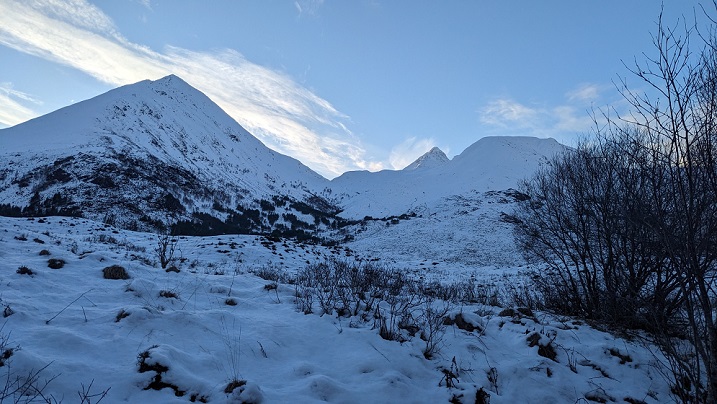
I will start with the native tree plantation I came across on a walk up Faochag in Glen Shiel the week after New Year.
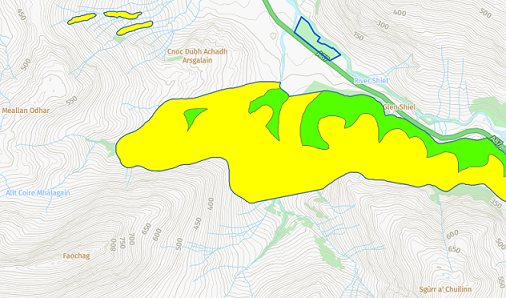
The plantation extends from Coire Mhalagain, around the lower part of the north east ridge of Faochag and then east into Glen Shiel and was planted under the Woodland Grant Scheme 2 1991-94. This was a product of the successful campaign by the RSPB, Nature Conservancy and others in the 1980s against the afforestation of the Flow Country. The forestry tax breaks which had driven planting on this important habitat were abolished and replaced in 1988 by the ostensibly more environmentally sensitive Woodland Grant Schemes. There were three versions of the schemes (WGS1, WGS2 & WGS3), which lasted until 2004 and provided direct subsidies to landowners to plant and manage woodland. They prompted a wave of new native tree planting across Scotland, including Glen Shiel, Glen Affric an Kintail..
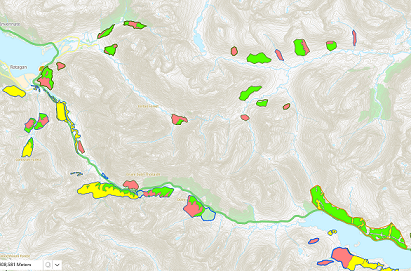
This particular scheme – its not named on the Scottish Forestry Map Viewer – appears to have been planted in two separate fenced enclosures leaving the ground between the two open.
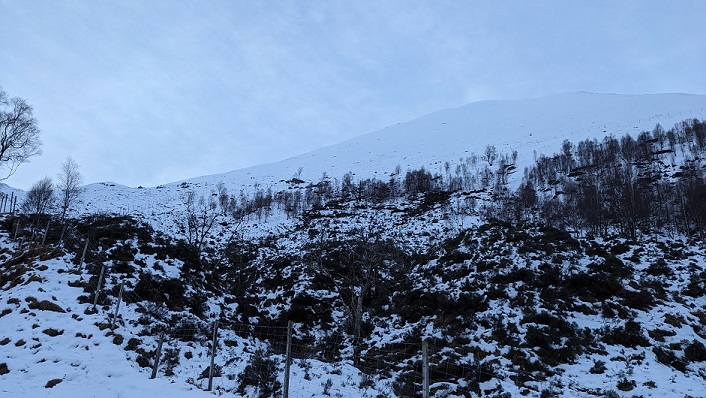
In the snow, there was no obvious way through the Faochag enclosure to its north east ridge so I decided to walk around it. Even from a distance, there were far fewer deciduous trees than one might expect in a planted enclosure of this size. When I reached the fence I spotted several red deer walking through the trees in the middle distance before losing sight of them. Deer are very hard to spot in woodland when stationary and I could not spot them in this photo afterwards.
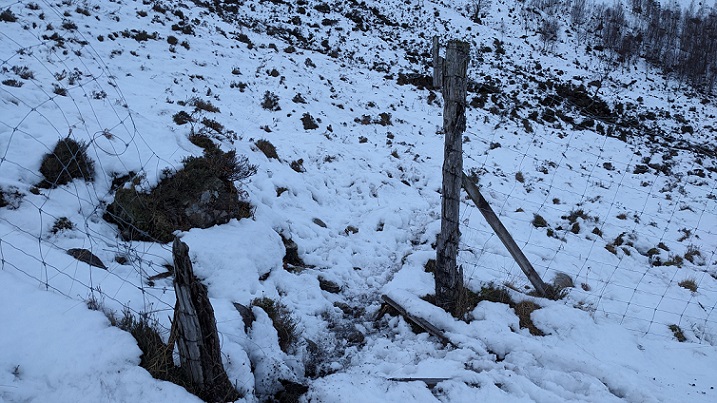
A little further on I came across a gap where there had once been a gate. It seems deer had been deliberately let into the plantation to provide them with food and shelter.
While the sparse distribution of deciduous trees within the fenced area provided a clue, the full impact that deer were having on this “woodland” only became fully apparent when I walked through the plantation on my descent.
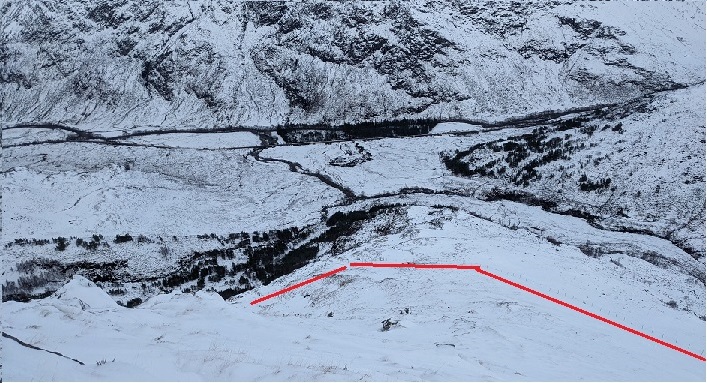
The densest woodland on the left of the photo is primarily Scots Pine. The bare ground behind the fence of the right of the photo appears to have been intended as deciduous woodland.
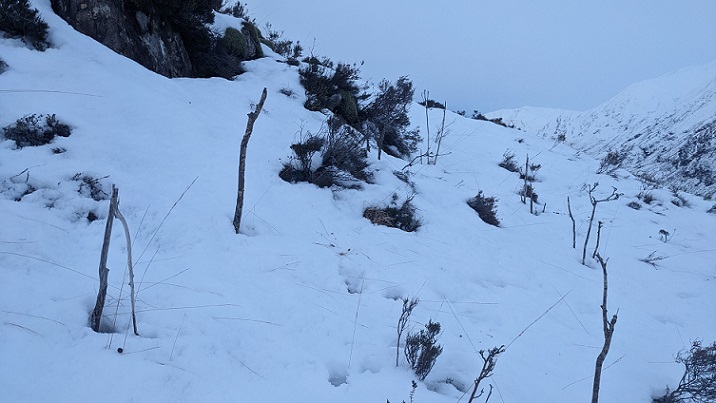
Once down inside the fence and below the upper treeless areas, there were many examples of dead or dying young deciduous trees that had been browsed, These trees may have been planted subsequent to the plantation being established or may represent a period when the plantation had started to regenerate naturally. Whatever the explanation, all the younger and smaller trees are being systematically destroyed by hungry mouths.
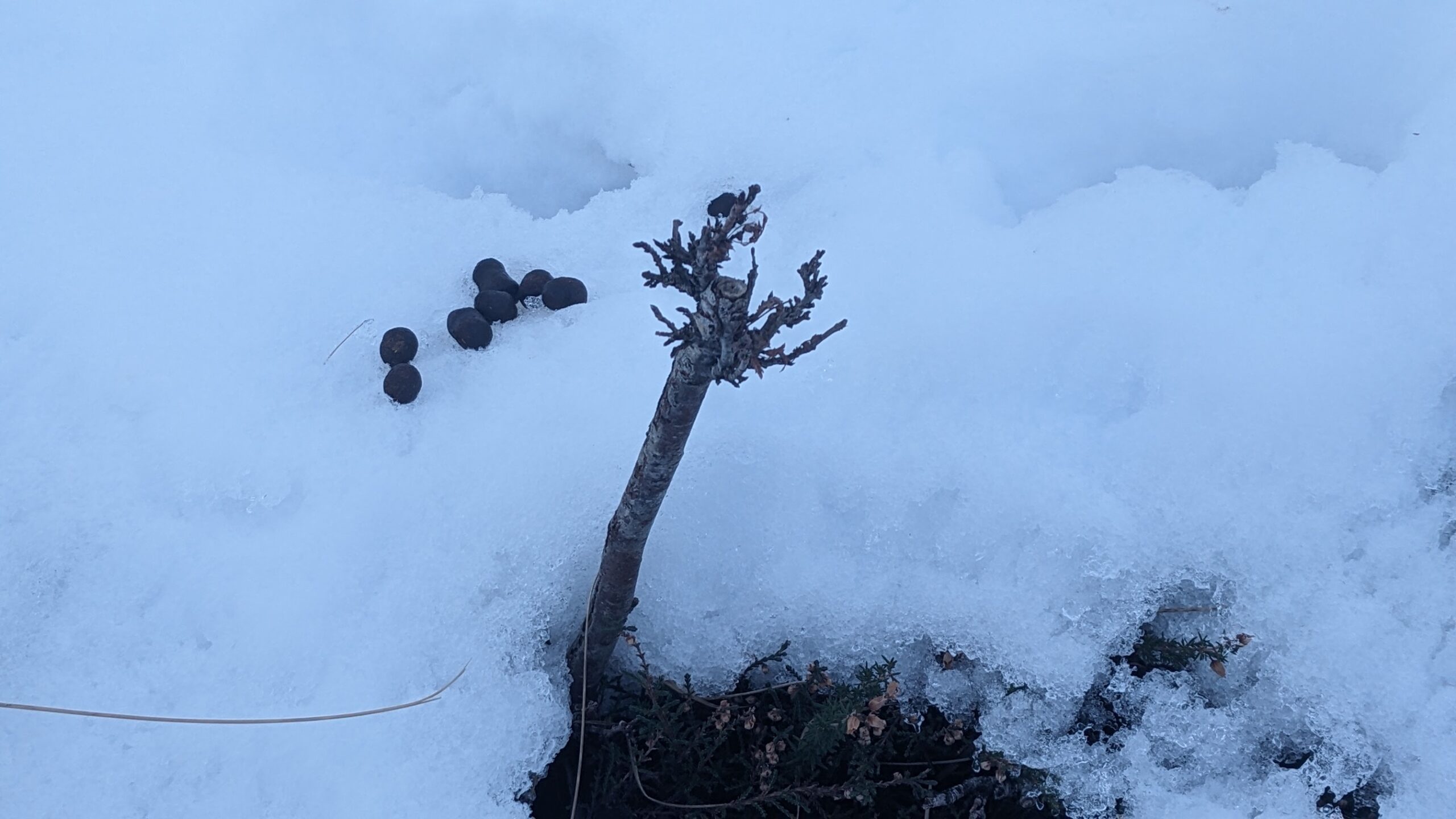
How long this process, which has put an end to woodland development, has been going on is unclear.
There was also evidence of Red Deer pulling down branches from older trees to chew the bark.
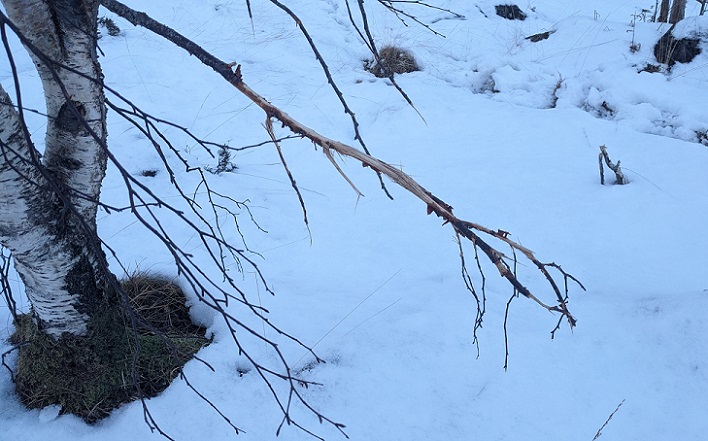
While people often talk about Scots Pine and non-native conifers “getting away”, deciduous trees remain vulnerable to grazing for a considerable time – much much longer than the average deer fence lasts. Except on better soils, where trees may be able to grow quicker than deer can eat them, high deer numbers are generally a death sentence for native woodland.
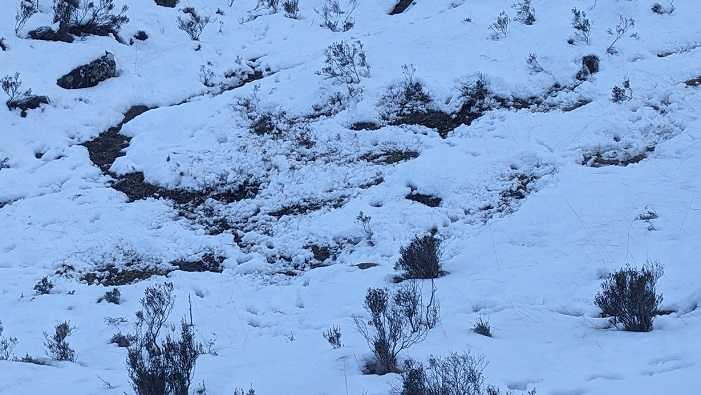
Since I first started really looking, I have observed many plantations like this, ostensibly intended to increase the amount of native woodland cover but where thirty years later many of the trees have been destroyed. What remains does not deserve to be described as woodland and has little value for wildlife.
From a sporting landowner perspective, however, what matters is not woodland but maintaining high numbers of red deer for stalking and estate valuation purposes. Opening up native woodland plantations after the first few years provides red deer with much needed food and shelter, helps them survive the winter and helps keep their population high. While this gradually destroys the value of the plantation as a refuge for deer, as evidenced by the photo above, from a landowner and land-management perspective this doesn’t matter. There is always another forestry grant available to pay for a new plantation for deer.
Far from promoting native woodland, therefore, the forestry grants system has become a means of subsidising stalking estates. Instead of paying stalkers to cull deer, reduce deer density to 2 per km or less and allow native woodland to regenerate naturally, the public are paying private landowners to plant trees to maintain deer numbers at high levels. The result is after thirty years of forestry grants, very little native woodland has developed on sporting estates, either as a result of planting inside fences or through natural regeneration because any accessible tree gets eaten.
Two factors have made this system, in which deciduous trees are repeatedly planted and then eaten, possible. The first is that the primary focus of the UK and Scottish Government has been on the amount of “woodland” created and planting targets – hence why there is always another grant to pay to plant trees for sporting purposes. The second is that Scottish Forestry and its predecessors have taken no interest in what happens to the trees they pay to plant in the medium term. Under the grants system landowners are required to maintain tree density at certain levels for the first few years, otherwise the money could be reclaimed, after which they can do what they like. We are paying landowners to plant trees whose average life expectancy is probably less than 15 years.
Unless we address deer numbers, recent plantations will suffer the same fate as many of those created under the Woodland Grants Schemes. Conversely, if deer numbers were reduced, there would be little or no need to plant – nature would do the job for us.
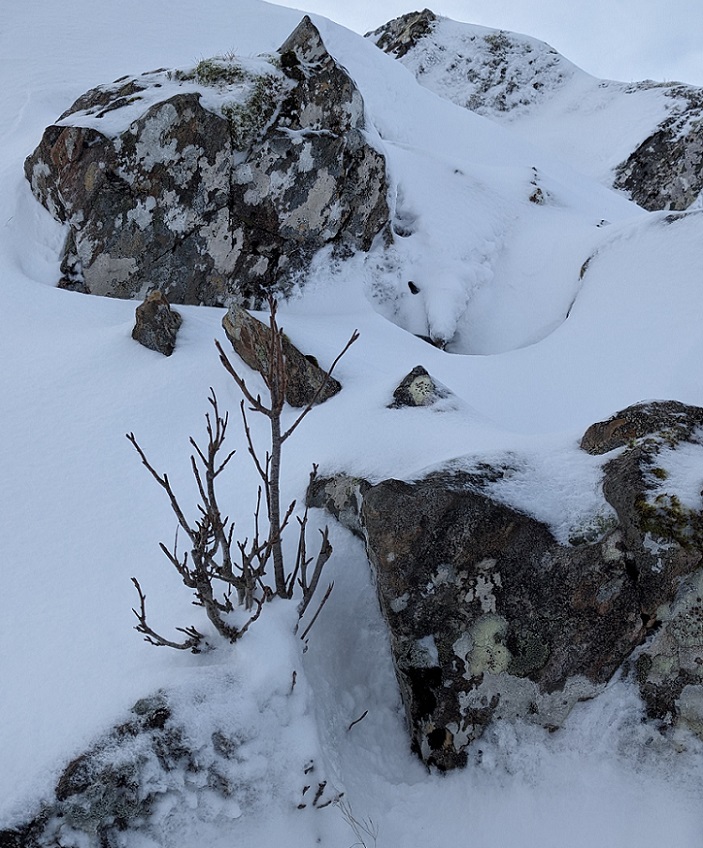
Apart from the Red Deer, the land was still and silent until I was on the summit of Faochag.
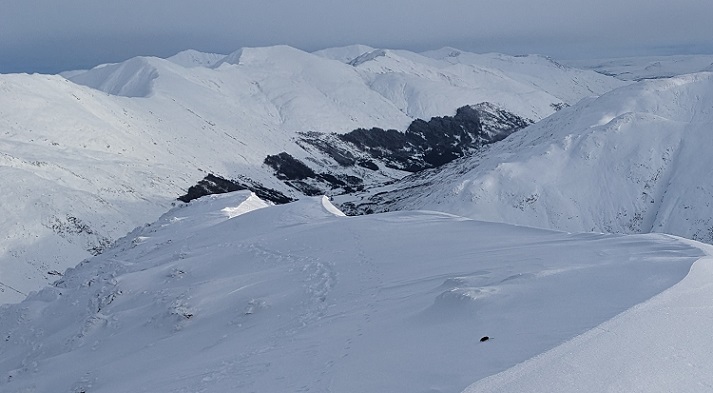
At almost 3000ft, a common shrew, a mammal more usually seen in woodland and grassland, was scurrying across the snow. My first thought was how could a shrew, which needs to eats two or three times its body weight each day, survive in such an environment. My second was what did its presence say about the state of the native woodland below.
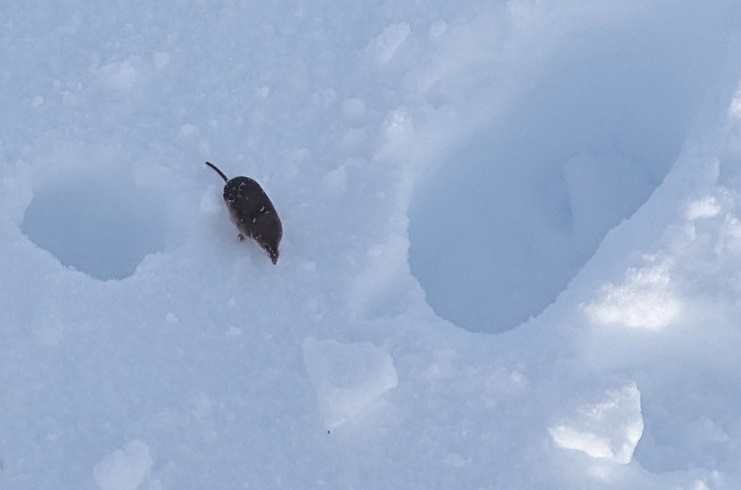
I found out afterwards that:
“Common shrews have evolved adaptations to survive through the winter. Their skulls shrink by nearly 20% and their brains get smaller by as much as 30%. Their other organs also lose mass and their spines get shorter. As a result, total body mass drops by about 18%. When spring returns, they grow until they reach roughly their original size. Scientists believe that low temperatures trigger their bodies to break down bones and tissues and absorb them. As temperatures start to rise with the onset of spring, their bodies start to rebuild the lost bones and tissues. This ability to shrink their bodies significantly reduces their food requirements and increases their chances of survival in the winter.” (Wikipedia).
Nature is amazing, it just needs to be given a chance.
In the LLTNPA’s news release yesterday about their award from the National Lottery, Simon Jones, Director of Environment and Visitor Services, was quoted as saying:
“Nature conservation at scale takes years of sustained, collective effort. There is no quick fix to habitat restoration, but this funding gives us the opportunity to embed long-term nature recovery processes with people, delivering benefits for decades to come.
It would be a major step forward if our National Parks were to state publicly that planting trees is not a “quick fix” for habitat restoration and does not create woodland. A start might be for the LLTNPA to use some of the National Lottery money to research what difference the Woodland Grant Schemes 1998-2004 made in the area they are now hoping to “restore”?
It is concerning, however, that the LLTNPA is still talking about “collective efforts” when, until such time as there is significant land reform, all that really matters is what large landowners do. If landowners were to reduce deer numbers to two or less per square km, there would be no need for any more large native woodland plantations, nature would restore itself.

How very true – and there would be no need to scrap forestry grants in order to bring in stricter regulation of deer numbers – the two approaches could be linked through required compliance for receipt of grants.
There were a lot of overly optimistic native schemes planted in the 1990’s, driven by the belief that almost all of Scotland was once forested, and therefore, almost anywhere is capable of sustaining trees now. You can certainly argue whether some of these schemes should have been planted at all. My other observation would be that when deer fences do start to deteriorate, they should be removed at that point, because their presence will only exacerbate any deer damage. If deer are running fencelines, unsure of their way out, their stress levels will go up, and they will eat/ browse more to compensate for that. Better if the fences are removed completely, and deer allowed to access more freely if they want to, whatever their density. I have advised several properties to remove fences around 20 year old trees, with negligible damage, even with a lot of deer around. The fences themselves are part of the problem, creating obstacles and stress for deer as much as anything else. The REALLY BIG issue going forwards is that fences are becoming more expensive, and their life expectancy now often < 10 years. Those two things together would force any thinking person to re- examine how they go about doing things. If we could pull the plug on carbon markets, and remove that as a motivation for fairly uniform but ultimately unrealistic plantations, then that would clear people's minds and help them see better what might be possible.
Good to read that you are making your way North. Perhaps you will take time to visit the new plantations further Northwest such as at Ben Shieldaig/Ben Damph .
As long as I have been driving past the forests in your article these trees have struggled to make anything of themselves. I have often seen deer along the fence. (that was as far back as when the fence went up)
The Estate should have been on the case, but what are FLS doing to monitor these schemes, I have worked in the past on many ex Forestry Commission plantations at various ages and on purchase, the first thing we did was repair the fences. In all of these years I never found a fence that was tight. Often thousands were spent repairing them. If that was the standard of their own plantations then it obviously is not a priority to monitor?.
You highlight a massive issue Nick …forest failure. Scottish Forestry would rather turn the other way. ….job done!
Landowners have, as you say, an incentive to destroy the forest in later years by allowing deer to enter and browse at their leisure. This is part of the reason that deer populations are still going up!
The anachronistic grant system is the problem from a policy perspective. Time to replace it with an annual management grant that helps pay for permanent rangers,/stalkers who will protect and nurture the woodland for all?
Aye, but the bureaucrats and politicians vision bypass operation has been a resounding, but deeply unfortunate, success. Sadly the pokerectomy still awaits.