[This post was updated and corrected 12/2/26 to reflect the fact that the costs of creating new plantations are not fully met by Scottish Forestry grants]
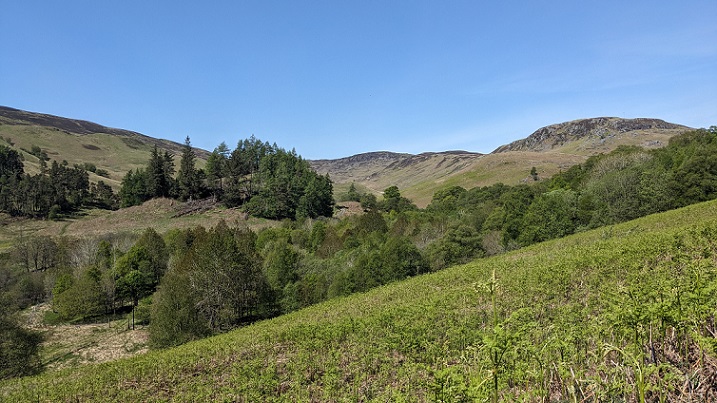
On Thursday Oxygen Conservation announced (see here) that they have been awarded £3.3m in forestry grants to plant a large chunk of the Invergeldie Estate north of Comrie. So far Scottish Forestry do not appear to have issued any news release explaining why they have awarded such an enormous sum to business which describes itself as “unashamedly capitalist” (see here). Perhaps that was because last week, on 28th and 29th January, Scottish Forestry were busy in Court trying to explain why they had decided no Environmental Impact Assessment was required before deciding to plant Todrig in the Borders?
Scottish Forestry have, however, provided me with a copy of their contract with Oxygen Conservation in response to an FOI request I submitted at the start of January. (I am very grateful to the staff who yesterday re-sent me a copy after the original disappeared into cloud from the Scottish Government’s automated FOI response system).
The contract contains detailed information about what what has been agreed, against which the claims in the news release made by OC and their developer, TreeStory, can be evaluated. I will consider what is going on in two posts, the first of which will focus on money.
The £3.332,318 forestry grant
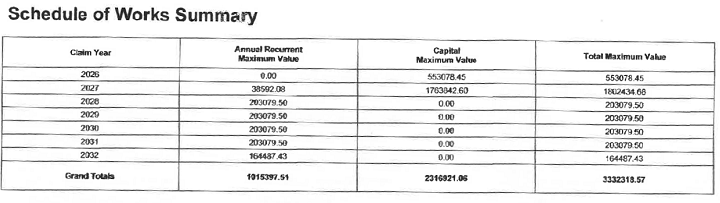
The forestry grant is significantly more than the c£2.4m Scottish Forestry awarded to BrewDog for their disastrous Lost Forest, a significant proportion of which was unspent. Ironically, that now appears to have been transferred to OC who bought the Kinrara Estate last year (see here).
£2,316,920, or over 2/3 of the grant, is for standard “capital” items, payable this year and next: deer fencing and gates; vole guards; the costs of buying trees and planting them.
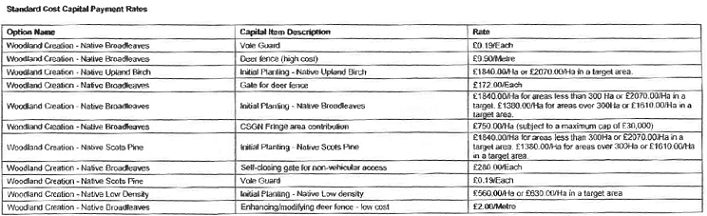
In their news item, OC claimed “Tree planting will start in spring 2026, continuing over multiple seasons to ensure quality, resilience and long-term success”. This is misleading. The vast majority of the trees will be planted in the next 18 months, with most planting after that to replace trees which have died and prevent Scottish Forestry’ reclaiming any grant under the terms of the contract. There are no payments in the contract for natural regeneration, which would enable a more varied woodland structure to develop. What Scottish Forestry has paid for is another large native woodland plantation and the contract shows the majority of trees will be planted on “inverted” mounds.
OC’s news release also claims:
“Invergeldie demonstrates how aligned private investment and public funding through the Forestry Grant Scheme can unlock high-quality woodland creation at a scale capable of strengthening ecological resilience across entire landscape systems. This model is underpinned by Oxygen Conservation’s commitment of over £4 million of private capital over the next two years, alongside robust regulatory approval and access to natural capital markets.”
OC has provided no explanation for how the £4m in private capital will be spent. The contract states the total area that will be planted is 1020 ha of which 925 ha will be funded by Scottish Forestry. That leaves 95 ha, about 10% of the total, to be fully “self-funded”. This area comprises “lower density higher altitude” planting and “silvopastural” planting at 50 stems per ha, compared to the 1,600 – 1,800 stems per ha being paid for by Scottish Forestry. This self-funded planting is likely to cost only a small part of the £4m OC are claiming to invest. General forestry costs, however, have increased and are now more than what is offered in grant (e.g deer fencing costs more than the £9.90 per metre offered by Scottish Forestry). It seems unlikely, however, that OC would need to spend double the £3.3m offered by Scottish Forestry to get the new plantation established, so perhaps they are investing some of their £4m into some other form of “nature restoration”?
[This is the paragraph that has been updated and corrected]
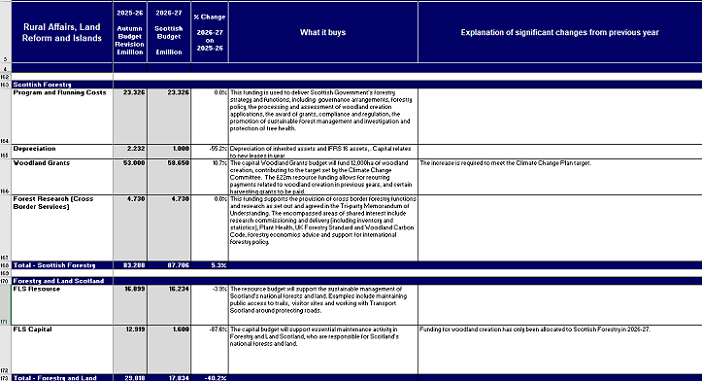
Taken together with their other planting projects, like Dorback in the Cairngorms National Park, it appears possible that OC could receive 10% or more of the £53m the Scottish Government has allocated to forestry grants for the next financial year.
Scottish Forestry’s grant award in context
 OC’s land purchasing and planting spree has been good news for Scottish Forestry, who have struggled to spend grant allocations and meet planting targets, but it raises important new questions about how the Scottish Government is now using money for woodland creation.
In the 2026/27 Scottish budget money for “woodland” grants has been increased by 10.8% to £58.650m following a 16.8% increase for the current year to £53m. Meantime, the capital budget for Forest and Land Scotland (FLS) has been reduced by 87.6% with no money for new woodland creation. That follows a 22.7% capital reduction, from £15m to £11.6m, for the current year and further cuts before that. On top of that is a 3.9% cut in revenue funding. Effectively, money is being transferred from the National Forest Estate to the private sector and responsibility for woodland creation further outsourced.
This budget re-allocation has serious consequences for:
- Deer Management. FLS own about 8% of the land in Scotland FLS and in 2023/24 was responsible for culling 42,500 deer, about a third of the total culled in Scotland. FLS have been aiming for a deer density of 2-3 per square km (see here) which would allow woodland to regenerate naturally. That is all now at risk. Private woodland owners, financed by the Woodland Grants Scheme, are required to cull far fewer deer proportionately. In the case of Invergeldie, Scottish Forestry’s contract states OC are aiming for 8 deer sq km outside the new fenced enclosures.
- Outdoor recreation. FLS have already cut their spending on outdoor recreational infrastructure and management to the bone. That now looks set to get even worse, undermining the public’s ability to exercise and enjoy access rights.
- Conservation management. Since Scottish Ministers spent £17,555,000 buying Glen Prosen in the Cairngorms National Park there has been no money to manage it (see here). Shortage of money has affected FLS’ ability to manage other land, held for conservation purposes, including a significant number of the 84 woods on the Caledonian Pinewood Inventory. Problems on these sites, such as FLS’ failure to remove invasive Sitka,are now likely to get worse.
Who will the £3.3m grant benefit?
While ‘Oxygen Conservation’ is used to cover the group of companies owned by Oxygen House, the company of that name is now effectively the management arm for the “nature conservation” side of the group of businesses. The landholdings that Oxygen Conservation manages are now all owned by other companies in the Oxygen House group.
The Invergeldie Estate at Glen Lednock is owned by a company called Invergeldie Conservation Ltd (IC Ltd) which was incorporated on 17th May 2022, i.e at the time it was purchased, with share capital of just £1 (see here). IC Ltd is now owned by Oxygen Conservation Holdings 1 Ltd, incorporated in November 2022, which in turn is owned by Oxygen Conservation Portfolio 1, whose parent company is Oxygen House Ltd. This complex company structure makes it very difficult to follow how money is being moved around the group.
The last accounts for IC Ltd, for the calendar year to 31st December 2024, show it had £19.5m in fixed assets, mainly represented by the land it had purchased, out of total assets of £21,749,028 but owed creditors over over £25m.
The accounts show Triodos Bank partly funded the purchase, lending c£11,800,000. It appears that the remaining £7.5m or so of the purchase price for the land plus the initial set up costs were financed through other companies in the OC group who were owed £12,707,430:
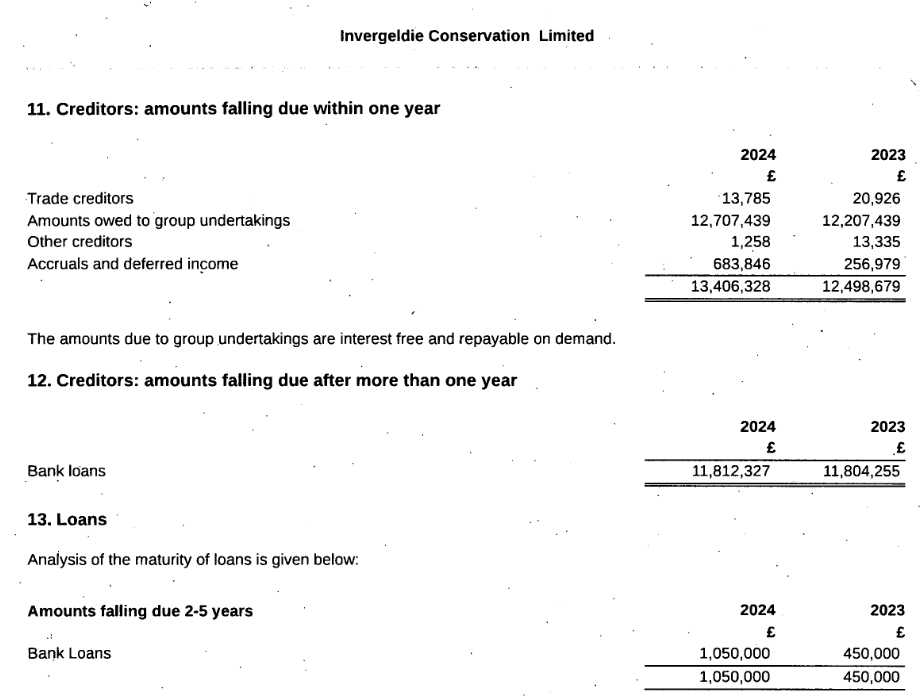
The important point to note about the £12,707,430 lent by other OC companies is that it was all repayable within a year, i.e by December 2025. IC Ltd was therefore technically insolvent from the start but was nevertheless reported as a Going Concern in the accounts because the ultimate parent company, Oxygen House, agreed to keep it going for another year (at what cost in terms of interest is not explained):
 The net liabilities of the IC Ltd raise questions about the £4m OC stated in their news release they are going to invest over the next two years will come from? If the money does materialise, it appears likely to be in form of more loans. That will add to the amount of income IC Ltd needs to generate just to stay afloat as investors will not lend money interest free for long. Add the £4m to the £25m already owned, then interest at even 5% comes to c£1,380,000 before any capital is repaid..
OC’s original intention appears to have been to pay back these loans through a combination of renewable energy developments (Oxygen House by my counts is parent of at least 20 solar power companies) and sale of carbon credits, including what are called Pending Issuance Units. Those plans at Invergeldie suffered a major setback at the start of January when Perth and Kinross Council unanimously agreed to object to the proposed windfarm (see here).
Without windfarm income, it appears the only way IC Ltd will be able to repay its loans is through sale of carbon credits and for that to work there needs to be a significant increase in current market prices. That may help explain why Richie Stockdale, the OC CEO, was featured in the Guardian just before Xmas as claiming OC is all about “premium carbon credits” (see here). Hence too why OC are trying to claim what they are doing through the use of standard Scottish Forestry grants at Invergeldie is somehow qualitatively different to what others, like BrewDog and Abrdn, have done with those same grants:
“This approval marks a defining moment not just for Invergeldie, but for the development of the UK woodland carbon market. It signals a shift from ambition to execution, where significant volumes of private capital and public funding are now being deployed to deliver premium-quality, high-integrity carbon credits at a landscape scale. With delivery now underway, Invergeldie demonstrates what is possible when rigorous design and long-term private investment are brought together to meet the climate and nature challenge at the scale it demands.”
(Chris Winter, Director of Natural Capital, of Oxygen Conservation – news release)
This appears to be all about talking up carbon markets while concealing the extent to which OC’s business model depends on public sector grants. (Another FOI response has recently revealed the Cairngorms National Park Authority have awarded over £250k to OC for Peatland restoration at Dorback).
If OC really had £4m to invest in “premium-quality, high-integrity carbon credits” through planting, why didn’t Scottish Forestry just let them get on with it and award the £3.3m to others?
While Scottish Ministers belief in what Richie Stockdale calls “regenerative capitalism” is apparently increasing, informed criticism is growing. Highly recommended (it mentions Parkswatch) is a recent post by Peter Smith, ‘The Offset Trap: Why UK Nature is Losing to Private Equity’ (see here):
“Summary
A growing body of evidence suggests that the current model of “Green Finance”—specifically Carbon Offsetting and Biodiversity Net Gain (BNG)—is actively harming the UK’s ecological recovery. Rather than funding nature, these markets have commodified it, creating a “Green Rush” that has inflated land prices beyond the reach of conservation charities. Furthermore, the pressure to deliver quantified “units” of carbon or biodiversity has led to ecologically naive management practices, such as planting trees on deep peat and other carbon-rich soils, which releases more carbon than it saves. The stark reality is that high land values, poor standards, and “carbon tunnel vision” are facilitating environmental degradation.”
My next post on Invergeldie will consider the extent to which Scottish Forestry’s contract with OC is about “ecologically naive management practices” (Peter Smith’s words) or “restoring native woodland in a way that strengthens ecological networks, expands and connects habitats, and creates the conditions for wildlife to thrive, from woodland plants and fungi to birds, insects and mammals” (TreeStory’s words)..

Whether it is ferries on the water or trees on the land the present Scottish Government has lost its compass. Value for public money spent is an alien concept for today’s ministers. The first task for the MSPs elected next May is to scrap the forestry grant system. No politician can continue to defend this gravy train whose main financial beneficiaries live in far away places.
Could the £4 million ‘contribution’ from OC be connecting to the cost of buying the land?
I think it really reflects badly on the government that despite all the evidence they have not required at least some of the area is naturally regenerated? Native woodland plantations such as this are poor mimics of a natural woodland and it is quite ridiculous to claim that you can ‘create’ a woodland of this size through planting seedlings on mounds in 18 months.
At the end of the day its all about the money and government targets.
This is a bit depressing.We have been through all this before– remember the planting schemes in the northern peatlands that had to be halted. I recall the RSPB telling me how they had a two hour meeting with the “investors” behind it and all they could talk about was their investment – the word tree did not pass their lips once in that two hours!
I visited sites of two neighboring farms – or now exfarms – quite near my home in Alford that had been bought for replanting. These farms are bought at well above the market price of land for farming. On site you discover the old traditional right of way connecting communities on either side of the hill and giving good access to the hill for walkers has been blocked off. One whole form from the top of the hill to base has been deerfenced in an area where there are no red deer. When the folk on site are asked what for they say it is to keep roe deer out. How do they know there are not roe deer within the area the fenced? Oh they went through and drove them out. Anyone who knows roe deer knows how they can simply duck down and conceal them selves within a few meters of you as you pass. I think they may h ave just fenced in a population.They also have planted right down over the arable land at the foot of the hill. One timber merchant has already said to me he would be unlikely to purchase timber grown soft and sappsy on such fertile ground. There is also the issue of food security in an increasingly uncertain world given climate change etc. Should we be planting on arable ground at all?
You are right Drennan. One of the best areas of improved pasture at Invergeldie, which was the keystone component for upland farming for generations in the Glen, is also going to be planted up. In terms of access, I have experienced the same where I live with woodland creation fences now blocking pre-existing access routes. It seems the consultation process around access is cleverly designed to be ineffective, with little or no outreach to the public. Main consultees seem to be organisations and groups connected to local councils which are hopelessly overstretched and have almost zero capacity to consult with the community. Why don’t Scottish Forestry use 21st century communications to alert people about up and coming woodland proposals so that walkers like myself can contribute to better design?
This illustrates the unshakeable belief of many that trees are always good for the planet. Evidence is not relevant…