In Scotland we need to restore our native woodland cover. The Government agrees and wants to see 18,000 ha of new woodland created per annum, primarily through native woodland expansion.
Not especially ambitious for an emergency, but perhaps overly ambitious for our antiquated grant system which has, except for the year 2023/24, delivered less than 10,000 ha of new woodland per annum in the past two decade: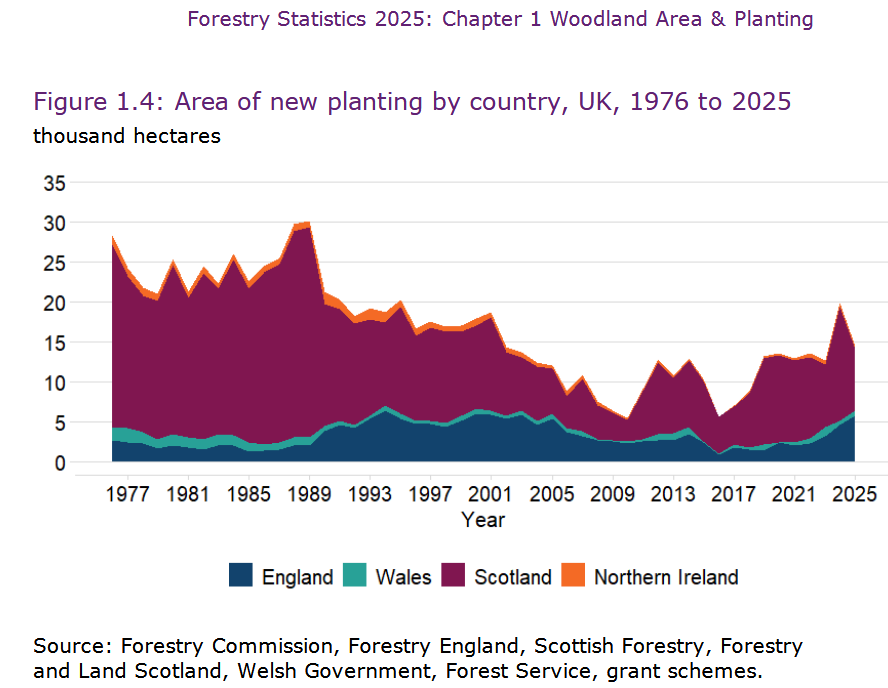
To achieve more ambitious targets we need to incentivise deer management.
eer and woodland expansion are intimately connected. Most woodland creation schemes are essentially plantations with ground cultivation and trees planted behind a 2m wall of steel fencing.
An expensive business model which blots the landscape, kills black grouse, and destroys the right to roam. Fencing also creates an unnatural ‘plantation’ woodland, devoid of montane scrub or habitat mosaics and concentrates deer in even greater numbers on the excluded land.
Deer control would be much better for nature, but is rarely used in the Scottish context because neighbouring land is managed for deer stalking and owners want high densities to improve the chances of a successful day on the hill (while supporting higher sporting land values thanks very much).
Sporting estates and woodland creation can coexist, but policy makers must stop hiding behind fences and create more supportive policy instruments.
My suggestion is simple: create a new designation that curates grant aid more cost-effectively: ‘Woodland Restoration Zones’ (WRZ).
All landowners in a WRZ wishing to create woodland can only attract grant aid if they protect trees by hunting. WRZs might consist of 5-15 landholdings in areas where there is already a high concentration of woodland. Overtime these areas could then be enlarged to form a focus for woodland expansion at scale.
Costs saved on fencing could be diverted into annual deer management:
- ‘Boots on the ground’ daily
- Permanent employment of stalkers/rangers
- Revenues and fees from venison and hunting
- Government grants levered in to support venison processing.
Adopting the WRZ approach would be transformative:
- Eradicate fencing (avoiding unnatural boundaries and grouse fatalities)
- Create more natural woodlands
- Reduce private and public costs of woodland creation per hectare
- Greatly accelerate the rate of woodland expansion
- Reduce deer pressure on adjacent owners
As an example, here is how it might work in Strathearn, where 3 large new woodlands are currently planned under the existing regime (including one by the “unashamedly capitalist” Oxygen Conservation (see here)):
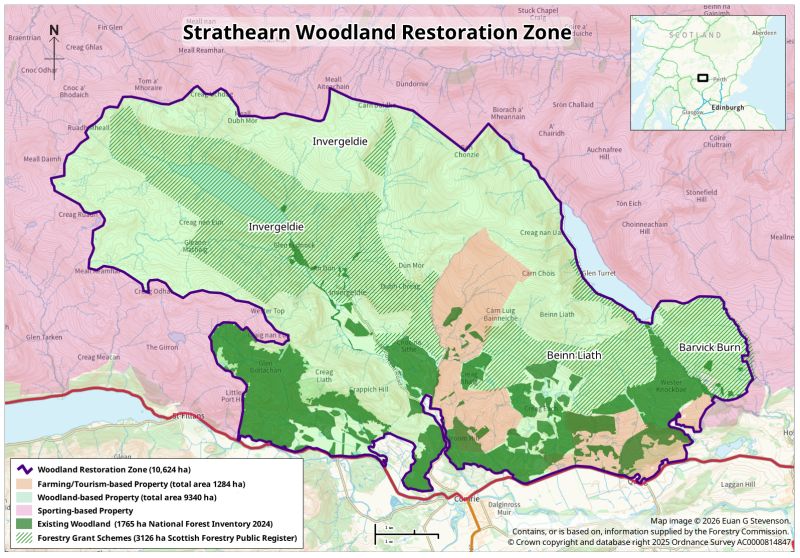
Current Regime V Woodland Restoration Zone
Woodland Created ~ 3126ha V 9340ha
Fencing ~ 65,000 metres V 0 metres
Grant aid ~ £2600/ha V £1200/ha
Surely this is a win-win that only requires some gumption from Scottish Forestry and NatureScot. A tall order you mutter, but this is an emergency is it not?
[This post was first published on Dougie MacMillan’s Linked In page]

Douglas…… your article might be more persuasive if you set out the workings on your costings For a scheme of that size, there is no way would the average fencing cost be £1400 for every ha enclosed. (I am assuming the difference between £2600 and £1200 is your claimed fence saving, and the £1200 is the cost of grounds preps/ planting/project development etc). It is also the case that if you are claiming that deer control should be supported, then you need to factor in the cost of that control over 20 years or so. Why dont you set out your costs in a way that might be persuasive to people like me? FYI, I think that there are places where deer control does make more sense, but there is a net cost associated with that. My own view is that the costs of fencing and deer control are actually very similar, it is just that they are structured in very different ways and over difference timelines. On your question, “This is an emergency is it not?” I am afraid the evidence is that it is not an emergency. If something is an emergency, then you have to act on it right away. You cannot hold people in a state of emergency for 5-6+ years on the promise you will do something to address it tomorrow. It appears to me that the emergency tag is shallow and superficial, just words, and all the evidence we have before us reinforces that point. If government really regarded this as an emergency, you would see a level of funding that was an order of magnitude greater than we have at present. Part of that might be used for fencing/ planting, part for deer control, depending on local risk assessment.
Sorry Victor… it is not correct to assume the fencing cost is £1400 per hectare. The figures I show are the average grant paid per hectare for planting trees under the FGS across the entire landscape defined by the ownership boundaries v the cost per hectare just for the plantation area as defined by the fence line. You are right to say the costs of fencing and of deer control will vary depending on site and local context but if one were to look nationally under the WRZ approach there would be significant costs savings to government, more full time local employment and more income from a deer control approach.
Yes I would agree that the savings here – and they are substantial should definitely be passed onto incentivise deer control. Would be interested in your thoughts about how those incentives should be designed? Payment per animal (bounty approach); support for venison production, training of community hunters ? Or all three?
The cost of deer fencing to the public purse is a scandal, and completely avoidable.
Two further points to throw into the mix:
1. Instead of the default position of ‘removing’ wildlife to achieve an objective – deer, foxes, stoats etc – why not open our minds to the natural processes brought about by apex predators – adding to the complexity of the system rather than continually simplifying it?
2. Deer aren’t the only large herbivore impacting on woodland expansion.
I agree that we should be working towards more complex systems, but deer pressures are so high the only way to bring numbers down is to shoot. Deer numbers are so high because of humans. In the future wolves and lynx can play a part in maintaining nature’s balance but alone they cannot bring numbers down to the critical threshold we need.
Fencing will be no help with reintroductions – a patchwork of enclosed woodlands is no environment for apex predators. My view is clear – anyone who supports fencing to create native woodlands is working against nature and working against the day wolves and lynx can be brought back to this country.
We do not need any new designations. A political commitment, from all those who aspire to be elected to the Scottish Parliament next May, will be sufficient – the new Scottish Government should announce that compulsory deer control powers, as provided for 30 years ago in the Deer (Scotland) Act 1996, will at long last be applied to Balmoral estate. Only when the ancient Caledonian pinewood of Ballochbuie starts to spread uphill, by natural regeneration, without deer fencing, will King Charles be able to demonstrate that, on his own land, he is living in “harmony” with nature. That would be worth another TV programme and might help to convince the rest of the landowning lairds that Queen Victoria is no longer on the throne. Or a community led compulsory purchase of Balmoral, using the powers contained within the Land Reform (Scotland) Act 2016, might be the answer. The castle could be excluded from the purchase, leaving King Charles to regularly survey the native woodland expanding steadily up the slopes of far away Lochnagar. But at the same time his environmental reputation will be melting faster than spring snow on a dyke.
Seriously, do you think this could ever happen Dave? You have met the King on a number of occasions so maybe have insight into his thinking? One would hope that his pro-environment views might just lead to some meaningful action on the ground.
The only problem with this approach is that most Scottish woodland declined naturally, and there is no nature conservation for restoration at a large scale. Scotland is internationally important for its temperate mooraland…
I dont believe that there is a CHEAPER means of extending our woodland area, but deer control may be BETTER in many circumstances, depending on your risk assessment. The way to test it would be to increase regeneration grants so that they are the equivalent of planting grants, or pro rata if a lesser tree density is required, and then people will very quickly work out what works best for them. Fencing will be an option for many people, and people with smaller properties may have no other realistic choice. Fencing is NOT a scandal, it is just a tool, but there are two things working against it now, (1) It is becoming too expensive, (2) The life expectancy of fencing is going down, often less than 10 years now. No-one can justify paying > £20/ metre and the fence only lasting 1/3 of the time you need it to. If deer control is the way ahead, people need long term commitment to support, probably for at least 20 years. If government are not willing to do that, then they cannot pass comment on results is they are disappointing. For context, by fencing or no, woodland creation levels in Scotland are still at historic lows. Even the English are starting to catch up with us now. Can you imagine the embarrassment there will be the year they overtake us in our efforts? If we want to do better, we need to support appropriate action, not just assume that it will happen. I personally am not optimistic about this. I see little evidence that our Scottish Government is interested in the environment, and I see little interest from opposition parties either. It is however important to have discussions like this and build the case for better support mechanisms.
Agreed!