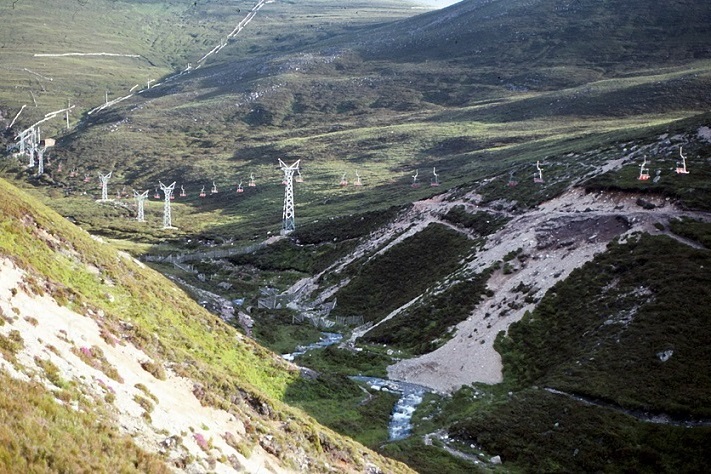
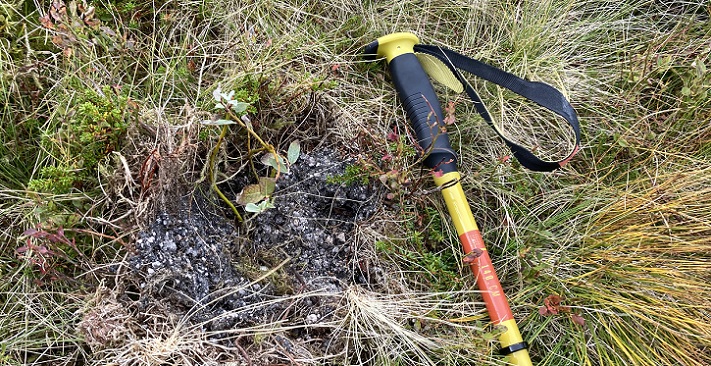
The BBC Scotland Outdoors radio programme broadcast from Cairn Gorm on 17th January (see here) included a piece on the montane planting project in Coire na Ciste. You would not know from listening to it on BBC sounds (here between 48-54 minutes) that there had been any controversy about the project, both because the Caledonian Pinewood in Glenmore has been regenerating naturally up into Coire na Ciste (see here) and because there is no evidence that the number and combination of willow species planted would ever occur naturally in this location (see here).
Asked by Mark Stephen from the BBC “What’s the point of this”?, David Hetherington, from the Cairngorms National Park Authority (CNPA), explained that they had been looking at South West Norway where there is pronounced altitudinal zoning of trees: a zone dominated by Scots Pine up to about 900m; then a zone of downy birch; and above that a zone dominated by willow scrub.
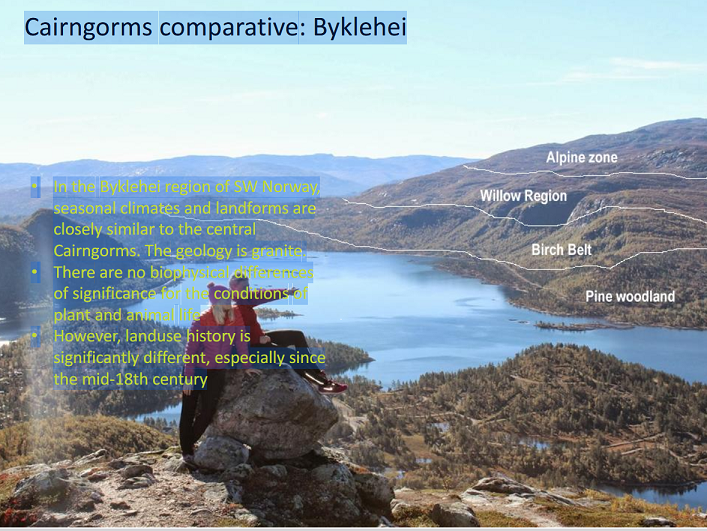
It appears that the CNPA and the Spey Catchment Initiative, whom they grant aided to carry out the planting of the 30,000 trees, were trying to create in Scotland what is now found in South West Norway. What they ignored is that much of Norway was as treeless as Scotland 200 years ago and almost all the woodland expansion there has been through natural regeneration, as Duncan Halley, from the Norwegian Institute of Nature Research, pointed out in his interesting presentation to Cairngorm Connect (see here).
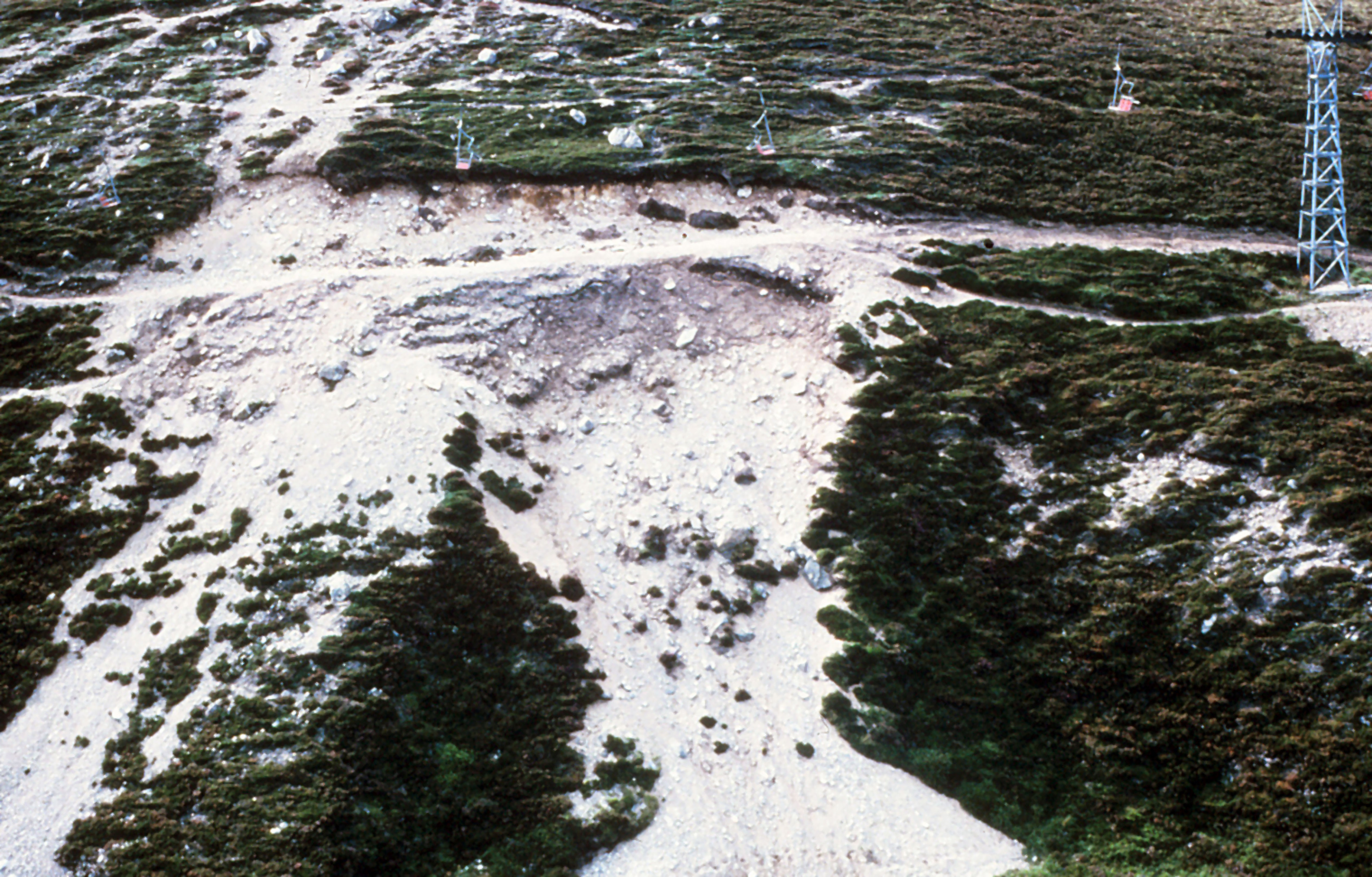
Forty five years after Adam Watson documented the impact that ski infrastructure had had on Coire na Ciste, the natural environment there is in a far better state. Part of that improvement is due to restoration work prompted by Adam’s work and some, however imperfect, resulted from the removal of the West Wall chairlift from Coire na Ciste in 2017 (see here).
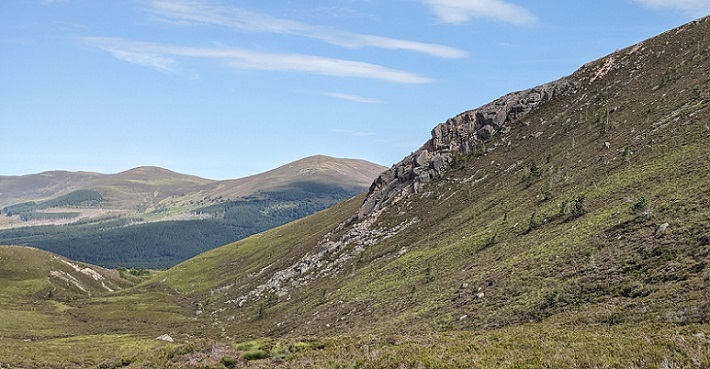
As significant, however, in my view is that vegetation in Coire na Ciste is now recovering naturally, gradually colonising and covering up the erosion scars caused by human activity, while Scots Pine from the Caledonian Pinewood in Glen More below have been spreading up the hill. I must go back to Coire na Ciste, try to replicate the views in Adam Watson’s photos and count how many trees there are now.
David Hetherington acknowledged some of the changes in his interview. He described the Scots Pine zone in Coire na Ciste as “truncated”, i.e lower than it would be in Norway, but stated that Scots Pine has been slowly spreading up the hill because deer numbers had been low for quite some time.
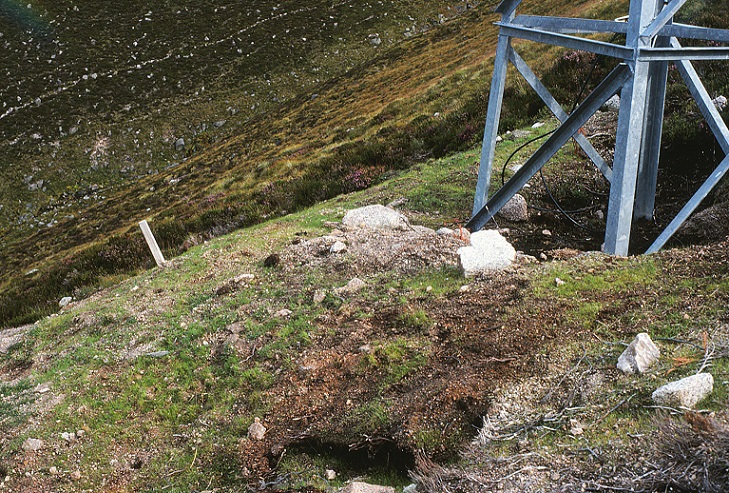
While the reduction of grazing by large herbivores is key to understanding the regeneration in Coire na Ciste, it appears likely that it was the removal of the sheep, which used to put out to graze on Cairn Gorm every summer, which triggered the recovery. While culls by Forest and Land Scotland in Glen More may have reduced the number of deer venturing up the hill, disturbance by humans who have been flocking to Cairn Gorm for well over 50 years has probably been the more important factor.
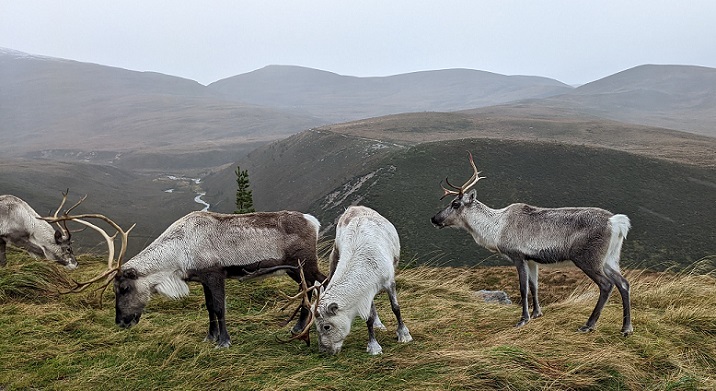
Reindeer, like sheep, are much tamer than red deer and might, as David Hetherington acknowledged, enjoy browsing the newly planted trees. Unfortunately, there appears to have been no assessment of the extent of grazing, if any, by reindeer in Coire na Ciste before the 30,000 trees were planted or the risks of them being eaten. Four years ago the reindeer were allowed to wander over into the Loch Avon basin where they ate many of the trees the RSPB had planted there (see here).
The planting of deciduous trees in the Scots Pine zone
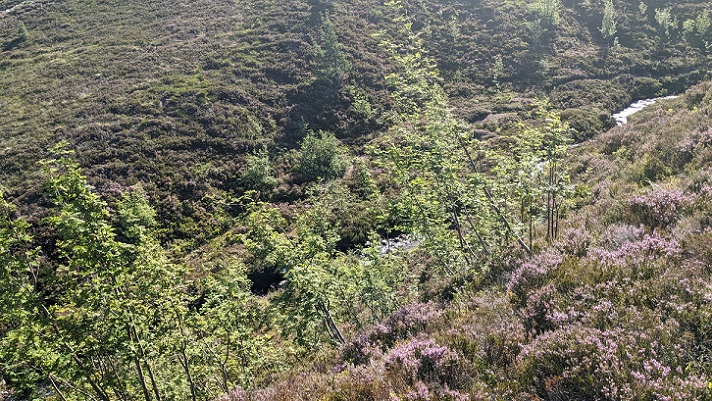
Conservation organisations have, for at least 15 years, been expressing concerns that the surviving fragements of Caledonian Pinewood contain only a limited number of other tree species. There is now research claiming that planting of deciduous trees in pinewoods is necessary to restore “biodiversity”, for example.(see here):
“Instead, active intervention, such as keystone species (re)introduction and tree planting, is needed to restore ecological processes and trigger ecological reorganisation (Sandom & Macdonald, 2015). This landscape-scale interpretation is supported by 30 years of evidence from the Cairngorms Connect partnership—also in the Scottish Highlands—showing woodland expansion in the presence of heavy deer culling for some tree species (Gullett et al., 2023).”
That conservation mindset may help explain why so many of the 30,000 trees the Spey Catchment Initiative and CNPA planted were in the Scots Pine “zone” and despite the evidence that deciduous trees were also slowly creeping up the hill. From the planting plans it appears likely there are now MORE planted deciduous trees in the Scots Pine zone than there are Scots Pine.
In January, important new research, led by the James Hutton Institute but including authors from the RSPB, Woodland Trust and Royal Botanic Gardens of Edinburgh, was published on “Does greater tree species diversity enhance the resilience of associated biodiversity and ecosystem functioning in Pinus sylvestris forests?” (see here). The research was designed, “given the rapid rise in tree pests and pathogens and policies”, to find out “if increased tree species diversity will provide enhanced resilience for associated biodiversity.” The authors have produced a complete list of species that use Scots Pine (Pinus Sylvestris) “for either feeding or living in/on in the UK” (see here). The total comes to 1589 species.
The researchers then assessed forty-seven other tree species “for their suitability to support these P. sylvestris associated species”. They found “the maximum percentage of non-obligate species (i.e those that are not dependant on a symbiotic relationship with Scots Pine) that could be hosted by any other alternative tree species was 15 %”. They also fund that 11 % of species found on Scots Pine “used only one other tree species” and no less than 23 tree species would be required to support just 41 % of species associated with Scots Pine.
What the research tells us is that planting other species of tree will do little to protect the biodiversity associated with the Caledonian Pinewoods because the vast majority are almost entirely dependant on Scots Pine. The implications are far reaching. If we acknowledge that the primary value of the Caledonian Pinewood remnants lie in their Scot Pine, then there is little justification for claiming that they are degraded and need to be restored.because most of them lack many other tree species. What matters is whether the Scots Pine is regenerating, as in Coire na Ciste. Moreover, the research suggests that those who are trying to justify the planting of deciduous trees in or around the 84 sites listed on the Caledonian Pinewood Inventory (see here), are actually trying to change what is valuable about them into something else.
The overriding importance of Scots Pine for the Caledonian Pinewood – the clue is in the name – fits with what I have observed the last few years, most recently at Coille Coire Chuilc (see here). Its Scots Pine which are the great survivors, the reason why the natural history of the Caledonian Pinewoods goes back thousands of years and the reason why these woods are so important. The presence of other tree species is, by comparison, unimportant and their absence does not justify planting in any Scots Pine “zone”. By wrongly making claims about the alleged biodiversity benefits of other trees, conservation organisations have been diverting attention from what is important, creating the conditions where Scots Pine can regenerate naturally. Enable that – as happened accidentally at Coire na Ciste until the recent planting – and other species of tree will also over time spread naturally as they have done in Norway.
The BBC covered the publication of the research (see here) and, having shown they did not understand the difference between a plantation and a Caledonian Pinewood, managed to turn it into a justification for planting trees! There is a series of interesting and critical comments on the article, which are worth reading, one of which I particularly liked:
“Can’t believe how long they must have taken to plant the Amazon rainforest” .
Recent research on montane woodland
January 2026 also saw the publication of important research (see here)on montane woodland by Sarah Watts, who convenes the Mountain Woodland Action Group (MWAG) and is conservation manager at the Corrour Estate. The research monitored three plots of (unfenced) dwarf birch (Betula nana) planted at Corrour, Glen Finglas and Ben Lawers over a six period. It found that:
“With red deer densities above three per km², the research found dwarf birch planted in grassland and heath habitats suffered increased mortality linked to substantially more browsing – where deer feed on woody vegetation such as leaves, twigs, and buds. In contrast, the trees in blanket bogs were browsed less and experienced far higher survival rates”.
“However, at lower deer densities, without the pressure of overgrazing, dwarf birch survival was similar across all three habitats – with some growth measurements better in the grass and heath than in bogs.”
“These findings show that blanket bog is a refuge where populations of dwarf birch have escaped overgrazing, rather than providing the ideal conditions for planting and restoration action.
“This means that Scotland’s lost mountain woodlands can return more widely if deer densities are reduced.”
“National deer density targets are currently set at 10 per km² across open range areas of the Highlands, but numbers vary locally from below one to over 64 per km². These figures are too high for the restoration of sensitive upland habitats such as woodlands and scrub.”
This is consistent with what I have been arguing, based on research conducted 40 years ago, that deer densities of 2 per km or less are generally necessary for woodland to regenerate in upland areas. It is very good to see a prominent ecologist, like Sarah Watts, stating this publicly. Also to see the Corrour Estate implementing her findings by reducing deer density from c15 per km to less than 3 per km now (see here)..
By contrast, the CNPA’s National Partnership Plan has a target average deer density of 6 per square km on the open hill. This is far too high for any montane woodland to develop and despite the recommendation of the Deer Working Group’s (paragraph 52) that:
“the Cairngorms National Park Authority and Scottish Natural Heritage should have a much greater focus on the need to improve the management of wild deer in the Cairngorms National Park, to reduce deer densities in many parts of the Park to protect and enhance the Park’s biodiversity”.
Instead of reducing deer numbers to enable nature to restore itself across the National Park (see here), which would mean challenging the traditional stalking estates (and ensuring the reindeer herd is properly controlled when on the open hill), the CNPA has decided it too should fund “restorative” tree planting (as NatureScot and Scottish Forestry already do). There are very few places in the Cairngorms, outside of the estates involved in Cairngorms Connect and Mar Lodge, where they could have planted montane trees without deer fencing or without risking the trees being incinerated by muirburn. Hence the planting proposal for Coire na Ciste.
Conservationists and tree planting
I have great respect for David Hetherington’s work on reintroducing beavers and lynx while, as Dave Morris pointed out (see here), as recently as August 2018 he published an article explaining the importance of natural regeneration in expanding the existing remnants of the Old Caledonian pine forests in the Cairngorms. I have no idea whether organisational or cultural pressures caused him to change his position and support the planting in Coire na Ciste, but I hope that the research described above will cause him – and the other ecologists who support tree planting – to think again.
The best practice advice on the MWAG website, which dates back to 2010 (see here), remains relevant:
“From an ecological perspective, allowing woodlands to regenerate naturally is the preferred option. Planting new trees may be quicker, but there’s a risk of our interventions producing something different from what would occur naturally.”
Or how about this from Sarah Watts:
“Any planting in novel locations must be justified by evidence that such management is appropriate and worthwhile. Otherwise, large-scale action in unsuitable or marginal sites could fail entirely, or create unhealthy populations with negative implications for soil carbon-nutrient dynamics, open ground species, and the spread of pests and pathogens (Watts, 2024).
The climate and nature crises are now being used to justify ignoring such recommendations, as with the planting in Coire na Ciste, on the basis that natural regeneration takes too long or is “impossible” because there is no seed source. To which, the response should be, yes there is a crisis which is why we need to dramatically reduce deer numbers across Scotland and then let nature take its course.
Unfortunately, the Natural Environment Scotland Bill, which was passed by the Scottish Parliament last week (see here), creates yet more bureaucracy around the management of deer which will be used by traditional stalking estates to prevent any meaningful reduction in deer numbers. Another massive opportunity missed. The consequences are likely to be more of the same: large amounts of public money wasted on ineffective deer fencing and planting to “save” Scotland’s rainforests, Caledonian Pinewood remnants and “river woods”; more planting of commercial conifers on peat to meet forestry targets; even aged plantations not woodland; industrial rather than continuous cover forestry; etc etc.
By paying for the planting of Coire na Ciste, the CNPA – which as a National Park should be leading on conservation – has helped legitimise the whole rotten system. They are not alone, as I will show in future posts.

One of the first things I remember being taught as a forestry student in the late 1980s by Douglas Malcolm was that Scots Pine forests were not just composed of Scots Pine trees, but that a mixture of other species would naturally be present as well. Most of our upland landscapes are very diverse in terms of topography, soil depth, water availability and all sorts of little micro- niches, and we might expect some species to out compete others in some areas, and the reverse maybe just a few tens of metres away. One of the reasons many of our east coast pinewoods “just” have Scots Pine is that pine lives much longer than the broadleaved components, so that if an area has had no regeneration for 200 years, you can have a pine seed source still left, but the birch/ rowan/ willow etc will have all died out, simply because they cannot live that long. We also have to accept that in a natural situation, it is pioneer species such as birch and willow that will spread on to open ground first, and pine will arrive at some point after that. Native broadleaves therefore allow your regenerating forest to spread more quickly. They also draw browsing pressure away from more vulnerable species like Scots Pine which then have a better chance of survival if growing in mixture. Native broadleaves are also much better at promoting nutrient cycling in the soil. which is good for the forest as a whole, including the Scots Pine, which does not itself deliver this function. As a woodland advisor with a particular interest in pine forests, I have gradually become aware that birch in particular is the foundation stone of just about every other woodland type, including oak woodlands in the west. I dont know anything about Corrie na Ciste or the politics of it, but in general terms, we should be encouraging debate on HOW to do things. Pass comment on what others are doing, yes, particularly those in authority, but not to the extent that any discussion is then closed down. Putting things in a box and saying that such and such an area SHOULD be one thing or the other is counter productive. Regenerating woodlands will reflect the seed source available, and their composition will change over time. But stepping back from things, it is the broadleaved species which are the real pioneers, and their presence will facilitate other species, Scots Pine included. All of our forests would naturally be a mixture of species, but with one species or another being dominant in different areas, but never in a monoculture. The JHI study is being interpreted incorrectly here. Scots Pine is important to the species which are dependent on it, but not every tree has to be a Scots Pine, and you will have a much better woodland in the longer term if this is not the case.
Thanks Victor and sorry if I have not been clear enough. I was not trying to argue that the Caledonian Pine Forest is only composed or important for Scots Pine – actually one of the striking differences between the Caledonian Pine Forest remnants and Scots Pine plantations planted for commercial purposes, windbreaks etc is the former have far greater diversity of tree species. What I was arguing against, however, was the view that as a result of a “lack” of broadleaves, it is justified on biodiversity grounds to plant them in areas where Caledonian Pine forest remnants are expanding naturally – as the Pinewood in Glen More is doing up into Coire na Ciste. That mindset has resulted in the extensive planting of Coire na Ciste and, as Andy Amphlett showed in his post, a combination of willows never before recorded in Scotland. That mindset imposes a human vision of what nature should look like and if it works in Coire na Ciste will create what is in effect a mountain garden rather than leaving it to natural processes. There are of course multiple visions of what these garden forests should look like. The importance of the latest research on species associated with Scots Pine in my view is it shows the biodiversity arguments for planting broadleaves to enhance the Caledonian Pine Forest are not very strong. In the case of Coire na Ciste I believe if it had been left to natural processes, broadleaves would have come with time and we should not be worrying about exactly what and when.
I completely accept that birch and willow can have an important role as a pioneer species in many places and the benefits you outline. However, the fact that Scots Pine have been expanding up into Coire na Ciste without them either birch or willow getting established shows that is not always the case. In my view that should be seen of value rather than being a “biodiversity gap” which needs remedied. If the CNPA wanted to spend money on Coire na Ciste it would have been far better spending money on research – monitoring what was happening in the coire – rather than jumping in to plant trees because of the biodiversity crisis.
Lastly, on your point on the need for debate, there was very little consultation on the planting of Coire na Ciste or indeed many of the other disastrous planting schemes that I have highlighted. By criticising what is going on I am not trying to close down debate – I couldn’t I have no power or authority – but open it up. Your contribution therefore is very welcome. It will be interesting to see if others involved in conservation respond!
Both of you make valid points, but I think the balance of the argument is in favour of Victor, especially in regard to broadleaves upgrading the soil-site conditions.
We are not asking trees to establish in natural conditions, but in a semi-industrialized cultural landscape where conditions are not the same as at the time of primary colonization. In the end the trees will tell us where they are going to grow.
You seem to miss (or misrepresent) an important point about the James Hutton Institute study. The study investigates which species primarily associated with Scots pine may be supported by other tree species, it doesn’t investigate which other (non pine associated) species may be supported – this would be a much larger number. An example is aspen, which is an exceptional tree for the diversity of epiphytic lichens and bryophytes it supports, as well as a distinct assemblage of invertebrates and fungi, most of which are not associated with pine. It’s presence in a pinewood increases the biodiversity of the pinewood considerably. I think the study shows how irreplaceable our pinewoods are, but it doesn’t say that increasing under represented broadleaf trees won’t increase biodiversity, clearly it does.
It is hard to trust your articles when you cherry pick and spin to match your values, I’d rather trust the professional ecologists, like Sarah Watts and David Hetherington who are working on these projects.
Hi Andy, I love aspen and you are quite right that the study does not look at the number of species they or other species support. That, however, in my view is slightly different albeit related topic. My understanding is no aspen have been planted at Coire na Ciste but, if they had been lower down, being the tree most favoured by herbivores they would have been the least likely to survive. The key point here in respect to my post is that because aspen are so favoured by herbivores they generally only thrive in pinewoods in protected positions or where grazing levels are very very low (as at Mar Lodge where aspen are making a comeback as a result of deer density being around 1 per square km or less. Whether or not they ever were an important component of the Caledonian Pinewoods therefore appears to me a moot question – it will have depended on historic grazing levels. If we want to plant aspen to promote biodiversity that is fine but not in areas like the central Cairngorms or the Caledonian Pinewoods where natural processes should determine what exists where. A second, but important point to emphasise, is that species which trees like aspen support (and give them their added biodiversity value) need to be able to move to new stands of aspen (whether self-seeded or planted) to give them their biodiversity value. I think it is beholden on those who are arguing we need to plant aspen (and other species) because they claim there is no seed source are not prepared to leave it to nature, to explain what other species might also need to be transferred with them (some spread far more easily than others). My viewpoint is that we are better to leave all this to nature and that in time, if grazing levels are low, tree species like aspen and the other species associated with them will become more common.
sadly Nick, Aspen does not generally set fertile seed in our climate and instead reproduces vegetatively via root suckers, which under the present grazing regime are all to often grazed down.
Hi Ron, my understanding is aspen rarely produces fertile seed in Scotland, maybe once every 10 years, but that illustrates my point. Aspen is a lovely tree but if it cannot reproduce in our climate then actually by planting it we are denying natural processes and gardening instead. Gardening is fine is some places but we should not be gardening in woodland, like the Caledonian Pinewoods, where natural processes have predominated for thousands of years. If it doesn’t set seed, we should accept that suckering is the only way aspen will reproduce and spread in places like the Caledonian Pinewood but my guess is that if deer numbers are reduced as they have been at Mar Lodge, as large stands of healthy aspen develop, the chances of them producing seed may increase.
You pretend that natural processes haven’t been compromised by millennia of human impact (see my other comment for detail).
Part of the reason for poor aspen seeding is their weak genetic diversity due to forest clearance and fragmentation by humans, we can repair some of this fragmentation and diversify their genetic health with responsible planting, alongside lower deer density. This isn’t an either or situation, a combination of approaches is needed to undo some of the incredible damage done to our habitats, including pinewoods, by people.
Do you agree that natural processes have been compromised by humans, so we cannot rely on them to restore our forests without some interventions on top of deer management?
I am not pretending anything, we just appear to have very different views of what natural processes are. All the things you list are true – they are about impacts humans have had on nature (which are extensive, we are in the anthropocene) but the basic elements of how nature works are still there. If humans disappeared tomorrow, nature would recover just as it has done from major extinction events in the past. We need to give it time. The reason why I am so against most attempts to “repair” nature is that in a majority of cases they have added to the damage – and that is even the case with landowners who have been promoting natural regeneration. My post was about the example of Coire na Ciste where nature was regenerating itself but then the CNPA/SCA make it better with a planting that is totally unnatural: if you accept the zonation of trees, they have planted more broadleaves than there are naturally regenerating pine in the pine zone; and planted a combination of montane willows above that has never been recorded in Scotland. There are, however, many other examples I have covered on this blog and which you referred to in your response to Douglas. My central contention however is even if some of these attempts to patch up nature are working (and I have quite a lot of time for Carrifran) they serve to divert people from the fundamental landscape scale problems (which you recognise), most importantly herbivores are too high and so much of Scotland os burned. Stop that damage, and nature would do a far better job of restoring itself than official “conservation” interventions are doing. To repeat though, I am not saying we should never plant, but rather than rushing to conclusions like we need to plant more aspen, I think it would be far better to reduce grazing, give existing clumps time to recover and expand by suckering and then see what happens before we do anything. So, to use Douglas’ proposed framework, get deer numbers down to less than 2 per km in a restoration zone (and strictly control any sheep grazing within it), then wait say 10 years to see what natural processes do (non-gardening measures like removal of fences could happen in this period) and then consider the case for specific “reintroductions”.
I am glad that you agree that other tree species add biodiversity to pinewoods, in your initial post it sounded like you thought them unimportant and that their biodiversity benefits were small. I used aspen as an example of course, the same argument can be made for many other tree species, native to our pinewoods, but that are rarer than they would be if it weren’t for human impacts (e.g. rowan, eared willow, alder).
You mention natural processes should determine what exists where. But natural processes have been compromised by humans for a long time, for example
– Felling huge areas of forest
– Digging ditches to drain or to flood out logs
– Intensively grazing sheep, often for decades, preventing tree regeneration
– Selectively removed broadleaves to favour pine production, removing seed sources and genetic diversity (reducing their ability to spread)
– Removed ecosystem engineers – aurochs, boar, bear, lynx, wolf, beaver, all of which influence trees (e.g disturbing ground, distributing seed, impacting herbivores)
– Changed the climate, impacting dynamics of vegetation development
– Changed the atmosphere, impacting respiration of plants and changing soil chemistry
– Surrounded forests with unnatural habitats
– Burned forests to improve grazing
– Whole communities lived in many of our forests for centuries until and often beyond the clearances. Ruined farmsteads and shielings are common, these communities would have used and exploited the forests for centuries, felling trees, grazing livestock, growing crops.
All of these have impacted natural processes and have dramatically compromised those processes so that, as much as we might wish we could, we cannot rely on them to fully restore habitats, especially not with the urgency that we need in the face of our collapsing natural world. There are things we can do to help those compromised natural processes along, and undo some damage e.g. remove sheep, reduce deer, block drains, reintroduce missing species. Increasing under represented species of broadleaf trees by planting is another way to help undo some of that damage to natural processes and I think most of those restoring these landscapes are doing this to some extent, Mar Lodge, Corrour, Wildlands, Abernethy are all planting broadleaves to some extent.
Do you agree that our natural processes have been compromised and if so, why is planting some aspen (responsibly, using local provenance, no soil mounding, no pesticide) not ok, but reintroducing beavers or blocking a drain (for example) is ok?
I agree that lowering deer density is essential, whether there is planting or not, but I think planting is ok when needed to help the compromised natural processes repair some of the damage caused over centuries of human impact.
You and others make some good points re diversity of woodland species and I tend to agree that we have lost diversity over time. Indeed it is remarkable that there are any natural trees left standing. I do think there is a place for enrichment planting of broadleaves in certain situations you cover. However, what I am concerned about is the use of fencing to exclude grazing animals. If we want a diverse ‘native woodland’ rather than a ‘native plantation’ we cannot use fencing. Instead we must shepherd the forest to manage grazing. At the moment this can only happen if deer are culled to less than 3km. The CNP are giving up on this aim and it would be good to understand why.
Douglas, I totally agree with you.
Fencing large areas of Scotland is no solution to our ecological problems. Neither is mound planting, planting where deer density is too high, or planting big blocks in grids. There are many awful planting projects in Scotland.
What I think this blog often fails to do is distinguish between those irresponsible projects whose objectives are quick fix woodland (usually for some financial incentive) and the many good projects that are genuinely trying to improve ecological function.
There is a world of difference between projects. A conservation organisation planting a few thousand broadleaves, unfenced, variable density naturalistic planting, on suitable soils, local seed, local grown, no pesticide, no fertiliser, no ground prep, minimal disturbance planting spade, gradual planting over time.. is so different in so many ways to large finance driven planting projects.
The main reason against those responsible planting projects seems to be that it isn’t natural processes. Well neither is reintroducing a beaver from a cage, felling a Sitka spruce, blocking a drainage ditch. My main point here is that natural processes are so compromised that to prevent further ecological loss ( e.g. loss of epiphytes on aspen) sometimes we need to help by planting. That, done well, increases naturalness by reversing one of the impacts of humans (reducing broadleaf trees).
I generally think that should only be done where deer density is low enough and I agree reducing deer density is critical. I think there is a place for temporary very small fences to protect features that are at risk of loss (e.g. the last aspen tree desperately trying to send out suckers that keep being browsed) as an emergency measure whilst deer numbers are reduced.
I have a lot of time for your arguments Andy and indeed have used them myself. We are not dealing with a recently compromised upland environment, but one that has not only been ‘raped’ but has actually been multiply gang-banged over many centuries. Direct and fundamental intervention is required most obviously in terms of dealing with the current grazing pressure and muirburning regime. What we have left might not be representative of what we had in the past (at any specific climatic period?) and direct planting and cogent reintroductions should also be part of the strategy. In any case what are we going for ‘rewilding’ or a new kind of cultural landscape; the two are often conflated.
I may be wrong but there is no mention of Mountain Hares in the article. They must have had an impact on tree regeneration?
It is a long time since I ventured up there but I remember on a relatively busy weekday (no snow/within the last 20 years) seeing hares not far from where the throngs were. I remember reading that Adam Watson had noticed a marked reduction of hares but I have it on good authority that there are good numbers still there. (From photographers.)
I thjnk nature’s way is best. Trying to imagine what was there and what was not is a shortsighted strategy. What will be, will be.
But as you point out Nick, the Park seems to enjoy political box ticking that leads inevitably to planting and usually the ultimate outrage, fencing.
Does CNP Authority have anyone on staff with any authentic forestry training and experience?
I think