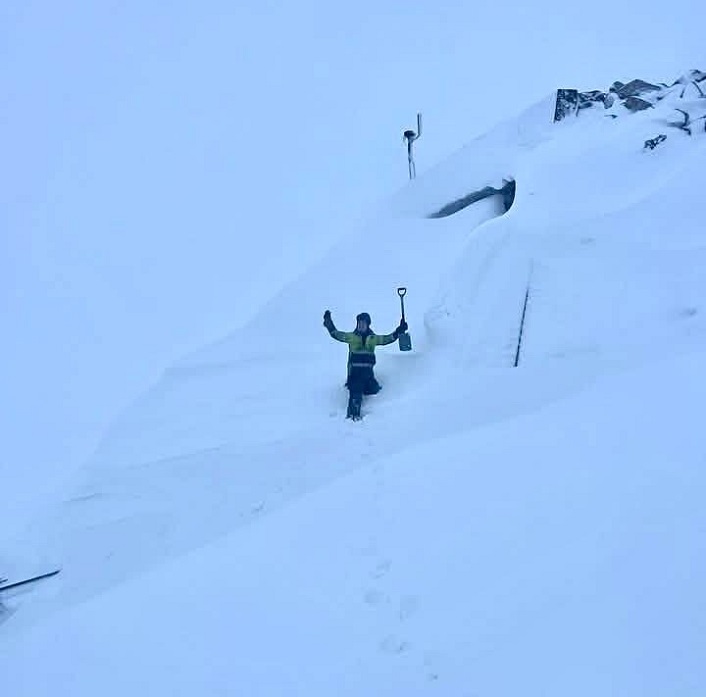
The predictable happened yesterday, the strong south east winds blowing across Cairn Gorm deposited large quantities of snow in the lee of the entrance to the tunnel at the top of the funicular blocking it. It took considerable efforts on the part of at least four CairnGorm Mountain staff working with shovels (see here) to unblock the entrance, potentially opening the upper slopes at Cairn Gorm to snowsports enthusiasts today. This morning the tunnel appears to be blocked again with staff reported to be working on the upper parts of the hill to get the funicular operating.
No wonder many people living in Strathspey regard the staff working at Cairn Gorm as heroes. But how many funicular railways at ski resorts on the continent need to be dug out like this when it snows?
The blocking of the funicular tunnel by snow was an issue we raised at the Public Audit Committee (PAC) on 14th January (see here for draft official report or here to view on Scottish Parliament TV – we are on at 11am). We used it to illustrate why the funicular is fundamental flawed as a means of uplift in both winter and summer and how this limits the income Cairn Gorm mountain is able to generate. We also pointed out that the funicular railways high up in the Alps they are usually underground (eg Val d’Isere & Tignes). Accompanying evidence submitted to the PAC from Graham Nugent showed funicular are more commonly used lower down to transport people up to mountain resorts.
Other fundamental design flaws with the funicular include:
- its limited capacity to carry people up the mountain made worse because it has NEVER run at its full design speed and those speeds now appear to have been restricted further due to ongoing concerns about the safety of the structure;
- the two mid-stations, one for those going up and one for those going down, which slows the funicular down further;
- the segmentation of the carriages into separate compartments that prevent people moving through the train – which would facilitate loading and unloading (a point made by Graham Nugent is his evidence) – and makes it difficult to carry mountain bikes up to the mid-station in summer
You would never have known any of this from listening to BBC Radio’s Scotland Outdoors programme on 17th January which was broadcast from Cairn Gorm (see here). When asked by Mark Stephen if all Cairngorm Mountain’s troubles were behind them, new CEO Mike Gifford replied (just after 58 mins) that the mountain had had “a couple of rough years”. Really? The funicular was closed for safety reasons in August 2018 and has been open for less than two of the succeeding six and a half years. During that time it has received at least £10,913,567 of public money to keep afloat (on top of all the money that has been spent by HIE on capital items including the repair of the funicular)..
Mr Gifford went on to assert state the funicular has been operating for almost a year now and “there have been no issues at all”. HIE must have been delighted. However, what he said is not true, as the following exchange, which took place between the Convener of the PAC and Stuart Black, CEO of HIE, illustrates:
The Convener: I read somewhere that it [the funicular] was closed in May 2025.
Stuart Black: Yes – I am sorry. There was a three-week period of closure in May 2025 for some additional works.
The Convener: I understand that there are also more scheduled closures in September and November this year.
Stuart Black: There will be a short scheduled closure for three days next week. There is also a routine maintenance period in November, which is usually a bit longer, but this year it will be just one week.
The Convener: Those are routine maintenance shutdowns. They are not to address substantive structural engineering issues.
Stuart Black: Next week’s closure is to deal with some final remediation issues. The closure in November might also deal with some of those, but they are not substantive. They are relatively minor, and there is nothing to concern the committee with regard to the structure. The closures are really about minor remediation works.
(Official record PAC meeting 17th September)
There is reason to doubt Mr Black’s claims about the safety of the structure, as I will show in a further post, but the more fundamental issue is illustrated by the snow blocking the funicular tunnel. Whatever the evidence, HIE and the senior management at CMSL appear incapable of acknowledging publicly the many serious problems with the funicular and that, as a result, they need to start planning an alternative form of uplift now.
The inability of HIE to acknowledge this or any other of its mistakes at Cairn Gorm is the reason why we told the PAC that Cairn Gorm needs to transferred from their ownership, leaving them the liability of the funicular. Only when that happens will people like Mike Gifford, who two of our delegation to the PAC had met and thought well-intentioned, be free to speak the truth.

Can I add a couple of points to this post. Re the blocked entrance tunnel, Adam (Watson of course) was employed to advise them on managing land management aspects of the funicular development as it was being planned etc. He got a bit frustrated at times in that role. He told me how he warned them that the entrance to the tunnel at the top, being basically in a trench, would fill, block the tunnel and prevent the funicular operating. The plan went ahead with the trench there as it was and he again advised against it – directly to Keith Bryers, who was working on the project for HIE, but is advice was ignored. Keith wasn’t a rogue or anything – a perfectly nice competent guy and Adam suspected there were problems higher up in HIE.
Re gaining access via a tunnel up under windy ridge I recall standing at the foot there with two of Scotland’s most experienced geologists as they considered that the most practical approach to uplift but of course there was a major incident in the Alps about that time involving the deaths of a number of skiers when fire or other issues trapped them in a tunnel created to provide uplift and that approach went out of fashion.
More broadly, the problem is much wider than just the funicular. If it ceases to operate, then the whole operation closes and summer and winter and apart from local economic losses – probably not a lot for loss of its summer operation, you are stuck with all that substantial development of top station, catering facilities, visitor centre etc decaying in the heart of a national park. You could not even just have winter operation as you need staff with the skills and experience to operate and maintain the funicular and run the whole system and you could not get them on a seasonal basis. You would have to retain the year round – which is why Nevis Sport continues with its winter operation even when it looses money on that aspect of it.
Broadly, are we stuck with a situation where we either continue subsidising the operation by £2 million a year or face a nightmare as to what to do with the whole operation. I recall the director of the Rocky Mountain National Park visiting the site and saying simply that, even if the funicular operation was ceased, “You will never take this out!”
In 2018 HIE received a report from SE GROUP, the USA based ski resort consultants who HIE had retained to provide them with advice on forward planning on Cairn Gorm. This report, entitled Cairngorm Ski Area Feasibility Assessment and Strategic Plan, was written before the funicular ceased to operate in 2018, followed by six years of intermittent operation as repairs were carried out. As HIE tried to justify the need to repair the funicular they sought additional funds from the Scottish Government and in the Full Business Case that HIE presented to the SG they referred to the SE GROUP report and stressed the importance of the funicular, quoting these words from the SE GROUP report: “The funicular is a major asset for the resort”. Subsequently the SG, with some reluctance, approved expenditure of £16million for the repair work, even though this was quite close to the estimated cost of completely removing the funicular from the mountain. In the end the repairs cost around £25 million. But HIE, either deliberately or inadvertently, had failed to explain the reservations that the SE GROUP had over the funicular’s operation. HIE only quoted part of the sentence about the value of the funicular and omitted an important qualification. The complete sentence said “The funicular is a major asset for the resort but the over-reliance on it is problematic given its limited capacity and non-skier use”. The SE GROUP report continued with: “Its susceptibility to closure also hampers the experience for both skiing and non-skiing visitors, and solutions are needed”. The principle solutions then suggested were the construction of two new chairlifts in Coire Cas. It is obvious that the SE GROUP had concluded that Cairn Gorm will never recover its reputation as a primary destination for downhill skiing until new chairlifts are in operation. But it would appear that, in the following 7+ years since they received the SE GROUP report, HIE have never admitted that the funicular is not fit for purpose as regards uplift for snowsports or mountain biking and have done absolutely nothing to correct this situation as regards the planning, funding and construction of the chairlifts that will correct this situation. Furthermore, the failure of the HIE Chief Executive, Stuart Black, to explain this situation to the Public Audit Committee suggests that nobody in the Scottish Government or Parliament can trust a word that HIE says about its activities on Cairn Gorm. As regards this mountain the top priority for the politicians to be elected to the Scottish Parliament next May should be to remove HIE as landowners from the mountain asap and replace them with a public body that can be trusted.