 In 2018 Historic Environment Scotland (HES) closed the Radical Road at the base of Salisbury Crags in Holyrood Park, Edinburgh, citing safety concerns . Many viewed this as a serious restriction on established Scottish access rights (see here). At the time, however, it was difficult to challenge the decision, as it rested on the argument that public safety must come first.
A recent FOI request has now forced HES to release the Rockfall Risk Assessment which justified the closure (see here). This document reveals not only how the decision was reached, but also why it was fundamentally flawed.
The 2019 rockfall risk assessment, carried out by Fairhurst, is a thorough and technically competent piece of work. The issue lies not with the assessment itself, but with how HES chose to interpret and apply it. HES asked Fairhurst to calculate the annual risk of a fatal rockfall occurring on the Radical Road. The result was estimated at 1 in 2,000 per year — a figure that sounds alarming, although it is better understood as an expectation of one fatality every 2,000 years.
Crucially, this figure represents the aggregate risk faced by HES as the site managers, not the risk faced by an individual walker. To arrive at their conclusion, HES multiplied the individual risk by the estimated number of users per year (over one million). When considered correctly, the report shows that the risk to an individual walking the one-mile length of the Radical Road is approximately 1 in 2 billion.
For context, the risk to a pedestrian walking one mile on public roads in the UK is around 50 times higher! Department for Transport statistics report approximately 23 pedestrian deaths per billion miles walked. (See Reported road casualties Great Britain: 2024.)
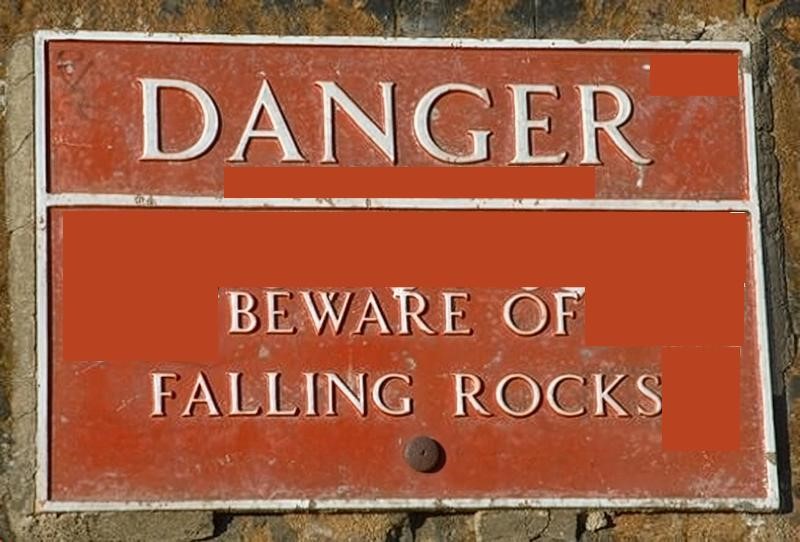
It is evident that HES are confused about their responsibilities and have misinterpreted the Fairhurst risk report. If we managed our roads this way, motor traffic would need to be preceded by a man with a red flag. At the Radical Road, all that is needed is a warning sign at each end.
Quoting from HES Statement of Significance “Holyrood Park is of great importance to the city and people of Edinburgh. For many, especially regular users, it adds immeasurably to quality of life and well-being.” The real tragedy is that this is currently being denied to a million visitors every year.
[Note from Nick Kempe. My apologies to Dave for taking over a week to publish his important post. There now appear to have been over 45 objections to HES’ planning application. The application could help legitimise the Radical Rd closure permanently on safety grounds (see here) and serve to undermine claims that it is a Right of Way. The City of Edinburgh Council has now called a meeting of their Local Access Forum for 5th March almost a month AFTER their current deadline for deciding HES’ planning application – Weds 11th February].

The closure to the public of dozens of HES controlled Historic Buildings across Scotland in recent years is down to the same ludicrous logic. Around any old building or rocky natural landscape there is an infinitesimally small risk of stones falling from height on to visitors. Warning signs that spell out the risk should be sufficient to allow visitors to make their own decision on whether to proceed or not. In Old Town Edinburgh the risk of pedestrians being hit by loose roofing slates or flying debris during storms is far greater. How long until CEC apply the same logic and close off The Royal Mile to visitors ?
The HES document has now disappeared so can’t be read. Can you find a way to make it available please. If needed I can do so using Google storage if you send me the files.
That would be very helpful.
Dick, Ben: Thanks for reading. I downloaded a copy before it expired and have put it in Dropbox here:
https://www.dropbox.com/scl/fi/oltcdm29gzcpcbmt9wrfz/131852-GL-G-R01-Holyrood-Park-Radical-Road-Rockfall-AMENDED-RA-DRAFT-R…_Redacted.pdf?rlkey=srllaw480bd0cb02rqjwfvvbb&st=4wwf24mu&dl=0
Key points: Risk varies along the RR. At the worst point, location 3b, the annual risk of fatality is 1 in 1930. (p10)
Number of visitors to RR =1,428,000 per year (Table A7.1 p65)
Finally, note blue text box on p15..” Given the low risk appetite of HES…”
As one of the objectors, and one who recruited others to object also, I think this post is very useful and should be more widely promulgated by all concerned. Let us hope it helps to produce a favourable outcome for access to the Radical Road again very soon.