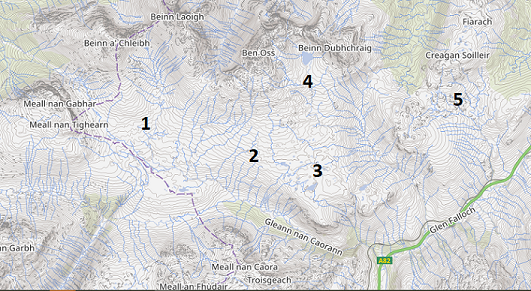
Since 2020 there have been a number of peatland restoration projects on the north side of Glenfalloch Estate with more in the pipeline. In the December 2025 there was an interesting article in Scottish Birds, which has also been made available on the Glenfalloch Estate website (see here), about the positive impact this work appears to have had on greenshank.
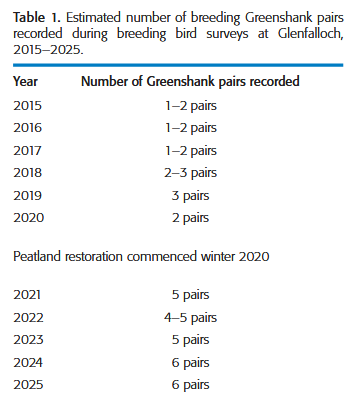 The abstract at the start of the article claims that “the Peatland Action Programme led to an increase in Greenshank territories at their most southerly breeding site in the British Isles from 1–2 pairs to six pairs.”
The evidence presented in the article does not support this conclusion to the extent claimed. First, the number of breeding pairs had increased BEFORE the peatland restoration took place. As the authors acknowledge the drop from 3 pairs in 2019 to two pairs in 2020 may have resulted from under-reporting due to Covid restrictions. Second, the peatland restoration works commenced in winter 2020 and only relatively small areas had been restored when sightings of breeding pairs started to increase. Indeed, as the article reports “two pairs colonised an adjacent area of mixed eroded and intact blanket bog in 2021 where peatland restoration work had not taken place and have bred there in every year since”.
While there is no national data about trends in greenshank numbers, the article notes that the area around north Loch Lomond appears to have been recolonised since the 1970s, that the population in the Flow Country is currently increasing and that this “is suggestive of an increasing national population during the period of expansion at Glenfalloch”. This casts further doubt on the claim that the increase in numbers of breeding greenshank on the Glenfalloch Estate is as a result of the work undertaken through Peatland Action.
If peatland restoration had such an immediate positive impact on breeding birds one would also expect to see an increase in the population of other bird species which breed in and around bogs, such as golden plover or dunlin. An “Appropriate Assessment” was undertaken by the Loch Lomond and Trossachs National Park Authority (LLTNPA) because all these projects lie within the Glen Etive and Glen Fyne Special Protection Area. It partly justified any short-term disturbance to golden eagles from the presence of diggers on the hill by arguing “the stopping of further degradation and potential restoration of these habitats is likely to increase the number of golden eagle prey species (e.g. breeding waders) over time.” So why did Alba Ecology not report in their Scottish Birds article the trends in other species too? (And why did the LLTNPA fail to mention in their Appropriate Assessment the results of the annual birds surveys which have been undertaken by Alba Ecology since 2015?. The lack of join-up is appalling).
The Scottish Birds article reports on the recent reduction in grazing animals since 2007, without which peatbog restoration is a waste of time and money, but fails to consider what impact that had had on the peatland before it was artificially restored:
“Up until 2007 there were up to 5,000 ewes on western Glenfalloch. From then on there remained
around 2,500 ewes, now reduced to 1,200 [the Glenfalloch website reports 1,100 sheep (see here)], albeit with over 300 sheep from neighbouring farms from time to time. As part of Glenfalloch’s commitment to the two deer management groups of which it is a member, deer have been actively managed, resulting in deer densities never being much above 10 per km2. Currently mean deer densities are around 7 per km2 and much lower in priority areas, such as key blanket bog habitats (D. Lowes – pers. comm.) [David Lowes is the owner of the Glenfalloch Estate].
Significantly, the documentation about the projects which can be found on the LLTNPA’s planning portal (e.g. see here for the Oss Flats) and on Public Contracts Scotland, states:
“Former high grazing levels have changed the vegetation on the peatlands from a moorland habitat to a grassy sward with heath vegetation components, and extensive erosion has taken place. Since the grazing pressure has been reduced in the last 23 years some recovery has started, with some hag faces revegetating over, but largely the climatic conditions and continued grazing by herbivores has kept erosion features open. (Caorann peatland restoration project INSERT)
In other words some of the area was being to recover naturally, without any need for human intervention.
The implication is that to the extent that habitat improvement may account for the increase in numbers of breeding greenshank, some of that could be explained by the free restoration resulting from natural processes. The limiting factor on that natural restoration is the “continued grazing by herbivores”. Deer densities “never being much above 10 per km2”, as described in the article, are in fact an absolute disaster for both woodland and peatland (see here and here). Indeed, there are serious questions to be asked about how long the peatbog restoration work would last if deer density around Glen Falloch was to remain around 7 per km2. Recent indications, however, linked to proposed woodland restoration on the estate are that deer density is now significantly lower than that reported in the article – maybe around 4 per km2.
That then begs the question is whether there would have ever been any need for peatland restoration if deer and sheep numbers had been reduced to current levels, or lower, 20 years ago? I love greenshank – the sight and sound of them circling above bogs is one of the great pleasures of late Spring – but the increase in their numbers at Glenfalloch does not justify the amounts of public money currently being spent to restore the peatbogs there.
Who pays and who benefits?
Glenfalloch is in receipt of considerable sums of public money but I suspect at present the only people who know how much are the Lowes family, who own the estate.
Unfortunately there is no national register showing which landowners and businesses are benefiting the £250m the Scottish Government is ploughing into peatbog restoration. Some information, however, can be gleaned from searching the Scotland contracts portal and this shows that for the Glenfalloch Estate:
- The contract for the Loch Oss scheme advertised in May 2025 but then cancelled was £90k excl. VAT (see here)
- The contracts for the Caorann and Eonan schemes, both advertised in 2024 but then cancelled were £90k and £25k exl VAT respectively (see here) and (here)
- An earlier contract for Eonan advertised by NatureScot in 2023 had no indicative price (see here)
I can find no information about the earlier schemes but based on this limited information it appears that the Glenfalloch Estate has been awarded over £500k for peatland restoration. (An FOI request will be required to try and establish exactly how much).
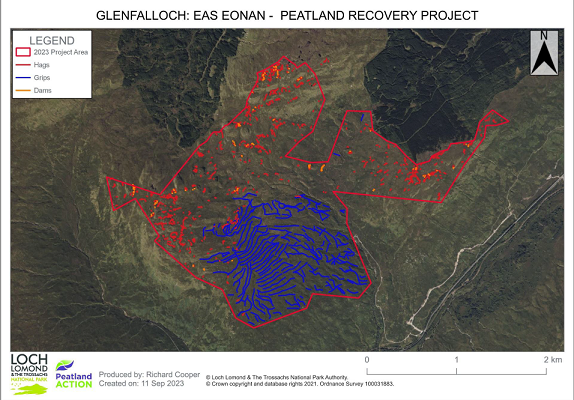
To the extent that this money is to restore damage to peat bogs caused by past land-management practices, rather than to try and “improve” them by interfering in the natural processes that cause them to degrade naturally over time, the public are paying the Glenfalloch Estate to rectify their own mistakes. With Glenfalloch having been in the same family ownership for over 90 years, there can be no argument that the Scottish Government is now paying the Lowes family to restore damage which they and they forbears have caused.
It appears that the entire costs of this restoration work are being met by the public purse. For example, the cancelled tender for the Loch Oss restoration states:
“The contract will be financed by Peatland ACTION administered by Loch Lomond & Trossachs National Park Authority and funded by the Scottish Government with the main objective of reducing the amount of carbon released by degraded peatlands.”
Moreover, control over how that work is undertaken has been handed back to the Glenfalloch Estate by giving them the contract for the works but with (free) support from Peatland Action:
“Once the costs from the preferred bidder are available, the project will be re-assessed and funding decisions made at that point. Should the project be offered funding Glenfalloch Estate will be offered Peatland ACTION support for the delivery of the work specified in this Statement of Requirements (SoR).
The contract for delivery of the works including full terms and conditions will be between Glenfalloch Estate and the successful preferred Contractor.”
What rational argument is there for putting the people responsible for causing a large proportion of the damage in charge of restoring it?
Even more extraordinarily,. after apparently being excused from contributing towards restoring the damage for which they are responsible, the Glenfalloch estate (along with many others) is then being helped to benefit financially from this work paid for by public money through the Peatland Code. This is through the system where landowners can sell Carbon Credits and Pending Issuance Units (PIUs) where peatland has been restored. (Landowners cannot claim credits for peatland which was already in good condition – as in a few small areas on the Glenfalloch Estate).
The UK Land Carbon Registry (see here) is “the Peatland Code’s electronic database that stores and publicly displays data about the status of Projects and ownership and use of Carbon Units. Managed by S&P Global, it records transactions and provides a public and transparent list of UK-based Carbon Units. All Peatland Code Projects and Carbon Units must be recorded on the UK Land Carbon Registry.” Unfortunately, the registry is not searchable by landownership or geographical location and unless you know the name of the project information is very hard to find.
Nor does the registry report the amounts of income that estates like Glenfalloch have generated through the sale of carbon credits/PIUs. It took me about 20 minutes to establish that two of the Glenfalloch estate peatland restoration schemes are “under development” for the carbon market:

and that PIUs for the Eas Eonan have been issued in several batches covering different time periods;




I have been unable to find any information on the register for the Caorann and Annaich peatland restoration schemes (see map above). Perhaps they have not been registered for carbon credits? It seem to me the only interests this lack of transparency serves are those of the Glenfalloch Estate and landowners like them. Should the public not have a right to know?
The greenshank surveys by Alba Ecology were also paid for by the public through the rural payments scheme. The DEFRA rural payments website (see here) is also very difficult to search, unless you know the name of the beneficiary, and provides very limited information. It is due to be shut down even though “The UK Government remains committed to full transparency in the use of public funds, including the publication of details about all payments made under the CAP.” How it will be replaced is not explained.
At present, however, if you search on “Glenfalloch” the following entry for “Glenfalloch Farms” appears:
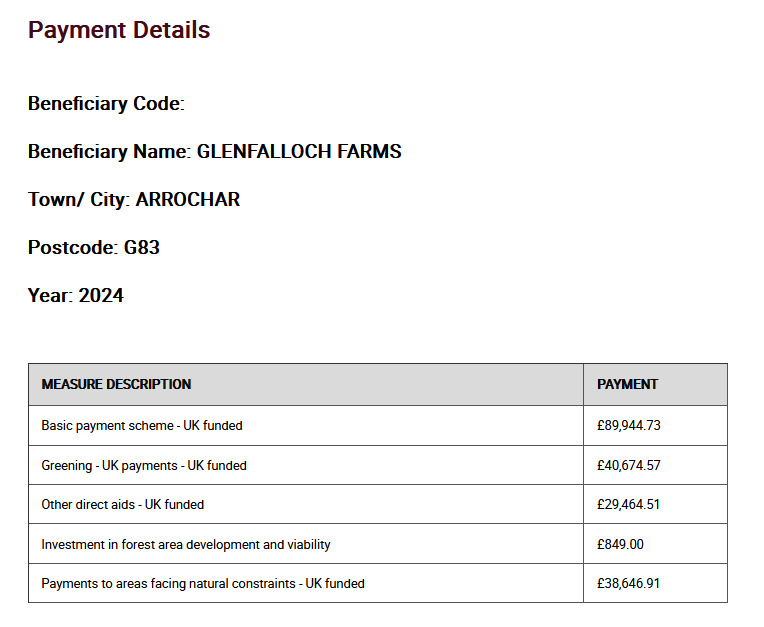
The Glenfalloch estate’s website states it has taken back all its agricultural tenancies so this appears to be further public money – £c£200k in all – which was awarded to the estate in 2024. Part of it appears to have helped pay for the Alba ecology surveys.
Discussion
The case in favour of all this public funding to landowners like the Glenfalloch Estate for peatbog restoration (and associated monitoring) goes something like this:
- we need to tackle the climate crisis;
- damaged peatland is a primary source of CO2 while restoring it provides ones of the surest means of offsetting CO2 in future;
- private landowners should not be held responsible for damaging land management practices but in any case will never pay for such work themselves;and
- by creating carbon markets we can create future income streams which will enable and incentivise landowners to maintain peatland in good condition.
The first two parts of this argument, about the need to tackle global warming and peatland has an important role to play in this, are both absolutely correct. It is the subsequent two stages which are highly questionable.
Richard Murphy, had an interesting piece in the National just before Xmas (see here) about the £120m the UK Government, supported by the Scottish Government, has promised Ineos to save jobs and industrial capacity at Grangemouth. He pointed out the money appears to be being given to Ineos without any conditions and questioned what benefit this will have for the public in the long-time.
Exactly the same arguments could be applied to the £250m being handed to landowners for Peatbog restoration. There are, for example, no obligations included in the grants to landowners to prevent sheep from grazing on peatbogs or to keep deer numbers down once peatbog restoration work has taken place. While it is possible landowners may use the money generated by the sale of PIUs or carbon credits to control grazing, there is no obligation for them to do so. In the case of Glenfalloch there is nothing on their website (see here) about how they plan to protect this public investment in future. As a consequence a number of peatbog restoration projects across Scotland are already failing.
This raises the question whether the £25m a year that the Scottish Government is spending on peatbog restoration might not be better spent. One option is to reform the existing scheme, for example by:
- creating a geographically searchable national register of all peatbog restoration projects including the amount of grant awarded;
- requiring landowners to make a financial contribution in recognition of part that historic and existing land-management practices have played in damaging peatbogs;
- attaching legally enforceable conditions to grants requiring landowners to prevent restored peatland being damaged by grazing herbivores.
A more radical option would be to use the money to tackle the causes of damage to peatland directly. The total annual costs associated with employing a well qualified stalker able to cull about 300 deer a year appear to be c£50-60k (see here). £12m from the £25m currently allocated to Peatbog Restoration would be enough for Forest and Land Scotland to employ 200 deer stalkers and bring down deer numbers across Scotland. That would enable peatland that has been damaged by deer to start to recover naturally but even more importantly would be a far surer way of preventing further damage and would have the additional benefit of enable native woodland to recover and expand too.
All that would be needed to make this happen would be for the Natural Environment Bill, currently being considered by the Scottish Parliament (see here), to reform hunting rights and give Forest and Land Scotland the power to cull deer on private land where it was judged to be in the public interest to do so – in my view that would be wherever deer density was on average more than 2 per km2.
I will come back to the Glenfalloch Estate, which I recently pointed out could be about to be awarded a lot more public money from the lottery with the help of the LLTNPA (see here), in a future post. Meantime it is worth asking why the Board of the LLTNPA has never publicly considered whether all the public money they are channeling to the Glenfalloch estate is in the public interest or whether there might not be better ways of restoring nature in what is supposed to be a National Park?

Good analysis. It is scientifically impossible to say anything about greenshank numbers based on such a short timescale and so few birds. Desperate stuff and very misleading. Money / funding will be at the bottom of it….