At the end of November the Scottish Government advertised (see here) the position of the five ministerially appointed Loch Lomond and Trossachs National Park Authority (LLTNPA) board members who will retire at the end of October 2026. The timetable for appointments is tight: applications close on 5th January, interviews will be completed by 2nd February and the decision of the responsible Minister, Mairi Gougeon, is due the week commencing 2nd March. This means the new board members will be appointed almost eight months ahead of taking up their appointments. That is quite a contrast to when previous Convener, James Stuart, reached the end of his term in 2023 – his position was only advertised six months later (see here). So why the rush?
It could be that the Scottish Government does not want to risk another Lorna Slater, the Green MSP, who while Minister threatened to shake up the Cairngorms National Park Authority board by not re-appointing board members automatically and staggering their terms (see here). Mairi Gougeon, the Cabinet Secretary now responsible, is stepping down from the Scottish Parliament in May and possibly she wishes to confirm the new appointments while she is still in post and before election purdah. Alternatively, the process could be being driven by staff to suit their interests.
What and who are National Park boards for?
While the Job Description for the board member posts refers to the four statutory aims of Scotland’s National Parks the application pack makes it clear that the primary function of new board members is “to ensure continuity in the delivery of our strategic aims,” as set out in the National Park Partnership Plan 2024-29. That plan includes “the delivery of tourism investment in Balloch as a core strategic
tourism gateway location” and a commitment to projects “in the pipeline for delivery” – a reference to the proposed Flamingo Land development (see here).
The introduction to the section on Board Responsibilities provides a description of the job:
“Under the leadership of the Convener, the National Park Authority Board provides leadership, direction, support and guidance to ensure that the National Park delivers our functions effectively and efficiently and in accordance with the aims, policies and priorities of the Scottish Ministers”.
What additional “leadership” appears to mean is parroting the leadership provided by the Convener, currently Heather Reid, whose contributions at board meetings frequently involves reading out scripts prepared by staff. Providing “direction, support and guidance” presumably refers to the very same staff who prepare those scripts! The reality is that for the last few years it has been paid staff who have provided “direction, support and guidance” to board members, not the other way round.
This has been evidenced by the whole Flamingo Land planning process where the only board member who has been prepared to challenge what has happened is Sid Perrie, the locally elected member for Balloch (see here). There is no mention anywhere in the Job Description of holding staff to account, even when or perhaps especially when it appears they lied (see here). Within the context of how the LLTNPA currently operates, the description of board members responsibilities is therefore pure flannel.
Other information in the application pack is equally misleading. For example, Heather Reid is quoted as saying:
“While the full Board oversees preparation of the Local Development Plan [it is currently being revised five years late (see here)] and occasionally takes decisions to determine planning applications for major developments [such as Flamingo Land and the Loch Loch fishfarm], the Planning and Access Committee meets more regularly to determine a wide range of planning applications as well as deal with occasional statutory access matters.”
Really Dr Reid? There were four planning and access meetings last year which considered a grand total of nine items (see here). Three were on local matters, a telecommunications mast in Balloch, a snack van and a mobile sauna, both in Luss and all heard by Committee due to objections from the local community council. Three concerned major windfarm developments outwith the boundary of the National Park but visible from it: Glen Tarken, Glen Lednock (see here) and Dunoon, all important but easy to comment on as not the primary responsibility of the LLTNPA. And the final three? An application from Board Member Richard Johnson to convert an office in Callander back into a residential dwelling, an update on the Cononish goldmine most significant for what it failed to report and a planning fees charter. That was it. Everything else was decided by staff.
The Cairngorms National Park Authority (CNPA) by contrast still holds twice as many planning meetings and considers twice as many planning items even though it has half the planning powers (as its constituent local authorities decide more minor planning applications). One wonders whether Dr Reid has very asked herself why the CNPA does things so differently?
National Park boards comprise local elected members, local councillors and Scottish Government appointees but it is the latter group who have always held the key positions on the LLTNPA Board. Of the five Scottish Government appointees due to retire in October, Heather Reid is Convener, Ronnie Erskine is chair of the Audit and Risk Committee and Claire Chapman chair of the Planning and Access Committee. The one exception to this is Martin Earl, the Tory councillor nominated by Stirling Council, who is depute convener.
The advertised board fee of £228.69 a day, for a nominal time commitment of 3 days a month, is significantly less than those working with the higher echelons of government would normally expect to receive. The explanation is that most members of the board are are expected to do very little, apart from attending the occasional meeting and briefings beforehand where they are told what they can and cannot say (with the special board meeting on Flamingo Land being the most notorious example). The role of these board members is decorative, to provide cover for Scottish Ministers and senior staff by taking “collective responsibility for the Authority’s decisions”.
The Convener and chairs of committees, however, have key roles to play in ensuring other board members don’t rock the boat and in protecting staff. Hence Heather Reid’s complaint to the Ethical Standards Commission about Sid Perrie (see links above) just before the special board meeting on the Flamingo Land planning application in which officers offered a very weak series of reasons for rejecting the development (see here). Hence too, it appears, why Claire Chapman was paid £15-20K in 2024/25 despite the lack of planning committee meetings.
Fixing the succession
In December Heather Reid and Martin Earl were re-elected unopposed as Convener and Depute Convener of the LLTNPA. With Heather Reid retiring in October and elections for locally elected members due in July (see here), staff took the opportunity at the December board meeting to propose interim arrangements for the Convener’s role (see here):
“Depute Convener to assume Convener duties from November 2026 to March 2027 when elections will take place, allowing newly appointed Board Members the opportunity to complete their inductions and consider standing for leadership positions.”
This was proposed AFTER Martin Earl had been elected Depute. Had others known staff would propose this perhaps they might have challenged Mr Earl rather than allowing him to be elected unopposed? At the same time the paper recommended (para 7.2):
“The continuity of the Board Leadership positions outlined at 4.3 will be managed as required – and elections/appointments papers brought to Board – following the end of the appointment period for each position.”
This helps show how locally elected board members are being sidelined in the LLTNPA. The expectation appears to be the new Convener will be a Ministerial nominee appointed in November and NOT a local member elected in June, otherwise why not hold the election in the early Autumn which would allow for a proper handover? If giving members time to “consider standing for leadership positions” is the real issue, why did the paper propose the chairs of the PAC and ARC be filled in December 2026 when these posts become vacant and shortly after the new Scottish Government appointees take up post?
The answer is that Martin Earl is seen as a safe pair of hands( or is that the power behind the throne?). It appears staff would be quite happy for him to take on the Convener role permanently should none of the new Scottish Government appointments be interested or deemed suitable. The chances of a directly elected local member, the only board members likely to be prepared to hold staff to account, being elected convener now appears s low as its ever been. Despite Heather Reid and a senior civil servant, Donald Henderson, being the two main members on the Scottish Government interview panel (the third “equal opportunities” rep clearly won’t be making the decision it appears the LLTNPA’s senior management were taking no chances.
Heather Reid and the quan-go-round
Two days before the Scottish Government advertised the forthcoming vacancies on the LLTNPA Board, the UK Government announced Keir Starmer had appointed Dr Heather Reid as the Trustee and Chair of the Scotland Committee to The National Lottery Heritage Fund board – as from 24th November (see here). The remuneration of £20,749 per annum will no doubt help offset Dr Reid’s loss of income (£20-25k according to the last accounts) when she steps down from the LLTNPA..
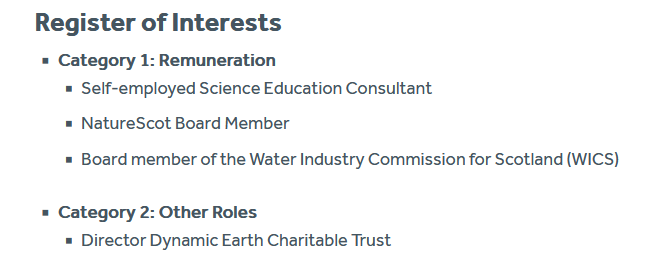
Dr Reid, who has been collecting public appointments and should know better, had not declared this latest career move on her register of interests at the LLTNPA (see here) a month after her lottery appointment commenced.
To do so timeously was particularly important on this occasion because in August the LLTNPA had submitted a major funding application to the very same National Lottery Heritage Fund. Their “Landscape Connections” bid is to fund woodland “restoration” and included projects in the Glen Falloch and Strathfillan areas. Never mind that nature could have restoring itself for the past 22 years if the LLTNPA had made any meaningful difference to reducing deer and sheep numbers in the National Park since it was created (see here), these projects create jobs for the quangocracy.
At the September Board Meeting the Chief Executive, Gordon Watson, reported (see here) the LLTNPA expected “to hear the results of the funding in December” and “If successful an initial development phase with a value of £1.3million would begin in April 2026 and be followed (subject to that development and subsequent further application) by an eight year, £15million delivery phase from April 2028″. The December deadline has passed but perhaps the announcement has been delayed to avoid what might otherwise be perceived as a conflict of interest?
With Heather Reid’s predecessor as Convener, James Stuart, moving on to the Lake District National Park Authority and the Advisory Board for Scottish Forestry (he now appears to have stepped down from both), getting yourself elected as Convener to the LLTNPA appears to be as much about career development as promoting the public interest.
This illustrates that it is the whole system of public appointments in Scotland that is wrong. While the Scottish Government proclaims a commitment to diversity, in practice a relatively small pool of people are selected by the civil service to form the quangocracy. A significant proportion move from post to post, chosen because of their willingness not to criticise staff or officials. Unless other political parties start to offer real reform, to restore democratic control and accountability of staff, support for Reform in Scotland is only likely to grow. The pathetic tweaks to the National Parks (Scotland) Act 2000, contained in the Natural Environment (Scotland) Bill (see here), which is now at Stage 3, just promise more of the same.

The CEO will already have created a wish list of applicants, and discussed with the Minister – and only those who fully support the Park & Govt agenda will be considered – Park Authorities don’t tolerate being held to account!
Was it ever approved by the scottsih electorate that their “National Park” should be run only by those who have the ‘ear’ of Scottish national party ministers?
With all appearance of a flagrant abuse of assumed ( transient????) authority, this attempt at ‘closed circle management’ by decree is amethod far removed from the democratic will of Scots.
Such a clique-ridden sinecure for the few could not have been in the minds of those late departed stalwarts who proposed the setting up of the first National parks for Scotland 30 years ago now.
Since when has the appearance of their name on any party’s electoral list been permitted to elevate that person to behave as if hereditary Laird over public land? Something here smells very rotten.
A quote, with minor adaptions, from the Chartered Governance Institute states:
“The board of directors is responsible for defining the company’s long-term goals and strategic direction,
ensuring adherence to its strategic plan and making necessary adjustments, selecting and overseeing executives
responsible for daily operations, and providing relevant stakeholders with updates on the organisation’s performance and activities”.
That is a much better summary of a Board Member’s role than the introduction section of Board Responsibilities quoted in the blog. What I really take exception to are the words, “in accordance with the aims, policies and priorities of the Scottish Ministers”. What crass arrogance of the Scottish Government in saying this! The Scottish Ministers are just one of the relevant stakeholders. It would appear that the other stakeholders are to be ignored, including the voice of the local people, but their voice is too often ignored as there are only a few directly elected Board Members. This is yet another example of the Scottish Government taking the lead …… because they know what is good for us!!
It would have made more sense for these appointments to have been left for the next Cabinet Secretary.