[NB this post was revised at 15.30 on 15th mainly to clarify/expand on some points]
The Caledonian Pinewood remnant at Coille Coire Chuilc (CCC), on the edge of Cononish Glen near Tyndrum, was first protected in 1949 as part of the Ben Lui National Nature Reserve and then designated as a separate Site of Special Scientific Interest (SSSI). Despite conservation efforts since the 1970s it appears in little or no better condition now than it was 50 years ago. When I considered the impact of landownership and the actions of public agencies on CCC four years ago (see here), I focussed on the smaller part of the SSSI lying to the east of the Allt Gleann Auchreoch. At the start of December I went to have a look at the larger western part with Victor Clements and another friend
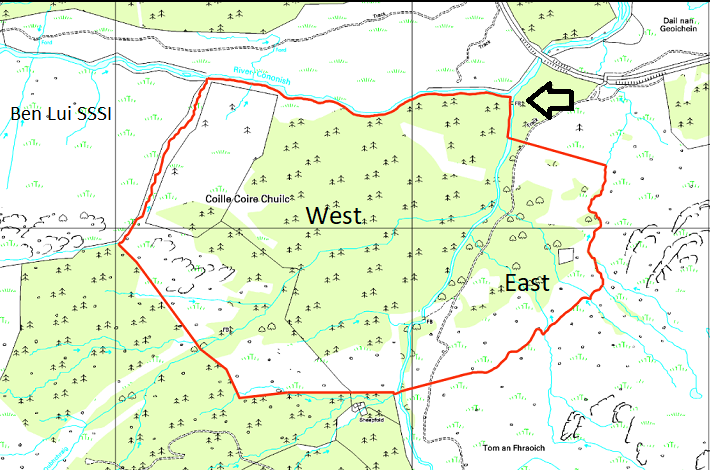
Victor had suggested the visit, having been involved in Scottish Native Woods surveys of the CCC SSSI in 2007. I was keen to discuss with him what was preventing the Caledonian Pinewood from regenerating and how the new framework I and others are proposing for their conservation (see here) might apply to CCC.
NB Inevitably, I have simplified our discussions and left out the contributions of our companion. In attributing key points I took away from them to Victor, I wanted to credit him for making me think. In practice, Victor’s viewpoint is more nuanced than I have been able present here.
Bog v woodland or bog woodland?
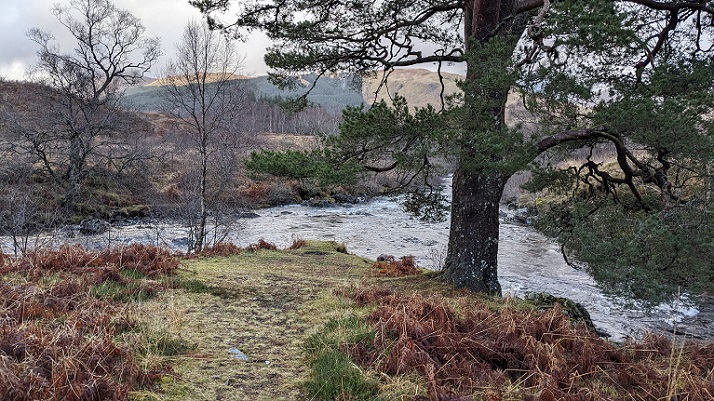
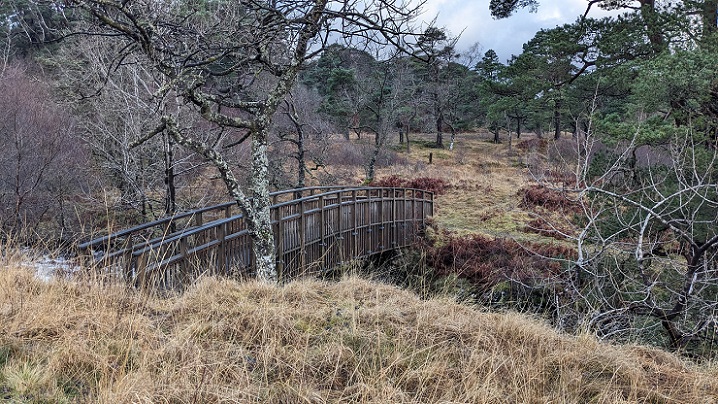
The largest patch of dry ground we saw in the SSSI was just over the bridge to the western part. While there are a number of knolls at CCC, formed from glacial deposits, the slope beneath is gently sloping, no longer drains well and much of it is now bog. As Victor pointed out there is no direct Gaelic- English translation of Coille Coire Chuilc, but it means something along the lines of “the wood in the wet sticky basin/ hollow”. While trees can grow on bog and in the process may break down peat releasing CO2 into the atmosphere – hence the fears about the spread of self-seeding sitka (see here) – it is not easy for them to do so.
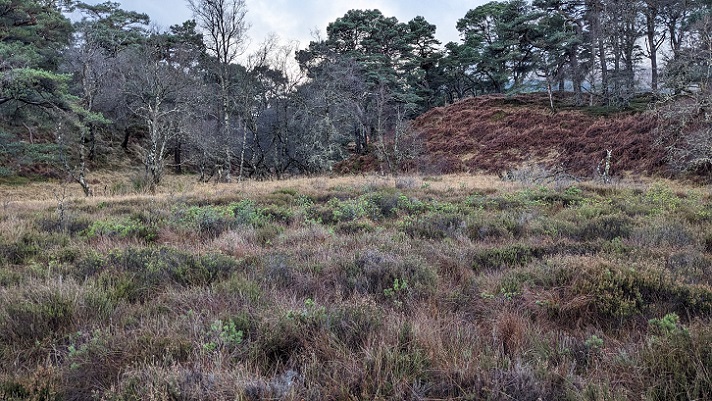
The natural regeneration of Scots Pine on the boggy areas within the SSSI is very localised. We walked over a treeless area of bog to take a look at where these numerous Scots Pine saplings had become established but looked more like bushes than trees.
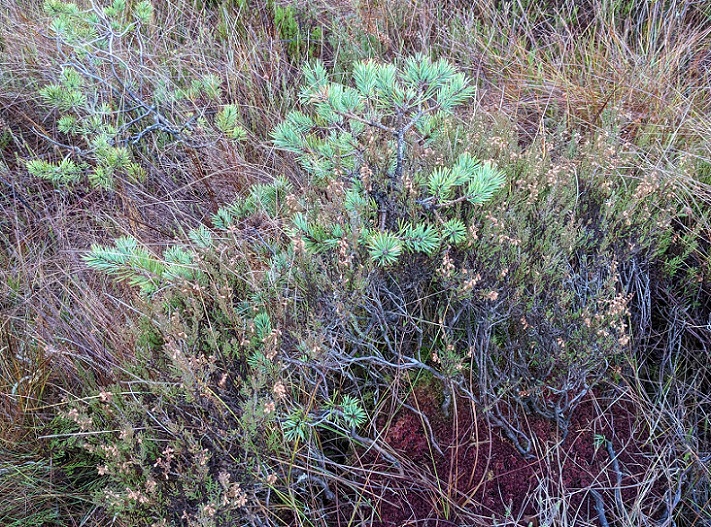
Bushiness can be an indicator of browsing by herbivores but might simply be because Scot Pine seem to lose their typical shape in such conditions. We did not find any actual signs of current browsing on these trees. The point Victor wanted to emphasise was that the annual growth of these trees, as indicated by the length of their leading shoots, is very small – often less than 5cm. That means a tree which is c1m high, as in this photo, might be 20 years old, and it might take another 50 years before they are properly established..
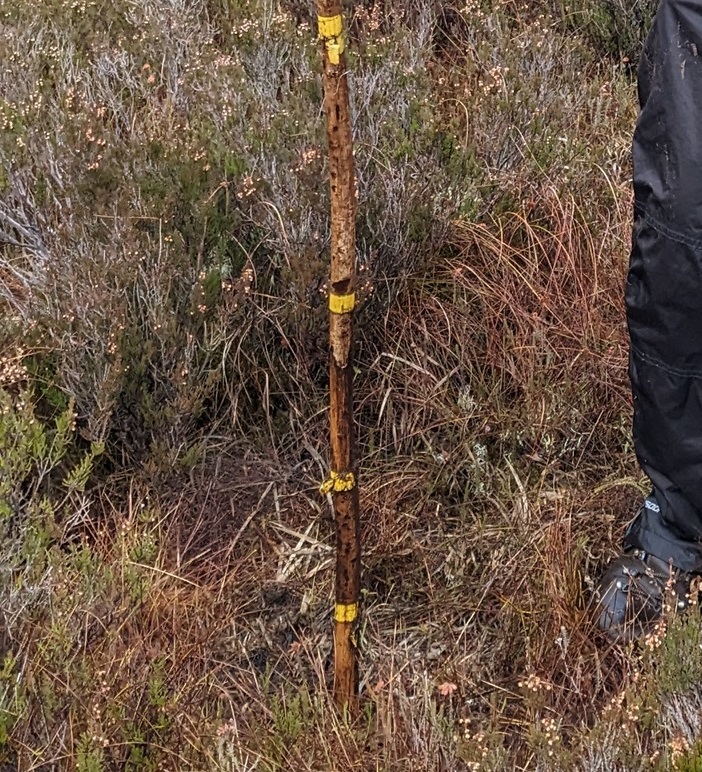
I was very slow to “twig” why Victor had brought along a marked stick:
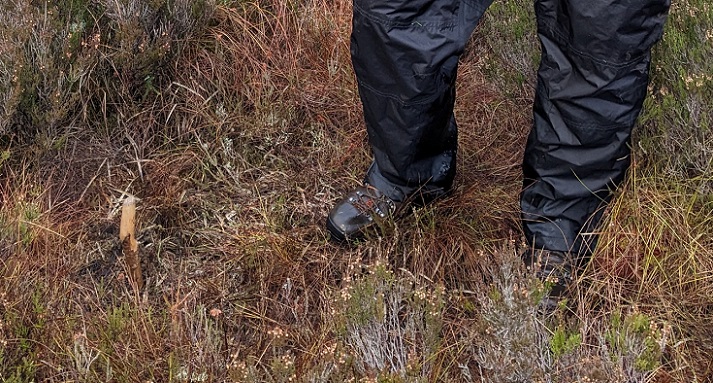
Victor sank the full length of his stick into the ground where we were standing without any effort. The stick was 1 metre long and the yellow tape marked 15, 30, 50 and 85cms. Deep peat! And no signs of seedlings in the vicinity.
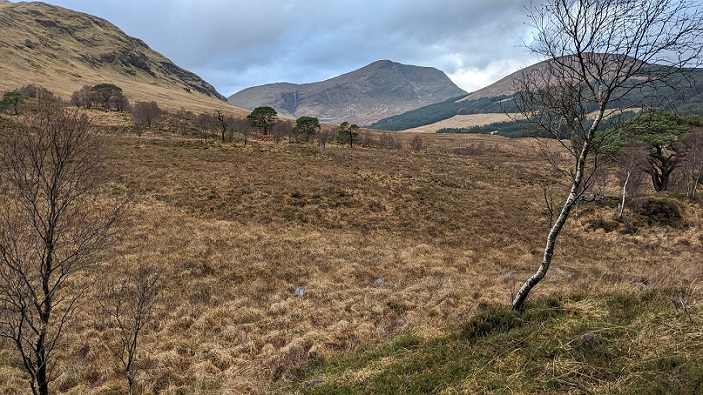
It appears that over much of CCC bog has been developing at the “expense” of the trees. If we want to protect the Caledonian Pinewood at CCC, understanding what is going on below the surface needs to be combined with an understanding of what is going on above. There is a struggle going on here between two habitat types, both of which we place intrinsic value in. For a large part of CCC, the developing bog is winning, and making it difficult for the pine trees to regenerate, except as this very slow growing bog woodland.
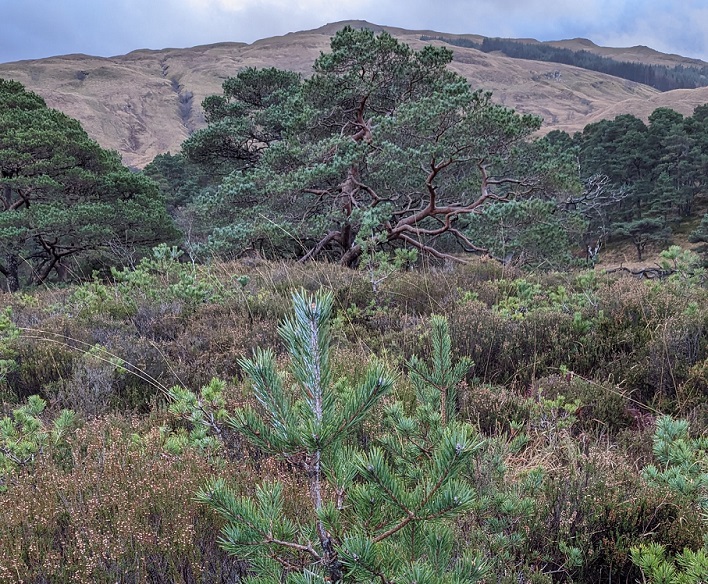
While the growth rate of most of the Scots Pine saplings we saw was extremely slow, making them vulnerable to continued grazing by sheep or deer, we saw a few that were starting to “get away”. Victor told us that were quite a few trees like this when he was conducting surveys of CCC in the first decade of this century. As a result he was very optimistic then that natural regeneration was about to take off after almost 30 years of attempts to achieve this.
But then came two harsh winters, including the snowy one of 2010/11, after which the areas of dense natural regeneration of Scots Pine had completely disappeared. It has taken another 15 years to get back to a comparable position and the saplings are still small enough to be extremely vulnerable to grazing.
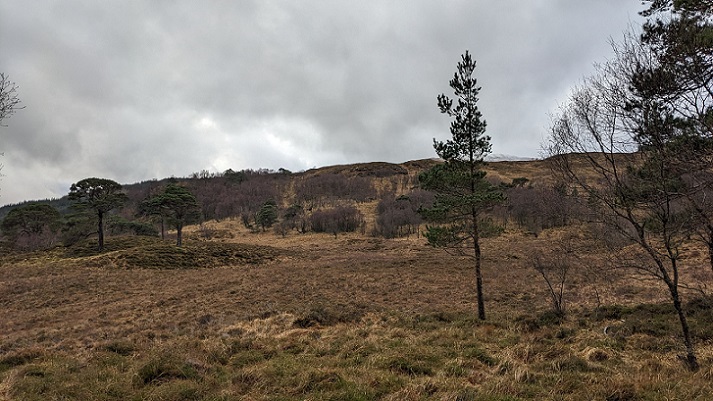
This history, of slow regeneration followed by “disaster”, is visible in the landscape. Apart from a small area near the western edge of CCC, we saw almost no Scots Pine or other tree species between 15 and 30 years old.
NatureScot’s Site Management Statement for CCC is dated 2010. It has never been revised despite the catastrophic event which followed immediately afterwards:
“To date, woodland regeneration at Coille Coire Chuilc has generally been poor and it is essential that this is improved to ensure the continuation of the woodland. The most significant factor thought to be inhibiting regeneration is grazing pressure. Therefore it is essential that stock and wild herbivore levels within the wood are low enough to allow the successful regeneration of native tree species. The growth rates of pine saplings appear to be very slow here but the current grazing levels to the west of Allt Gleann Auchreoch are thought to be just low enough to allow the currently established saplings to get away. To the east of Allt Gleann Auchreoch regeneration cannot be expected without a reduction in sheep browsing pressure to allow some established young pine to develop. Priority should, however, be given to the west section as many of the mature pines in this section are beginning to degenerate and reaching a stage where they will no longer produce viable seed”
While the Site Management Statement is absolutely correct to state “the growth rates of pine saplings appear to be very slow here”, it begs a number of other questions.
The impact of grazing in CCC
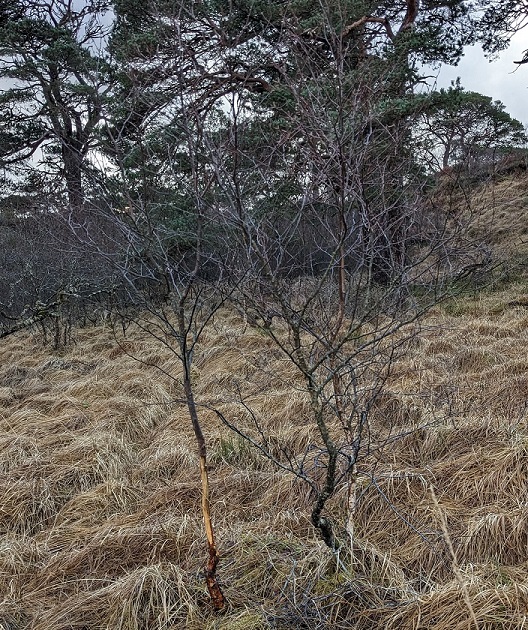
In winter, the vegetation on the western part of CCC appears dominated by bracken, purple moor grass and heather, of which only the latter – which is more nutritious than Scots Pine trees growing on nutrient poor ground – provides reasonable fodder for herbivores.
CCC is designated as a SSSI not just for its Scots Pine but for its flies and beetles, While some of those beetles which feed on dead wood now risk extinction in summer CCC can be biting invertebrate hell.
As a consequence Victor told us that deer and sheep tend to steer clear of CCC much of the time. Deer numbers have been further reduced by the fence on the western boundary and the natural barriers formed by the Allt Gleann Auchreoch and River Cononish.
These factors help explain why the very slow natural regeneration since 2010-11 has been able to survive despite overall deer density in the area still appearing higher – at c7 deer per square km (see here) – than would normally allow woodland to regenerate. While we saw some some signs of deer, there was less evidence of overgrazing in the western part of CCC than in many other pinewoods, including the eastern part of the SSSI.
It would only take one bad winter, however, for the deer in the neighbouring areas to be forced down into the wood to find food and most of the young trees that have established since 2010/11 would be at very high risk of being destroyed. While Victor thought an influx of deer might help account for the 2010/11 disaster, he also said he had found limited evidence of death by browsing and other factors may have contributed to the tree death toll – he suggested browsing by voles underneath the snow.
While influxes of deer are a recognised as a major problem for much woodland, as I recently described for the Caledonian Pinewood on the Dulnain (see here), where soils are better and trees grow more easily natural regeneration can still outpace the deer. On the western part of CCC, however, the speed of natural regeneration is so slow, in large part because of the nature of the vegetation and so much of the ground is bog, that the likelihood of any tree “getting away” is very low.
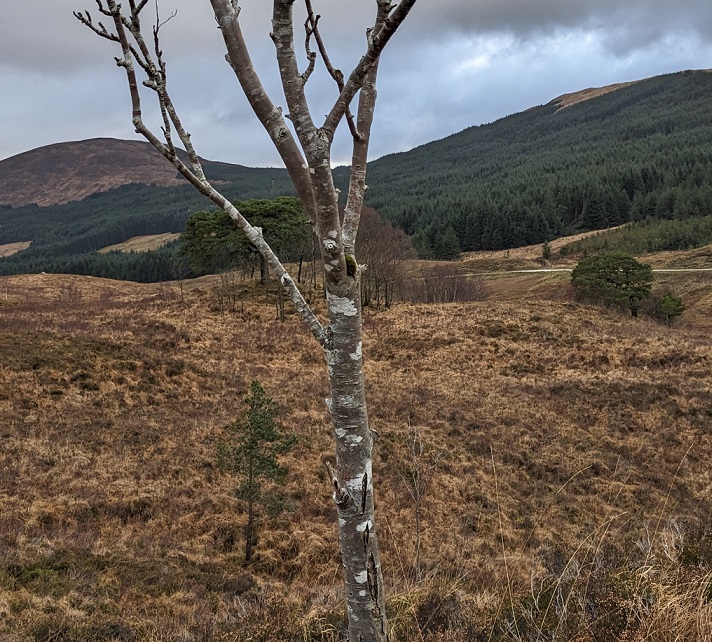
On the western part of the SSSI there are very few deciduous trees apart from birch and these are concentrated along sides of watercourses where the soil is regularly enriched by flood debris. And while there are sizeable clumps of birch natural regeneration, the only birch tree I saw that was possibly over 30 years old was dead – a contrast with the eastern part of the SSSI.
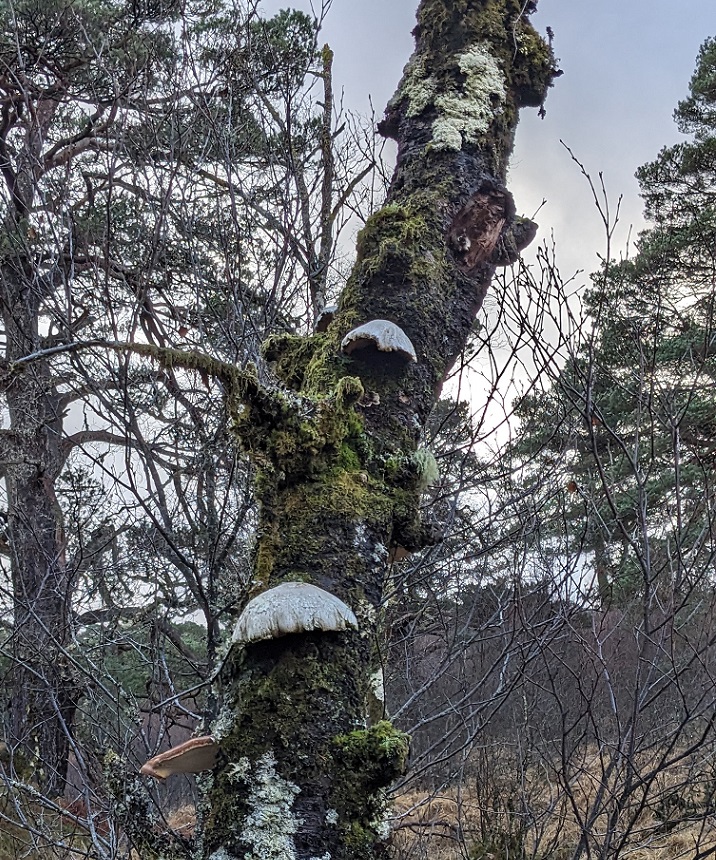
With little alternative fodder for herbivores, any deciduous tree which regenerates is very vulnerable to browsing, particularly the most palatable species like rowan which also spreads very easily. That may explain why we saw so few. It only needs one or two deer in the wood for the more nutritious tree species to get gobbled up.
As an illustration of the complexities in the interplay between bog, woodland and herbivores, it is possible that if the new young birch survive for long enough they could over time start improving the soil again making it more suitable for trees and speed up tree growth. I was left with the impression however that unless deer numbers are kept extremely low, even lower than the 2 per square km where it has been shown pinewoods in the Cairngorms start to regenerate rapidly, and for a very long time the western part of CCC is likely to continue to move from pinewood, a species rich habitat, to peatland/bog, a generally species poor habitat.
This raises doubts about whether Nature Scot’s management objective for the western part of the SSSI, that the natural regeneration be “improved to ensure the continuation of the woodland” is realistic. It appears that our public agencies are now using cattle (see here) to try and break up the ground vegetation on the western part of CCC to make it easier for trees to get established. As a one-off intervention it might help promote a further surge of regeneration, but my suspicion is that represents a vain fight against the encroaching bog on the western part of the SSSI.
The likelihood that the western part of the Caledonian Pinewood SSSI may be in a process of irreversible change does not make it any less interesting. As Victor put it CCC is arguably a living example of the natural forces which have been present in these landscapes for the past 5000 years and in some cases, there may be little we can do about it, deer or no. But this is a very strong argument for re-thinking the management objectives for CCC as a whole.
The future of CCC
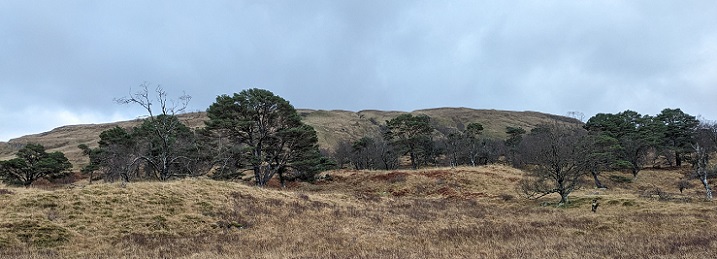
By contrast to the western part of the SSSI, the much smaller eastern part is generally better drained, some of it is on limestone and has better soils. While the very lowest slopes are also quite boggy, above that the ground is is much drier, less peaty and more suited to natural regeneration. However, apart from some pine seedlings along the track – which as Victor pointed out don’t count – there is far less evidence of natural regeneration than on the western part of the SSSI.
The explanation for this is that NatureScot’s Site Management Statement focusses on the western part of the SSSI and sheep grazing has been allowed to continued on the eastern part. It is also far more open to influxes to deer. The consequence is tree seedlings don’t have a chance and get mown as soon as they emerge.
When surveying CCC Victor said he found the Scots Pine on the eastern part of the SSSI appeared significantly younger than those in the western part. The implication is that after the western part of CCC ceased to regenerate successfully, there was a further pulse of successful regeneration to the east before herbivore grazing pressure put a halt to that. There is a lesson there and it seems to me that the conservation priority for the CCC should be to enable that to happen again.
In Victor’s view, if a fence was erected around the eastern part of the SSSI and up the slope beyond and cattle were then put into the area for the winter to break up the vegetation, then most of the slope in the photo would be covered by Scots Pine and other tree seedlings within five years. That would be a much better plan for conserving CCC than the current one. It would also, apart from the fences, fit with the arguments I and several other authors described in our recent paper in Scottish Forestry: that instead of trying to conserve small areas of Caledonian Pinewood as at present, the Scottish Government should be aiming to expand sites on the Caledonian Pinewood Inventory up to the watershed and through river catchments.
CCC actually provides a very good illustration of the need for this. Where the former designated core area of a pinewood like CCC is now losing a battle with bog, the conservation answer is not to try and reverse those natural processes within a restricted area but to enable the wood to expand/move onto new ground and outwith the boundaries of designated sites.
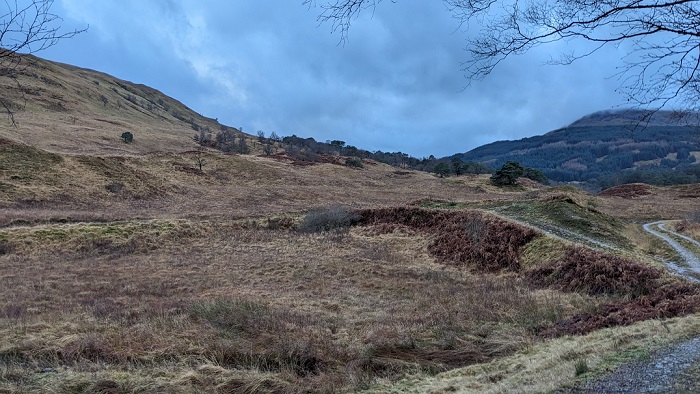
Victor doesn’t doesn’t much like fences – they are a very expensive way of protecting woodland – but the problem at CCC is the number of neighbouring landowners and their different objectives makes control of herbivores very difficult. For example, the Danish owners of Acharn, which includes the sitka plantations above CCC, list their management objectives as forestry and deer! In the case of CCC a specific challenge is how to prevent influxes of deer from Acharn. Even where a landowner, like Forest and Land Scotland on the north side of Cononish Glen, is committed to reducing the deer population in sitka plantations, culling among dense trees presents a significant challenge,albeit one that has become easier with the legalisation of night shooting and removal of the close season for stags.
That got us talking about how the population of red deer around CCC could be managed effectively and how the damaging impacts of occasional influxes could be managed. Victor has managed deer stalkers in the past and in his view, one top notch stalker with the skills and commitment to reduce the deer population – such a person might cull up to 300 deer a year – would be sufficient to enable CCC to expand naturally. But any stalker would need to be locally based, so they could develop the knowledge to know where the deer were likely to be, and empowered to work across the local estates. Victor’s estimated cost for such a stalker, including wages, equipment and accommodation costs, was c£50-60k a year. I used that figure to point out that the £1.5m Scottish Forestry has committed to paying BrewDog and their successor Oxygen Conservation to erect deer fences and plant trees on the Dulnain, they could have funded a full-time local stalker for 25 years.
If NatureScot and the Loch Lomond and Trossachs National Park Authority really want to save CCC, they need to be coming up with such solutions and could be doing so as part of their nature restoration projects in Strathfillan and Glen Falloch.

Pinewoods in Scotland have been declining naturally for the past few thousand years, with some decline starting over 7,000 ago. Why do you expect this decline to stop?
They think they can control nature and decide what is “natural”. It would be funny if there wasn’t so much public money involved. Nice work if you can get it.
And why do you see this decline as inevitable? What I was arguing is Coille Coire Chuilc appears likely to decline if its confined to its current site but if it was allowed to regenerate and spread onto new ground it could end up larger than it is now. The decline of pinewoods has been partly natural, a consequence of changing climate, but they have also been affected greatly reduced in extent by felling and herbivores whose numbers have been controlled/boosted by humans. So, if you reduced herbivore numbers, which would reduce bog erosion/reduction, and had more trees, which can breakdown peaty soils, the question is what would happen where?
I examined this woodland in the 1970s as part of Caledonian Pinewood survey work being carried out across the Highlands. It was obvious that the recently erected deer fencing around a 12 hectare exclosure was not going to achieve much natural regeneration. Most of the enclosed land appeared to be wet and boggy and the effect of the fence was to allow the purple moor grass and associated vegetation to flourish, creating a dense mat that would prevent the establishment of tree seedlings. Subsequent fencing projects over a wider area of ground also appear to have largely failed, partly as a result of failure to repair breaches in the fences. The answer must surely be to employ stalkers instead of more deer fencing and secure the corporation of nearby owners, Forestry and Land Scotland and the Danish owner of Acharn, to allow this Caledonian Pinewood remnant to expand in a westerly and southern direction by natural regeneration.
There is no doubt that the initial fenced enclosures did not work very well, and the current outputs of a strong cohort of birch regeneration and the areas of bog pinewood which lie outwith any fences are much more meaningful. Anything which gives more confidence around the establishment of that would be very welcome. There is a case for fencing the eastern side of the watercourse, and getting a fast turnaround there, where the ground conditions are much more conducive to regeneration. It appears to me that the spruce plantation above CCC might be locked in if timber cannot cross the railway line. I am not sure what might be possible there, but overall, CCC is most definitely not a lost cause, and it would be wonderful to see a co-ordinated approach to it now, regardless of what has happened in the past. That the main body of the wood is constrained by peat needs to be regarded as a feature of the area, not a problem, the two habitats having their own intrinsic value.
One could imagine willow doing ok
“Chuilc” seems to be a difficult word to translate, but I have seen a suggestion that willow may be one interpretation, as in wet/ boggy/ willowy…… not really suitable in part for Scots Pine at all. interestingly, although plenty of downy birch regen, very little if any willow now at all.