Last Monday, 17th November, the accounts for Highland and Island Enterprise (HIE)’s subsidiary which operates Cairngorm Mountain were published on Companies House (see here). The next day the Scottish Parliament’s Public Accounts Committee (PAC), which is currently investigating the funicular railway, met local stakeholders at a round table session in Aviemore. Parkswatch campaigners have checked and been told thee was no mention of Cairngorm Mountain (Scotland) Ltd (CMSL)’s latest accounts at the meeting. We don’t know if MSPs were handed a copy afterwards but have forwarded a copy to the PAC as evidence for them to consider. The annual report and accounts make interesting reading and not just because of what they tell us about the finances at Cairngorm Mountain.
How well used are the new facilities at Cairngorm Mountain?
After starting with some figures about funicular use, which we considered in our submission to the PAC (see here), the Chair’s statement provides some partial figures about the numbers visiting the new tourist attractions at Cairngorm Mountain:
 Carting (see here for what is on offer) was never mentioned in the Cairngorm Mountain masterplan, published in 2021. Nor has the Cart track from the :Ptarmigan to the Day Lodge ever had planning permission, which would have required CMSL to produce some information on the visitor numbers it was predicted to attract, and provided an opportunity for the public to comment on whether the proposal made any se.
The creation of mountain bike tracks, however, did require planning permission and the Committee Report for the Cairngorms National Park Authority (CNPA) included information on predicted use (see here):
“The supporting information projects visitors to use the mountain bike facilities between May – October (inclusive). Annual visitor numbers are projected at 10,408 in year 1, increasing to 11,488 in year 2 and 13,738 in year 3. This is based on a maximum capacity of 90 people, a 10% increase in year 2 and 20% in year 3, driven by increased efficiency in operation and maximisations of potential season use”
By my reckoning that is 8,488 mountain bikers short of what was predicted, a fact which Peter Mearns, the chair of CMSL, fails to mention that in his report. The PAC should ask why?
The PAC could also ask some basic questions to enable them to compare the income raised with the costs of constructing, maintaining and operating the trails (which includes the two magic carpets which are also used in winter). To illustrate the issue, the cost of an uplift pass for the mountain bike trails this year, if bought in advance, was £36 for adults and £21 for U-16s – enough to put most people off. If every child was accompanied by an adult and all chose the uplift pass rather than the cheaper pedal pass, the total income generated would have been £85,500 (3000 x £28.50). One wonders if that even covers the operational costs of managing the facility if, as reported (see here), each year “the trails get six weeks work with the digger to fix worn out sections and make it all new” let alone whether they can help turn Cairngorm Mountain into a viable “all year round visitor attraction” which is the professed aim behind all the new developments at Cairn Gorm.
While letting mountain bikers onto the funicular to facilitate access to the top part of the trails may increase on numbers slightly, the funicular is a poor means of uplift compared to the chairlifts used on the continent (or at Glencoe Mountain). The more fundamental problem is that trying to create a “family friendly” mountain biking facility high up on a mountain that has some of the severest weather in Scotland was never a sensible proposition.
Conservation work in the Cairngorm ski area
 Peter Mearns appears to have written this part of his Chair’s Statement without actually checking what had happened on the ground. The planting in Coire na Ciste started at the end of this summer, i.e after the period covered by the annual report and accounts which cover the year until 31st March 2025. I visited Coire na Ciste 0n 13th July and saw no sign of recent planting by school children then. 30,000 trees indeed appear to have planted in Coire na Ciste after that date but 40% were birch:
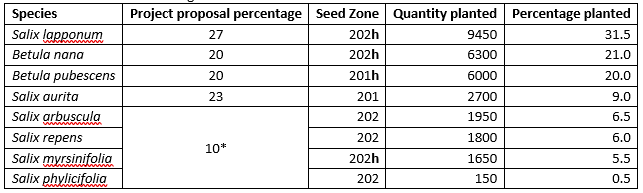 And without getting into ecological arguments, not all the willows were strictly speaking montane (see here), with eared willow (salix aurita) and creeping willow (salix repens) being nationally frequent.
What this demonstrates is that the current CMSL Board has very little interest in what is actually happening on the ground at Cairn Gorm and lacks even the most basic ecological knowledge necessary to ensure the Cairngorm Estate, a very sensitive environment, is managed in a sustainable manner.
Cairngorm Mountain’s finances
The profit and loss statement in the accounts shows that the new visitor attractions, such as carting and mountain biking, are make very little difference to CMSL’s overall financial position. Even if £85k had been raised from mountain biking it would still comprise only c5% of total income:
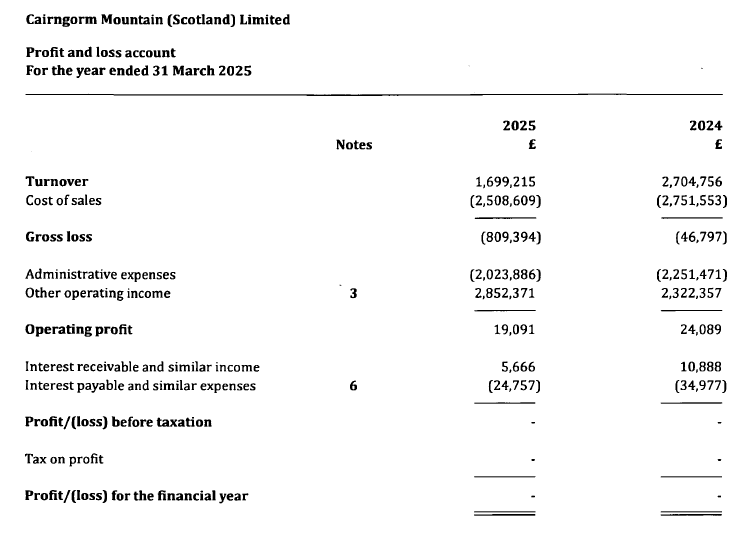 One suspects that CMSL last week did not want either stakeholders or MSPs to know that turnover (i.e income generated) at Cairngorm Mountain had dropped by over £1m and the gross loss increased by over £750,000k. Even more important from a financial perspective, however, are the two lines below the operational loss of £809,384, showing over £2m in administrative expenses and “other operating income” of £2,852,371.
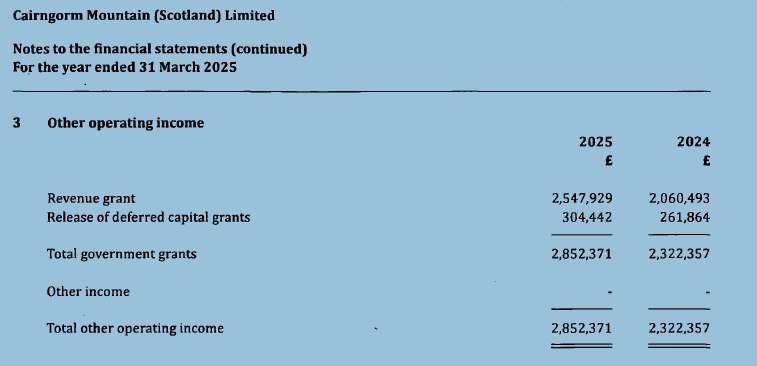 That “other operating income” consists of grants from HIE, some to fund capital projects but most revenue grant. In other words HIE’s total subsidy for CMSL last year was £2,852,371, c£530k more than the year before and a very poor result.
The most important point to appreciate, however, is in the statement of going concern in the accounts:
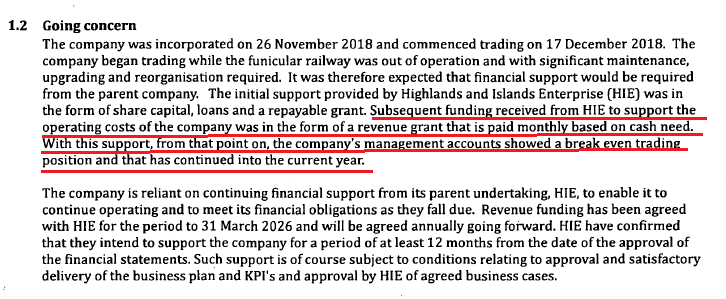
In the last few years HIE has effectively given up on requiring CMSL to act like a normal business and instead has been paying out “revenue grant……..monthly based on cash need” guaranteeing this from one financial year to the next. In other words, HIE pays what it is asked for and this results in perfectly balanced accounts where income equals expenditure.
What could MSPs on the PAC be asking HIE about their management of Cairn Gorm?
HIE’s failures to provide a copy of CMSL’s accounts to the PAC stakeholder event last week and the content of those accounts should provide further evidence to MSPs – as if more was needed – that HIE cannot be trusted. HIE needs to be grilled by MSPs about the propaganda they continue to issue about their management of Cairn Gorm.
Sticking to the finances and the public interest, however, among the questions that the PAC could be asking HIE are:
- could the significant sums of public money HIE is handing over to CMSL in capital and revenue grants each year be better spent on the mountain?
and,
- would this public money not be better spent elsewhere in the Highlands, including Strathspey and the other ski centres?

These are derisory numbers from Cairngorm Mountain.
Laggan Wolftrax gets over 25000 MTB visits per year. Further afield, Glentress is now at over 200k visits pa.
Karting – Midlothian Council installed a mountain coaster alongside its dry ski slope at Hillend 1 year ago, which has done over 300k rides since, which is double the business plan estimate (this may be the black swan of Scottish officialdom usership estimates, in that the business plan wasn’t hopelessly optimistic!). The dry ski slope’s future now appears secure.
Fundamentally, these are the wrong type of activities at Cairngorm. They have been served many places elsewhere in Scotland better, for longer, and taking the views of potential users into account and not for granted. And no doubt cheaper, also.
CMSL’s one USP in terms of outdoor activities was relatively snow-secure (for Scotland) skiing and boarding, and its neglect of its facilities and its once-loyal user base probably can’t be overcome.
It’s easy to see why Glentress is so successful, outstanding scenery with the thrill of riding through trees compared to Cairn Gorm riding through an industrial site and proximity to major conurbations. Laggan Wolftrax, another scenic site. FLS showing how it should be done. The Midlothian alpine coaster site is probably visually the same as Cairn Gorm but with some treeplanting/ landscaping could become even better, probably on a par with the alpine coaster at Zipworld in Wales. The thrill in the Welsh coaster is riding through the trees, not being able to see where you are going until you get there. It doesn’t matter that CM(S)L/ HIE will make a coaster the longest in the UK it just doesn’t have the thrill factor. They should stick to what makes Cairn Gorm the outstanding centre that it was…snowsports.
Re the Finances, surely the subsidy from HIE was £530,000 MORE than last year, not less as you say. £2,852,371 v £2,322,357? Yes, a terrible result for the taxpayer. Almost £8,000 every day.
Thank you Tim – heaven knows why I managed to get the figures the wrong way round – almost £8k a day is a great way of putting it!