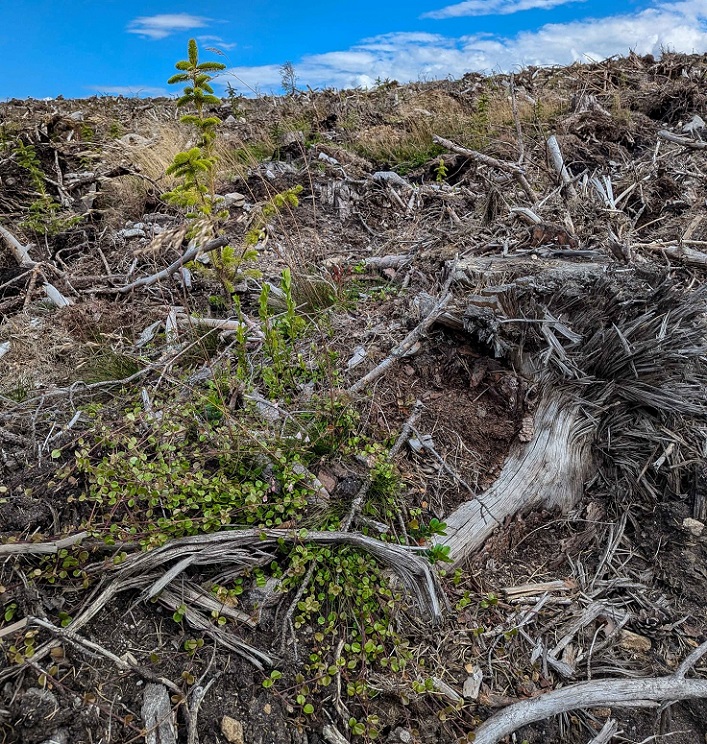
In response to my blog post of 10th October (see here) on ‘The near total destruction of a Twinflower population at Creag Bheithe Bheag in the Cairngorms National Park. What went wrong, and what lessons might be learnt for the future?’ I received replies from the CEO of the Cairngorms National Park Authority (CNPA), Scottish Forestry (SF) and Plantlife, which I summarise below.
- I was thanked for bringing the destruction of the Twinflower population at Creag Bheithe Beag to everyone’s attention, via the Parkswatch Blog.
- It was accepted that statutory processes to protect nature had failed here and that this is unacceptable. Scottish Forestry and the CNPA will work together to ensure Twinflower is better protected in future.
- For both the Long Term Forest Plan and felling permission consultations, CNPA reported the presence of Twinflower and requested a walkover ecological survey to mark all Twinflower sites for exclusion from felling. SF confirmed this request was passed verbatim to the applicant.
- In future consultations around felling, CNPA will ask that an agent provides Scottish Forestry with proof that a comprehensive walkover survey has been completed on any site with suitable Twinflower habitat. SF should have sight of that survey and suitable mitigation should be suggested if Twinflower is found.
- A site visit was held at Creag Bheithe Beag on 15th October 2025 and was attended by SF, CNPA and Plantlife.
- SF confirmed they will investigate this incident under the UK Forest Standard (UKFS) in order to ascertain whether UKFS has been breached. Discussion covered how consultation processes can be improved in future to prevent this scenario from occurring again. As a result of this incident SF will now include Plantlife Scotland as a consultee on any forestry works in woodlands identified by Plantlife as potential Twinflower sites.
- Discussion also covered any possible remedial work to protect what remains of the Twinflower population. Options considered included taking cuttings from remaining Twinflower plants at the site and growing them on in a nursery before translocating these cuttings to adjacent suitable woodland. Another option is shade netting, removing newly planted Sitka, and then restocking nearby with Scots Pine and birch in an attempt to restore the Twinflower remnants in-situ. SF will be in communication with the agent to discuss and agree any remedial works.
- Plantlife have submitted a bid to the NatureScot Nature Restoration Fund (NRF) for funding to build a publicly accessible Twinflower database.
- In the short term, SF have requested details of Twinflower locations so they can create an up-to-date mapping tool for Twinflower when consulting on forestry projects.
- SF are looking to join the soon to be established Plantlife led Twinflower steering group.
Regarding points 8) and 9), above. The most complete and up to date dataset of Twinflower records is the Botanical Society of Britain and Ireland (BSBI) Distribution Database. Agencies, including NatureScot can access this, along with Plantlife. Any BSBI member can access these records. The National Biodiversity Network (NBN) has a more or less complete Twinflower dataset up to 2017, with a few more recent records. Scottish BSBI data at full resolution up to 2023 should be on NBN in the spring of next year.
In my previous blog another correspondent pointed out that I had overlooked that 16.47 ha of the clear fell at Creag Beithe Bheag was mapped as Ancient Woodland of semi-natural origin as evidenced from the OS first edition map of 1860 – (see here). The NatureScot web page (see here) provides additional information. These woodlands usually have much richer wildlife than that of more recent woods.
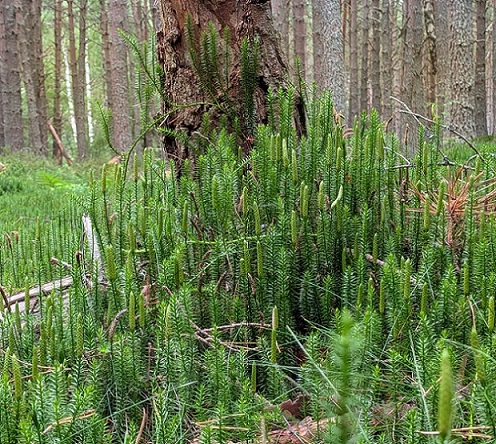
It is therefore of note that in 2020 two patches of Interrupted Clubmoss (Lycopodium annotinum), 6 x 6 m and 10 x 10 m in extent were found close to the Twinflower patch. In the British Isles Interrupted Clubmoss (Lycopodium annotinum) is very rare outwith the Scottish Highlands, and is recorded at only one site in England post-1999. It is extinct in Wales and has not been recorded from Ireland. It is a sprawling, evergreen plant, typically found on mountains and moorlands and occasionally in pinewoods.It is not known if either patch survived the clear felling and subsequent ground cultivation.

Well done PW, CNP, SF.
I will look for twinflowers, but I don’t think its easy.
Andy, thanks for this interesting post. Thanks too for the first post, which I have not yet read but which appears to have forced some corrective action out of the 2 public bodies concerned. As an environmental lawyer, I ask: what conditions (if any) did SF attach to the felling licence to protect Twinflower or, for that matter, Interrupted Clubmoss?
Ian,
I only know what is in my bullet point 3, that for both consultations, CNPA reported the presence of Twinflower and requested a walkover survey to mark all Twinflower sites for exclusion from felling, and that SF confirmed this request was passed verbatim to the applicant. SF would have to clarify what conditions they attached to the felling. The felling application is here – https://casebook.forestry.scot/w/webpage/805BECBF1?context_record_id=25504389&webpage_token=bf0934b18bd551bbbc9dd42027a1c2d4bf7ff404082f4d38db9a9dc645eee6e3.