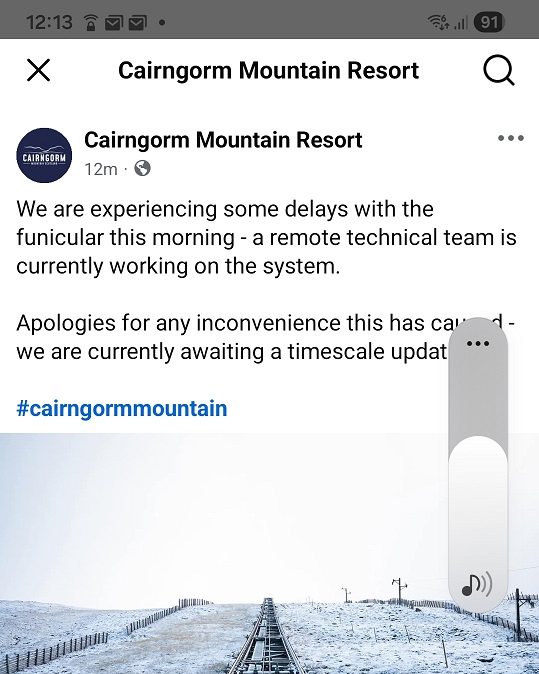
Today the Public Audit Committee (PAC) of the Scottish Parliament, which is investigating the funicular railway (see here), is holding a round table discussion in Aviemore and is due to visit Cairn Gorm. Yesterday, the funicular was out of action yet again. The reference to “a remote technical team” is significant. It suggests that these latest problems are with the operating system rather than the structure as has been extensively documented on parkswatchscotland, most recently (see here) and (here).
Cairngorm Mountain (Scotland) Ltd has removed this post from its Facebook page. There is no mention on the FB page or the Cairngorm Mountain website whether anyone who bought into the cheap ticket offer, designed to attract the public to the funicular at the time of the PAC visit, will have their money refunded (see here). It appears to be still trying to hide from MSPs the extent of the problems with the funicular, which the eminent civil engineer John Carson predicted a few weeks ago would be lucky to last 25 months (see here), and the poor customer service at Cairngorm Mountain.
It seems a good time therefore to publish on parkswatchscotland the submission that six of us made to the PAC. It and an additional submission made by Dave Morris are also available on the PAC website – link above.
Cairngorm Funicular Railway – submission to Public Audit Committee from individuals associated with parkswatchscotland
Introduction
We are a group of people associated with Parkswatchscotland who have written extensively about Cairngorm Mountain and the funicular railway (Appendix 2). In 2022 we submitted a report to Ivan McKee, the then Minister responsible for Highlands and Islands Enterprise, including its operations on Cairn Gorm. Our report criticised the financial business case for repairing the funicular and proposing an alternative way forward for Cairn Gorm which we have now updated for the Public Accounts Committee (Appendix 1). We subsequently met with Mr McKee, who had expressed serious concerns about repairing the funicular but whose hands appeared to be tied by previous decisions. Almost all of what we said in our original report remains as relevant now as it was then and we will not repeat it here.
This submission provides a critique of the submission HIE presented to the PAC on 17th September 2025. It focusses on four out of the five issues identified by the Public Accounts Committee.
Governance and oversight of operations
It is very difficult for any outside body or person to examine critically HIE’s oversight of operations at Cairn Gorm because of the cloak of secrecy which surrounds how they operate. This is exemplified by HIE’s failure to explain to the PAC why the repairs to the funicular have gone so badly wrong. The lack of facts and figures in their submission and other information extracted from HIE does not explain the massive cost over-run.
Papers for HIE Board meetings, for example, are never published, minutes appear months later and are usually extensively redacted “in the interests of the effective conduct of public affairs” or “commercial confidentiality” (e.g. item 3.2 https://www.hie.co.uk/media/bn5j0kgo/approved-risk-and-assurance-committee-18-march-2025.pdf). Most of the information that has been made public about the management, failings, costs and safety of the funicular has been obtained through Freedom of Information requests and often only provided after requests for review or appeals to the Information Commissioner.
The description of the governance structure for the management of the funicular repairs and Cairngorm Mountain submitted by HIE to PAC is extraordinarily complicated for a company which in the year to March 2024 had a budget of c£5m (£2,704,756 turnover and £2,322,357 government grants) and 88 employees. By comparison, Glencoe Mountain, although historically a smaller business employing c45 staff, still manages to offer a similar range of facilities (snowsports, mountain biking, café (open in the evenings unlike Cairngorm Mountain), camping and campervan/motorhome facilities. Glencoe is managed by the owner and a small management team, a handful of people. Its accounts, while abbreviated and not reporting turnover, show its net assets are worth over £3m more than Cairngorm Mountain Ltd.
The costs of HIE’s extensive and complex governance structures are not reported by HIE but appear linked to the extraordinarily high level of public monies that are being channelled into Cairngorm Mountain. There is no evidence that that governance has made any real difference (see section on management of repairs below) to long standing problems with HIE activities on the mountain.
At an operational level there are many examples of how the business has been badly managed by HIE: much of the masterplan shows no sign of being delivered; plans chop and change; planning applications are not implemented after approval (e.g. the proposal to move the “temporary” snow factory uphill); people who had purchased season tickets were not refunded when the funicular did not open as promised; expensive equipment, such as the snow cannon purchased by HIE, is hardly used; there have been allegations of staff bullying and toxic culture reported in the press; there are long delays in responding to information requests and, not least, failure to ensure the funicular repair work was supervised properly.
How repairs to the funicular have been managed
HIE’s submission emphasises the list of specialist consultants and contractors involved in the repairs. Yet with all the interlinked management and governance structure and presumably the best specialists they could find, the project has still massively overspent. The initial quote for the repairs, including bearings, by BAM based on the designs of COWI was £5.85m +/- 25%. By the time HIE first announced the repair costs they had risen to £10m. They then rose to £16.16m in the business case approved by the Scottish Government. By 2022 The Herald reported the costs had increased from £16m to £21m and “are feared to be going even higher”. By January 2023, when the funicular first re-opened, the BBC reported the repairs to have cost £25m (HIE has now reported to PAC that the actual costs were £25.4m plus another £2m in professional fees). HIE’s claims that the huge increase in repair costs was attributable to the weather, Covid and building product inflation are not credible.
This was before the funicular was closed for a further 18 months in August 2023 to conduct repairs to the repairs. The cost of these latest repairs is unlikely to be less than £5m and could be considerably more. HIE has still not clarified how much of this will be paid by Balfour Beatty but will probably not include other costs, such as lost income from the closure.
In short there has been a five-fold increase in the costs of repairing the funicular since the original estimates.
HIE have never revealed or explained why the funicular structure became unsafe. Since we explained some of the reasons for that in our 2022 report, further important information has been revealed through FOI requests which we believe helps explain some of the recent problems. The initial proposal from COWI, when asked to design repairs for the funicular, was to replace the concrete beams – which were breaking up – with steel beams as used in many funiculars across the world. This was rejected by HIE as too costly as a result of which COWI proposed strengthening the beams and scarf joints with brackets.
The original designs for the brackets, shown in the diagram HIE provided to the PAC, used metal channels to secure the strengthening rods above and below the joints. These, however, would not fit under the rails and therefore on the topside of the joints they were replaced by brackets connected by two further rods (shown in the right-hand photo in HIE’s submission to the PAC).
This further change doubled the number of rods around the scarf joints, all of which needed to be tensioned correctly – a highly skilled and time-consuming process. Our recent investigations suggest it was failure to manage that process correctly which led to the funicular having to be closed for another 18th months from August 2023 and the subsequent closures this year as described to the PAC on 17th August.
In the medium term, the continued stresses on the structure (described in our 2022 report) and the impact of big variations in temperature (COWI’s original estimates were from -28c to +30c) on the tensioning in the metal brackets, mean ongoing monitoring and repair costs are likely to be far higher than originally estimated in the Full Business Case. Any adjustment to the tensioning – most of which will require scaffolding to be done safely – is also likely to require further closures of the funicular and consequential reductions in income.
If this is not serious enough, there is evidence of further cracks in the concrete in areas which have not been strengthened which may require more brackets, each of which will need to be tensioned correctly.
Our view therefore is the repairs are unsustainable, both physically and financially, and that the claims in the Full Business Case that the repairs would extend the life of the funicular by another 30 years were preposterous. Give the funicular an optimistic 5-10 years, and the Gross Value Added figures used to justify the repair of the funicular collapse.
The questions we believe the PAC needs to examine is how with the wealth of knowledge and experience HIE assembled, such a mess was made of the repairs (financially and physically), and what should happen when the repairs fail again, as they will inevitably do.
The economic impact of the railway on the local community
HIE in their submission claims the funicular is “a significant Scottish visitor attraction and economic driver for Strathspey and Badenoch” and makes various assertions about the Gross Value Added. HIE provides no evidence, in the form of statistics about the total number of visitors to Cairn Gorm. They have not even explained how many of those visitors use the funicular in summer and winter or other attractions, to substantiate their claims of economic value.
One of our authors undertook doorstep research on behalf of the Aviemore Business Association in 2020 and surveyed around 50 local businesses to get their views on the impact of the funicular closure on their business. >75% said that the closure had no discernible impact during the later spring, summer and autumn months. 45% said that it didn’t affect them much in winter either. Although not asked specifically there were a good number of businesses who said that in fact the funicular closure had been of benefit because they were gaining from the spend that was no longer going to Cairngorm Mountain. Several businesses referred to Cairngorm Mountain as a parasitical business that sucked spend out of Strathspey outwith the winter months but did not deliver any local benefit other than the wages paid to employees.
That problem, as reported in 2020, has now become worse because of HIE’s focus on developing summer attractions to keep the business going. HIE has given no consideration to the impact of these attractions on other local businesses, with the proposed Alpine Coaster for example likely to compete with G2Outdoor near Aviemore and Landmark at Carrbridge. Not only is HIE setting up Cairngorm Mountain in competition to other businesses in the strath it is doing so unfairly because of the very high levels of subsidy it attracts. Despite the unfairness and lack of regard for others, it is HIE’s summer attractions which are likely to prove unsustainable. This is mainly because Cairngorm Mountain is not a suitable location for such facilities on account of the weather there but is being compounded by poor design. Our understanding for example, is the proposed toboggan run/alpine coaster will be dismantled each winter and re-assembled each spring at significant additional cost.
In the absence of research since then it is notable that the Cairngorm Business Partnership, which HIE claims believes the funicular is “hugely important, particularly over the winter months” reported in January 2025 a bumper start to the winter season despite the funicular being closed https://scottishtourismalliance.co.uk/industry-update-cairngorms-businesses-report-bumper-start-to-winter-season/
HIE reported to the PAC that there had been 65,000 funicular users in the four months to the end of August, i.e. the prime period for summer visitors, and £1.2m in income. What it did not say was that the business case for the repair of the funicular was based on attracting 87,000 summer visitors and so the actual figure of 65,000 is likely to lead to huge losses UNLESS there is a bumper snow sports season.
Nor did HIE explain how many of the visitors this year were attracted by discounted tickets.
Our understanding is that much of the coach market, which used to provide many of the summer users of the funicular (at a discounted price), now goes elsewhere. We recommend the PAC ask HIE for far more detailed figures about who is now using the funicular and report this against the numbers and income used in the business case to justify the repairs.
Future plans
HIE fail to explain in their submission that their masterplan for Cairngorm, published in 2021, was only produced as a result of pressure from the Cairngorms National Park Authority who were concerned about the number of planning applications being promoted on the mountain in the absence of a strategic framework. What HIE finally produced is not actually a masterplan in the planning sense but rather an aspirational document using ideas from consultants based in North America (the “SE report”). Many of the aspirations, such as for a mountain centre or new lift in Coire Cas, have not been properly costed or progressed.
The main focus of HIE since the funicular first closed has been on broadening the “range of activities to attract customers to Cairngorm in all seasons of the year” including children’s tube sliding, adventure play park, “family-friendly mountain biking trails”, karting and a ball run. It has also bought a snow factory, to produce snow for the beginner’s ski area and two magic carpets to provide uplift for this and the bottom half of the mountain bike trails. While claiming “All have proven popular, strengthening the resort’s year-round appeal” HIE have provided no figures on the capital costs, running costs or income generated by this new infrastructure. Having abandoned the idea of a zip wire, proposed in the SE report that preceded the masterplan, they are now proposing a toboggan run/alpine coaster.
The best area on Cairn Gorm for snow holding is at the highest level in the Ptarmigan bowl, adjacent to the Ptarmigan restaurant. This can be accessed by the funicular or ski tows (the Car Park T-bar followed by the M1 Poma, both in Coire Cas, or the Day Lodge Poma, in Coire Cas, followed by the West Wall Poma in Coire na Ciste. These ski tow access routes can only be used by competent skiers and snow boarders but are often non-operational because of lack of snow at the lower levels which prevents the operation of the Car Park T bar and the Day Lodge Poma. The replacement of these lower-level ski tows by chairlifts would overcome this problem and are an essential next step to ensure that, if the funicular is non-operational in winter, at least the Ptarmigan Bowl is accessible to competent skiers and snowboarders who can then use this area as a piste or as an access route for ski mountaineering or touring. It would also resolve difficulties caused by snow blockage of the funicular tunnel. The absence of such chairlift facilities results in a massive fall in income from snowsports participants who go elsewhere because of the problems with the funicular (snow blocking and long queues), even when it is operational.
The replacement of the existing Day Lodge Poma with a chairlift would have the further advantages. It would open a new viewpoint on the mountain, less likely to be in cloud, for all types of visitors, and could form the basis for a new network of trails, for walkers and mountain bikers wanting to descend down into Coire Cas and Coire na Ciste and along the shoulder between these corries. It would also increase the popularity of the walkers’ access route to and from the upper slopes for walkers in combination with the existing constructed trail to the Ptarmigan restaurant.
Since the funicular has re-opened there have been restrictions on bikes taking the funicular to the mid-station to access the existing mountain bike trails which run from there to the base station. This will have deterred people from going to Cairn Gorm to use the mountain bike trails. Mountain bikers are also deterred from using the Cairn Gorm trails because of the application of charges for trail use which is not compliant with Scotland’s public access rights (Land Reform (Scotland) Act 2003). Such charges can only be applied to uplift facilities associated with the trails, but not to the trails themselves. Visitors using e-bikes, which enable them to return to the top of the trail system, without using the uplift facility, should not be charged for trail use.
The go- karts, which use the access road to the Ptarmigan, are being transported there by vehicle instead of the funicular. This is likely to be a loss-making arrangement, given the costs of such uphill transportation.
In short, HIE appear to be throwing significant amounts of money at trying to attract new visitors in summer, in a series of ad hoc initiatives which are unlikely to attract more visitors to the funicular or to generate significant further income. Setting aside landscape and other considerations, the financial problem is the amount of income that summer “visitor attractions” for families at Cairn Gorm will generate will always be limited by the weather – its too cold, wet and windy and, for one third of the year, cloud obscures the upper slopes. We recommend the PAC therefore, ask HIE for details on the numbers of people and income that are being generated by all these new attractions and their projections going forward.
Our view is that unless the winter business can be made to work, there is no point in having a summer business at Cairn Gorm which seems to be developing into a sort of arctic version of Disneyland, consuming ever increasing levels of public funds. Decreasing snow cover may make snowsports even more problematic in future, albeit that ski mountaineering and touring away from the pistes is likely to increase. But in snow poor years there are still opportunities in winter for the greater development of trail systems for walking and mountain biking, associated with new uplifA better plan for winter use may also lead to a better plan for summer use. It is obvious that the existing and planned summer attractions would be better relocated elsewhere, leaving only some basic facilities for informal recreation like the walking and mountain bike trails, information points, campervan park, toilets and cafes on Cairn Gorm above the treeline. The public funds saved could then be invested elsewhere and have more beneficial economic impact, ensuring that summer facilities on the mountain are not competing adversely with others elsewhere in the strath. Cairn Gorm would then provide essential employment on the mountain in winter, but with much of that employment moving to other locations in the strath in the summer to facilities less dependent on an endless supply of public money from HIE.
Whether recommendations from Audit Scotland have been addressed
The HIE paper does not address whether the previous recommendations of Audit Scotland have been satisfied, apart from listing the previous reviews. We believe the Committee are better qualified than we are to comment on that.
Next steps
We believe the crucial challenge at Cairn Gorm is to avoid compounding the mistakes of the past and that part of that must include a plan to decommission the funicular when it fails again.
As a first step towards informed decision making we recommend the Public Audit Committee:
- Require HIE to provide facts and figures about all the capital and maintenance/running costs of the various “attractions” at Cairn Gorm, including the funicular, since 2014, the numbers of visitors using them and the income generated.
- Ask HIE to compare running costs, visitor numbers and income generated against those presented in the Financial Business Case
- Ask HIE to provide revised estimates of the public subsidy required over the next 25 years IF the funicular does not require further repairs and to provide revised costs for decommissioning (which will be required someday)
- Ask local businesses and other stakeholders, anonymously if necessary, about the local economy, the contribution made by Cairngorm Mountain and for suggestions about how the money currently being sunk into the funicular might be used to better effect.
- Make the essential recommendation that alternative uplift facilities must be developed on the mountain for outdoor recreational use which are independent of the funicular. That is the only way that the reputation of this mountain can be recovered after decades of mismanagement by HIE.
Alan Brattey, Gordon Bulloch, Graham Garfoot, Nick Kempe, Dave Morris and Graham Nugent with the assistance of others who wish to remain anonymous
3rd November 2025

1. I hope the PAC are aware of the ‘sunk cost fallacy’.
If not, they should read here:
https://asana.com/resources/sunk-cost-fallacy
2. The sub-arctic landscape of Cairngorm Mountain is not the place to build cycle runs and go-kart tracks.