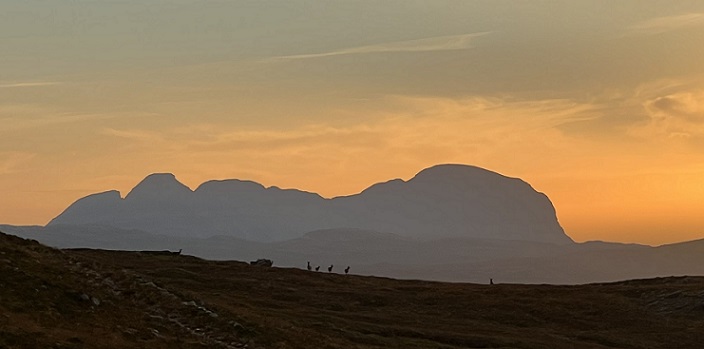
Sun going down on Cuinneag/Quinag, Assynt with red deer on near horizon. Photo credit Victor Clements
(Updated Ed. Note. I offered Jane Smallman, chair of the JMT, the opportunity to reply to this post at the same time it was publishednstating I would be happy to publish any response Jane Smallman (or other trustees of JMT) have to Victor’s criticisms. I am pleased to say David Balharry, the Chief Executive, has now done so).
Introduction
The ongoing media coverage of the John Muir Trust (JMT) and its many problems should be enough to enforce changes to any organization, but it is not happening yet in this case. People can see the range of allegations and JMT’s failure to acknowledge or address them, and speculate on the damage that it must be causing. Their reputation is shot to bits, their membership is falling, their presence on the ground is non existent on many of their properties. Their funding is totally reliant on donations and legacies, which depend on people having trust and confidence in them. In contrast to many other environmental groups who own and manage land, they do not have any significant income from agriculture, forestry, sporting, housing, visitor attractions, renewables or even carbon trading. They are almost uniquely dependent on their members for support, and therefore an inevitable question arises from all that has been going on. Might all this bad publicity lead to the demise of JMT? And if it did, would we miss them?
The John Muir Trust was formed in the early 1980’s because at that time, there was no other organization campaigning for the important role of wild land in Scotland. The National Trust for Scotland (NTS) was more interested in its range of big houses and visitor attractions at the time, and the door was open for JMT to step in and make an impact, which it did very successfully. They were a practical organization who could get things done, and many local communities and landowners supported them. They evolved to take on a lobbying function as well, and with this, their profile grew.
People remember all this good work, and in my opinion, this helps explain why JMT members still largely support their organization, if not their current management. They hear the various allegations and complaints, but they don’t want them to be true. They want JMT to do well, and they think that as an environmental group, they must be in the right, that they must try to support them going forwards, and that the current difficulties will pass. Their loyalty is very strong.
I want to see JMT survive and do well too, but know from experience that they have no God- given right to exist and their current management need to understand this when it comes to implementing an effective strategy going forwards. The environmental group I used to work for, Scottish Native Woods, disappeared in 2012. No-one missed us. When the former Farming and Wildlife Advisory Group (FWAG) disappeared, no-one missed them either. The reason? The battles they had been fighting for had largely been won, and the ethos developed was then carried forward either in to other organizations or in to self employment. The issues they represented had become mainstream.
If you look at JMT press releases at the moment, you would think they are central to the management of our wild mountain landscapes in Scotland, and they will quote their management of Ben Nevis, Schiehallion, Knoydart and the Cuillins as evidence of this. However, in reality, JMT own a part of Schiehallion (less than half), a small part of Ben Nevis, a very small part of Knoydart, and a part of the Cuillins. They do not own and manage iconic mountains at the landscape scale they often refer to. They own bits and pieces, here and there, and all largely detached from one another. What this means in practice is that to be effective, JMT have to work with other people, something which they used to be very good at. Their approach now is confrontational and aggressive, and dismissive of the abilities, knowledge and objectives of others. Many people in different parts of the country make this point. They cannot all be wrong.
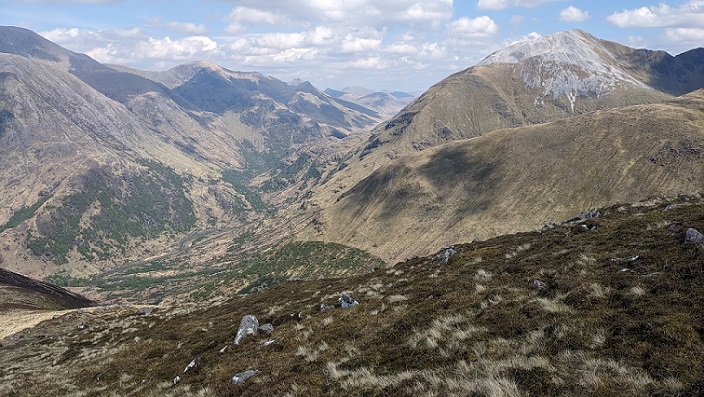
The native woodland project in Glen Nevis, where JMT has been working with other landowners through the Nevis Partnership. View from north ridge Mullach nan Coirean 2025. Photo credit Nick Kempe
If you look closely at JMT sites, the one where they are most likely to make progress on the environmental management front in the next few years is in Glen Nevis, where bridges with neighbours and the local community have not been burned, and they are likely to be rewarded for that now. Things were good in Assynt for a while until their local staff were discarded. There is no relationship with the local community there at all now. At Schiehallion, JMT staff were instrumental in setting up the Heart of Scotland Forest Partnership, which helped deliver improved car parking and toilets, a very good all abilities low level walk, and woodland extension efforts on lower ground. But there are no JMT staff left there now, the fencing plans on Schiehallion are hugely unpopular locally, and people are now questioning whether JMT are now an asset to the area or not, and whether they should maybe distance themselves from them. With no-one there to do anything, local commentators have noted the main mountain path starting to deteriorate again. If true, then this is not a good direction of travel for what is one of our most important natural heritage assets in Highland Perthshire.
If you look elsewhere in Scotland, even the very large landholdings like Wildland Ltd and Forestry & Land Scotland recognize that for effective management of our mountain environment, you need co-operative management at scale across ownership boundaries, and we now see these collaborative projects like Cairngorms Connect and the Great Trossachs Forest. The largest conservation group managing our wild mountain environments in Scotland is not JMT but the National Trust who have genuine landscape scale landholdings like Mar Lodge, Glencoe, Ben Lawers, Affric/Kintail and St Kilda. Their management is effective in a way that JMT cannot match. They have learned to consult and to listen, and they have been rewarded with good results for having done so. That is a big change from 40 years previously.
JMT do not have their scale, and they cannot behave as if they are right and everyone else is wrong, as they currently do. Their attitude is at the core of all their current problems. Their current land management is largely dysfunctional, which is an incredible thing to say, but it is undeniably now true. Their land based employees are almost all gone now, and this has been a particularly difficult and troubling aspect that people in local communities have been forced to witness. JMT act as a relentless meat grinder, sucking in young people and spitting them out again some months later with their confidence and career prospects ruined. It is not their fault, as the calibre of their recruits is usually pretty high, and invariably, they do try to build bridges but do not get supported or listened to by their top management. There is no sign of this ending. It is an ongoing process.
So, here is the thing. Over forty years or so, many organizations, institutions, government bodies and individual business and members of the public have come to recognize and value wild land, and have developed this in to their thinking. It is not a USP for JMT anymore. When their many scores of departing employees go to work for some-one else, they still believe in the vision, and they bring that ethos with them, be that to other NGOs, public bodies or the private sector. Everyone now recognizes the value of wild land. At all of JMT’s properties, there is an obvious community group or government body who could take over management if the asset needed to be transferred, and it is likely that no actual harm would arise from this. Almost certainly, there would be new opportunities and ways of doing things, and a renewal of energy and focus, and the mountain assets would benefit from this.
None of this is inevitable, of course, but those of us who have to work with JMT know that it is a possibility that we may be confronted with at some time in the near future. Ultimately, signals are important, and the signals in this case are not good. Some-one needs to recognize this and chart a different course if we want to see a more effective and integrated approach to our mountain management in Scotland. As things are, JMT have little to contribute to our deliberations around that. In the cold light of day, few would miss them if they were gone. Other groups would step up and address problems in a different way. The JMT board in particular need to understand that.
Victor Clements is a woodland and advisor working in Highland Perthshire. He is a frequent critic of the John Muir Trust and the way they have often gone about their business in recent years.
9 Comments on “Does Scotland need the John Muir Trust?”
Sorry but this is just a rant and I dont understand why it has been published on this site. Not a shred of evidence or even information is offered to explain why the author is so hostile. Is their a personal grievance in the background?
Douglas…… the post is not a rant. It is a commentary on something important that is going on at the moment which effects our wider mountain environment. There is a huge amount of disquiet being expressed in the Press over the last few months about JMT, most of which is informed by current and past members, including office bearers. Others have expressed the view that what is going on there is affecting the wider environmental movement. I have been critical of certain aspects of JMT management in recent years because I have felt that some of their actions have been unbecoming of an environmental charity. But guess what? In Scotland in 2025, we are allowed to make critical comment on the actions of others, if we think that is warranted. The purpose of this post is to say something that is needing said, and the feedback I have had today, including from JMT members, is that the tone is fine.
You may wish to take a look at some of the issues with JMT that are highlighted here: https://www.facebook.com/jmt.in.crisis. Some of us don’t want to see JMT go under and are trying to galvanise members to effect change, but sadly this is a valid question to ask.
As one who used to depend on JMT leadership for objections to inappropriate infrastructure, including their lead on the SRN debacle, I’m deeply saddened by their current invisibility and woolly response to my comments to them. I remain a member, but don’t donate any more than the basic subscription these days. Mr Balharry says little to convince me otherwise. John Muir would be turning in his grave.
I think Victor Clements has had the courage to say what a very high proportion of people who know the JMT are seeing and thinking. The turnover of Trustees and staff has looked like something for OSCR shoud be very concerned with.
Other than a short lapse, I’ve been a member of JMT since around 2000 and until careing duties took priority 10 years ago, was a regular volunteer. So it saddens me to see the current state of the organisation. Although living south of the border, one of the key reasons for joining JMT was its willingness to work with local communities and respect their heritage. This, sadly, seems to have seriously declined. There used to be a extensive programme of volunteer weekends and weeks which is now no more. These were well attended and a great deal of valuable work was done. They also gave us the opportunity to not only partake in a wide range of conservation work. But through meeting JMT staff, including local land managers, learn about the trusts activities and nature conservation in general. You felt that you had a genuine connection with the Trust and proud to be part of it. All this seems to have gone under the current leadership. Indeed JMT now appears to be just another land owner, and in some cases, almost an absentee one.
JMT were once a trail blazer and exemplar for wild land conservation. They are now one voice amongst many, and many other organisations and individuals have undertaken extensive rewilding projects. I would be sad to see the demise of JMT. But unless things drastically change within the organisation. Membership fees and donations to JMT may well be better directed to other nature based organisations. For the moment I remain a member.
Beautiful photo, but maybe correct the caption? It’s Suilven – also in Assynt. Not owned by the JMT, although they were previously involved in pathwork there.

Sorry but this is just a rant and I dont understand why it has been published on this site. Not a shred of evidence or even information is offered to explain why the author is so hostile. Is their a personal grievance in the background?
Douglas…… the post is not a rant. It is a commentary on something important that is going on at the moment which effects our wider mountain environment. There is a huge amount of disquiet being expressed in the Press over the last few months about JMT, most of which is informed by current and past members, including office bearers. Others have expressed the view that what is going on there is affecting the wider environmental movement. I have been critical of certain aspects of JMT management in recent years because I have felt that some of their actions have been unbecoming of an environmental charity. But guess what? In Scotland in 2025, we are allowed to make critical comment on the actions of others, if we think that is warranted. The purpose of this post is to say something that is needing said, and the feedback I have had today, including from JMT members, is that the tone is fine.
You may wish to take a look at some of the issues with JMT that are highlighted here: https://www.facebook.com/jmt.in.crisis. Some of us don’t want to see JMT go under and are trying to galvanise members to effect change, but sadly this is a valid question to ask.
As one who used to depend on JMT leadership for objections to inappropriate infrastructure, including their lead on the SRN debacle, I’m deeply saddened by their current invisibility and woolly response to my comments to them. I remain a member, but don’t donate any more than the basic subscription these days. Mr Balharry says little to convince me otherwise. John Muir would be turning in his grave.
I think Victor Clements has had the courage to say what a very high proportion of people who know the JMT are seeing and thinking. The turnover of Trustees and staff has looked like something for OSCR shoud be very concerned with.
Other than a short lapse, I’ve been a member of JMT since around 2000 and until careing duties took priority 10 years ago, was a regular volunteer. So it saddens me to see the current state of the organisation. Although living south of the border, one of the key reasons for joining JMT was its willingness to work with local communities and respect their heritage. This, sadly, seems to have seriously declined. There used to be a extensive programme of volunteer weekends and weeks which is now no more. These were well attended and a great deal of valuable work was done. They also gave us the opportunity to not only partake in a wide range of conservation work. But through meeting JMT staff, including local land managers, learn about the trusts activities and nature conservation in general. You felt that you had a genuine connection with the Trust and proud to be part of it. All this seems to have gone under the current leadership. Indeed JMT now appears to be just another land owner, and in some cases, almost an absentee one.
JMT were once a trail blazer and exemplar for wild land conservation. They are now one voice amongst many, and many other organisations and individuals have undertaken extensive rewilding projects. I would be sad to see the demise of JMT. But unless things drastically change within the organisation. Membership fees and donations to JMT may well be better directed to other nature based organisations. For the moment I remain a member.
Beautiful photo, but maybe correct the caption? It’s Suilven – also in Assynt. Not owned by the JMT, although they were previously involved in pathwork there.
My mistake, the deer must be on Quinag, admiring the sunset and Suilven. Fantastic place.