
The Abrdn Property Income Trust (APIT) is now marketing Far Ralia for offers over £6.9m (see here), which is less than the recent £8m valuation, less than the £7.5m they bought it for five years ago and considerably less than the £12m they were asking for 15 months ago (see here). Deduct from the new asking price the £1.65m in grants from Scottish Forestry payable to APIT to date and you get £5.25m. While I fundamentally disagree with how land is valued at present, the drop in price does to some extent reflect the environmental destruction caused by the tree planting and the amount of CO2 that is likely to be released into the atmosphere as a consequence of planting on peaty soils.

Even with Oxygen Conservation, who have purchased Dorback and Kinrara in the last year, hoovering up property on Strathspey for carbon offsetting purposes, APIT appear to be having significant difficulty selling the property. They are now marketing it through Savills, having apparently given up on Knight Frank.
Savills manages the Pitmain Estate, where an investigation into the destruction of a goshawk nest recently featured on the BBC programme Highland Cops (see here). Savills’ website states “Our integrity, honesty and professionalism is what gives our clients and colleagues the confidence to works with us”. That raises the question who was it then who engaged a solicitor to ring all estate staff effectively telling them not to co-operate with the police?
Savills’ have produced a new sales brochure which portrays Far Ralia in a very favourable light.
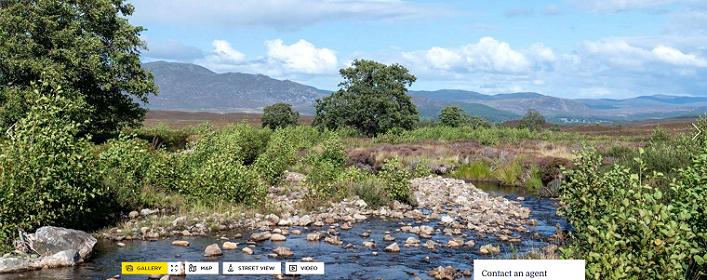
If it looks good it is good! What Savills’ haven’t explained is that the banks of the Allt Ghuibhais have not been planted, the trees have been regenerating naturally due to a reduction in deer numbers and that only a small proportion of the site looks as beautiful as this photo.
In fact, except where the peat is over 50cms deep, most of Far Ralia looks more like the photo below as a result of APIT’s management:

This photo also shows why the aerial shot from Google Earth looks like it does. There are hectare after hectare of trees planted on mounds in plastic vole guards in the name of nature restoration (see here) and carbon offsetting (see here).
The Savills’ brochure claims “Imminent validation of estimated 328,940 PIUs (tonnes) of carbon sequestration through the Woodland Carbon Code (WCC)”. Abrdn’s original calculations under the WCC showed that the tree planting would result in an net increase in carbon emissions for the next 15 years. That calculation, however, failed to take account of the research which shows that planting birch on peaty soils can result in a net increase in CO2 over a 40 year timescale (see here). Moreover the potential value of PIUs is dependent on the planted trees not dying from drought, wind, fire or disease.
Savills of course are free to market properties as they wish, so long as it does not breach advertising standards, and their photographers are not stupid, they got the best photos they could. The photos are actually very helpful in showing what could have been:
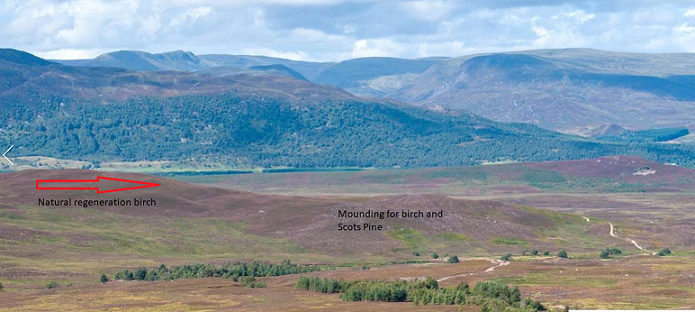
APIT originally want to plant Meall Dubh but after it was pointed out lots of birch was naturally regenerating there, APIT and their agents AKRE agreed to reserve a small area for natural regeneration. What Savills’ photo shows is how little it would have taken for that birch to join up with the native woodland plantations and extensive alder regeneration along the Allt Ghuibhais. That, however, would have attracted very little forestry grant which has paid for the mounding and planting of the ridge to the right. Savills’ brochure states while 47 ha of the estate has been reserved for natural regeneration 788 ha have been planted.

This area of moorland looks pretty good too but while about half has been protected from planting because it is on peat over 50cms deep the rest has been blanket planted as shown by this map:
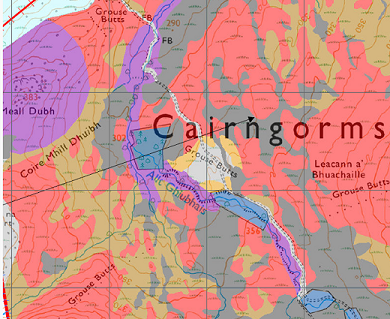
Most of moorland earmarked for planting trees, apart from a strip along the river, is covered with peaty soils so the consequence for CO2 emissions are likely to be serious. APIT are in effect asking Savills to market soiled goods!

What APIT should have done is focus on blocking up old drains – almost certainly paid for by the public – in the peat bog. Its unclear why they never progressed this and chose to plant trees in preference. The Savills’ brochure states there is the potential to restore 200 ha out of 438ha of peatland at Far Ralia and then claim credits for this under the Peatland Carbon Code. One of the fundamental design flaws of both the Peatland and Carbon Codes is you can only register credit where “restoration” has taken place not for having kept the land in a good state for years.

Another fundamental flaw in the two codes, as this photo illustrates, is they are not joined up and public money is being used to fund landowners to dig up peat to plant trees next door to peat bogs that are being restored. While direct responsibility for the crazy Forestry Grants system and what has gone wrong at Far Ralia so far lies with Scottish Forestry – with the Cairngorms National Park Authority sitting uselessly aside on a nearby deer fence – ultimate responsibility lies with the system created by Scottish Government.
The Scottish Government and most of our politicians are still being driven by the mistaken belief that attracting private finance through grants and developing carbon markets holds the key to restoring the land. In fact, as Far Ralia and APIT fleeing the scene shows, it does the opposite and has been responsible for the speculative bubble in land prices. That bubble, faced with science and the evidence of what is happening on the ground, now looks as if it is about to burst.

Possibly or more probably this will be a common pattern due to numb nut institutional land holders dawning that rural land management is a tricky game, and as a capital item it is way over valued in relation to profitable outcomes. Due diligence boys.
Agents have done well I suppose.
Hold on ain’t that a bit what current stock market valuations indicate…