Background
After the Reporter appointed to hear Flamingo Land’s appeal, Mr Buylla, issued his Notice of Intention in May that their proposed development be approved (see here), the only option left to campaigners to stop the development at Balloch under planning law was to ask Scottish Ministers to call in the application and for the Scottish Government to decide it. The Minister responsible, Ivan McKee, initially refused to do so but then did a U-turn. Any hopes campaigners may then have had were quickly shattered (see here). Mr McKee (or rather his officials) appointed Mr Buylla to produce another report, without even a steer about what parts of his original report he should reconsider. Mr Buylla was also instructed to ask Flamingo Land to draft their own (Section 75) Agreement for how the development would be governed .
A number of people/organisations then made public representations to the Scottish Government’s Department of Planning Enforcement and Appeals (DPEA) criticising the legality of the whole process. These were published on the DPEA planning portal but then, as the Daily Record/Sunday Mail revealed, removed on the grounds they had been “made public in error” (see here). The DPEA and Scottish Government want as few people as possible to understand how corrupt Scotland’s planning system is.
What are Section 75 (S75) Agreements?
All developments are covered by planning conditions, enforceable by planning authorities. S75 Agreements are in effect a special type of planning condition, known as a planning obligation, which go further than normal planning conditions would and assume the form of a legal contract. Whatever the original intentions, they have become a means (see here) :
“to overcome obstacles to the grant of planning permission. In this way development can be permitted or enhanced and potentially negative impacts on land use, the environment and infrastructure can be reduced, eliminated or compensated for” (Scottish Government Guidance on Planning Obligations).
People should also not be fooled into believing that S75 Agreements are any more enforceable or likely to be enforced than normal planning conditions. For example, the Loch Lomond and Trossachs National Park Authority (LLTNPA) did nothing to enforce the provision in the Cononish Goldmine S75 Agreement that if it ceased operations for a year the land would be restored (see here). (More on how the mine has now re-opened, under different owners, using different technology but under the same planning consent and same S75 Agreement soon).
The purpose and development of the Flamingo Land 75 Agreement
The main purpose of Flamingo Land’s S75 Agreement is justify their proposed development, which will overwhelm the village of Balloch and consume its green space, going ahead. More specifically Scottish Ministers have asked Flamingo Land to turn their “Lomond Promise” (see here), which they had falsely claimed was legally binding, into a S75 Agreement and present that to Mr Buylla for consideration. As Mr Buylla put it in his Notice of Intention to approve the development issued in May (para 390):
“the offer [by Flamingo Land] to incorporate the terms of the Lomond Promise within a planning
obligation under section 75 of the Act, or in a contract with the planning authority, was new
evidence in respect of an existing matter (the Lomond Promise) and a direct response to
the planning authority’s argument that the promise would be unenforceable.”
Mr Buylla had, in his Notice of Intention, considered the various elements of the Lomond Promise against the Scottish Government;s Guidance on Planning Obligations (paras 391-395 of his report). He grouped these promises under six headings – Community Support, Employment Issues, Environment Issues, Social Issues, Transport Issues and Social Value portal – before concluding that only the second and third met the tests for a S75 Agreement. In effect Mr Buylla told Flamingo Land that government saw no need for them to guarantee their promises – which had been made without any consultation with local people – on various matters including:
- telling visitors about other local businesses
- employing staff qualified to manage anti-social behaviour;
- giving local people discounts to the proposed leisure complex and other facilities;
- monitoring private care useage;
- introducing an electric hopper service;
- to report back to the public on the social and environmental value of the development
Flamingo Land must have been delighted! More profit!
The S75 farce then evolved over the summer. Gillespie’s McAndrew, acting on behalf of Flamingo Land, submitted four different versions of their initial proposals for the S75 between 18th and 22nd July as a result of identifying various minor errors(for link see here). Just to show how transparent they are, the DPEA (Department of Planning and Enforcement Appeals) published all four on 25th July. The response from Anderson Strathearn, the lawyers representing the Loch Lomond and Trossachs National Park Authority (LLTNPA), was submitted on 15th August and published five days later on 20th. A response and further set of documents from Gillespie’s McAndrew, on behalf of Flamingo Land who had been given the last word in the whole “process”, was then published on 2nd September. The public have been effectively excluded from the whole process.
At the LLTNPA meeting on Monday 15th September Gordon Watson, the Chief Executive, told the board which he controls (see here) that the reporter – he did not name Mr Buylla – had submitted his report to Scottish Ministers the previous week. That information, which the DPEA had said would be published in an email exchange with Ian Cowan on 7th July, eventually appeared on the DPEA website in the “Case overview” line:
“**Case Update – 09/09/2025** A report for this case has been submitted to Scottish Ministers. A decision by Scottish Ministers will be made in due course”.
The emails to Ian Cowan also confirmed that Mr Buylla’s report will be kept secret until Ministers have made a decision (which could be days or could be years).
The LLTNPA could have refused to comment on the draft S75 because, as Gordon Watson stated in his report, “it is unusual to provide comment on a draft Legal Agreement in the way it was requested“. “Unusual” was an understatement, the whole process has been outrageous!. Instead of asking his board what they wanted to do, Mr Watson got his staff to respond to Flamingo Land’s S75 Agreement, giving the process credibility, while limiting them to commenting on matters which related to the (restricted) grounds staff had provided the Board for refusing planning permission (see here). This is important because, as I will show, several of the proposed clauses in Flamingo Land’s draft S75 Agreement which the LLTNPA has failed to comment on are either unfit for purpose or raise serious governance issues.
The LLTNPA Board at their meeting on 15th September accepted what Gordon Watson said about the Flamingo Land Appeal without critical comment. The only person who might have challenged this, the local member for Balloch, Sid Perrie, was effectively prevented from saying anything at the meeting by the Convener, Heather Reid. In responding to the draft S75 but restricting what they commented on, Gordon Watson and his Director of Planning, Stuart Mearns, have done Flamingo Land another huge favour.
Access rights and Flamingo Land’s S75 proposals for Drumkinnon Woods
In the Lomond Promise Flamingo Land had said they would guarantee “24/7 access to woodland paths and national walkways”. The freedom to roam currently applies to the whole of the development site and Drumkinnon Woods so the promise to to maintain access to national walkways and woodland paths effectively represented a theft of Access Rights.
This was never challenged by the LLTNPA who had, without any evidence, expressed concerns about the impact of people walking off path in Drumkinnon Woods. Mr Buylla’s Notice of Intention asserted in several places that improved maintenance of a limited number of paths would represent better recreation and access without considering the impact of the loss of access rights. Indeed Mr Buylla concluded:
“At this planning permission in principle stage, I find no reasons to disagree with the EIA report’s conclusions or to suspect that the proposal would have any unacceptable effect on access or recreation”.
Mr Buylla also endorsed a draft planning condition that:
“the Visitor Management Plan shall include the following, as a minimum:
a) All existing paths, tracks and rights of way, and any areas currently outwith or excluded
from statutory access rights [the only reference to access rights in the entire report] ;
b) Management and mitigation measures (such as fencing and signage) to be put in place
to minimise impacts on sensitive habitats and species in line with Scottish Outdoor Access
Code;.
This fails to consider that the Riverside Site is currently a popular public park, where locals and visitors alike are free to roam, or impose any requirement on the developer to explain how access rights will be affected by various elements of the development if they go ahead. Borders Council’s approval last month of a byelaw restricting public access to the proposed Center Parcs development near Hawick (see here) shows what could happen.
The only reason why Flamingo Land proposed that public access to Drumkinnon Woods should be included in the S75 agreement is that the area, which Scottish Enterprise has promised to sell them, lies outwith the area covered by the planning application and normal planning conditions and they wanted to be seen to be doing something. Both Flamingo Land and Mr Buylla, however, have so little understanding of access rights that they thought the only way this element of the Lomond Promise could be given legal force was through a S75 Agreement. In fact, the Land Reform Scotland Act 2003 gives the LLTNPA, as the access authority, all the powers they needed to maintain access to Drumkinnon Woods for all time.
Given the LLTNPA’s record on access rights, however, no-one should be surprised they failed to point this out.
The core clause about access to Drumkinnon Woods in the S75 agreement drafted by Gillespie MacAndrew reads:
 “Core Paths” are defined at the start of the S75 Agreement as meaning “the paths (not forming part of the Informal Woodland Paths Network) that facilitate, promote and manage the exercise of access rights under the Land Reform (Scotland) Act 2003 across the Drumkinnon Wood…………..”.
Unfortunately for Flamingo Land and Gillespie MacAndrew there are NO core paths across Drumkinnon Wood:
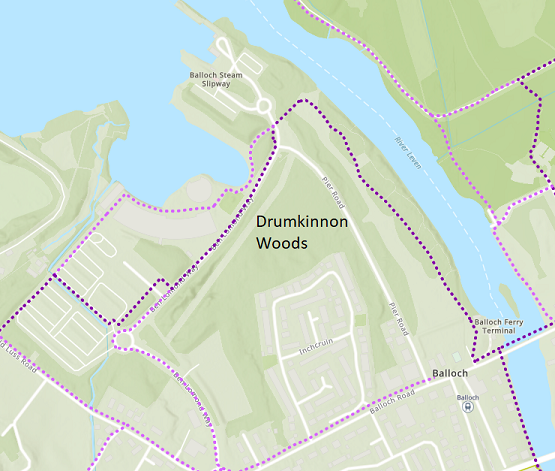
Flamingo Land’s commitment to core paths is therefore completely meaningless. While “Informal Woodland Paths Network” is also defined to mean “the existing network of Informal Woodland
Paths within the Drumkinnon Wood that are to be maintained and enhanced by the FLL
Proprietors” this is also meaningless without a map.
The term “full and free” access, which is immediately qualified by the reference to paths, is also not defined and has no meaning under the Land Reform (Scotland) Act 2003. Meanwhile the statement that access shall be “for leisure purposes permitted n terms of the Loch Lomond byelaws” appears completely ridiculous as the Loch Lomond byelaws apply to water! But perhaps Flamingo Land has already negotiated a secret deal with LLTNPA staff to introduce byelaws to control access over the whole of Drumkinnon Woods and the Riverside Site like Center Parcs in the Borders?
That LLTNPA senior management failed to comment on any of this clause in their response to the S75 Agreement speaks volumes. You only miss an open goal if you want to lose.
The use and abuse of Drumkinnon Woods for planning purposes
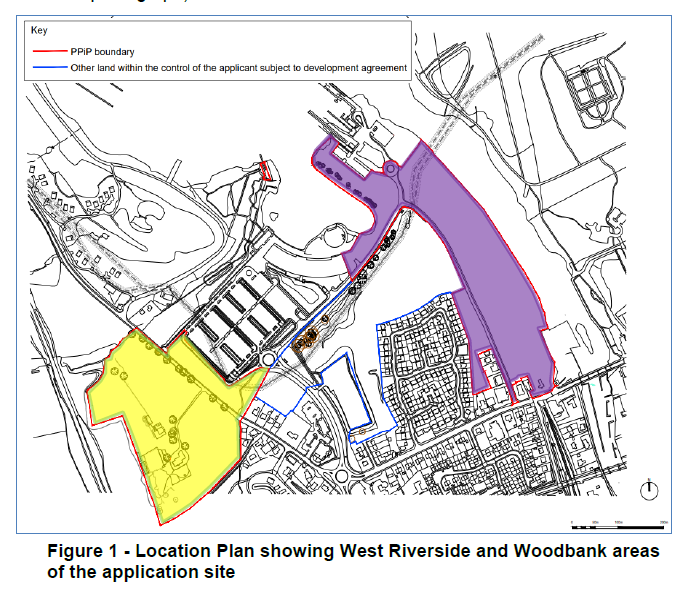
Once Flamingo Land finally agreed to withdraw the last remaining part of Drumkinnon Woods from their current planning application (see here) and (here), Scottish Enterprise could have just offered the land to the local community. Instead, they renewed their agreement to sell it to Flamingo Land – for a price that has never been revealed.
The most likely explanation for this is someone with significant planning expertise had advised either Flamingo Land or Scottish Enterprise that the only way the development could be approved is if the impact it would have on nature etc could be mitigated elsewhere, e.g. by planting trees to compensate for the ones cut down. And so it has proved with Mr Buylla in his Notice of Intention giving significant weight to the importance of “biodiversity enhancements” in planning applications but at the same time agreeing with Flamingo Land this could be delivered by better management of Drumkinnon Woods. For this compensation argument to work, conservation management for Drumkinnon Woods needs to be secured in perpetuity.
Gordon Watson’s report to his board meeting on 15th September noted that Flamingo Land had submitted a final version of the S75 agreement in response to the LLTNPA’s comments but failed to mention this included a totally new clause/proposal:
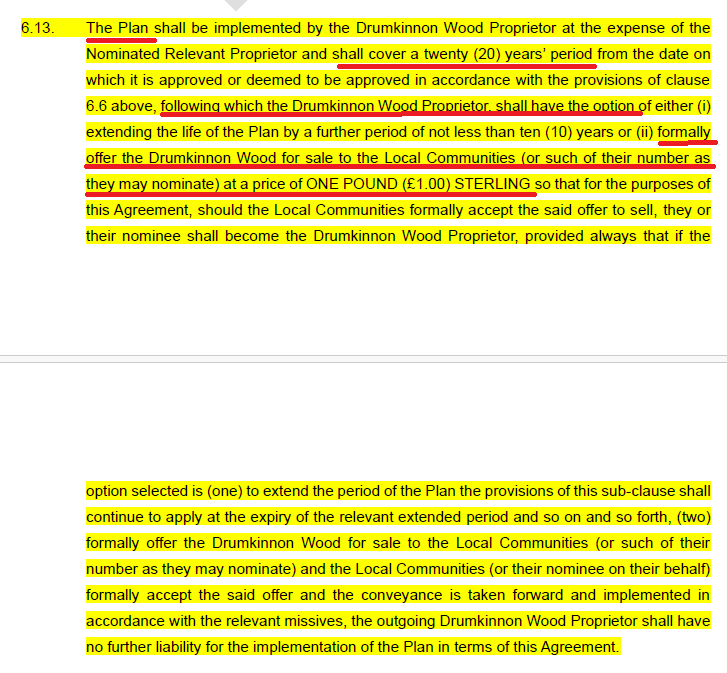
What this say is Flamingo Land will be quite happy to sell Drumkinnon Woods to the local community for £1, possibly in as little time as 20 years.
Local Communities are defined in the S75 Agreement as meaning “the communities within those areas of West Dunbartonshire that are represented by the Community Councils” which in turn are defined as referring to Alexandria, Renton, Balloch and Haldane and Bonhill and Dalmonach. Flamingo Land appears to have included this clause without any consultation with the local communities concerned and more specifically Balloch and Haldane Community Council which has set up a Community Development Trust to buy land in the area as an alternative to Flamingo Land (see here)
What the new clause indicates that Flamingo Land has little interest in improving the natural environment in Balloch in the long-term and its only use for Drumkinnon Woods is as a means of securing planning consent from the Scottish Government. It is clearly keen to rid itself of this burden and hand-over any financial responsibility for managing Drumkinnon Woods to others at the earliest opportunity.
The fact that Flamingo Land is offering to sell the land for £1 suggests that Scottish Enterprise may have promised to sell it to them for the same sum.
It will be interesting to see what Mr Buylla has said about this in his secret report currently sitting with the Scottish Government when it is eventually published. It will be even more interesting to see how Ivan McKee responds to the scandal of public land being sold off on the cheap to a developer with the sole intention of getting the most unpopular planning application in Scotland ever approved.
I will consider further issues with Flamingo Land’s S75 in a further post.

5 Comments on “What happens when developers are put in control – Flamingo Land’s planning obligations (1)”