
Introduction
It has been well covered in the media recently that the craft beer company BrewDog have sold on their “Lost Forest” at Kinrara Estate, which stretches from Speyside into the Monadliath, things not having worked out for them in the way that they might have hoped. It is actually quite astonishing that a relatively modest sized native woodland scheme (by today’s standards at least) should have created the interest that it did. But why was that, and could things have been done in a different way?
Something of interest
I first became aware of BrewDog’s plans in 2020 when the picture above appeared on social media. As a woodland advisor, I was curious about where this new forest might be. Everything about the story suggested this was the actual site.
The adverts appeared regularly for about a year, and we finally became aware that BrewDog had bought Kinrara Estate, stretching from Speyside into the Monadhliath, for about £9 million or thereabouts.
There was a lot of PR hype around it as you might imagine, in keeping with the company approach to their wider business promotion and modus operandi. There is nothing wrong with that in itself. Most people recognize that for what it is, and tolerate it as long as it does not create any actual harm. There seemed to be a new player in town, and people will have been interested to see how things developed.
The First Problems
In early 2022, the BBC Scotland Disclosure team had been developing a story around a range of alleged problems within the company. In the hour long programme that went out, about 5 minutes was devoted to the Lost Forest, and the claims being made about CO2 mitigation. BrewDog had been claiming they would be planting trees to mitigate their own emissions, and the implication was that they were paying for this themselves through beer sales. However, some-one within the Scottish Government/ Scottish Forestry had contacted the BBC to let them know that grant applications had been made to the Forestry Grant scheme (FGS) to fund the tree planting. So, who was actually paying for this? BrewDog or us? It was a good question to ask.
I got a phone call from a BBC researcher. Not being one to usually comment on other people’s business, I initially declined the invitation to say anything, but when I thought about it, I realised that the BBC must have come down through the list of Who’s Who in Scottish forestry a long way to get to my name. I phoned them back a few days later, and they confirmed that no-one else wanted to speak about it. It felt to me like a bit of a conspiracy of silence within the forestry industry, and to me, that did not feel right. At some point down the line, it would get us all in to trouble.
Not knowing anything about the site, I simply clarified how the Forestry Grant Scheme worked, and suggested that BrewDog might have hyped up their scheme too much, when saying a bit less might have been better. The BBC Dispatches programme, The Truth About Brewdog is no longer on the iplayer, but you can view it here. The Lost Forest stuff starts at just before 9 minutes in.
A lot of people have seen that programme, and even though the Lost Forest part was only 5 minutes or so, people understood what was being alleged. The company had become a byword for conspicuous greenwashing. Everyone knew what that word meant, and that it was not a good thing.
After the trees were planted in 2023 there was a very dry spell across the eastern Highlands, with virtually no rain for almost three months. BrewDog’s recently planted trees could not deal with it, and many died. Most foresters did not say anything, quite rightly, because such a thing could easily happen to them too. But because it was BrewDog, many others indulged themselves fully in their misfortune. The hype and limelight were now working against them. Eventually, BrewDog announced that they were getting out of the carbon offsetting game, and would instead invest in reducing CO2 emissions at source. This of course is a much better strategy for everyone, and if that is what they are doing, then we should all applaud that. They took the hit, and tried to move on. Moving on inevitably meant selling the site, which has now become a story as well.
Wrong side of the country
Now, go back to that picture. What do you see?
Well, the obvious thing to say is that this is not on Speyside or in the Monadhliath at all. The vegetation, the shape of the hills, the type of forestry in the background, none of that fits. So, why might that be?
BrewDog actually announced their “Lost Forest” in August 2020, the year before they bought Kinrara. The media reported at the time that they had bought 2000 acres “to the north of Loch Lomond”. (2000 acres is 800 ha, but of course 2000 acres sounds bigger.)
Loch Lomond? Now, that does fit with the picture. Here is another version of it, obviously in the same place.
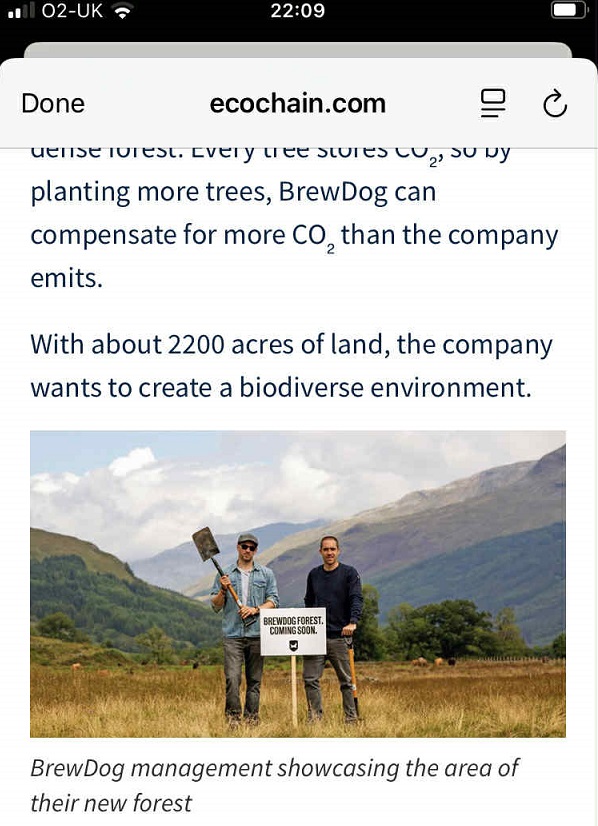
The story was covered here and also in several other business type publications at the time, although not apparently in the more “mainstream” press. For those of you still on X/Twitter, you can see their video at the time here
The news stories specifically say that they had bought the 2000 acres, and that it was to be the “biggest ever native woodland scheme in the UK” etc etc. Curiously, although it says roughly where it was, it does not name the property. We don’t actually know where this site is. It might not be “north of Loch Lomond” at all. If you recognize the area, either from the photos or from the videos, please leave a comment to this post. This is part of the BrewDog story as well.
We learn later that the purchase fell through, seemingly very soon after the news reports that BrewDog had bought the 2000 acres.
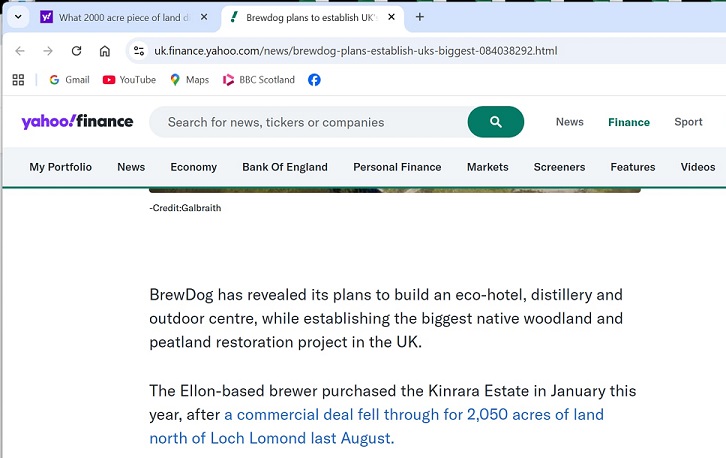
BrewDog had taken their pictures and made their PR video before the sale had been completed. It was to be the following year before they managed to buy Kinrara.
Five years later however, those pictures from Loch Lomond are still the images used to illustrate the story at Kinrara. You can understand why the media continue to use them if they don’t know any differently, but you would have thought BrewDog or their advisors might correct them. It does not reflect well on them that they have not. It is the sort of detail that some-one should be on top of.
That they started to spin things before a sale had been completed is not good either. Some-one did not think that one through.
What if?
Here is a question, what if the “Lost Forest” had been located in the Loch Lomond & Trossachs National Park area and not the Cairngorms? Would things have worked out any differently?
Although the 2,050 acre site was less than 25% of the size of Kinrara, it was still big enough to serve BrewDog’s purpose apparently. From that angle, it would have cost a lot less. There was to be 1500 acres or 600 hectares of trees. That would have been a sizeable scheme, but far from being the “biggest native woodland scheme in the UK”. The regeneration at Glenfeshie is 3 times that size, Mar Lodge is bigger again. The Forest and Land Scotland scheme at Loch Katrine planted 15 years ago, is twice that size. There are a whole host of much bigger planting schemes in the Highlands, and that is before you consider the collaborative schemes such as Cairngorms Connect or the Great Trossachs Forest. Trees for Life will point to their efforts in Glen Affric, or the Borders Forest Trust will mention their efforts at Carrifran and other properties. Apologies if I have missed anyone else out. I know there will be many others too.
There would have been advantages on Loch Lomond. The obvious thing is that being on the wetter side of the country, the drought induced mortality would have been much less likely to happen. There is obviously a significant seed source around the “Loch Lomond” site, so possibilities for regeneration arise, at least in part. Trees would grow faster in more fertile, moisture retaining soils than on the drier slopes of Speyside. It could have worked for BrewDog very well indeed.
What went wrong?
We don’t know why the Loch Lomond sale fell through, but we can speculate that BrewDog announcing their plans before the sale had taken place was maybe not the best thing to do.
Everyone involved in land management in Scotland understands how discretion is valued above all else. BrewDog made their name by blowing up other people’s beer and dropping dead cats on London and all the rest of it. That sort of novelty works for a while, but in forestry, a lower profile is always better.
All foresters understand that things can go wrong. If you have some experience, you know how to stack the odds in your favour, but even then, events can happen that overwhelm you. You could argue that a three month drought is not their fault, or you could argue that on those type of soils, with that type of cultivation, that drought might have been a significant risk. Planting only the moisture retaining soils and encouraging regeneration elsewhere might have been a better approach. You have to engage in this sort of thinking if you recognize that difficult weather conditions are increasingly going to arise, and our actions have to try and be resilient against these.
It is also the case that the carbon trading system forces people to do things that they may not want to do when designing a new woodland. These schemes favour uniformity and regular planting, delivering (hopefully) predictable and uniform outputs which are easier to attribute a value to. But our best nature conservation woods are irregular and vary in structure and density, a total nightmare for any type of verification or bureaucracy. The carbon trading system encourages plantations, not woodlands, and it is important to understand that. This builds in unnecessary cost, and bakes in inevitable failure in many areas as well. Combine this with BrewDog’s urgency to have fast results, and you can understand why something bad was always likely to happen.
A better way
Chilled out dudes who like drinking beer should have realised at the outset that forests take time to grow, and that if they were going to get involved, they needed a longer term approach. There was regeneration, or certainly the scope for it, on both sites. That could have been bolstered by areas of strategic planting, and greater areas of open space could have been tolerated. Fences may or may not have been required, depending on your risk assessment around that, but overall, a lower cost, more variable woodland would have been possible, instead of trying to maximize the grant income or carbon potential of every hectare. But what do you do when the entire forestry establishment and government is forcing you down a different route?
The other aspect of this is the purchase money. In terms of woodland establishment in Scotland, every 200 ha costs roughly £1 million, depending on the size of the scheme. So £9 million could plant you 1800 ha, say 2000 ha with some economies of scale. If we accepted the regeneration that is either there or could be there, and reduced our planting densities a bit, we could stretch that area out much further, perhaps even to 5000 ha or so if we tolerated a higher proportion of open ground as well.
In spending that £9 million on Kinrara, BrewDog did not achieve anything for the environment. They simply changed the name on the title deeds, and nothing else.
If BrewDog had given that £9 million to the Scottish Government to plant trees on other people’s land or community land or on open areas of the National Forest Estate, they could have achieved 3-5000 ha with it, simply because they did not have the cost of purchase. They could then rightly have claimed that this was the biggest native woodland in Scotland, albeit it may have been scattered around in different parts of the country. BrewDog would not have benefited financially from a £9 million asset that appreciated in value, but their PR would have been a lot better, and who knows what value that might have had to them? It could have transformed their prospects totally. That would have been better value for the £9 million.
With the influence BrewDog had, they could have written the rules for their own grant scheme, and I suspect that it would have turned out to be wildly popular and probably over- subscribed.
None of that happened of course, and as they say, we are where we are. The Lost Forest does not reflect well on anyone, be that BrewDog, the Cairngorms National Park, Scottish Forestry, carbon trading or forestry in Scotland more widely. Along with other such schemes, it has dragged us all in to disrepute, and we are going to have to try and find a way back out of that again.
Ultimately, the big mistake that Brewdog made at Kinrara was to blow their own trumpet too loudly at the outset and draw attention to themselves. They should just have treated it as a practical project, got the new woodland established, and then when there was something to see, explain to people what they had done and why. People would have respected them for that, if only they were prepared to play a slightly longer game. With a bit less pressure to maximize carbon uptakes and less urgency to splash it all over the press, they probably could have designed that forest in a different way, and got a better result. That they continued to use a PR shot that is not even on Speyside suggests that no-one ever had their eye on the detail that much. That made the whole thing look shallow and superficial from the outset, and people have reacted to that.
If we are to learn anything, it should be this this. A considered approach will give you better outputs and more satisfaction than the hyperbole we have seen here, and will probably be a lot cheaper as well.
So why do some people not do that? That is a very good question. I suspect the answer is that they did not really understand what it was they were trying to do, and their spreadsheet projections came unstuck when faced with the reality of a Scottish hillside, and how unforgiving that could be if you try and work against it in the way that they did.
Victor Clements is a woodland advisor working in Highland Perthshire. He is a bit reluctant to write about other people’s projects, but in this case, there are important lessons to be learned.

Believe the site is in Glen Orchy ( a couple of km east of Dalmally , just north of where the B8074 joins the A85) – think it was made public at the time . Possibly what is now the 2000 acre site purchased by Craig Woodlands Ltd in 2021 (Companies House has further details on company) once part of Craig Farm. Photo from west side of the river looking north up Glen Orchy.
Thank you. Must try to verify. Interesting if it has been planted and established well without any bother.
Thanks Victor for your excellent exposure of all the tricks that BrewDog were up to. But you “forgot” to mention Scottish Woodlands. I commented on Scottish Woodland’s role in Nick’s post on 4 Oct. That was BrewDog’s biggest mistake – employing Scottish Woodlands to help them deliver their Kinrara project. In other words Scotland’s corporate forestry sector are up to their necks in the BrewDog fiasco. We need to move on from BrewDog and use Scottish Woodland’s performance on Kinrara as an illustration of the damage being done to our natural environment by these corporate giants and the huge sums of public money that is being wasted on them as they help gullible landowners chase the carbon credit dream.
Getting phoned by the BBC arose my curiosity on all this. It mean’t NO-ONE else was talking. Red flag alert……..
Victor, good stuff, but you do not give us much in the way of figures? Cost? What was the initial price, you gave that. How much was spent getting rid of staff, did they sell the houses/Lodge. What was the cost of the scheme? What was the cost to them, was there an owner percentage? Finally what was the sale price, did they loose or gain? If I missed any other costs ,fill them in.
Where did the £9million come from if they did not fund it?
Would be good to see as a tax payer.
Hi Bill, I have written several previous posts on the Lost Forest Accounts which tell you almost nothing – they show almost no income except forestry grants and info like cost of redundancy, assuming staff employed by previous owners had employment contracts, is simply not public. Nor is their contract with Scottish Woodlands, so whether BrewDog or Scottish Woodlands have borne the cost of replanting all the dead trees is unknown. As for the cost of the sale, this is meant to be recorded on the Registers of Scotland but that is so badly resourced that sale price can now take several years to appear. I hope to write another post on BrewDog’s Lost Forest balance sheet soon
This is such a well written article, in every way, it deserves the widest circulation.