[Author note. Andy was previously an Ecologist, now retired, working for an NGO in the Cairngorms. He is currently the Botanical Society of Britain and Ireland (BSBI) vice-county recorder for East Inverness-shire (https://bsbi.org/easterness). In recent years he has published a number of scientific papers including several relevant to this project. These include, ‘Identification and taxonomy of Betula (Betulaceae) in Great Britain and Ireland’ – Here; ‘A review of the vascular plant flora of the Cairngorms Connect project area, Scotland, and some possible implications of forest expansion to the natural treeline’ – Here; and ‘Tree and scrub species of the Treeline Ecotone in the Cairngorms National Park, Scotland’ – Here].
Introduction
The ‘Coire na Ciste Montane Woodland Project’ was announced via a joint press release on 15/04/2025 from Spey Catchment Initiative (SCI), Cairngorms National Park Authority (CNPA), Cairngorm Mountain (Scotland) Ltd. (CMSL), and Highlands and Islands Enterprise (collectively the Project Partners). It is largely funded by CNPA. Chris Townsend wrote a blog post on 25th April (with excellent photographs) – Here – titled ‘Tree planting in Coire na Ciste in the Cairngorms. Is it necessary? No, the forest is already returning‘. Nick Kempe authored a critical blog post on 16th May – Here – titled ‘The proposal to plant Coire na Ciste on Cairn Gorm – a new low for conservation in the National Park‘.
Following a site visit on 30/07/2025 I emailed CNPA and SCI on 14/08/2025 raising a number of concerns, and spoke at some length with staff of both organisations on 19/09/2025. Nick Kempe let me see the full Project Proposal (November 2024), a minute of a meeting (19/09/2024) and a copy of a Soil Survey (June 2024) which had been supplied to him by CNPA in response to a Freedom of Information request. SCI provided me with a list of the species and numbers of trees planted. Planting was completed in mid September, and I made a second site visit on 24/09/2025.
Coire na Ciste adjoins or is close to areas designated as Sites of Special Scientific Interest (SSSI), National Nature Reserves (NNR), Special Areas of Conservation (SAC), and Special Protection Areas (SPA). See Here for their boundaries. Adam Watson, Stuart Rae & Alexander Walker in their 1997 report to the Worldwide Fund for Nature “A provisional scientific assessment of the boundaries of proposed nature conservation sites at Cairn Gorm and Glen More” – Here stated that no scientific justification was found for excluding the area from SAC, SPA and SSSI designation. Especially at higher altitudes the vegetation in Coire na Ciste is, to all intents and purposes, natural.

Concerns and contradictions
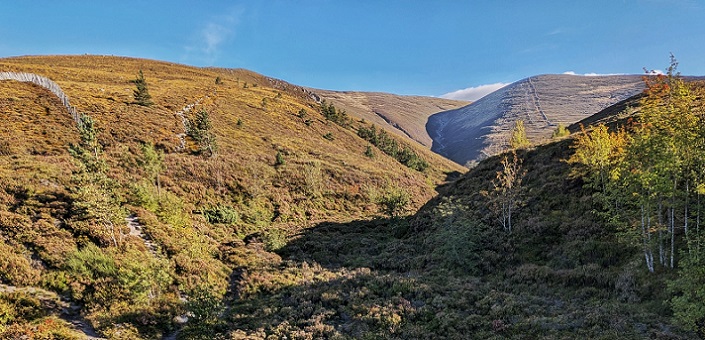
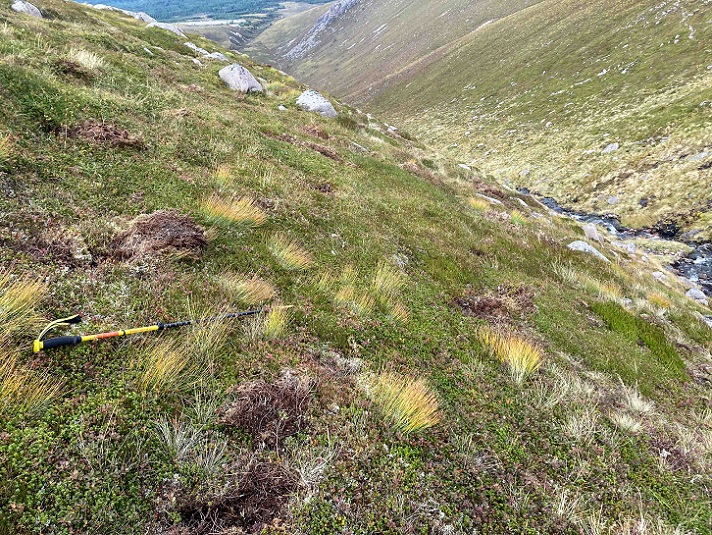
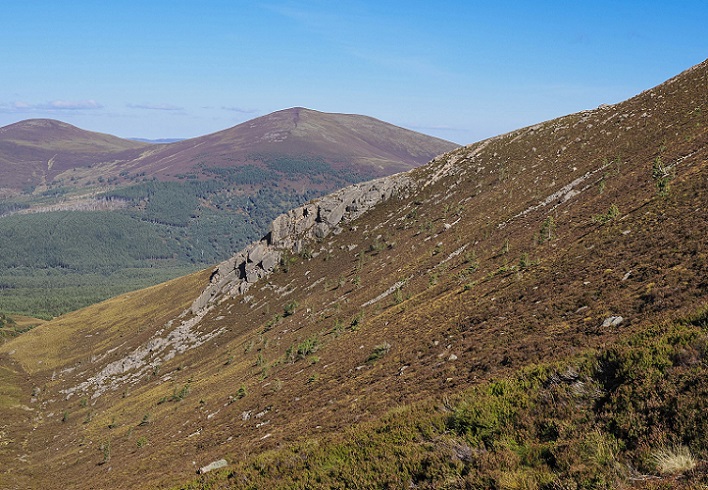
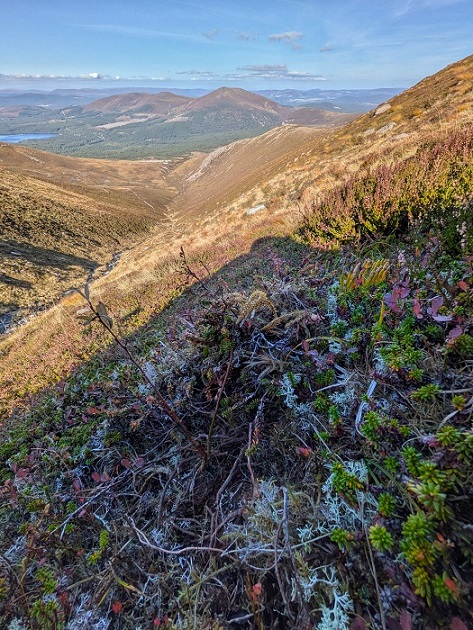
A natural treeline ecotone is already developing in Coire na Ciste. The lowest part of the project area, along the incised section of the Allt na Ciste, has abundant Rowan with Scots Pine (photo at head of this blog post). On west facing slopes below the Creagan Dubh footpath, treeline woodland and montane scrub of Scots Pine extends from 590 m to 800 m altitude (photo below). Here the density of pines is comparable or greater than that seen across wide areas of the nearby Northern Corries SSSI. Occasional pines are to be found higher still, the highest I have found within the project area being at 924 m.

The Soil Survey, undertaken in June 2024, also noted that “There is a degree of natural regeneration occurring throughout the site, with the exception of the montane Racomitrium heath on the highly exposed upper slopes at the head of the Gully“, and “It appears that regeneration of native species is already occurring and if low grazing pressure is maintained, it is likely in time, that the whole area will regenerate without any additional input.” However, the Soil Survey goes on to qualify those comments by saying “due to the short growing season and sparse density of parent trees, expansion and growth rates will be slow and some desired woody species may not have a local seed source which may limit the full diversity potential of the habitat“.
Minutes of a project meeting (November 2024), stated that the project “has arisen from the mutual desire (my emphasis) of land managers CMSL, CNPA and SCI to encourage the expansion of high altitude montane woodland and scrub in Coire na Ciste“, and that “The project aligns with CNPA’s Partnership Plan and Cairngorms Nature Action Plan including increasing native montane woodland and building and strengthening habitat networks“. The outcome was that “Low density (my emphasis) planting of native montane tree and shrub species will be used to speed up, diversify and enrich the natural regeneration already taking place in the corrie“.
Within a planting area of 17.5 ha (within a project area of 41.3ha), 30,000 trees have been planted (mean density 1714 ha-1). This is actually slightly higher than the 1600 ha-1 required for grant aided new native woodland schemes. Because of steep slopes, the area on the ground will be somewhat larger, so actual densities will be a little lower. While this is by no stretch of imagination low density planting, SCI predict that there will be losses, and there are no plans to replace lost trees, so the eventual outcome will be a lower density.
However, even allowing for losses, this number of broadleaves planted will dwarf the number of naturally regenerated Scots Pines already present, and so will not “diversify and enrich the natural regeneration already taking place in the corrie“. Rather it has the potential to replace a naturally developing treeline ecotone with planted broadleaves, with a minority of naturally regenerated Scots Pines.
The Planting Proposal stated that planting stock will be predominantly (my emphasis) from seed zones 201 and 202 (map below), which means from anywhere in the eastern Highlands, not locally sourced or even from within the Cairngorms National Park.
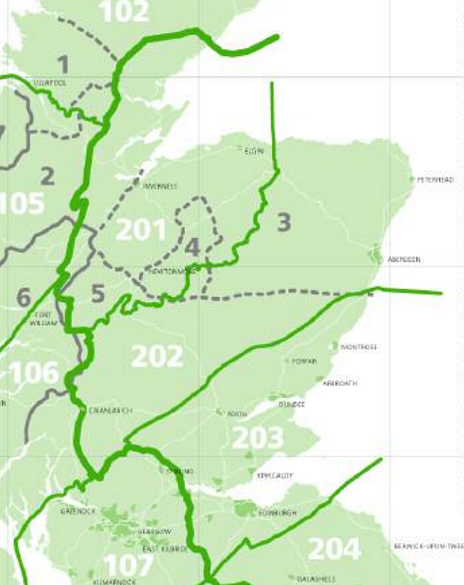
The species proposed to be planted (November 2024) and actually planted are listed in the Table below. All were sourced from seed zones 201 and 202.
Species planted in Coire na Ciste in descending order of abundance. Seed zone suffix ‘h‘ indicates where the altitude of the seed source is greater than 300m.
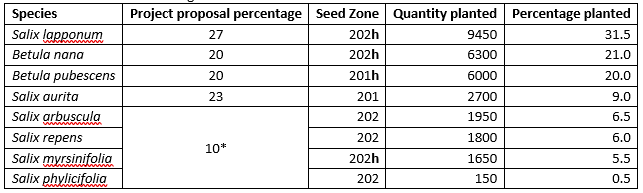
I checked the ‘Basic Material Register reference’ given in the ‘Tree Passport’ for the supplied planting stock against the online Register of UK Basic Materials (maintained by the Forestry Commission). Of the eight species planted two of the Basic Material Register references are not listed; for Salix myrsinifolia and Salix lapponum. The other six are listed, but plotting the latitude longitude of the seed sources indicates that two are from Dundee (outwith seed zones 201 and 202) and four are in the North Sea! I can only assume the online database is corrupted in some way. Therefore it is not known where the planted trees originate from.
Seed of four species was sourced from above 300 m altitude. For the other four species this is not specified, so seed may have come from lower altitudes, which is not ideal given that planting extended to more than 900 m. However Salix arbuscula which is not specified as having been sourced from above 300 m, is rare below 600 m, and is not recorded from below 342 m (https://plantatlas2020.org/atlas/2cd4p9h.cvf).
I discuss each of the species planted below. Note that the Project Proposal stipulated that “Only native and locally appropriate species (my emphasis) (were) to be planted“.
Dwarf Birch (Betula nana) – 21.0%
There are no native populations within 4km of Coire na Ciste. The vast majority of sites for this species in the Cairngorms National Park (CNP), and those nearest (on the RSPB Abernethy NNR), are on flat or gently sloping blanket bog, very different from the Coire na Ciste project area. However, B. nana can grow in wet heath vegetation, most notably in Corrie Chash, above the south-west end of Loch Muick, where a large population occurs on steep slopes with mineral soils. In the CNP, 89% of sites for this species are below 700 m, with the highest native site at 860 m. On my recent visit I found B. nana planted up to 933 m.
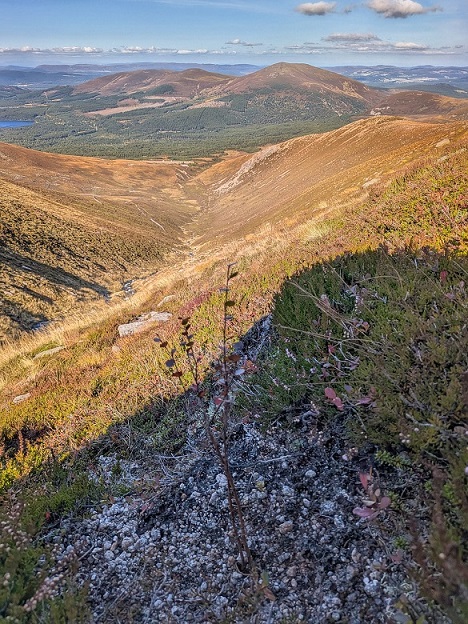
Downy Birch (Betula pubescens) – 20.0%
Already occurs up to the Coire na Ciste car park area and in the lower part of the project area. This species would have undoubtedly expanded naturally within the Coire given time. The seed zone (201h) indicates that seed was sourced from above 300 m. Downy Birch is variable, and planting stock should have been of the small-leaved form typical in Strathspey. This is currently named B. pubescens var. fragrans, (see my 2021 paper ‘Identification and taxonomy of Betula (Betulaceae) in Great Britain and Ireland‘, link above) though is often incorrectly named as B. pubescens subsp. tortuosa. Unless care has been taken, there is the risk that the larger leaved subspecies / variety ‘pubescens‘ may have been planted.
Mountain Willow (Salix arbuscula) – 6.5%
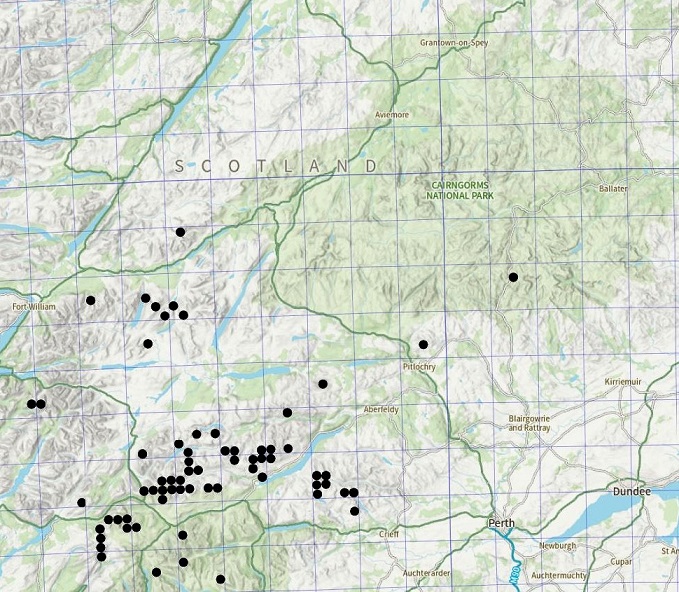
In the CNP the only confirmed records of Salix arbuscula are of two bushes south of the Glenshee ski area. Doubts have been raised about the other (few) CNP records, which may be misidentifications for other montane Salix species or hybrids. The core of this species’ range in Great Britain is in Breadalbane, Perthshire (map below), where it is found on base-rich substrates in flushes, on stream sides and on rock ledges.
Eared Willow (Salix aurita) – 9.0%
This species already occurs up to the Coire na Ciste car park area, and would have undoubtedly expanded naturally within the Coire given time. This species readily hybridises with Rusty Willow (S. cinerea subsp. oleifolia) = S. x multinervis. The hybrid is common in the CNP, but tends to occur at lower altitudes than reached by S. aurita. It is not stated that seed was sourced from above 300 m, and if from lower altitudes that increases the risk that hybrid rather than pure S. aurita may have been planted. They are commonly confused.
Downy Willow (Salix lapponum) – 31.5%
The nearest extant (very small) native populations to Coire na Ciste are in the vicinity of Loch Avon c. 4-5 km away. It was also recorded on Creag an Leth-choin in the 1970s and in 1991, again c. 4-5 km away. It has never been recorded from anywhere else within the Northern Corries SSSI, and I am unaware of any evidence that S. lapponum has ever grown in Coire na Ciste. While S. lapponum tolerates a wider range of soil conditions than most montane willows, it is typically a plant of moist moderately base-enriched soils derived from calcareous schist or limestone – https://plantatlas2020.org/atlas/2cd4p9h.w0b.
Dark-leaved Willow (Salix myrsinifolia) – 5.5%
In the CNP this is mainly a species of the south-western and southern areas of the Park (map below). There are only a few, mostly old records from Strathspey, and it has never been recorded from Coire na Ciste or the Northern Corries SSSI. There is a single old (1994) record from near Loch Avon.

Tea-leaved Willow (Salix phylicifolia) – 0.5%
This species does grow by the Ciste car park, where it may have been planted, and one very small bush was noted in lower Coire an Lochain this year. There are two recent records (2016) from near Loch Avon. Otherwise, in Strathspey it is mainly a more lowland species, most frequent on riverbanks and on loch shores. In the CNP 95% of records are from below 700 m altitude.
Creeping Willow (Salix repens) – 6.0%
There are no records from Coire na Ciste or from the Northern Corries SSSI. It has colonised the verges of the road up to Coire Cas, to c. 600 m altitude. In the CNP 99% of records are from below 700 m altitude. I found this species planted up to 912 m.
Records held on the BSBI Distribution Database (DDb) – https://database.bsbi.org/ for the eight planted species and for Scots Pine, Juniper and Rowan (already present in Coire na Ciste) were analysed. At the 1km Ordnance Survey grid scale (monad) one or more species are recorded in 27,882 monads in Scotland. In only 0.3% of these monads were more than six of the 11 species recorded, and in zero monads were all 11 recorded. Widening the analysis to the 2 x 2 km grid scale (tetrad), one or more species are recorded in 15,398 tetrads. In only 1.6% of these tetrads were more than six of the 11 species recorded, and in zero tetrads were all 11 species recorded. Therefore the planting in Coire na Ciste will create, if all the planted species survive, a species assemblage, which at the monad and tetrad scale does not occur naturally in Scotland.
Conclusion
An objective of the Cairngorms National Park Partnership Plan 2022-27 is “larger, more natural woodlands, expanding in places up to a natural treeline“. The Project press release described the Project as ‘woodland restoration‘. But, given that 70% of the trees planted are of species that have never been recorded in Coire na Ciste, it can surely not be described as restoration? That the assemblage of tree and shrub species is unknown in Scotland, confirms that the project has, indeed, not been one of woodland restoration and the outcome will therefore not meet the CNP Partnership Plan objective of ‘more natural woodland’. In addition, it has not been possible to clarify the origin of the seed used, though it seems unlikely that any of it was of local origin.
I am not as strictly anti-planting as some other critics of this scheme. There is sometimes a conservation case to intervene by planting, e.g. to reinforce existing remnant populations, perhaps with new, unrelated individuals (termed ‘genetic rescue’); or to create new stepping-stone populations between remnant stands of a species; or to create new seed sources in locations remote from existing populations. However, where nature conservation is the management priority, (and since the dismantling of most of the skiing infrastructure that applies to Coire na Ciste), a strong case can be argued that interventions, such as planting, should be the minimum to achieve conservation objectives, and no more than that.
I can envisage three different management options for Coire na Ciste, a case for each of which could have been developed as scientifically and ecologically credible proposals. In outline these are:
1). No planting. Treeline woodland and montane scrub will continue to develop naturally and gradually.
2). Small scale planting of Downy Birch in the lower part of the coire, with planted trees grown from seed collected from trees above 500 m in the local area. These planted trees to provide a seed source for future woodland expansion within the upper part of the coire.
3). As 2) with additionally, trial planting of Dwarf Birch on mineral soils, and Downy Willow. No planting above 700 m altitude (the approximate treeline).
The Cairngorms National Park Partnership Plan 2022-27, in section A2 Woodland expansion, states that “Our guiding principle in the National Park is ‘the right tree in the right place for the right reason’“. Even being charitable, it is very difficult to square the actual planting in Coire na Ciste with that principle. To be honest, I think it impossible.
What went wrong, and what lessons might be learnt for the future?
- The Project Partners, especially CNPA and SCI exist to deliver Actions. The first sentence in the Cairngorms National Park Partnership Plan 2022-27 states “The nature and climate crises require leadership and action …”. They have Plans and timetables. They are impatient to see change.
- Existing upland habitats in the CNP have inherent value, often expressed through nature conservation designations. Yet, in my conversations with CNPA and SCI it was argued that we should not be too tied to the existing vegetation communities as models for the future, and to do so was an artificial restriction.
- The combination of the above two points, a sense of urgency to implement Actions, and insufficiently valuing existing habitats and vegetation communities, risks making mistakes, as happened in Coire na Ciste.
- SCI’s work typically involves riparian woodland creation, river restoration, and removing man-made barriers to fish migration. The Coire na Ciste Montane Woodland Project was a departure from their usual on the ground activities, and they may have lacked expertise in this area.
- There was an uncritical adoption of planting rather than allowing for the slower option of ongoing natural regeneration. It appears that a decision to plant trees was settled on from the outset.
- There was a lack of understanding by the Project Partners of the plausible species composition of treeline woodland and montane scrub in Coire na Ciste. The most likely species to form woodland and scrub in this coire, with its acidic soils, are Scots Pine, Juniper, Rowan, Eared Willow and Downy Birch.
- Based on their Scottish and CNP distributions neither Dark-leaved Willow (Salix myrsinifolia) or Mountain Willow ( arbuscula) should have been planted, the latter being an especially bizarre addition to the planting mix. The case for planting Dwarf Birch, Tea-leaved Willow and Creeping Willow was weak or absent. A case for limited, experimental planting of Dwarf Birch and Downy Willow could have been made, but 6300 and 9450 planted trees, no.
- It is unclear how the choice of trees to be planted was decided on and it is unclear if consultation during the initial stages of the Project included anyone with sufficient knowledge of species and habitats so as to avoid the inclusion of unsuitable species.

As soon as this project became public knowledge both the SCI and CNPA were told that the Ciste was a totally inappropriate place for this planting, given that natural regeneration was already establishing new woodland in Coire na Ciste. The place for such planting is in the already much modified Coire Cas, not the natural landscape of the Ciste. This advice was ignored, with the result that the CNPA has wasted over £40,000 of public money on planting trees in the wrong place. When is the CNPA Board going to get a grip on this misguided use of their budget? Or do we have to wait for a ministerial intervention to bring this shambles to an end?
It is not the first time planting in this general area has taken place. I seem to recall the Forestry Commission did some to diversity the landscape as they saw it many years ago. The area used to be quite heavily grazed by sheep from a neighboring holding but these were eventually excluded. In the 1980s the then HIDB launched a project to plant across that wider Ciste -Cas area. The approach was a lot less sophisticated than the most recent attempt – a good deal less sophisticated in fact! A large area was deer-fenced off. Areas to be planted selected and designed by simply outlining them on a photo I recall to give a more varied landscape – no nasty straight lines etc! These were then planted with mainly Scots pine. I then visited the site with Adam Watson.It was revealing. There was already widely scattered regeneration of pine and birch (I cannot recall which birch – sorry). It was by no means a dense regeneration – but very significant and, given time, would develop well. So why plant all this? Had the site been properly assessed before planting? Would simply scarifying some areas a bit to encourage natural regeneration not have worked fine? As a consequence of designating planting zones by outlining them on a map/picture or some such simplistic approach, guess what? One at least of the areas was actually deep rather soggy peat (My fading memory is a bit vague on nos). Not to be defeated, the planters simply brought in a large tracked digger which scooped up peat into some steep small peat piles (drying out nicely and getting windblown) and trees were planted on to of these! As it trundled across the hill, the digger wrecked numerous self sown young trees along the way. I have not visited the site for a long time. Andy Amphlett might find it interesting.
Planting trees in earlier days in the whole area – that is the Glenmore National Forest Park -could be even more irrational. The most famous tree in Glen More was not some ancient pine but The Glenmore Birch! I cannot recall anyone studying it but anyone who visited it knew they were looking at something unique and very different. It was a well grown. One of the foresters appointed to manage the area decided to plant Sitka spruce (some enraged members of the public started tearing them up). But those planted around the Glenmore Birch were not and the shaded it out over time.
great to see that you’re still to the fore, Drennan. Pity those great interviews we did in Norway for the’ Whose Land Is It Anyway’ program, way back in 1994, have been consigned to the missing archives.
A thorough and detailed critique of an ill-conceived planting project by CNPA and SCI – my problem is whether CNPA is taking any heed of what they did wrong. The ‘adult’ way forward for CNPA would be to either publicly defend the planting they funded using the scientific approach Andy has presented in this blog, or admit that there are lessons to be leant and open up a professional dialogue on what should happen if and when similar future projects come to light.
Unfortunately my money is on CNPA ignoring this knowledgeable criticism and hoping that the issue will just ‘blow over’.
I have a vague memory of a plan to plant trees in the adjacent Coire Laogh Mor in the late 1990s which I think was abandoned. I’m sure I can remember visiting the area proposed and finding that the vegetation survey (a random sampling rather than a full survey by Neil Bayfield & colleagues at ITE/CEH) had missed the exisiting natural regeneration (& also some Sitka spruce seedlings). This new planting seems very misguided although I suspect that the sub-alpine willows which have never occured in the northern Cairngoms will die as the soil conditions are very different from their usual sites.
Oliver Rackham said: “planting trees is a failure of conservation”! At the community-managed Craig Meagaidh (I’ve probably spelt this wrongly), native Scots pines are regenerating simply due to selective deer culling.
A very well-researched and scientifically and sensibly argued case, based on deep local knowledge (which I can vouch for, knowing the area in question and its habitats fairly well), against this extremely ill-advised planting scheme.
Good work, Andy.
Whether CNPA (and SCI) will pay any attention is another matter. Also wonder whether we have already seen or will see other such ill-conceived planting schemes in other ‘montane woodland’ target areas?