
One of the great pleasures of walking in the Alps are the mountain flowers. I have always got particular enjoyment from seeing plants which are rare in Scotland, like the Alpine Sow Thistle, growing profusely. Until recently the Alpine Sow Thistle was confined to a few inaccessible ledges in the Cairngorms but last year was “re-introduced” to the northern half of the Mar Lodge Estate by the Royal Botanical Society of Edinburgh (see here). a project made possible by the huge reduction in deer numbers there (see here).
The distribution of more common plants also have a story to tell. This year I had walked by quite a few wild raspberry rubus idaeus and had eaten some of their berries, which are smaller than the cultivated varieties, before I noticed something I had never noticed in Scotland. Wild raspberry was growing profusely alongside blaeberry vaccinium myrtillus:
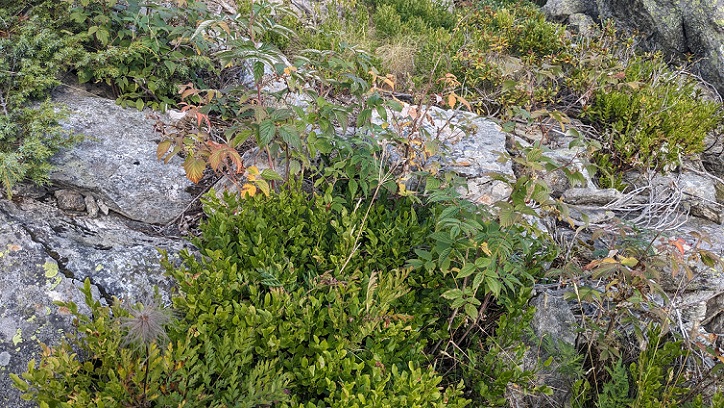
In Scotland I have thought of the two species as growing in different places: blaeberry on open slopes at higher altitudes and in the Caledonian Pine Forest; raspberry on lower ground and in and around deciduous woodland. While it is quite possible I have not been looking nearly carefully enough in Scotland, my copy of the Joint Nature Conservation Committee guide to British Upland Vegetation (2004 edition) contains frequent references to blaeberry but only four to raspberry. The two species are never mentioned as occurring in the same vegetation communities, i.e as growing together.
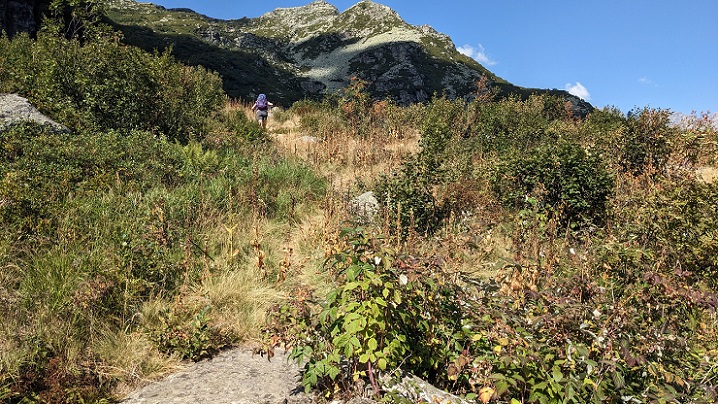
The evidence I saw in Italy showed the two species do grow together in the montane scrub zone and from what I saw are associated with both green alder, which is non-native to Scotland, and juniper. The question this raises is why don’t we find a similar vegetation community (minus the green alder) in the Scottish uplands?
While cultivated raspberry is often associated with Scotland’s temperate climate, the seeds of wild raspberry have been found in interglacial deposits in Britain (Godwin, History of British Flora 1956) and it re-colonised Scotland soon after the end of the last ice age. Its association in Italy with green alder, a small tree whose bendy branches flatten under snow and avalanches before bouncing back in spring, also shows it is adapted to the colder conditions which are found in the Scottish Hills. In fact, one of the most commonly cultivated raspberries in Scotland is known as Rubus idaeus “Glen Clova” as it was bred from wild raspberries from that glen. While the wind may, as with trees, play an important role in determining where in our hills wild raspberry might grow in Scotland, it doesn’t explain its absence/rarity.
There seems no reason why the two species should have not once occurred together in upland Scotland as they do in Italy. Research into pollen records could help establish whether that was once the case or not. But, if it was, there is a good explanation for why the two species are no longer associated as growing together in Scotland’s uplands: three hundred years of overgrazing! While this has suppressed bilberry, it has had an even more disastrous impact on wild raspberry which is very palatable to deer (see here).
Eleven months ago the James Hutton Institute was awarded £1m to try and address the crisis enveloping the UK’s raspberry industry. This is in part economic and in part environmental (see here). The plan is to respond “by developing raspberry varieties that require less water, fertiliser and labour to grow”. Previous research by the James Hutton has shown the populations of wild raspberry in Scotland represent a “huge genetic resource” that could be used to respond to such challenges (see here).
That research, however, also showed that while there were small wild raspberry populations in the Scottish hills – the highest at an altitude of 600m – that resource, much of which was in what is now the Cairngorms National Park had been in dramatic decline:
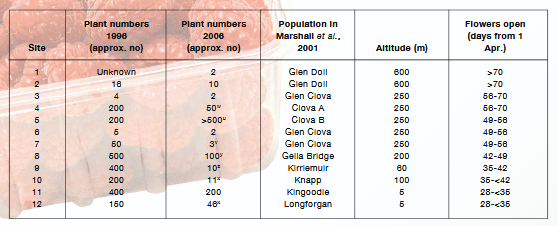
That begs the question of how many plants there were at these sites in 1976 or 1956 and whether the plants found in 1996 were remnants of a once much larger population. It would be interesting to know what has happened on these sites since 2006 but the failure of our public authorities to tackle the huge deer population in Caenlochan (see here) suggests the plight of the wild raspberry in Glen Clova and Glen Doll is unlikely to have got any better. Perhaps the scientists at James Hutton will have to visit Italy to find the wild raspberry genes that might save Scotland’s raspberry farmers?
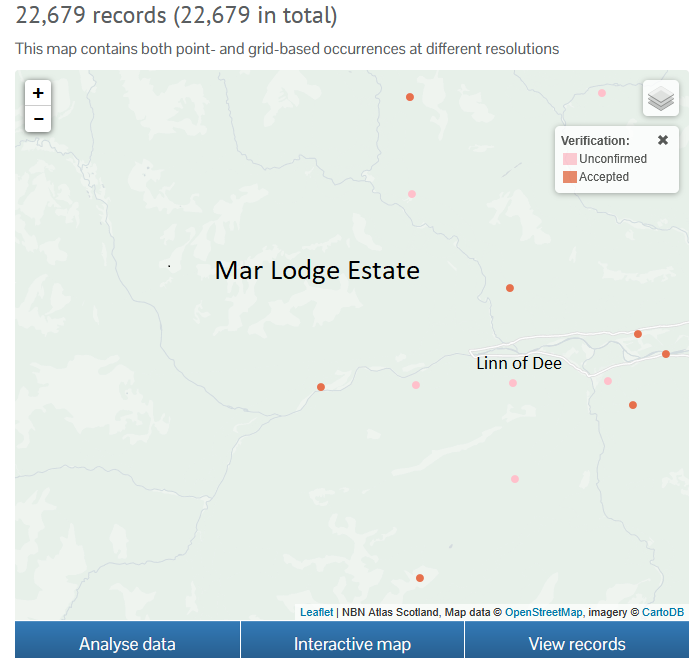
Despite wild raspberry being fairly common in Scotland, records show it is now almost completely absent from parts of the uplands as this screenshot illustrates:
Even if research into pollen records were to show wild raspberry was once far more common in the central Cairngorms, the conservation response should not be to plant it. This is partly because centuries of overgrazing and burning (on the southern part of Mar Lodge) have changed soils and these may now in places favour other plants. It is also because wild raspberry could spread quite rapidly through birds and mammals (including humans) eating its berries and then distributing its seed through faeces across the countryside.
Italy also provided evidence which demonstrated how nature restores itself. Much of the montane scrub where I saw wild raspberry was on land that just a generation or so ago had been used as “alpes” and far more heavily grazed. The wild raspberry has recolonised that ground in Italy without any human intervention apart from the reduction in grazing pressure. It could do so in Scotland too along with all the other plants that have now disappeared or are rare in the uplands because of overgrazing.
