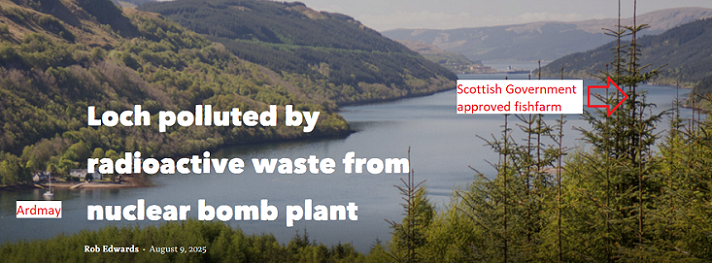
 The timing of the Scottish Government’s announcement on Tuesday that Scottish Ministers, i.e Ivan McKee the Minister for Planning, had decided to overturn the Loch Lomond and Trossachs National Park Authority’s decision to refuse the proposed fishfarm in Loch Long (see here) could hardly have been worse. It came just two weeks after the Ferret had revealed the leaks of radioactive waste into Loch Long that had been covered up by the Ministry of Defence (see here).
Does Ivan McKee, the planning minister, never read the Ferret? But perhaps, given the terrible track record of the fishfarm industry in Scotland, as uncovered by the Ferret and other activists over many years, he has decided Scotland’s fish farm industry needs finishing off for good? How will anyone who still eats farmed salmon know what has been farmed in places where there have been radioactive leaks and what not?
Even more incredibly, the Ministerial decision letter (see here) states (para 45) that Scottish Ministers agree with the Reporter that “the health or welfare of the fish or the adequacy of fish for human consumption were not relevant considerations in this appeal”. The implications of this for people in Scotland are serious. It means the Scottish Government sees no reason for the planning system to refuse fish farm applications by the outflows to nuclear power stations or other sources of pollution, such as sewerage. Worse, it means the Scottish Government sees no need for the planning system to consider the health implications of developments on any polluted site since such matters are “for other regulatory regimes”, regimes such as those which allowed radioactive water to be discharged into Loch Long and then covered this up.
In the list of conditions attached to Mr McKee’s decision letter, there are no requirements on the developer to provide any further information relating to either human or animal health and welfare. Contrast this with the planning condition proposed by the LLTNPA in its submission to the Scottish Government Reporter in the Flamingo Land appeal BEFORE Ivan McKee decided to allow Flamingo Land to write its own set of planning conditions (see here) :
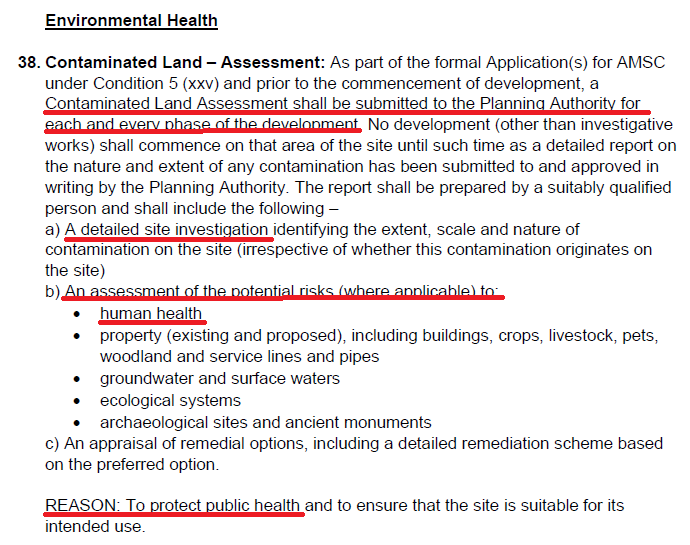
It is clear that the LLTNPA, like other planning authorities, believed that human health should be a material consideration when it comes to determining planning applications. Mr McKee has opened the door to every developer in the country to appeal against such conditions. More specifically, his decision on Loch Long does not bode well for his decision on the Flamingo Land application, where much of the development proposed for the Riverside Site is on land that is widely suspected to be contaminated. From the precedent he has set at Loch Long it appears Mr McKee will be content to have that land dug up without any further assessment of the risks and without there being any agreed mitigation measures in place.
The unaccountable power of Scottish Ministers
After the LLTNPA Board rejected the Loch Long fish farm application in October 2022, the developer appealed. Then, in March 2023, Scottish Ministers announced that they, rather than the Reporter conducting the appeal, would take the decision because:
“the proposed semi-closed farming system is a new technology for Scotland that raises issues of national significance in view of its potential impact on Loch Lomond and the Trossachs National Park. Therefore Ministers recall the appeal for their own determination.”
That new technology is more properly called a semi-closed containment system (SCCS). Instead of farmed fish being kept in netted pens, which allow sea lice in and salmon faeces out onto the sea-floor, under a SCCS the fish would be kept in huge impermeable bags. Sea water, pumped from depths lower than where sea lice can survive, would then be pumped in and out of the bags while an estimated 85% of the salmon faeces would be extracted onto dry land. A good idea, in theory.
The Reporter appointed to report on the Loch Long fish farm planning application held public hearings in September and October 2023 – a contrast to Mr Buylla in the Flamingo Land case who decided no public hearing was necessary – before publishing his report on 15th February 2024. This report recommended the application be rejected. Scottish Ministers then sat on that report for 18 months. While every other public sector player in the planning system is subject to timescales and targets, Scottish Ministers and their supporting cast of civil servants do as they please.
The extraordinary thing about this long delay is that, having called in the application because the proposed semi-closed containment system (SCCS) was untested in Scotland, the decision letter states Scottish Ministers fully agree with what the Reporter said about these systems 18 months earlier:
“The extent to which the proposed development is novel or untested.
11. The Scottish Ministers agree with the reporter’s consideration of the proposed development relying on novel or untested technology (paragraphs 19 – 26). Aside from the consideration of the various potential effects of the development, there should not be an overarching presumption against
approval based on any novelty of the technology proposed.”
If this is correct, why then was there any need for Scottish Ministers to call in this appeal or wait 18 months to issue their decision? In my view, however, the original letter was right and the issue is that Scottish Ministers have failed to consider properly the implications for the precautionary principle, which formed part of EU Law and is embedded in “Scotland’s Guiding Principles on the Environment” (see here) and Policy 4 of National Planning Framework 4 on Natural Places:
“The precautionary principle will be applied in accordance with relevant legislation and Scottish Government guidance”.
While the Reporter took quite a narrow view of the precautionary principle, he at least considered it in relation to the marine environment in Loch Loch , whereas the Ministerial Decision letter takes an even more limited approach and only considers this under the heading “Effects on Wild Salmon” where it asserts “there is no sound basis for taking a precautionary approach purely on account of any notion that the technology which would be used, is untested.”
In my view both the Reporter and the Scottish Government have completely undermined the precautionary principle missed the point here. The whole point about the precautionary principle in respect to planning is it is precautionary. The issues in respect of introducing new fishfarming technology to Scotland is about HOW and WHERE such new fish farming technology should be tested or applied. Most of those concerned about the environmental impact of fish farms would have welcomed an application for an existing polluting open net fish farm to be replaced by the newer SCCS technology on a trial basis, as long as the development was of a scale that if the system failed for some reason the impact of this could be contained. But that is not what has been proposed at Loch Loch: a mega new fish farm in a loch where there are no fish farms or their associated pollution at present and in a National Park which was set up to protect the natural environment.
What Loch Long needs is resources to clear up the marine litter (see here) and effective regulation of the MoD by SEPA, to prevent any further radioactive escapes, not a fish farm which will add that litter and pollution, let alone one using technology of which there is no experience in Scotland.
The Reporter did, however, find that the development would conflict with the LLTNPA’s Local Development Plan – approved by Scottish Ministers! – and the statutory aims of Scotland’s National Parks, which puts conservation first, which is why he endorsed the LLTNPA’s decision to reject this application. The decision overrides those conclusions, for example:
“The Scottish Minister agree with the reporter that fish farm development is inevitably industrial in appearance but consider this should not count against it”.
What????!!!!! This is supposed to be a National Park? On this logic, every single National Park and National Scenic Area in Scotland will soon be plastered with windfarms because the industrial appearance of these developments should not count against them.
And:
“62. The Scottish Ministers agree with the reporter that the special landscape qualities of the National Park would be protected in accordance with the first requirement of Natural Environment Policy 1 of the LDP. The Scottish Ministers give this significant weight in their consideration as to whether there is, as the reporter concludes, conflict with the first aim of the National Park (to protect and enhance the natural and cultural heritage of the area) from a landscape, seascape and visual impact perspective. Overall, the Scottish Ministers are satisfied there would be no conflict with the first, or any other, aim of the National Park”.
Here Scottish Ministers twist a policy, which is secondary to the statutory purpose of Scotland’s National Parks, to undermine those objectives. Note how there is NO evidence provided to justify this conclusion.
And,
“The Scottish Ministers agree with the reporter and are not aware of any means by which visual effects could have been further minimised through design changes”.
What this says is Scottish Ministers believe the ONLY function of the planning system in respect of the landscape is to mitigate the visual impact of development and once this has been “minimised” the development should go ahead whatever the impact on the landscape.
Scotland’s “finely balanced” planning system – every policy has a qualification which allows the opposite – is a developer’s charter. Within this context the way the planning appeal and call-in system works in Scotland works is that all Scottish Ministers have to do is say they give more weight to one policy rather than another and then state they “are satisfied” and they can do whatever they want.
Although they had no reason to call-in this decision, given that they fully endorsed what the Reporter said about the use of new technology, by doing so Scottish Ministers gave themselves the power to override the Reporter should they find in favour of the LLTNPA on other matters, which they did.
The position of the LLTNPA
The response to the LLTNPA to this scandal, which completely undermines the purpose of National Parks and the reason they exist, was completely anaemic. They issued a news release (see here) the same day as the Scottish Government issued their decision letter, suggesting its content may have been prepared and agreed with Scottish Government officials beforehand. The quotes from its Convener, Heather Reid, start well:
“The National Park Authority Board refused this planning application on 31st October 2022, concluding that a National Park was not the appropriate location for a fish farming development of such industrial scale. Board members cited the significant landscape, seascape and visual issues of the proposed development and that the risk of an escape of farmed fish could impact on the fragile wild salmon population.”
But then, while stating the LLTNPA stands by those reasons, Dr Reid completely rolls over, claims this was a “finely balanced decision” and indicates the LLTNPA will co-operate with implementing the Ministers’ decision claiming the planning conditions:
“will help ensure there are the significant environmental and operational safeguards in place to mitigate – as far as possible – the impacts of the development on the nationally important landscape.”
It appears that neither Dr Reid nor her staff had read the planning conditions properly or considered the implications of Scottish Ministers removing any requirement for further assessments on the potential impact on human health.
What Dr Reid should have done was state that her Board would be fully discussing the implications of the Ministerial Decision and what they should do next at their next meeting (Monday 15th September). By effectively endorsing the Ministerial Decision, Dr Reid and Gordon Watson, the Chief Executive, advising her have made it much harder for anyone else to challenge Mr McKee’s decision legally. That in my view is not an accident. Those who are supposed to be custodians of our National Parks won’t bite the hand that feeds them.

The Scottish Government’s decision to approve the Loch Long Salmon fish farm proposal could represent the death knell to most of the salmon farming industry in Scotland. If this Loch Long project comes to fruition how can anyone buying salmon in the UK from a shop or restaurant be confident that it has not been contaminated by the radioactive pollution present in Loch Long? It is the same problem as eating grouse. I stopped ordering grouse from a menu when I realised how much medicated grit is used to feed the grouse on our moors. So anyone who wants to eat salmon in future, or benefit commercially from its production, needs to consider how to stop the Loch Long salmon farm becoming operational.
Star job Nick and well said Dave Morris
for those of you who were disappointed over the decision not to have a Galloway National( fakeroo) Park you missed out on Sweet Fanny Adams–or words to that effect.
As taught in school science, before getting worked up about radioactivity, you ned to consider the level of radioactivity compared with (for example) the natural background: arising from the rocks below and from cosmic rays above.
SEPA do that job, and regarding the recent incident, they concluded the risk to the environment from effluent discharges was “of no regulatory concern.”. So, while the RN is rightly castigated for taking insufficient care to prevent discharges, they and their neighbours have got away with it so far.
The way to deal with the risk of bad nuclear accidents in the future is to get rid of the nuclear bases at Faslane and Coulport; not restrict the lives of people who live, farm and work within 10 miles of the bases.