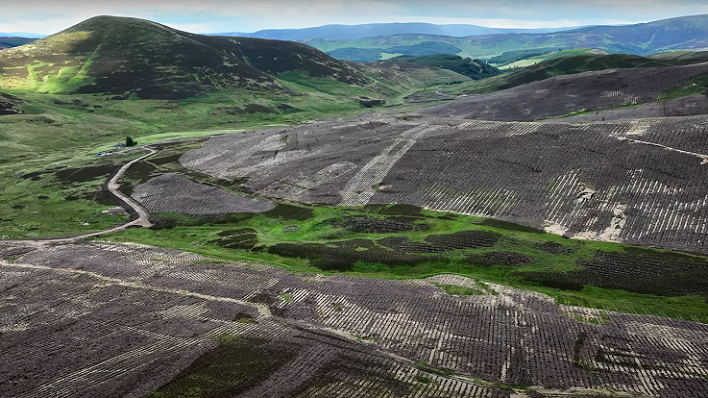
It is over six months since I blogged about how the crisis facing commercial forestry interests at Stobo Hope in the Borders (see here). Since then a successful judicial review by the Stobo Residents Action Group has forced Scottish Forestry, the public agency responsible for regulating forestry and distributing grants, to cancel the £2m grant contract they awarded to the Forestry Carbon Sequestration Fund.and later to concede that an Environmental Impact Assessment is now required. The group’s crowdfunder page (see here) has more details about what is going on and fantastic drone footage (as above) of the damage that was done to the site before forestry operations were forced to stop.
In response, True North Real Assets Partners, who manage the Forestry Carbon Sequestration Fund, and their forestry agents, Euroforest Silviculture have set up a Stobo Hope Forest website (see here). Last year Euroforest, then called Pryor and Rickett Silviculture, applied for a fox hunting licence at Stobo Hope for the “environmental benefits” this would bring by reducing predation of black grouse (see here). Those claims were rejected by NatureScot who concluded that the new Sitka spruce plantation would result in the effective extinction of black grouse on the site.
The new website is now claiming the project will “create a new mixed productive forest that will bring environmental, social, and economic benefits to the Scottish Borders”. This posts takes a look at their claims in more detail, based in part on a visit to the site in February
Mixed forest or sitka plantation?
The species plan for the Environmental Impact Assessment scoping opinion on the Stobo Hope Forest website (see here) states pure Sitka will cover 55.2% of the ground, while another 2% would be covered by a Sitka and broadleaf mix. Other tree species will cover just under 25% of the area. If open ground is removed from the equation, over 72% of the trees which would be planted are Sitka, with commercial conifers making up 82%..
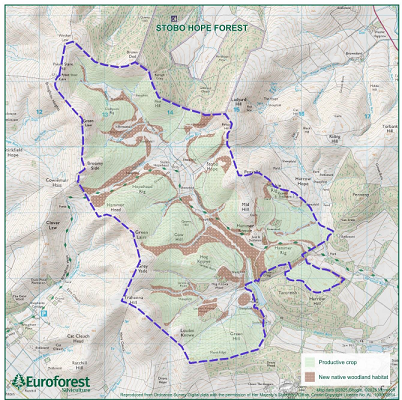
The planting map on the new website, as shown above, is highly misleading. All the “productive crop” is Sitka spruce except one small area of Douglas Fir in the south east corner while the native woodland habitat, some of which has been sprayed with herbicide, includes densely planted Scots Pine grown for commercial purposes. The actual proposal is shown from another map which formed part of the grant documentation:
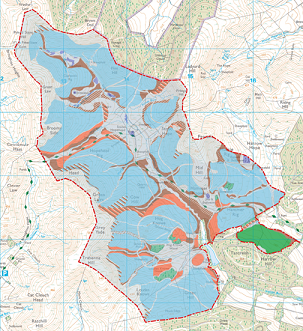
The end result, in terms of trees on the ground, will be even more Sitka than this because it is the tree species least palatable to herbivores. Seed from Sitka is therefore most likely to colonise the open ground (as is happening all over Scotland), while a proportion of the planted deciduous trees will be killed off by browsing as deer get through the fences (as is also happening all over Scotland). It is certain therefore that under current plans Sitka would end up covering far more of the ground and a far higher proportion of the trees planted than claimed.
Yet the opening Stobo Hope Forest webpage state: “the site will be broadly developed as a mixture of 50:50 native woodland & open ground and commercial crops” and “Non-native conifer species will not exceed 50% of the scheme area”. That claim is disproved by the developers’ own data.
Currently almost half of all trees (47%) in Scotland are Sitka spruce, significantly less than what is being proposed at Stobo Hope. That is still, however, far far higher than what the seventh report of the UK Climate Change Committee, published earlier this year, recommended to the UK and Scottish Government::
“The pathway assumes a mix of broadleaf (65%) and conifer (35%) new woodland to avoid non-resilient monocultures and to deliver wider benefits,’.
Meantime, Scottish Forestry goes on approving and awarding massive subsidies to schemes with ever higher proportions of Sitka spruce so it can keep the timber industry happy.
Alleged biodiversity benefits
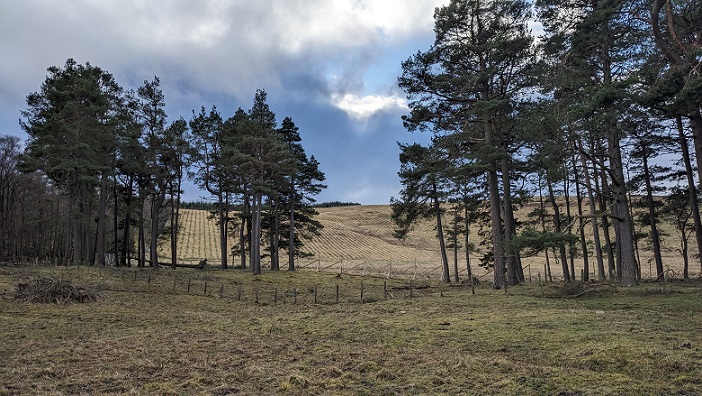
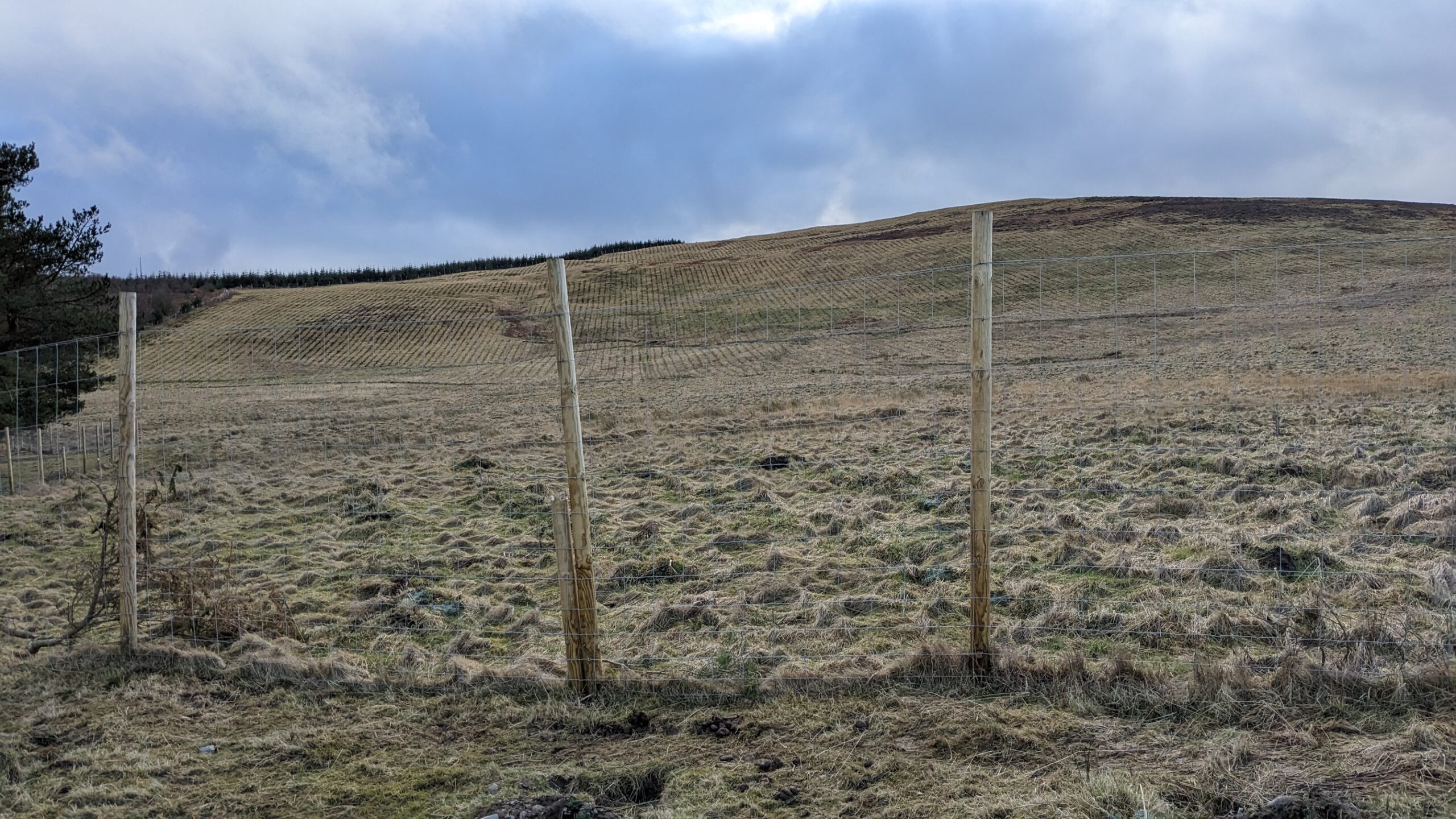
The approach track from the spa at Stobo Castle to Stobo Hope passes through various examples of tree planting, old and new, before you get a glimpse through a Scots Pine shelter belt of what True North and Euroforest (whom I will refer to as the “developers”) did to the land before they were stopped. Rows upon rows of mounds behind an unmarked deer fence.
The black grouse on site may well, like capercaillie (see here), l be finished off by the invisible wires of the large mesh deer fences:.
 The developers omitted to mention these fences when claiming the trees they hope to plant will improve habitat connectivity for animals:

Nor did they explain how larger mammals like foxes and deer will get through these fences (but perhaps they can use the gates – see below?!).
Once onto Stobo Hope it became clearer that the developers had not only started to plant Sitka on mounds, they had killed off much of the vegetation around through the application of herbicide
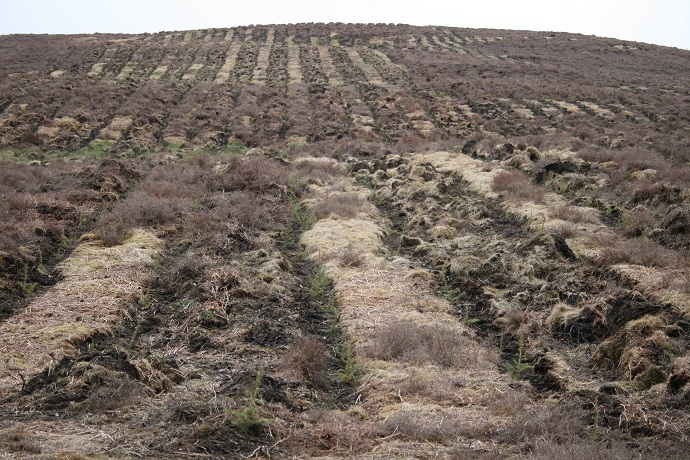
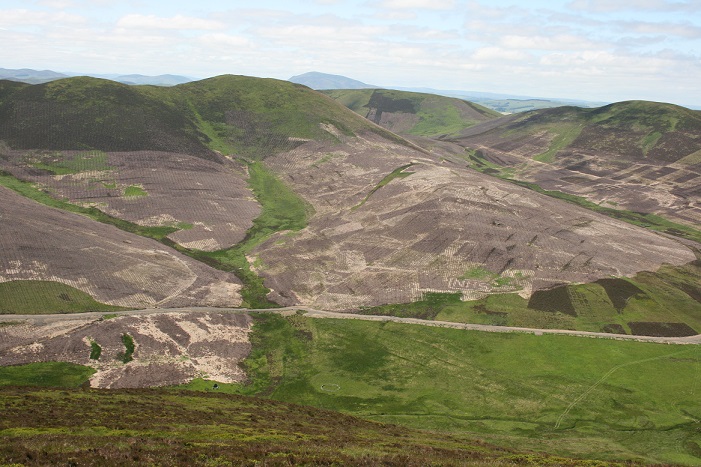
While the effects of the spraying had faded over time and due to vegetation having died off naturally over the winter, on closure observation it explained the state of the hillside. The differences between sprayed and non-sprayed areas are even striking in a photo taken by the Action Group almost a year after the herbicide was applied in August 2023:
The herbicide spraying is not mentioned on the new website where the sections on the benefits of new woodland starts with:
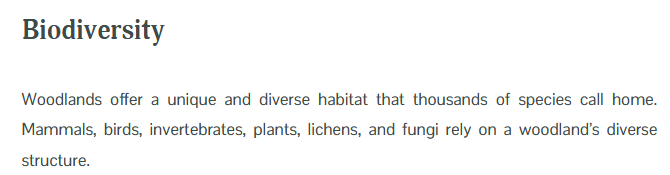 To date the creation of the Stobo Hope Forest appears only to have killed species!
The developers go on to make some claims about the specific benefts of non-native conifers which in this case basically means Sitka:
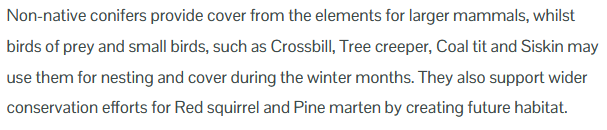
The question of how the Sitka will benefit larger mammals if they are kept out of the area by deer fences is not addressed!
As for seed eating birds and squirrels, the developers don’t explain that of all the trees planted in Scotland Sitka supports least native wildlife because its seed is so small and lacking in nutrition (see here for fuller explanation and why other non-native conifers like Norway Spruce are better).
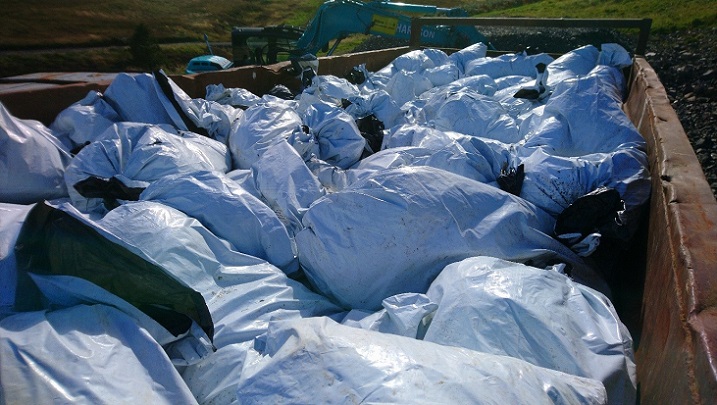
The website also does not mention the thousands of plastic tree tubes the developers started using to “protect” broadleaf trees and the impact these will have on biodiversity as they get into the food chain:
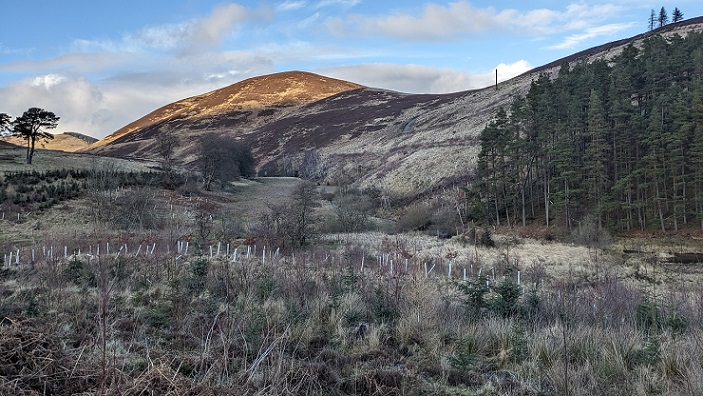
Flood mitigation?
The website makes a number of claims about flood mitigation which bear no resemblance to what the developers have done on the ground, for example:
“soils under woodland tend to be better structured than under other land uses, enabling more storm rainfall to enter and pass through the soil rather than quickly run-off the surface. Woodland soils have 11 – 20 times greater permeability than pasture soil increasing the capability for stormwater to pass in to the soils.”
Actually, peaty soils and their associated vegetation store water better than woodland but the developers totally undermine their claims by what they have done on the ground:

Killing off vegetation with herbicide and the vehicles used for mounding creating lines down the hillside increases the rate of water run-off and the risk of flooding. The developers also claim tree cover protects soils but have destroyed the soil structure through mounding in order to plant trees. They will then modify that soil structure all over again when the Sitka is harvested approximately 35 years after planting and then, if current rules continue to apply, restocked!
Carbon offsetting
Carbon offsetting and the Scottish Government’s tree planting targets has provided the commercial forestry industry with a new justification for planting trees which it is now using to justify the planting of Sitka. Their basic argument is that since Sitka grow faster than any other tree they absorb more carbon from the atmosphere and are therefore the way to save the planet. This is how it is put by True North and Euroforest Silviculture:
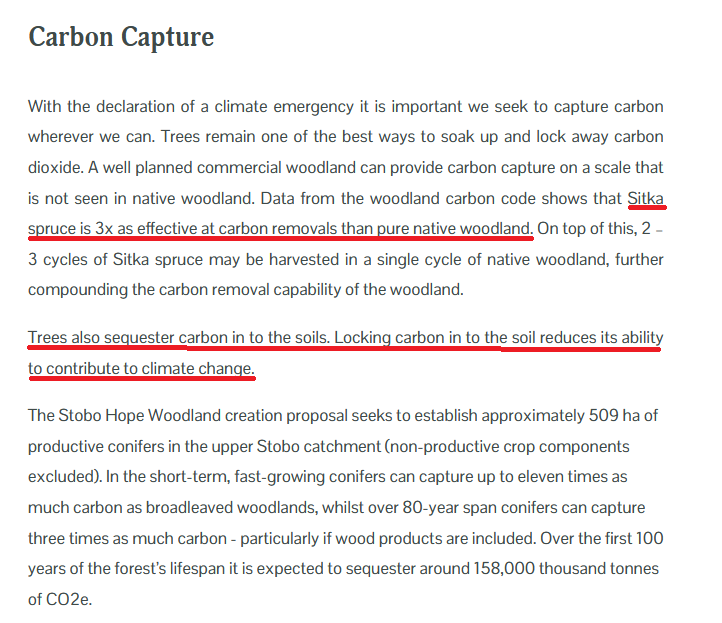
This argument ignores both the Sitka carbon cycle and the impact that planting has on organic soil carbon.
Most Sitka, once harvested, has a very short life span, being used for things like wood pulp, and therefore the carbon captured by the wood is rapidly released back into the atmosphere. There is a place of course for short-life wood products, although demand for them products would be reduced in a more “circular economy”. However, to claim this makes Sitka better for absorbing carbon than native woodland is nonsense.
Carbon that is captured as an oak tree grows can be kept out of the atmosphere for hundreds of years and if the timber it then produces in embedded in buildings (many of Scotland’s oldest buildings are still held up by oak), oak can potentially lock up the carbon for a thousand years. That compares to 35-40 years for most Sitka. If atmospheric carbon is the concern, Scotland’s forestry industry should be taking the long-term view and planting native hardwoods.
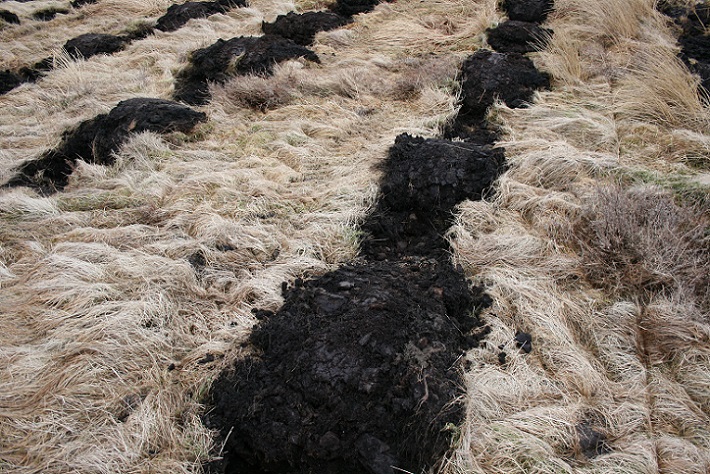
Organic soils, peat especially, are a far more important means of storing carbon than trees and planting Sitka on such soils is even more damaging because of the way the forestry industry harvests the species as soon as possible. Turning the developer’s argument above against them, three timber harvests in a century represents three major events causing soil organic carbon to be released into the atmosphere.
Health and well-being and access
It is perfectly true that forests CAN improve health and well-being! But none of these benefits have been shown to apply specifically to Sitka plantations in the UK – or indeed native woodland plantations – rather than woodland more generally.
On 10th July Forest Research published its latest public opinion survey on Forestry in Scotland (see here). The section on Woodland Visits asked the public about how often they visit woodland and the activities they undertake there but, while distinguishing woodland in and around towns from that in the countryside, treats all other types of woodland/forestry as one, whether Caledonian Pinewood or Sitka plantations. It is thus completely useless for establishing what if anything people get out of visiting commercial forestry plantations.
The truth is that in such plantations trees are planted so closely together to make them grow faster that it is impossible to do anything IN the woodland after the first couple of years. Looking for photos to illustrate the point I realised I had very few::
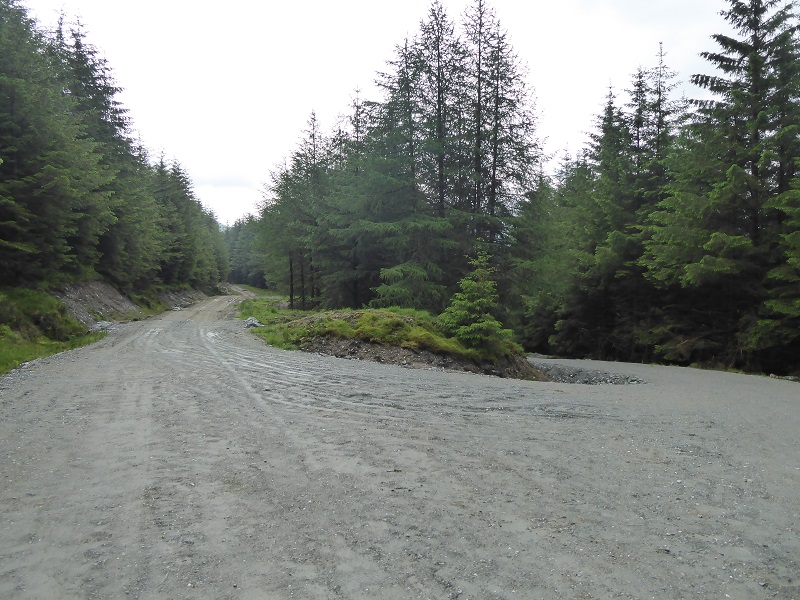
That is because few people want to take photos of wall of identical trees unless, as here, to illustrate just how awful they and the tracks through them are. As Professor Douglas McMillan has said about the alleged recreational value of commercial forestry, people don’t say “lets go to Sitka Spruce plantation” although they might be attracted to specially constructed mountain bike trails or the Long Distance Paths, like the Southern Upland Way, which are forced to pass through them.
I did hear Stuart Goodall, the Chief Executive of Confor which represents the forest industry, tell the Rural Affairs Committee of the Scottish Parliament in January how much he enjoys walking through Sitka plantations. I wonder whether that is because Mr Goodall sees £ signs behind every branch?!
The truth is rather different:
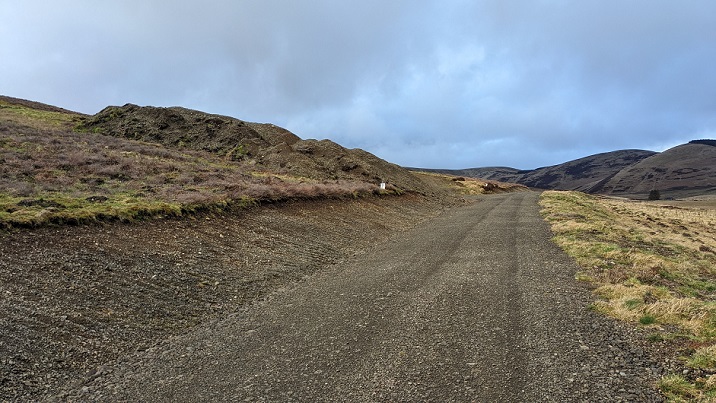
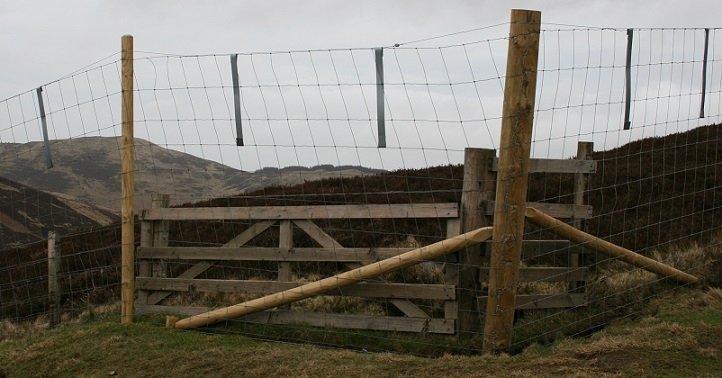
As for the claimed benefit of removing stock fences and replacing them with a deer fence which now runs round the entire perimeter of Stobo Hope, that deer fence has blocked a gate on Hammer Head (just like the blocked gate I recently came across at Far Ralia (see here).
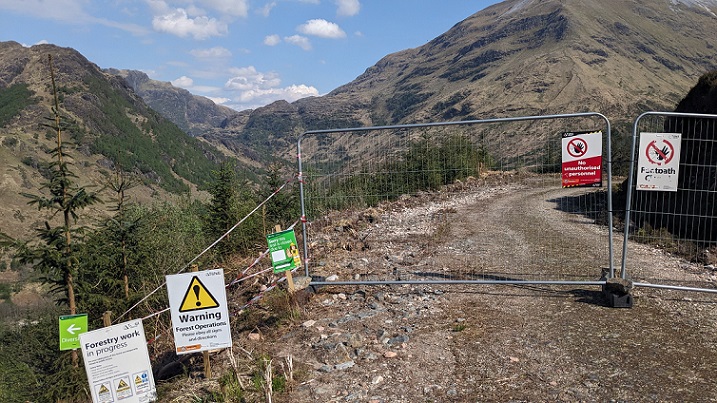
As for the claim that forestry results in fewer “access limitations” than stalking or shooting what about all those, “Halt” Forestry operations in progress” signs? Advice to avoid certain areas for stalking or shooting only applies for a couple of hours whereas forestry operations go on for weeks.
And at the main entrance gate to Stobo Hope in 2024 potential visitors were greeted with this sign:
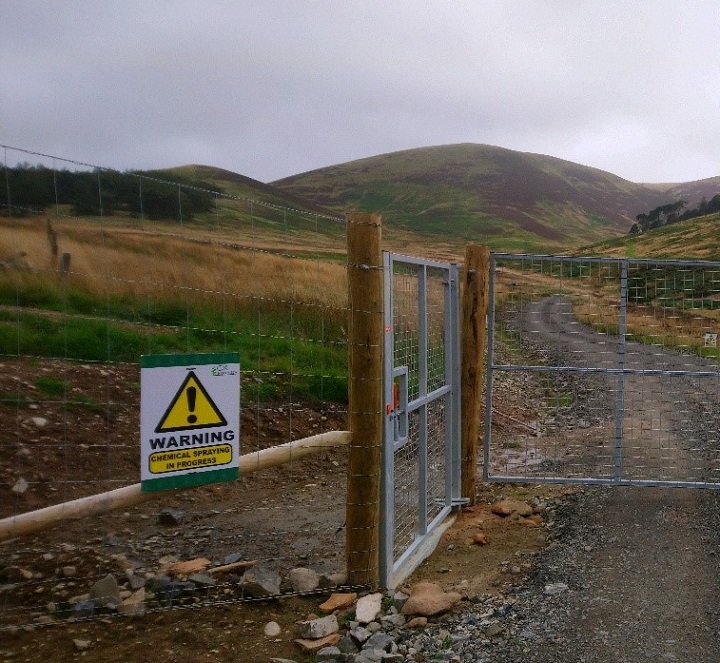
Did this sign represent a limitation on access? Objectively, it is safer to walk through the middle of a shoot, as I once did accidentally at Drumochter coming off the hill, than risk being covered with herbicide.
Timber imports
One of the favourite arguments in the forestry industry is that because the British Isles have far less woodland cover than other European countries, we should be planting far more trees for commercial timber purposes.
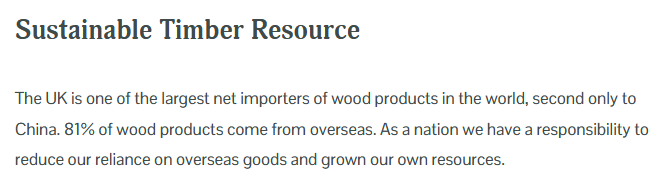
Actually, its a lot more complicated than that because while the British Isles has significantly less woodland than other countries, it has significantly more peatland and more prime agricultural land for example. If one takes a holistic view, therefore, rather than accepting the vested interests of the forestry industry, it should be apparent that it would actually make sense for us to import timber rather than digging up peatland to plant trees. The question the Scottish Government really needs to address is how much of our timber requirements could be met by planting on mineral soils, once other uses for those soils (like agriculture, wildlife) are taken into account?
What the Stobo Hope Forest website also fails to explain is that well over a third of the wood imported to the UK is in the form of wood pellets:

Moreover, most of these pellets are destined for the Drax power station in Yorkshire, the biggest single source of CO2 emissions in the UK and which receives massive subsidies from the UK Government (the scandal is periodically covered by Private Eye).
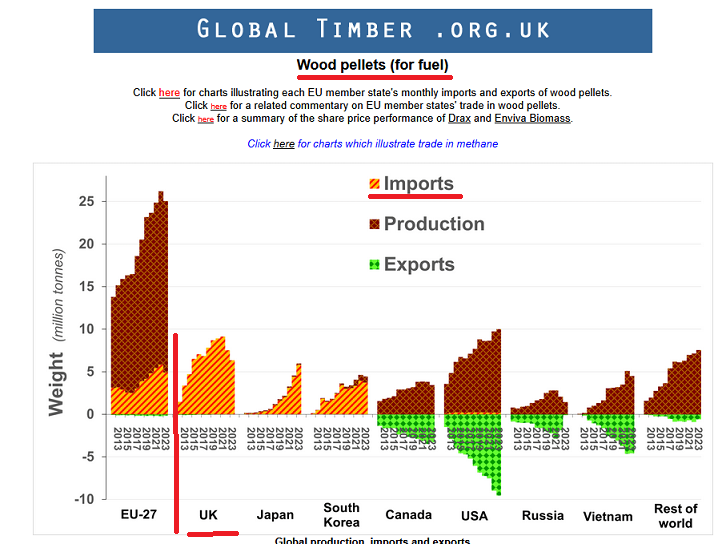 So when will the timber industry call for Drax to be shut down?
Jobs
Scotland desperately needs foresters on the ground, people who understand woodland and can manage it for public benefit, not temporary contractors paying low wages or pen pushers located in far away offices:
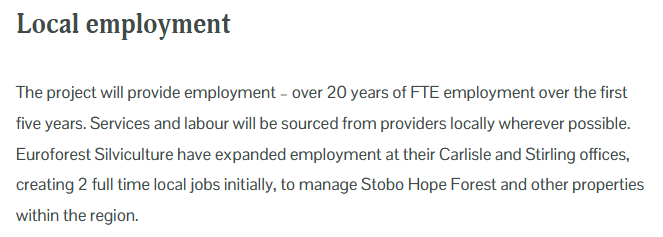
Scottish Forestry’s £2m grant to the Forestry Carbon Sequestration Fund did not guarantee a single permanent local job while local job losses from agriculture have resulted.
Seeing the wood for the trees
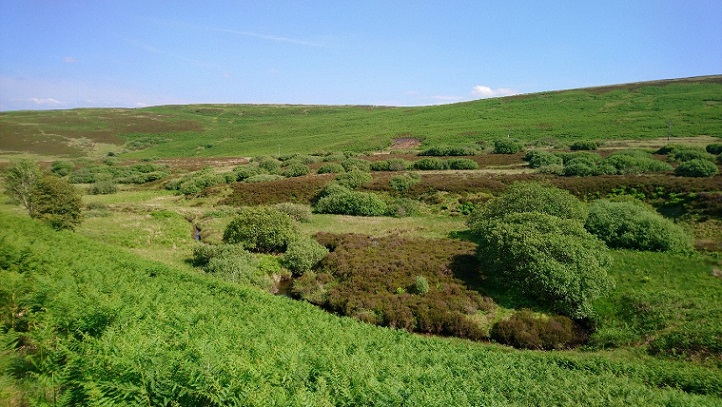
The question of how best to use land such as that at Stobo Hope is a complicated one. The fencing for forestry has led to the loss of 1,000 hectares of grazing land. How does one trade off the need for wool (a sustainable material) and some meat against the need for timber while also taking into account the need to tackle climate change and restore nature?
What one can say for certain about Stobo Hope is that while overgrazing for many years may have caused some damage, the damage that Scottish Forestry has allowed to happen on the site so far as a result of preparing the land for tree planting appears far worse. Unfortunately, instead of taking rational decisions about how land is best used – which might mean using part of Stobo Hope for growing timber, part for grazing and setting aside part for nature (rewilding) what happens to land is decided by what is the most profitable way to use it. And the production of timber in the form of Sitka is highly profitable at present because of forestry grants, tax exemptions and the carbon offsetting bubble aided and abetted in the case of Stobo Hope by the Carbon Sequestration Fund, who own the land, being registered in a tax haven.
All the claims of the timber industry, as represented on the Stobo Hope Forest website, are just window dressing for this fact, that forestry as currently practiced is all about money. The fundamental challenge is we need to put people and nature before the private financial interests of the forest industry and what has happened at Stobo Hope exemplifies why. While just one of several local communities challenging commercial tree planting proposals, the Stobo Hope Residents Action Group has shown that such campaigns can be successful.
Another legal challenge to Scottish Forestry – Todrig in the Scottish Borders
Another petition for judicial review has been lodged against Scottish Forestry, for approving a woodland scheme called Todrig (near Stobo) without an Environmental Impact Assessment. This has the same forestry agents as Stobo, Euroforest Silviculture, and similar habitats for golden plover, black grouse and many other species face being lost.
The landowners are Gresham House Forest Growth and Sustainability Fund LP, who received £50 million of taxpayer funds from the Scottish National Investment Bank, set up by former First Minister Nicola Sturgeon on the advice of Benny Higgins. Mr Higgins (see here) is now chairman of “green finance” group Oxygen Conservation who have been buying up land for “green” projects, including Dorback (see here) in the Cairngorms National Park and the Glen Lednock Windfarm (see here)
A crowdfunding appeal (see here) which contains further information about what is proposed has been set up to try and stop theTodrig forestry scheme. Judicial reviews are often uncertain and may be won or lost, but this could be another opportunity to try and encourage the Scottish Government and Scottish Forestry to consult on a fundamental a review of forestry policy and the current grants system. Please consider donating.

There is nothing wrong with large mixed woodland plantings as long as the proper checks and balances are in place. There is a timber industry in Scotland worth £1 billion a year that employs people that we should support, and we need relatively fertile soils as appear to exist at Stobo in order to do this. However, as has been clarified here, the EIA determination process has been all over the place, and that has undermined confidence for everyone. It is not just the commercial forestry sector either. We were advised to take the JMT fence on Schiehallion to judical review, but that one was too close to the deadline for doing so, and we had to let it go. So, the NGOs are at it too. The EIA process is supposed to be getting remedied, but I suspect it will take some time and decisive action before public trust can be restored. The irony is that at the other end of the spectrum, small and medium sized schemes get everything but the kitchen sink thrown in their way, to the point that the development costs are too high and they are not worth it any more. I keep saying this, Scotland’s tree planting outputs are not going up, they are going down, despite all the money supposedly available. The mechanisms are not working effectively for anyone. I have been weaning myself away from woodland schemes in recent years because the risks and uncertainties are just too high, and the carbon credits are just exacerbating things. If we want to improve things, we could start by making carbon trading illegal in Scotland. That is not adding any value at all. It just increases the costs of everything, and encourages people with short term financial motives, which is not what forestry should be about.