
In December abrdn told the Scotsman that they had made mistakes with their carbon offsetting tree planting scheme at Far Ralia, the land they had bought for £6.5m in 2021 and are now trying to sell. While admitting these mistakes included “basic things around designing woodlands and certain processes” they did not explain what they had got wrong or the implications for Scottish Forestry’s grant system (see here). This post addresses some of those omissions following a visit to part of the estate last Saturday.
Rather than follow the access track (see here), I decided to look at the planting towards the north end of the landholding opposite the bothy at Luibleathain, only to find access barred by a basic mistake which should never have been allowed to happen:

A stock fence had not only been erected along the line of the existing deer fence but also across the gate making it impossible to open! There was nothing wrong that I could see with the deer fence – apart from sagging wires where I and others had been forced to climb over it. But that had not stopped Scottish Forestry paying out a grant for over 5km of new stock fence while allowing the deer fence to remain alongside a significant part of it.
According to Scottish Forestry’s contract with abrdn, obtained by a Freedom of Information Request, the metal droppers on the stock fence were supposed to be “reflective”, to make the stock fence more visible to birds. I struggled to see any reflection and the droppers are spaced too far apart to deter birds from trying to fly between them. While the four droppers by the gate and its posts serve no apparent purpose, the wires on the upper part of the deer fence above the top of the stock fence remain almost invisible.
The evidence shows neither abrdn nor Scottish Forestry have made any real attempt to reduce the carnage caused by birds flying into fences (see here).

The explanation for this stupidity has nothing to do with promoting public access, protecting nature or reducing carbon emissions – the wire in the deer fence could and should have been recycled – but that land managers generally will only do things Scottish Forestry will pay for through its grants system.
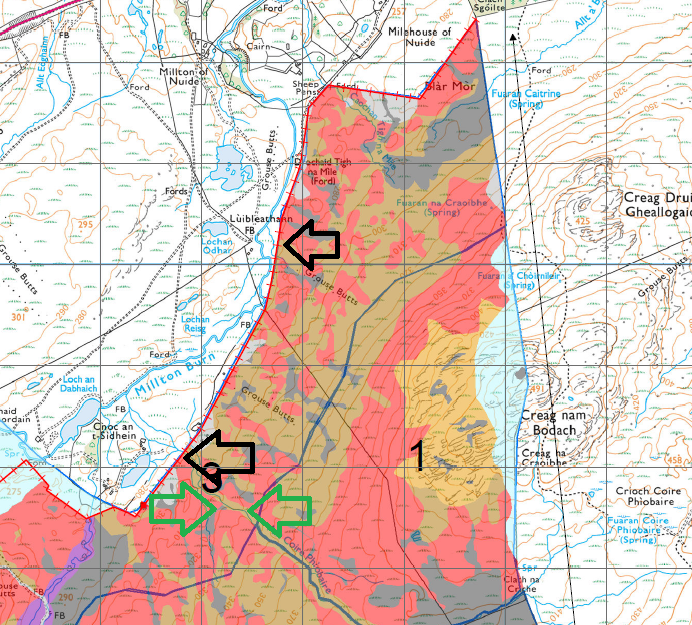
In the area just above the two fences, there was extensive natural regeneration of native trees among which Akre Trees, abrdn’s agents (see here), had planted further trees in plastic vole guards:
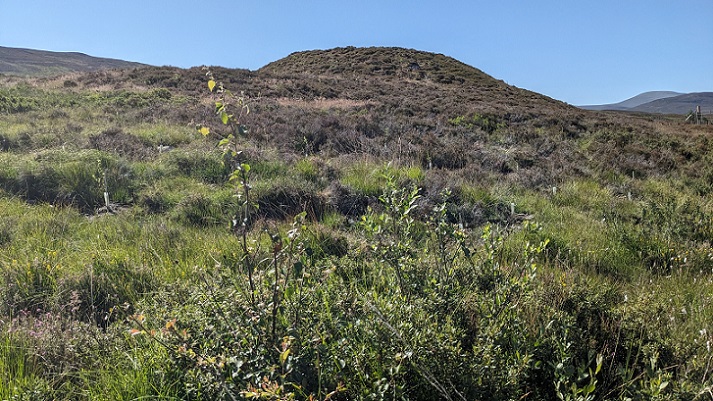
The reason for this is again explained in abrdn’s contract with Scottish Forestry:
“The extent of natural regeneration within the proposal is at a maximum that can establish within the 5 year period as per the FGS New Natural Regeneration Establishment guidance.”
Part of the problem is that Scottish Forestry only pays grants for natural regeneration if it achieves similar levels of tree density to what it requires to pay for tree planting. In the case of tree planting this results in even-aged woodland that end up looking like plantations and is of very little ecological worth while in the case of natural regeneration this results in ungrazed thickets (such as the birch in the south west corner of Far Ralia, the small area which is allocated for natural regeneration).
The other part of the problem is the Woodland Carbon Code which calculates the carbon-offsetting value of any new woodland by the number of trees planted. In other words under the current system almost ALL the money lies in planting as much ground as possible. And it was money, rather than any real concern about nature, that drove abrdn’s initial decision to buy Far Ralia as an “investment” before it decided it was not such a good idea after all.
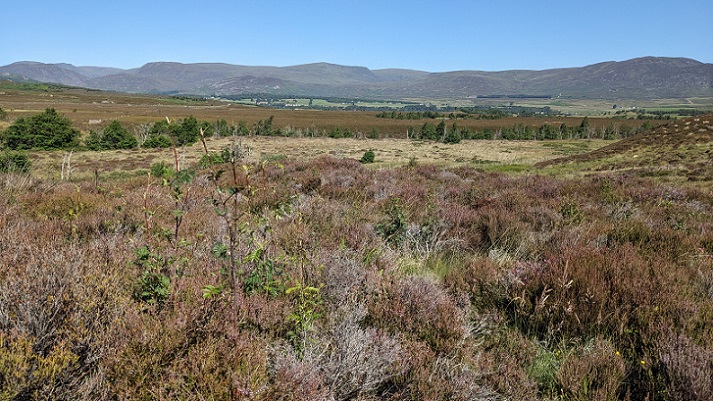
The naturally regenerated trees which preceded the planting were still being browsed – to give them some credit it appears abrdn has been s been trying to reduce deer density still further) – but the density of red deer has clearly been low enough to enable even palatable species like rowan to rise above the heather.
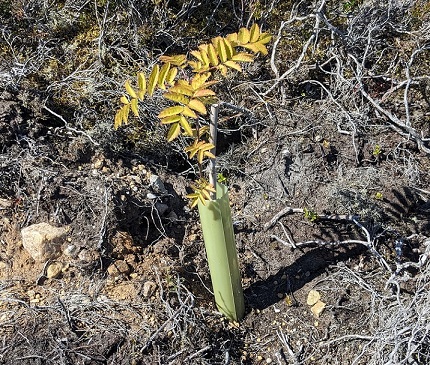
There should never be any justification for Scottish Forestry to award grants to plant rowan, a species which is being constantly dispersed by birds and readily colonises new areas. What Scottish Forestry should be doing is requiring land managers tor reduce deer numbers so far more naturally regenerated rowan survives.
But so what, if this helps meeting the Scottish Government’s tree planting targets and high tree densities? At Far Ralia rowan makes up 2-5% of the “new” woodland.

A significant number of the plastic vole guards had been blown or knocked over by animals killing the trees inside. I could have filled several rucksacks full. Even if as few as 5% of the 556,500 vole guards, funded by the Scottish Forestry grants systems, are already redundant that means there are over 25,000 tubes littering this small area of countryside.
Abrdn’s Woodland Grant application claimed the vole guards would be made from “biodegradable material” which includes everything from cardboard to plastic. The problem with “bio-plastics” is the jury is out whether such materials actually biodegrade, even in soils rich in fungi and micro-organisms, while even if they do the particles that remain could still have adverse impacts for a range of life. . There is no evidence which I am aware of about what happens to such plastic tubes in peaty soils and. Abrdn appears to have no plans to remove them. In my view ALL “biodegradable” plastic tree tubes should be treated as a signficant environmental liability unless proven otherwise.
Meantime I have put the remains of one broken tube I retrieved from the site into my compost heap to see what happens in an environment far more favourable than Far Ralia for breaking down “bio-plastic”!

Inverted mounding is where a digger turns the soil over on itself, whereas in hinge mounding the soil is deposited next to the hole the digger has created. Scottish Forestry/abrdn’s contract states:
“Ground preparation will be invert mounding across the area. Invert mounding has been chosen silviculturally, as it is felt that with the mainly podzolic soils across the area invert mounding will aid in mixing soil horizons and aid in breaking shallow iron pans within microsites. Within wetter areas of shallow peat or gleyed soils invert mounding will also aid in creating localised drainage to aid in tree establishment. Invert Mounding will also help to minimise the visual impact of the ground preparation
(non linear) and give a site that is more easily accessible for future management. In heavily greyed areas, hinge mounding will be used to avoid waterlogging.”.
This gives the impression that inverted mounding, which is slightly less damaging than hinge mounding, would be the main method that the ground across Far Ralia would be “prepared” for planting trees. In fact, a large proportion of the total area appears to have been hinge mounded creating rows of trees, just like a sitka plantation.
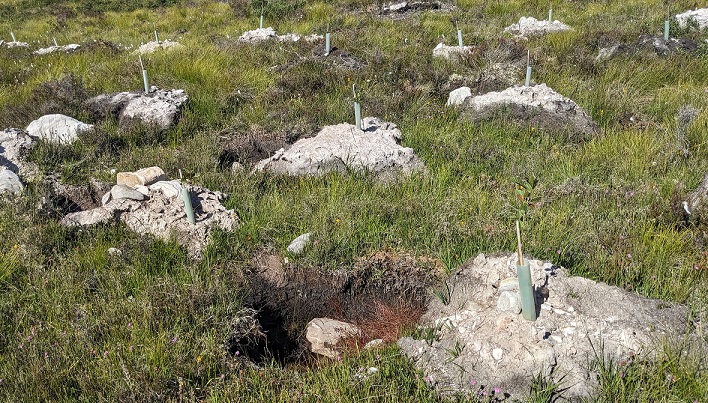
The hinge mounding has indeed resulted in “mixing soil horizons”, as claimed in the contract, and created “localised drainage”. In fact it has completely destroyed the soil structure and the “biodiversity intactness” of the site and throws further doubts on the Natural History Museum’s extraordinary claims that it would improve from under 52% to over £94% by planting trees (see here).
Above this area where mineral soils had been brought to the surface, there was an area of boggy ground where the Abrdn/Scottish Forestry contract stated hinge mounding should take place:
“Where it is deemed too wet to invert mound, hinge mounding will be used. Hinge mounding only be used where it is silvicultural felt it is the best option, especially in wetter areas, where the invert mound hole could fill with excessive water.”

This claim was nonsense, since inverted mounding should leave no hole, but was nevertheless accepted by Scottish Forestry and embodied in their contract with abrdn. To me it looked like most of the peat in this area was over 50cms deep but unfortunately I had left my measuring tape at home. If so, it should have been marked as “deep peat” on the map above and excluded from any planting.
What was indisputable, however, that many of these deep holes in the peat were filled with water which was evaporating into the atmosphere in the heat (it was over 25°C) instead of being retained under the vegetation. The exposed peaty surface of the hole will also slowing be oxidising releasing the CO2 that had been stored under the vegetation into the atmosphere.
As for the mounds, when touched the peat, the best store of carbon we have, crumbled into dust. In other areas peat exposed by scraping or inverted mounding was also drying out, with consequences both for the newly planted trees and for carbon emissions:
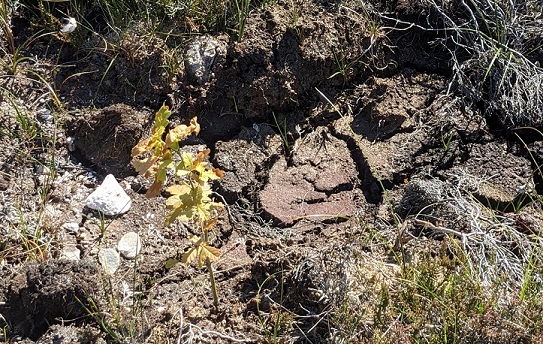
I was quite surprised therefore that, unlike BrewDog’s Dead Forest a few miles north and west at Kinrara (see here), most of abrdn’s trees on the lower to middle ground appeared to have so far survived the periods of very dry weather this year. Perhaps that is because so many of the trees had been planted on boggy ground – my walk did not take me to the higher areas.
There were signs, however, that some of the trees abrdn had had planted are now dying through lack of water even in areas where inverted mounding had been used:
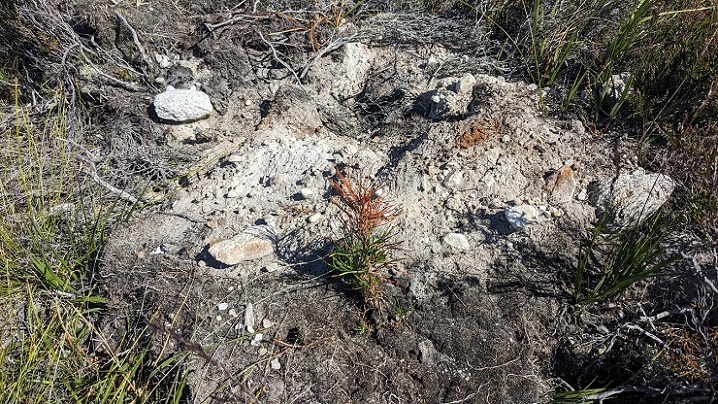
Much will probably depend on how much rain falls in the next few weeks. Even better established trees with larger root sytems were suffering (see rowan above):
By contrast with the planted trees, I did not spot a single example of a naturally regenerated tree which appeared to be dying through lack of water.
For all the talk of planting the right tree in the right place, in practice very little attention is given to this with the pressure on the underpaid planting workforce to stick trees in anywhere:
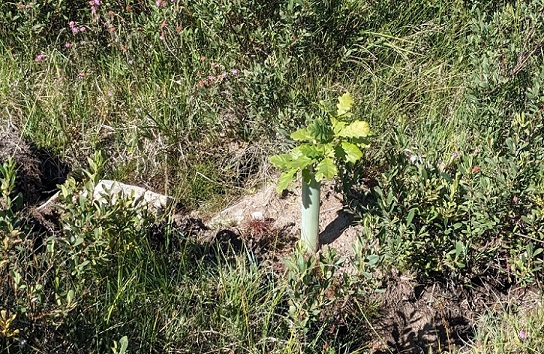
This oak, while looking healthy enough, has probably only survived because its been planted on wet heath, hence the bog myrtle, a habitat where it would not normally be found. On returning home I checked my copy of the JNCC guide to British Upland Vegetation which classifies vegetation communities according to the species which grow together. Nowhere could I find any mention of oak and bog myrtle being associated together naturally. Perhaps abrdn has created a new national vegetation community?
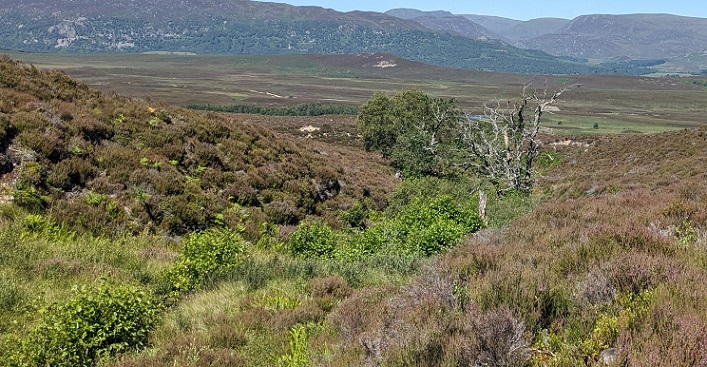
After wandering across the site I descended by the Allt Coire Phiobaire, which was flanked by a number of old trees and plenty of regenerating alder and birch, none of which had been marked on the Scottish Forestry grant application maps. As well as all the existing trees on the land at Far Ralia, the background to the photo shows there are multiple seed sources within a few miles. A basic understanding of ecology will tell you thousands and thousands of seeds will have been carried around and onto the site by birds, mammals and the wind for years.
All abrdn needed to do, therefore, if they wanted to increase the number of trees on their land was to reduce deer numbers and wait. Trees would then have established themselves on suitable ground through natural regeneration and failed to do so on the wetter peatier areas. This would have been the nature friendly way to conserve nature and lock up carbon. Instead, abrdn chased the money offered by the Scottish Forestry grants system and have been responsible for yet another environmentally disastrous tree planting scheme in what is supposed to be a National Park.
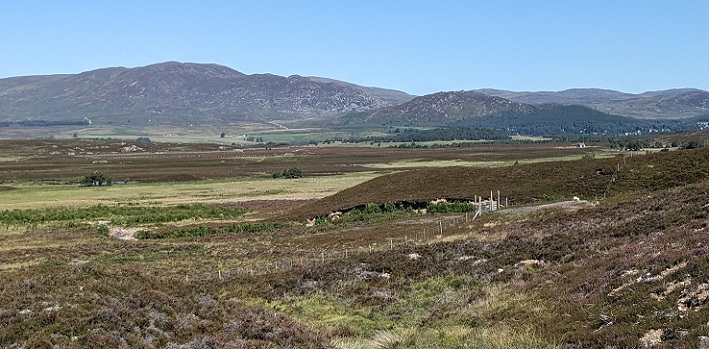
Just above this gate I saw two young curlew circling over the moor. As a result of representations from birding interests, abrdn moved the stock fence up the hillside, away from the best areas for waders along the Milton burn. They also avoided using rabbit netting along the stock fence to allow wader chicks to pass through it. A small mercy. However, assuming abrdn or the future owners meet the requirements of the Forestry Grants system for tree density, most of the moor will be no more. The population of birds like curlew will then inevitably decline. Instead of humans playing god with what species are found where, we would be far better leaving it to nature.
The Abrdn Property Income Trust (APIT)’s latest annual report (see here) confirms that all its assets except Far Ralia were sold off to Goldentree on 24th November 2024. The annual report states APIT’s AGM has been delayed to 10.00am on Monday 11 August 2025 because “the timing of the sale of Far Ralia is uncertain so the Board have decided to defer the AGM from the usual June date”. It also explains there is considerable uncertainty about its value:
“As a natural capital investment (in an emerging market), where a proportion of the value is attributed to the value of potential carbon offsets offered by the tree planting, there isn’t a large number of potential investors. That said, we have had interest to date from a variety of potential buyers and
anticipate completing a sale during the course of the year”;
and:
“As at 31 December 2024 the sole property Far Ralia, was valued at £10.0m and the Company held cash of £36.6m”
That represents a significant decrease in abrdn’s original asking price of £12.5m but £10m is still far too high a price for an area of land that Scottish Forestry’s Grant system has turned into an environmental liability rather than an asset. Some of the £36.6m in cash that is still being held by APIT, rather than being distributed to shareholders, has possibly been retained to meet those liabilities.
The best thing that could now happen to Far Ralia now would be if abrdn donated it to the Cairngorms National Park Authority (CNPA) who could then use it as an example of how to restore the damage being caused by native woodland planting scheme. All the CNPA would need to do is get some peatland restoration specialists back on site, flip the hinged mounds back into the holes that have created, keep deer density at 2 per square km or less as Wildland Ltd is doing over the hill in Glen Tromie, take down the deer fences……. and then wait. That, rather than tree planting, would be the best way to restore nature and reduce carbon emissions on a former sporting estate, where the land had been overgrazed and burned as part of an attempt to produce more deer and grouse for shooting purposes.

Using vole guards at that scale is a nonsense. Vole guards are useful for high value trees on very grassy sites. On a moorland like that, the clear space created by the mound should keep the voles away (they dont like crossing open ground). You might lose a few to them, but it is a risk assessment. The cost of beating up on a site like that due to voles is going to be a lot less than the cost of putting a vole guard around every tree, and hugely inflating your planting cost. 500,000 vole guards…. !! Somebody was not asking too many questions there……. the cost of the guard, and the stake, the logistics of getting them on site, and the cost of putting them on…. all unnecessary.
Maybe I’m being thick & naive, but why not make abrdn (what a daft name!) and other wealthy “investor” applicants, plant the trees FIRST, and then inspect their work at a later date to see if it meets the grant criteria standards? No success- No grant.
They can, almost by definition, afford to front the cash, get the trees in the ground and await approval before being handed huge sums of public money. Isn’t that what “investment” is ? Fronting money, taking a risk, and waiting for long-term yeilds to accrue.
Not a smash n’ grab at the public purse. Why are we taxpayers helping these financial spivs to deplete our natural environment. It makes no sense either ecologically or economically (except from their, and their share-holders’, perspective).
Let them carry out specified works, to a high standard. Inspect the works 12-months later. If all OK they get 50% of the grant, with the rest payable after say 3 years when the succesful survival and growth rate of the new trees can be verified. If not, tough luck, go and “invest” elsewhere.
Scottish Foresty (i.e. the governemnt) could afford to re-plant the whole of Scotland itself using central gov. funds if it were so empowered. Why do we even “need” these spivs?
Whilst I agree with about 99% of your point, the bit about the shareholder perspective does need some clarification. Yes a company like Aberdeen (they got their vowels back) has corporate shareholders, the individual investment funds are generally filled with money from pension funds. Pensions of your average Joe or Joanna on the street, so it’s not just some fat cat in a penthouse office that’s a shareholder or beneficiary of these things.
I also would add that carbon credits feels like another financial scandal in the making in the next few years.
Stories are emerging from the recent Dava/Duthill fires on mounded sites – such as Muckrach – that mounding makes fire fighting more difficult. Mounded areas are hard to cross on foot or by vehciles like Argos. Fire also burns into the holes where peat is exposed and under the turfs. Meaning, in places, flare ups occurring even after surface fires were extinguished. Moreover, it is reported, people locally associated with the mounded sections, had little or no fire fighting decision capacities. Doubtless fencing/gates will have been damaged too. It will be interesting to see if such issues are verified and recommendations reported in any official review.
This is very interesting. While I am sure mounding does make fire fighting more difficult, according to information released by Scottish Land and Estates most of land affected by the fire was moorland, not new native woodland. While mounding can exposes peat to fire, so does muirburn!
The SLE report shows that there was 1253 ha or 3132 acres of woodland taken out, almost all native in that part of the country. There was just over 11,000 ha of land burned overall. (Read beyond the Exec summary). Much of the “moorland” will also have had low density natural regeneration on it. Fires do not expose peat. They do expose the surface of the ground, where there will be a depth of partially decomposed plant material on top of the actual peat. If you bury a March bar in this, and run a fire over the top, you will find the chocolate is untouched. Mounding brings the actual peat to the surface, because the whole point of mounding is to break up the existing soil profile. This peat will burn,, create a little hot- spot that can then penetrate deeper. So, mounds can exacerbate a wildfire problem in the way that has been described.
For context, the 1273ha of woodland lost is approx 15% of the area of woodland creation in Scotland last year. So, not an insignificant amount. If you had to replace it, every 200 ha would be approx £1 million.
This is just a couple of miles from my house as the crow flies. For the last three years or more we have tried to get Standard Life and then ABRDN to come and talk to us as a community but they have avoided us despite claiming they have “consulted” with the local communites ! Now it is up for sale and even the selling agents will not speak to us
What a disgraceful waste of public money. Don’t they have to justify the grant conditions?