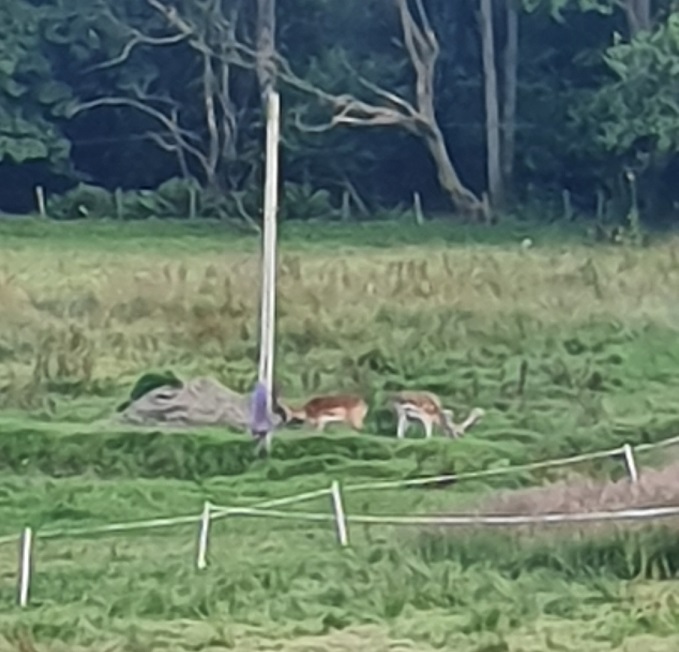
Prof Douglas McMillan, a contributor to this blog, sent me this photo taken by a friend of his a week ago, noted that the report of the Deer Working Group highlighted their introduction and spread as a significant problem and asked whether the Loch Lomond and Trossachs National Park Authority has done anything about it? That got me checking but the short answer is no!
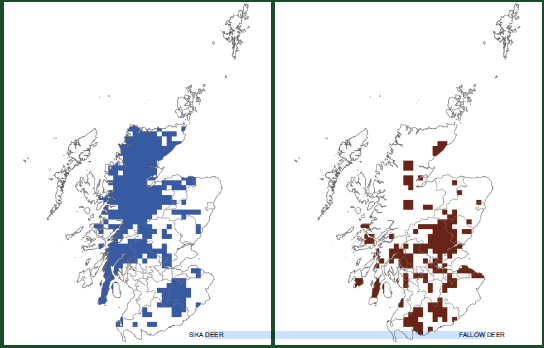
The cover of the report of the Deer Working Group, The Management of Wild Deer in Scotland, published in 2019 (see here), included the latest distribution maps for the four main species of deer found in Scotland and made no less than 147 references to fallow deer whose population and distribution has increased significantly since 1990:
 The report acknowledged that Sika, which were introduced from Asia and hybridise with red deer, pose the greater problem but emphasised that “Public policy in Scotland has long been against expansion of the ranges of Scotland’s two species of non-native wild deer, sika and fallow deer”. The report endorsed that policy and highlighted that while numbers of fallow deer are far lower than the other species, after red deer they appear to do the most damage to agricultural crops and gardens in peri-urban areas. As a result of this and the lack of data they made a specific recommendation that:
“Scottish Natural Heritage (now branded NatureScot) should develop its own maps of the existing distribution of fallow deer in Scotland and implement a clear strategy to prevent the further spread of these fallow deer populations, including the use of Scottish Natural Heritage’s regulatory powers under the Deer (Scotland) Act 1996 if necessary.”
Fallow deer, which are native to mainland Europe, were first introduced to Scotland as park deer in the middle ages but wild populations subsequently became established in a handful of areas, most importantly Tayside and Dumfries and Galloway. Their population has grown, however, over the last thirty-five years and as that has happened they have colonised new areas. The Tayside population was originally concentrated around Dunkeld and the two deer in the photo represent how that population has expanded west into the Loch Lomond and Trossachs National Park.
The Deer Working Group report devoted three pages to non-native deer species in National Parks but most of their discussion focussed on the Cairngorms at the end of which they recommended:
“The Working Group recommends that the Cairngorms National Park Authority and Scottish Natural Heritage should adopt and enforce a clear policy against the establishment of any populations of Scotland’s two non-native deer species, fallow and sika deer, in the Cairngorms National Park.”
Why they made no specific recommendation for the Loch Lomond and Trossachs National Park Authority is unclear but helps explain the policy differences between our two National Parks on non-native species of deer. The CNPA’s National Park Partnership plan explicitly mentions fallow deer in its target:

It is worth noting that this target is weaker than what the Deer Working Group recommended “a clear policy against the establishment of any populations of Scotland’s two non-native deer species” but is still better than the LLTNPA. Their NPPP 2024-29 fails to mention non-native deer species or what the LLTNPA intends to do about this and tries to palm off any matters relating to deer as being the responsibility of NatureScot. The LLTNPA’s Future Nature Route Map (see here) approved in June 2021 makes not a single mention of sika or fallow deer let alone what should be done about them.
But then the LLTNPA has been dragging their feet when it comes to controlling red deer numbers, which is the single most important thing they could do to improve the state of nature in the National Park. The LLTNPA’s NPPP, for example, adopts a target deer density of 10 deer on the open hill when the CNPA’s plan adopted a target of 5-8 deer two years earlier.
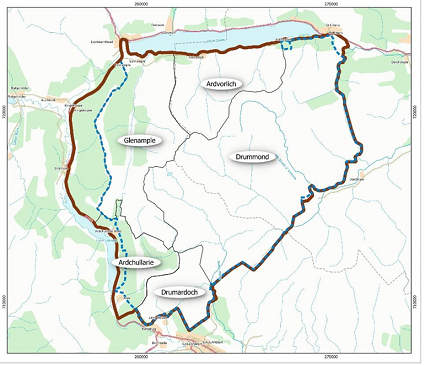
In addition the eastern part of the Loch Lomond and Trossachs National Park includes part of the , Glenartney Deer Management Group (DMG) which has some of the highest deer numbers in Scotland (see here) – a problem equivalent to Caenlochan in the Cairngorms National Park (see here):

While the Drummond Estate, which mostly lies outwith the National Park, is the worst offender the deer density at Ardvorlich is also incredibly high and over twice the target the LLTNPA set in their plan. If deer numbers in the National Park were reduced that would also have spill over benefits for the areas outside and if the LLTNPA had any influence with landowners they could have got Drummond to reduce deer density across their whole landholding.
I understand that the LLTNPA have been working on a Herbivore Impact Assessment for the National Park for three years but as yet there is no sign of that. While the LLTNPA dithers and procrastinates – the problem has been staring them in the face form their entire existence – the countryside is being grazed to bits and the rest of nature suffers. Which brings us back to the fallow deer in the photo.
The Glenartney DMG Deer Management Plan 2024-30 states that:
“Fallow Deer and Sika Deer have been seen and shot occasionally over recent years, but they are not considered to be established within the Group area.”
Really? The truth is far likely to be that as a result of the failure of the Glenartney DMG and LLTNPA to control deer numbers around Loch Earn, fallow deer have been able to spread round the loch and into other parts of the National Park. If I have got that wrong, perhaps NatureScot could start publishing regular data on the distribution of fallow deer, as recommended by the Deer Working Group, and the LLTNPA would then have no excuse for failing to explain to the public what they will do about this..
