In my post on the Scottish Government’s decision to call in the Flamingo Land application for a decision by Scottish Ministers (see here), I highlighted the fact that the Planning Minister, Ivan McKee, had asked for another report from a Reporter at the Department of Planning Enforcement and Appeals (DPEA) without saying who he had asked and what he wanted them to consider. I have now seen an email confirming that the Reporter is David Buylla, i.e the same Reporter whose Notice of Intention that he was minded to approve the Flamingo Land Planning Application resulted in 50,000 people complaining to Mr McKee and demanding he call in the planning application and decide it himself!
It appears the DPEA is still ivery much in charge. Without any instructions/steer from Mr McKee about what he wishes Mr Buylla to reconsider, it is difficult to see why he would change anything substantial in his report. Indeed, were he to change his report without reason he would lose all professional credibility. The main difference between the two reports therefore is likely to be that instead of setting out his own intentions to approve the planning application Mr Buylla will recommend Mr McKee does so. Scotland’s planning appeal system is a farce!
If Mr McKee had been serious about getting the DPEA to take another look at the appeal, he could either have appointed another Reporter to do so, one who valued landscape and the natural environment more, or instructed Mr Buylla about the issues he wanted him to consider further.
To help Mr McKee and Mr Buylla, I have highlighted six failings/issues with Mr Buylla’s first report which, in the cause of justice, should be addressed BEFORE Ministers make any decision.
1) Views of the public
Scottish Government Reporters have the power to hold public hearings as part of the planning appeal process. Mr Buylla decided NOT to do so in the case of Flamingo Land appeal and as a result his Notice of Intention to approve their application was mainly informed by the documentation submitted by the developer and the Loch Lomond and Trossachs National Park Authority (LLTNPA). As I have previously explained, the weak reasons the LLTNPA had given for rejecting the Flamingo Land Application (see here) then made it easy for Mr Buylla to back the developer. It is crucial therefore that Mr Buylla should now, before going any further, be required to open up the whole appeal process by holding public hearings.
Public hearings will in my view undermine the credibility of some of the documentation which Mr Buylla relied on when making his original decision. For example, the Transport Assessment and documentation on parking submitted by Flamingo Land and supported by West Dunbartonshire Roads staff was accepted by the LLTNPA without question when, as every local resident knows and as local MSP Jackie Baillie has stated in the Scottish Parliament, sunny weekends and public holidays bring traffic chaos and gridlock to Balloch.
Mr Buylla needs to hear such evidence directly himself and then pass it on to Mr McKee.
2) The Local Development Plan (LDP)
Mr Buylla relied a lot on the policies and allocation of land in the LLTNPA’s Local Development Plan in reaching his original decision. That plan, long out of date, was considered and amended by two other Reporters prior to Scottish Ministers approving it in 2015. Those Reporters, as part of that approval process, issued a statement about public participation (see here), effectively an assurance to Scottish Ministers that there had been proper consultation on the LDP.
It should now be blindingly obvious to Scottish Minister that there could have been no proper consultation by the LLTNPA on their plans for Balloch because only a handful of people objected to the LDP compared to the 150,000 + people who objected to Flamingo Land’s planning application, the most in Scottish history. This shows that almost no-one realised what the LLTNPA’s allocation of land at Balloch for Visitor Experience really meant. I have explained why and how the LDP process was manipulated by the LLTNPA in the Flamingo Land story (see here) and (see here) but Mr Buylla now also needs to do the same for Scottish Ministers and the DPEA issue a public apology for getting this so wrong.
Admitting this would then allow Scottish Ministers to rectify all the LLTNPA’s failures in governance (which have continued with the recent Pierhead Action Plan which appears designed to enable the Flamingo Land development to go ahead (see here)), declare that the LLTNPA’s LDP as it applies to Balloch is unfit for purpose and intervene to ensure the current “consultation” on the Local Place Plan for Balloch is driven by the public.
3) Landscape
Mr Buylla needs to re-look at the landscape impacts of the proposed development. His report gave reasonable consideration to the landscape impacts of erecting lodges on the Riverside Site and concluded that because they were set back from the bank of the River Leven they would hardly be seen. However, his report skates over the impact of erecting a large apartihotel and leisure complex at the Pierhead and he declined my suggestion that he should hire a boat and look at the site from Loch Lomond. He should now do so and ask organisations with landcape expertise, such as those who form Scotland’s Landscape Alliance, to give evidence at a public hearing.
Recently Scotland’s Landscape Alliance launched a new landscape charter (see here). This has been endorsed by the Scottish Land Commission, Nature Scot, Historic and Environment Scotland and Mairi Gougeon, the Cabinet Secretary responsible for National Parks who said:
“the Charter helpfully highlights the twin crises of biodiversity loss and climate change and points to landscape considerations being a key element in decision making if we are to achieve our ambition of a net zero and nature positive Scotland”
As a consequence the Herald reported (see here) the Charter “will be integrated into public planning decisions, aligning with policy goals such as net zero, land reform and public health”.
Landscape has NEVER been “a key element in decision-making” at Balloch and the Flamingo Land appeal provides the perfect opportunity for the Scottish Government to demonstrate how the charter, which emphases importance of community participation, will make a difference.
4) Nature
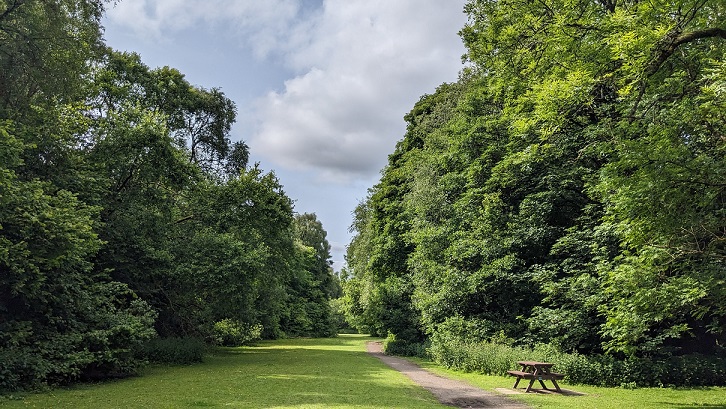
While the LLTNPA objected to the Flamingo Land planning application because of its impact on nature, which it claimed was contrary to the Scottish Government’s policies on protecting and restoring nature in National Planning Framework 4 (NPF4), they way their objection was framed was very weak. It was all about interpretation of policy, with claims and counter-claims between them and Flamingo Land, and the only evidence considered were old surveys from the developer which claimed most of the woodland was of little value.
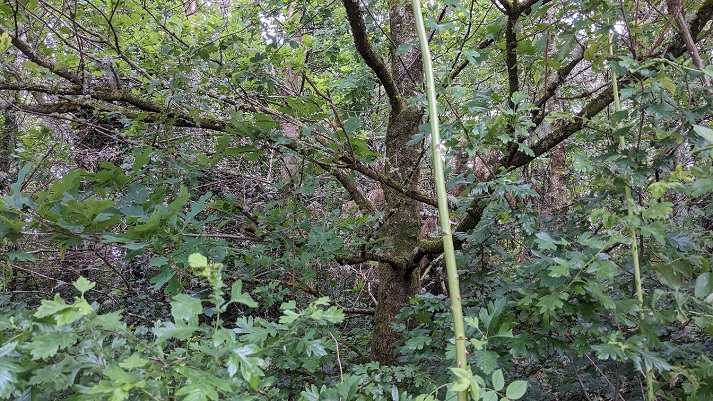
While originally most of the trees on the Riverside planted as part of the restoration of the former industrial area, on a recent visit I appreciated just how far it has re-wilded. Part of the explanation for this is the presence of dogs has limited grazing by (roe) deer (they have been seen on site) and as a consequence the woodland has been able to develop with lots of saplings, and has been colonised by a host of plants and invertebrates.
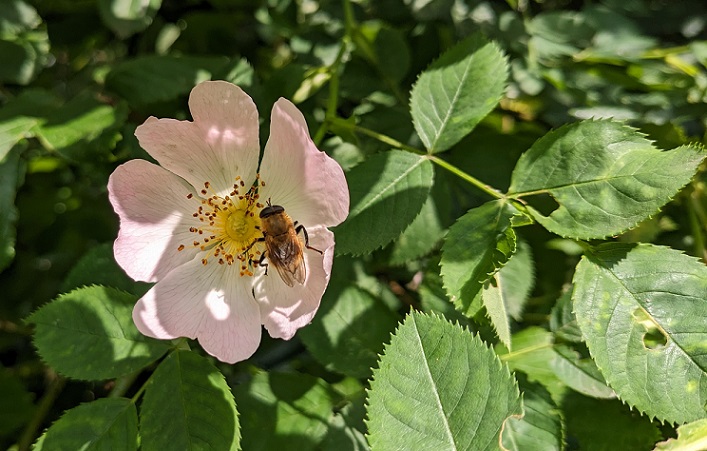
This is not to claim there is anything particularly rare on site but rarities, which traditionally have been the focus of the planning system, should now be only a small part of considering the nature value of the site. What is rare is that 40 or so years as a lightly managed park, the biodiversity value of the Riverside Site has increased considerably and worth a lot more than many of native woodland plantations that were planted in the countryside at the same time and were grazed to bits. This cannot be replaced by planting one, two or three trees for every one removed. The fact that it would likely take 40 years to replace the biodiversity loss at a place where biodiversity is of particular importance, the Gateway to the National Park, should not be allowed by the planning system.
This week NatureScot published advice that had been commissioned by the Scottish Government (see here) on means of measuring “biodiversity” changes to support the implementation of Policy 3b in NPF4. This requires major developments, such as that proposed by Flamingo Land, to result in significant biodiversity enhancements. The point here is that while the LLTNPA disputed Flamingo Land’s claims that their plans (which included cheap[ and easy things to do like sprinkling wildflower mixes on the grass) would enhance the wildlife value of the site, they never conducted or commissioned their own assessments to provide the evidence to back up their claims.
Mr Buylla should now commission independent surveys of the current state and ecological value of the site and, as a safeguard, ask the Woodland Trust, who objected to the Flamingo Land application, to comment on those surveys. Meantime local residents and others could help by recording what they see and hear (it is quite easy now to do this with Apps like Seek – which helps identify plants, insects etc – and Merlin which identifies bird song).
5) The economic benefits of Flamingo Land
There has never been any proper critical scrutiny of Flamingo Land’s business plans despite the statutory duty of the the LLTNPA to promote sustainable development. At the public meeting called by the Balloch and Haldane Community Council last month Pam Gosal, the Tory list MSP for the area with a background in development, explained that the £40m Flamingo Land is promising to invest is not much for a development of this scale. If right, the implication is its being done on the cheap, which makes it even less appropriate for this location.
Mr Buylla also needs to consider whether the more costly elements of the development, such as the restoration of Woodbank House and the monorail, are ever likely to happen.
Flamingo Land’s latest accounts show its net assets are over £32m but most of that is represented by their Fixed Assets in Yorkshire and, as a result, they will have to borrow most of the £40m (less any further subsidies provided in the form of grants from the Scottish Government). Flamingo Land therefore appears to be bringing very little to the table.
Mr Buylla could also usefully spend a little time investigating Flamingo Land’s record in Yorkshire, for example the review into Scarborough Council’s decision making process about their involvement in the Futurist Theatre (see here). This found that the project lacked “a clear link back to inclusive growth and expected benefits, such as better jobs, training, economic impact on the town”.
6) Flood risk
Of the six reasons the LLTNPA actually gave for rejecting the Flamingo Land application, the strongest in my view was that the site is at risk of flooding (following the new guidance on flood risk given in NPF4). There are four exceptions to that policy, one of which is “redevelopment of previously used sites in built up areas where the LDP has identified a need to bring these into positive use”. Mr Buylla interpreted that to mean that there can be development on any land which has in the past been used in any way whatever, whereas the LLTNPA took it as meaning land that had been developed but then abandoned.
As Ross Greer MSP has pointed out, Mr Buylla’s interpretation of Policy 22a would effectively allow Planning Authorities to continue to allocate any flood plain for development if there had been so much as a telephone box there in the past, so long as they claimed “there is a need to bring it into positive use”.
Mr Buylla, appears not to regard either the natural environment, land dominated by natural processes, or the re-wilding on the Riverside Site as a positive use of the land. That appears to me to undermine the intention of policy 22a completely, which was to stop development on sites at risk of flooding except for water compatible uses and in exceptional circumstances. Mr Buylla should therefore consult with others and set out clearly the full range of possible interpretations of Policy 22a and then ask Mr McKee what the Scottish Government actually intended.
Maintaining the pressure on the Scottish Government and Ivan McKee
There will be further issues and actions to the six that I have described here which would justify Mr Buylla producing a different report for Scottish Ministers. Without an explicit steer from Mr McKee, however, the report will be no different and Mr McKee could use that to justify deciding the Lomond Banks appeal in Flamingo Land’s favour.
Anyone who is concerned about this could consider emailing Mr McKee MinisterPF@gov.scot and asking him to explain why Mr Buylla’s new report will be any different to the last one and tell him what issues the report and Scottish Ministers need to address.

Your point about placing Mr Buylla in an impossible position, yet again, is very well made.
What many should easily find deplorable is the realisation that as Scots schools close for the summer staff of .gov departments are also about to disperse for their annual Holiday breaks. No ‘business’ will now make any progress under full scrutiny of MSP’s, until the whole ‘circus’ reconvenes in September?
It seems clear several Scottish ministers may wish to put this matter of Flamingo land to “bed”. For the wider public this called in proceedure must occur in full view. This is essential. Such great energy has been devoted for so many years to the misguided attempt to sideline and disregard tens of thousands of valid objections. Full accountablity around the ongoing “process” becomes even more essential.