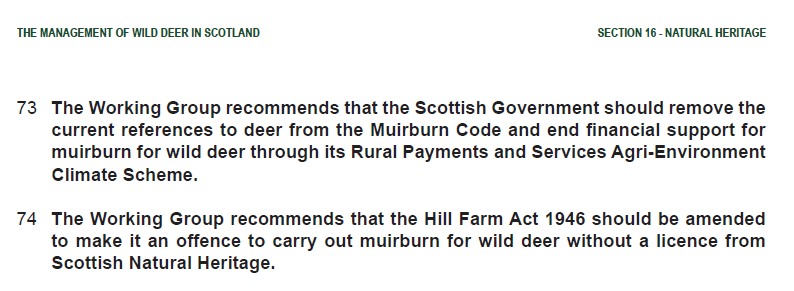
The Report of the Deer Working Group “The Management of Wild Deer in Scotland” published over five years ago was very clear that the use of muirburn to improve grazing for deer was very damaging and the Scottish Government should stop supporting it financially and only allow it in exceptional circumstances:
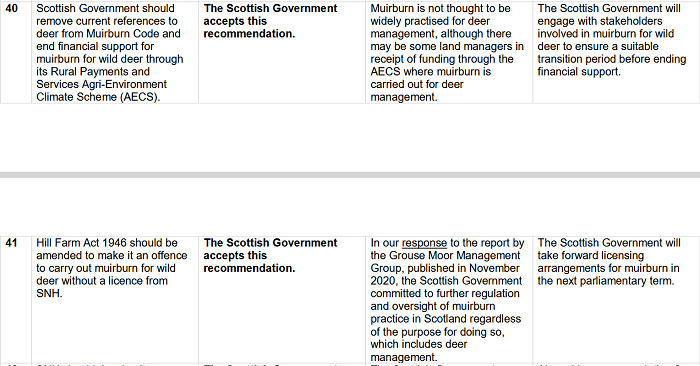
The Scottish Government accepted both these recommendations (see here):
Public subsidies to improve grazing for deer have been suspended since January 2023 (see here) while the Scottish Government agreed to take forward the licensing proposal as part of the Wildlife Management and Muirburn (Scotland) Act.
Section 13 of that Act (see here) allows muirburn licenses to be granted for six specified purposes and although these include “improving the grazing potential of moorland for livestock” there is no provision for burning to improve the grazing potential of moorland for deer. Once the muirburn licensing scheme comes into force therefore burning for deer will only be allowed for “conserving, restoring, enhancing or managing the natural environment”. This is in line with the Deer Working Group’s report which stated that the option of muirburn for deer should be retained in case “needed for a wider environmental purpose in some instance”. While I have been unable to find any examples of why muirburn for deer might be justified what is clear is that it should be at most be a rare exception not the rule:
“there is no public interest justification for continuing to allow a general right of land owners and occupiers to carry out muirburn for deer. The environmental costs of these fires in upland environments is at odds with the Scottish Government’s healthy ecosystem approach and its measures to mitigate climate change”.
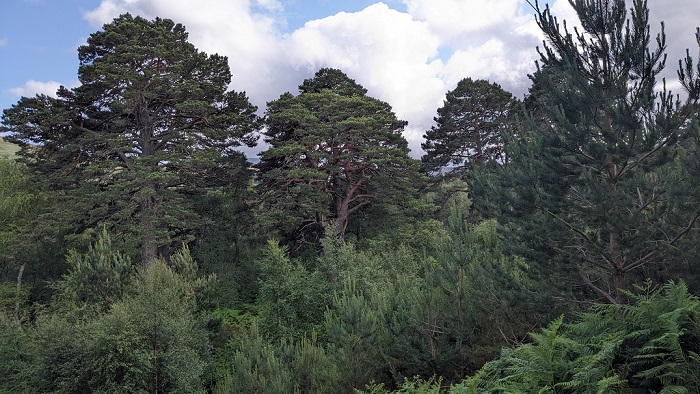
On Sunday I walked from the Amat Caledonian Pinewood fragment, at the road end in Strathcarron east of Ardgay, to the summit of Carn Chuinneag via Glen Calvie
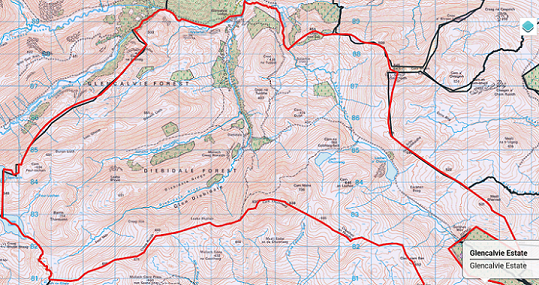
While the Amat Native Pinewood Site of Special Scientific Interest (see here) does not extend to the Glencalvie Estate, there were a few isolated old Scots Pine in the glen as well as numerous old birch. Both may be direct descendants of the Caledonian Pine Forest in this area which was once much larger in extent and has the potential to expand back up Glen Calvie.
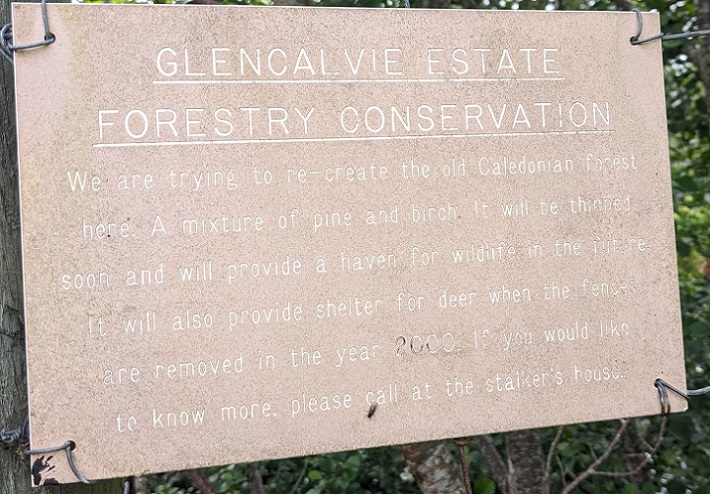
An old sign, predating 2000, showed the potential for Caledonian Pine Forest in the glen once acknowledged by the estate. However, the idea they could do this by planting pine and birch rather than through natural regeneration and that they would then remove the fences to provide shelter for deer was at best misconceived and at worst suggests other agendas were at play.
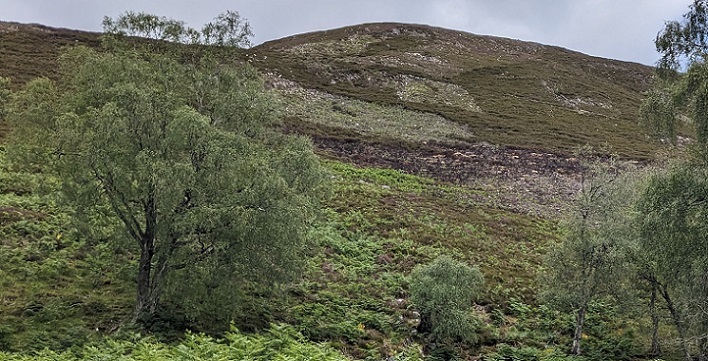
Shortly after the sign, above an area of birch woodland, we spotted an area of hillside which had been subject to muirburn over several years. At first I wondered if this muirburn was for “conservation purposes”, created with the intention of enabling to become established more easily on bare ground, mimicking the role of wildfire in the Caledonian Pine Forest (See Ron Summers book on Abernethy Forest).
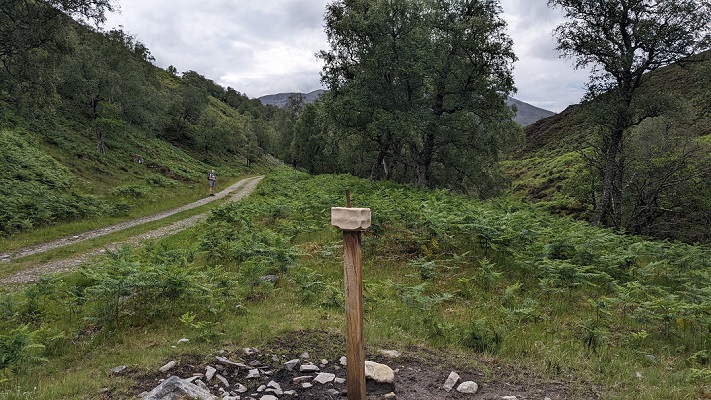 Then we arrived at a deer lick and it became clearer that it was the presence of significant numbers of deer in these woods which explained the lack of natural regeneration outside of fenced areas. The corollary of that was that it appeared I was witnessing an example of muirburn being used to improve grazing for deer, a practise which the Deer Working Group did not consider to be “particularly widespread”.
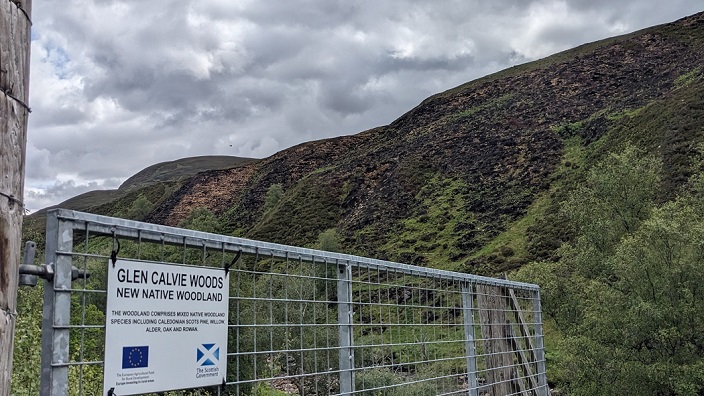
That was confirmed shortly afterwards. It would be interesting to know if the Glencalvie Estate ever received any rural payments from the Scottish Government to carry out muirburn for deer. Whatever the case, funding them to plant in the glen while they burn the land around the wood represents a misuse and waste of public money.

A much larger area of muirburn for deer started at the top of the vehicle track where a fine old stalkers path leads almost to the summit of Carn Chuinneag.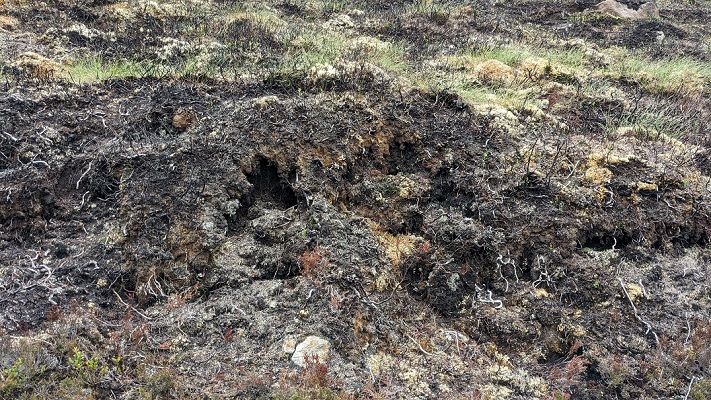
Sphagnum mosses, known for their water holding properties and which play a key role in the formation of peaty soils, had been incinerated by the most recent muirburn. While I do not hold with the claims that “light burns” are good for the natural environment and don’t damage peat, setting fire to large areas and on steep slopes, such as that on the righthand side of the stalkers path, guarantee destruction as described in the report of the Deer Working Group:
“in the context of deer management, the research is clear that the larger the size, severity and duration of the fire, the greater its impact on the soil structure and above ground biodiversity. In addition, there are the wider environmental effects of muirburn (e.g. particle emissions, increased water run-off).”.
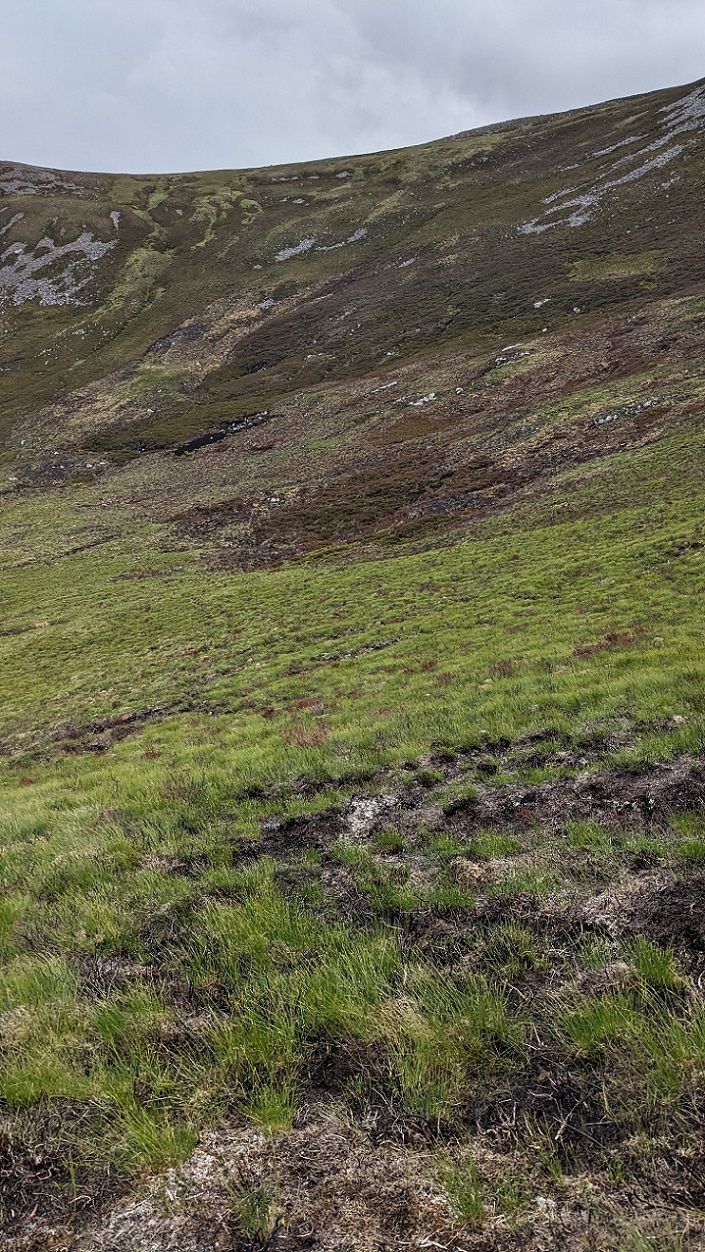
Previous muirburn had promoted the growth of deer grass, a sedge, which while not particularly nutritious tolerates grazing like grasses (see here) and provides better browsing than heather.
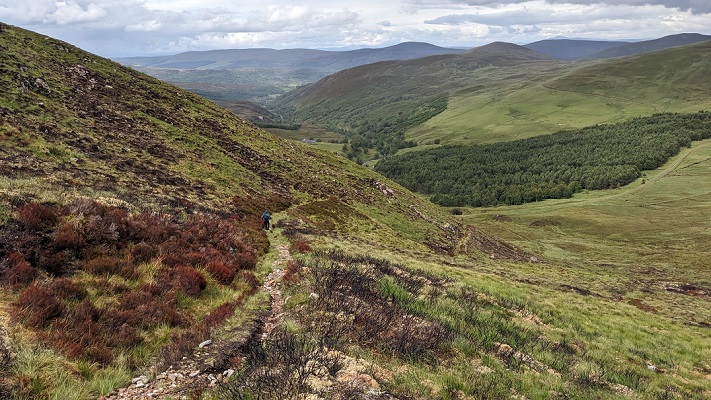
Almost the whole of the lower part of the unnamed north facing coire had been burnt, up to the ridge on the west and then down the other side into Glen Dibiedale:
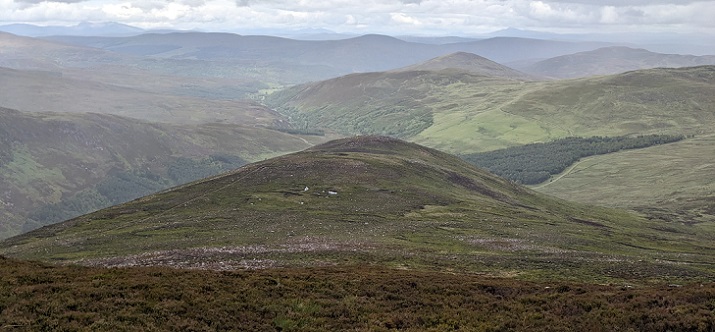
In Glen Dibiedale fires had been started just above the native woodland plantation there (top photo), destroying any possibility of it expanding and becoming a more natural wood. Although the size of the burns were smaller than that on Carn Chuinneag and more like muirburn as practised on grouse moors, the cumulative effect of the burning has been to remove heather from much of the lower part of the glen:
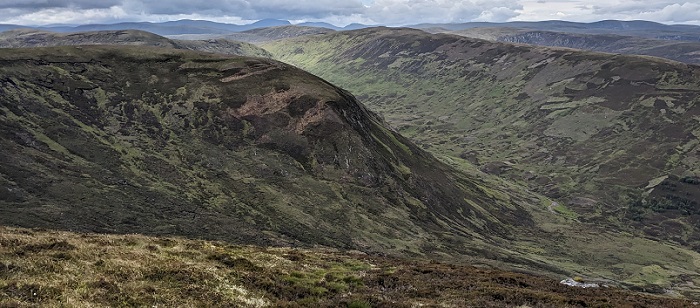
The green in this glen does not appear a consequence of natural processes but represent areas where heather (and trees) have been destroyed by burning to provide more feed for deer. That boosts deer numbers and reduces further the possibility of woodland regenerating naturally.
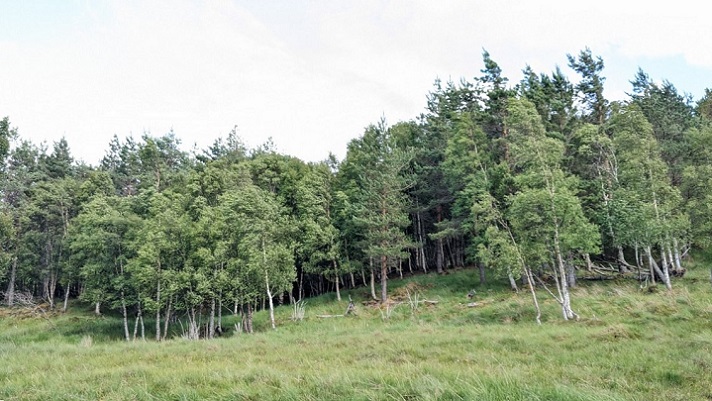
The Glencalvie estate had removed the fences around the older native woodland plantations as it said it would do on the sign we had passed. While it might provide good shelter for deer, as woodland it has very little value: no understorey of woodland plants had developed and there was no sign of natural regeneration. Compare this photo with that of the Amat Pinewoods above and it is clear that it will never develop or expand into anything remotely resembling Caledonian Pine Forest.
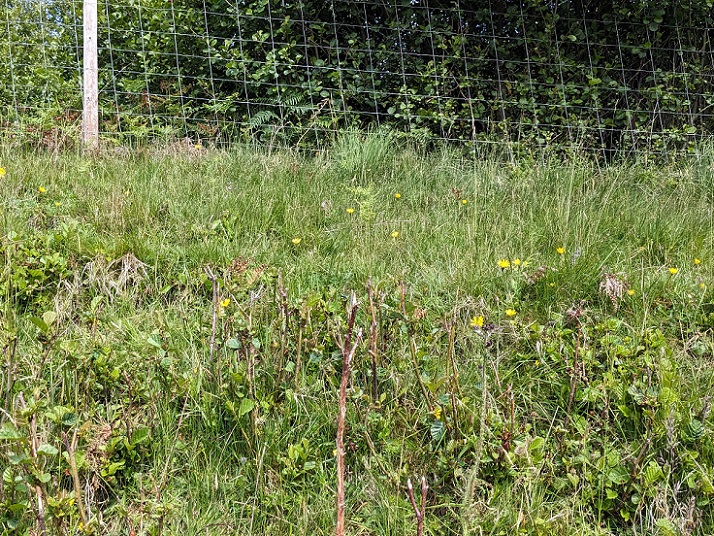
The consequences of improving the grazing the deer for muirburn appears to have been to increase deer numbers which in turn has increased grazing pressure outside of fenced areas. Scottish Forestry classifies alder along with rhododendron and sitka as the last palatable of trees and shrubs browsed by deer and shrubs because of factors relating to digestibility and toxicity (see here). Deer avoid alder where they can, hence why it can be found along otherwise tree-free river banks, but in winter when there is nothing else to eat like sitka it is browsed.
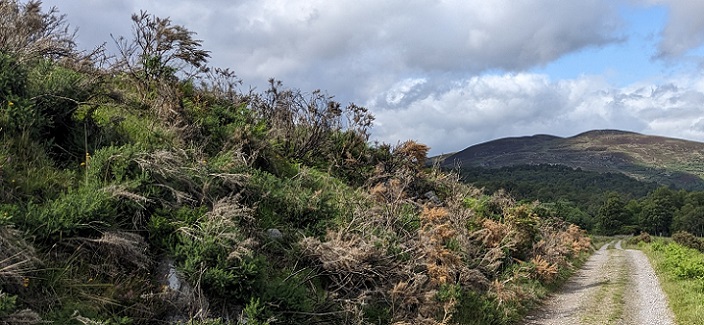
Returning towards Glen Calvie Lodge, I realised an area of burned gorse we had passed on the way up was quite deliberate. That gorse would have provided some protection to self-seeded trees and allowed them to get established but has been burned to provide yet more grazing for deer.
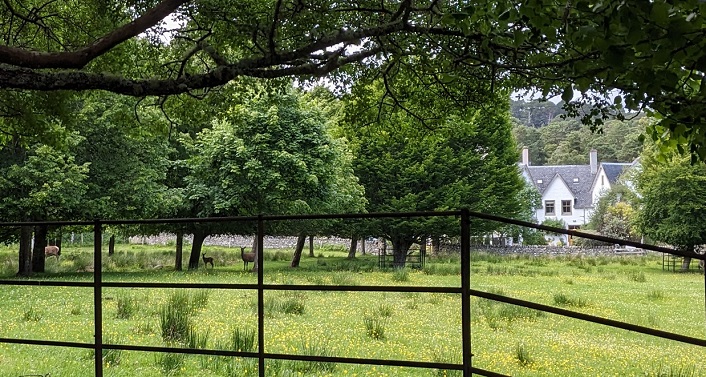
The photo tells a tale, the owners of the Glencalvie Estate (there are three trusts which own Glencalvie Estate Ltd) see no problem with deer grazing almost up to their front door even in the middle of summer. Its clear from their website (see here) that the estate is primarily used for stalking and fishing with the beautifully located Diebidale Lodge being marketed for its position among the deer (see here).
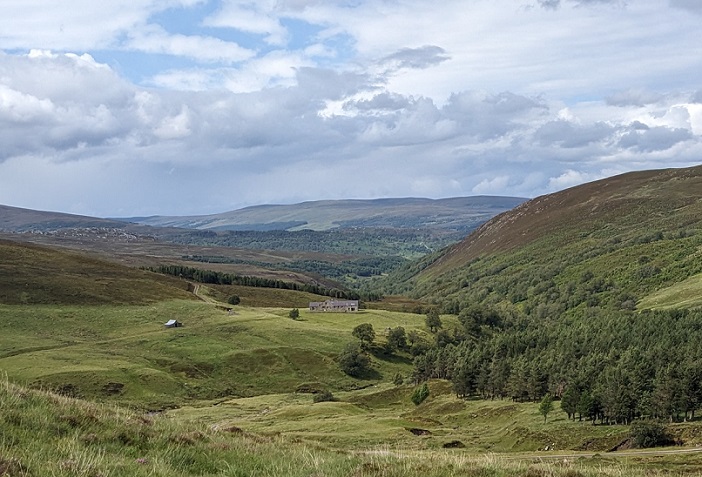
The muirburn appears to have been designed to attract and support larger deer numbers to the area around the shooting lodge – hardly “sporting” – and the combination of the two makes the expansion of the Caledonian Pine Forest south from Amat impossible.
The implications of muirburn on the Glencalvie estate for muirburn licensing
It may be that the recent extensive muirburn to improve deer grazing on the Glencalvie Estate has been an attempt to pre-empt the introduction of muirburn licensing and the estate will end the practise when the provisions of the licensing scheme come into force.
However, it is also possible the estate may try to circumvent the clear intention of the licensing scheme to end muirburn to improve grazing for deer, for example by putting a few more sheep on the land and claiming it is muirburn to improve grazing for livestock or else by carrying on burning without a license and risk being fined for doing so. Under the Wildlife Management and Muirburn (Scotland) Act the maximum fine for doing so is £5000, a relative small sum for the very rich people who own places like Glencalvie and less than they received in public funds for greening practices in 2024:

So far neither NatureScot nor the Scottish Government appears to have explained how they intend to stamp out muirburn to improve grazing for deer. Having last week caved into sporting estates and delayed the start date of the new muirburn licensing scheme from 15th September until 1st January 2026 (see here) they have plenty of time to do so.

You have highlighted a major problem in conserving Scotland’s natural heritage. The post illustrates the conflict, and to be honest, the disingenuous nature of the government’s policy on native woodlands. Estate owners always find a way to get away with it…friend’s in high places etc. All native woodland should have a 500m buffer where no fires are allowed.
This is another relevant blog about the apparent interests and attitudes of NatureScot and the Scottish Government:
https://raptorpersecutionuk.org/2025/06/25/scottish-government-naturescot-delays-start-date-for-new-muirburn-licence/
Thanks Keith, I have added link to post