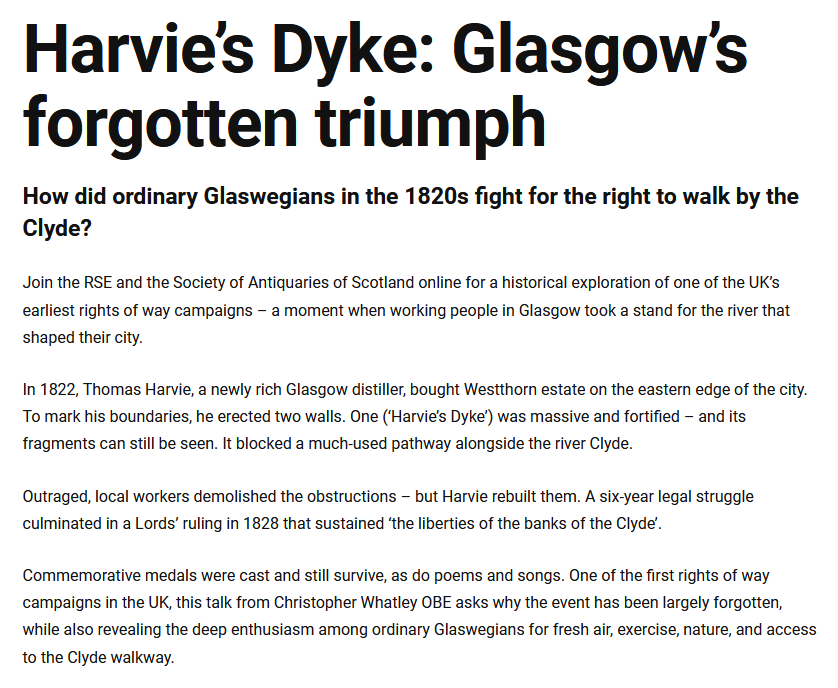
 The Royal Society of Edinburgh and the Society of Antiquaries for Scotland organised a very interesting talk his week by Professor Chris Watley about the access battle at Harvie’s Dyke. This is recommended viewing for any interested in access rights. (The main talk starts at 8 mins 20 secs see here and last about 30 minutes but there is an interesting discussion afterwards which is also worth listening to too).
Once celebrated, then forgotten, the battle for Harvie’s Dyke took place 25 years before the Battle of Glen Tilt (see here). That “battle” led to the creation of the Scottish Rights of Ways Society and is often thought of as the starting point for the campaign which eventually led to the Right to Roam being enshrined in law in Scotland in 2003.
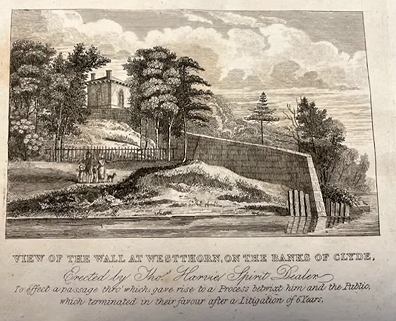
In fact the battle for Harvie’s Dyke was also considerably more radical than the Battle of Glen Tilt and involved protesters blowing holes through the main wall with gunpowder before taking the legal route which eventually culminated in their victory. Twenty years after the Land Reform (Scotland) Act 2003, at a time when access rights are once again being eroded because almost no-one in government is prepared to defend them, it is an inspiring story.
I thought Professor Whatley was particularly good at explaining why access to the Clyde was important to people at the time. While the legal contest played an important part in the development of Rights of Way law (across the whole of the UK), the issues at stake were similar to those which eventually won us the right to roam in Scotland such as being able to relax outside after work, enjoy nature and enjoy the company of others.
Alan Blackshaw, whose research was mentioned in the discussion afterward by Pete Higgins and was crucial to the right to roam being embedded in the Land Reform (Scotland) Act 2003, would have been delighted. It was Alan’s research (see here for example) which demonstrated that customary access rights that had “always” existed in Scotland and had been accepted by the courts. He also showed the claims that people anyone venturing onto another person’s land was a trespasser were invented in the 1960s to deter people from visiting the countryside. Once it was accepted there were customary access rights in Scotland it was a short step for the first Labour Government under Tony Blair, which had promised to extend access rights, to enshrine these in a right to roam.
Most of Alan’s research has never been published, although he developed a number of other excellent arguments for access rights, including the case for a human right to enjoy nature (see here). I have two box files of his research but cannot recall him ever writing about Harvie’s Dyke – perhaps because his focus was on access to the whole of the countryside rather than rights of way as such. Professor Whatley’s research is a reminder that ,despite the passing of the Land Reform Act, we still have no popular history celebrating the battles for access rights in Scotland.
That history is important for many reasons not least for its relevance to the present:
1) It tells us something about the attitudes and power of rich people who buy land. The story of how Thomas Harvie tried to use the courts to stop access has its present day equivalent in the story of how the Darwalls went all the way to the House of Lords to try and prevent people camping on their land on Dartmoor – and that despite people having a statutory right to do so (see here).
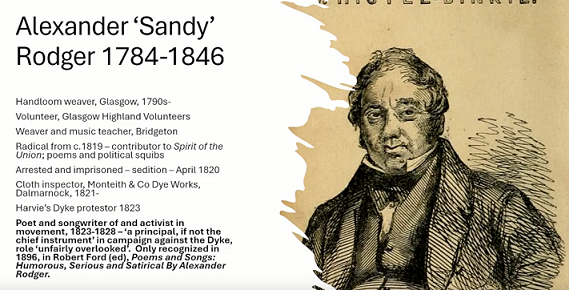
2) It tells us that direct action can make a difference. Some of the good folk from the RSE and the Society of Antiquaries in the audience made that very point about the scandalous closure of the Radical Road by Historic and Environment Scotland (see here). With modern tools there would be no need to use gunpowder to remove it! However, perhaps the radical action at Harvie’s Dyke could provide the inspiration not least because there is a connection between the two. After the Weaver’s revolt in 1820, many of those who were not hanged or deported were sent to Edinburgh where they constructed the Radical Rd. One who escaped, however, returned to Glasgow and played a central role in the Harvie’s Dyke protests although as Prof Whatley explained, he was never officially commemorated:
Prof Whatley has written a book about Harvie’s Dyke due to be published at the beginning of July which you can pre-order (see here). Following a suggestion from the floor I will also be suggesting to the organisers of the excellent Radical Glasgow Tours (see here) that the overgrown remains of Harvie’s Dyke would be worth adding to their itineraries.

It is better to speak about “customary freedoms or liberties” rather than “customary access rights”.
Otherwise legal “experts” are encouraged to claim that no such rights existed before the Land Reform (Scotland) Act 2003, except for rights of way that had been vindicated through court action. This is why the Law Lords, in their judgement on the Harvie’s Dyke case used the phrase about the public exercising “the liberties of the banks of the Clyde’ to justify taking access across Harvie’s land. The fundamental principle that underpinned the 2003 Act was the securing of our existing customary freedoms or liberties to take access to land and water as statutory rights and so prevent further erosion of these freedoms or liberties by the obstructive attitudes and actions of landowners.
And today, try to walk westwards from the city centre along the south bank of the Clyde. It’s obvious that the redevelopment originally provided a formal path along the waterfront but several of the flat developments have subsequently been allowed to erect high fences at each end, blocking it off and incorporating it into their private gardens.
There isn’t even a formal signposted diversion.
I came across this strange blockage too, needs looking in to.
No, no it’s fine because per the first reply above we have the Magic Bit Of Paper to “prevent further erosion of these freedoms or liberties by the obstructive attitudes and actions of landowners.”
We’re just imagining those fences and signs.