I became interested in how the model Codes of Conduct for councillors and members of non-departmental or devolved public bodies (NDPBs) had evolved over time as a consequence of the way they were being used against Sid Perrie for trying to raise concerns about the Flamingo Land planning application. This was not just about Sid (see here, here, here and here) but others like Councillor Fiona Higgins who had also tried to challenge cover-ups by unelected officials in Glasgow City Council.
In a post in February (see here), written just before the Standards Commission for Scotland (SCS) decided to suspend Sid from the Loch Lomond and Trossachs National Park Authority Board for six months for sending six emails about this (see here), I compared the 2014 version of the Code for NDPB members with the current version. I explained then how in 2014 there had been two rules relating to the “Respect” principle but by 2020 these had been expanded to eleven. I further explained how these rules severely curtail what councillors and board members can say and do about the conduct of unelected officials.
I had also wanted, however, to compare the original versions of Codes, which came into force in 2003, with the subsequent versions to understand the full history of the changes to the codes. The Code for councillors was first revised in 2010 and then the Code for members of NDPBs in 2014 to ensure consistency. While all the later versions of the Codes can be found on the Standards Commission for Scotland website (see here) the original codes are not available on the internet. This, as I eventually found out from a very helpful person at the National Records of Scotland, is because they were published before the Scottish Government started digitalising publications. NRS pointed me to the National Libraries of Scotland and for £50 I recently obtained scanned copies of both codes. Even documents that were supposed to form the bedrock of devolution in Scotland now have a price.
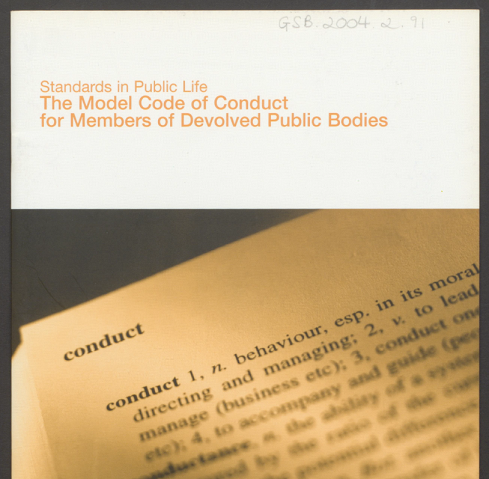
It was worth helping to fund the National Libraries of Scotland, however, because even the cover of the original codes (see above) are instructive. The words that are legible in the graphic are not an accident: “conduct 1, n behaviour especially in the moral” [sense]. These are clearly a reference to the purpose of the codes and an indication that they were primarily intended to provide guidance about moral behaviour. The phrase, “Standards in Public Life”, provided another indication of the what the codes were about. In the 2014 code for NDPBs both phrases were removed leaving a plain white cover with the words ‘Model Code of Conduct for Members of Devolved Public Bodies’, like something out of Brave New World.
The disappearance of the foreword
The original versions of the Codes were issued by the Standards Commission, rather than the Scottish Government, and had a foreword from their first Convener. This started:.
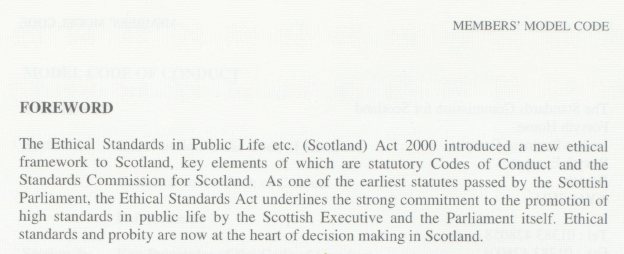
Note the phrases “ethical framework” and the statement that “ethical standards and probity are now at the heart of decision-making in Scotland”. There was no need for a statutory Code of Conduct for officials because at the time it was councillors and board members and not unelected officials who took the decisions.
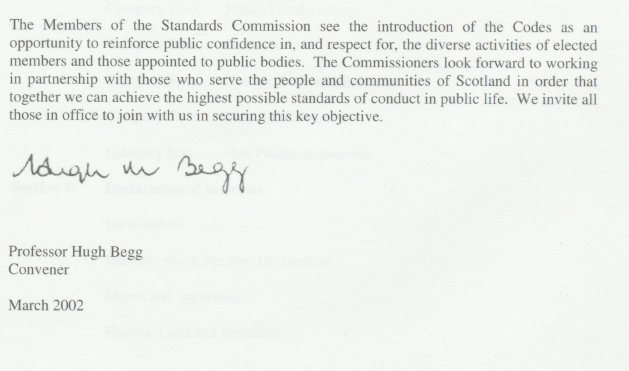 Note the reference “to serving the people of Scotland”.
A modified version of the foreword appeared in the revised Code for councillors in 2010 but with the references to putting ethical standards at “the heart of decision making” and “serving the people of Scotland” removed. In 2014 Code for NDPB members the foreword had gone, along with its content. It has never been replaced in either version of the Code. This appears to have opened the door to the changes in the Code that followed.
Undermining the Principles in the Codes of Conduct
The Ethical Standards in Public Life (Scotland) Act 2000 (see here for the Act) put the codes of conduct at the forefront of the new ethical framework it was creating:

Clause 1 concerns the Code of Conduct for councillors and Clause 2, which is similarly worded, for members of NDPBs. Clauses 1.2 (and 2.2) provide for the codes to include both principles and rules.
Although the wording in Section 9 of the Act has been updated to take account of the Chief Investigating Officer now being called the Ethical Standards Commissioner (ESC), under the law their key function remains the same, to investigate breaches of the codes as a whole:

What this meant is the then Chief Investigating Officer was able to investigate, and the SCS able to consider, all breaches of the codes. This was whether these were breaches of Section 2 containing the principles, which had been derived from the Nolan Principles for ethical conduct in public life, or the rules that had been developed in the sections that followed. Both principles and rules were integral to the codes.
In the original codes the rules were focussed on registrations of interests (section 4), declarations of interest (section 5), lobbying (section 6) and planning (Section 7). (Section 7 only appeared in the Code for councillors despite it being known at the time the two NDPBs, the new National Park Authorities, would have planning functions).
What then happened is the original working wording at the start of the section on Principles:
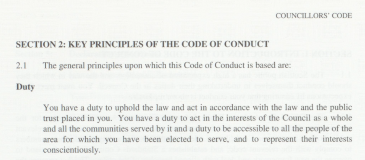 was changed to read;
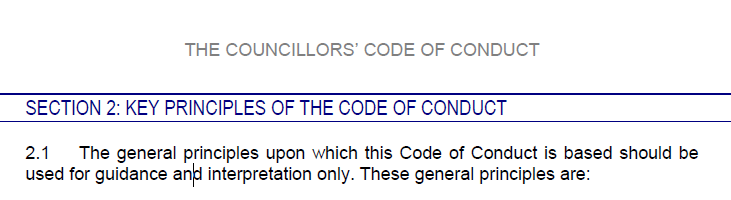
The new wording was then incorporated into the 2014 revision of the Code for NDPBs
This apparently small change fundamentally changed the scope of the Codes of Conduct. No longer was the behaviour of councillors and board members to be judged by the ethical principles that had been developed for conduct in public life, but only by the rules that followed.
If this change of wording was not clear enough, the new codes for both councillors and NDPB members issued in 2021 (there had been further revisions to the code for councillors in 2018) added this further wording to the introduction:
“1.6 I will comply with the substantive provisions of this Code, being sections 3 to 7 inclusive and Annex A, in all situations and at all times where I am acting as a councillor, have referred to myself as a councillor or could objectively be considered to be acting as a councillor.” (A similar clause with similar wording about clauses 3-7 being the substantive parts of the Code was added to the Code for members of NDPBs).
While the wording of the ethical principles (Duty, Selflessness, Integrity, Objectivity, Accountability and Stewardship, Openness, Honesty, Leadership and Respect) has been tinkered with since 2003, those changes are of little account since the principles themselves have been made redundant.
Unless a principle now has a set of accompanying rules, it is effectively meaningless. The example of this I gave in my February post was a councillor or board member who lies. Both that and being economical with the truth would be seen by most people as clear breaches of the principle of the need for honesty in public life. Without any rules stating this, however, councillors and board members have been freed up since the changes in 2010/2014 to say whatever they like without any statutory repercussions. While lying has been made acceptable, criticising people who do so has been made unacceptable. Welcome to the Brave New World!
The development of the rules in Section 3 -7 of the model codes
The radical change in the status of the principles created a major gap in the codes. The original version of Section 3 on conduct contained 22 clauses for councillors and 12 for board members but most of these clauses were worded more as advice than rules. Section 3 was hardly changed in the 2010 revision for councillors but then gradually developed over the course of subsequent revisions of both codes to include new rules.
The primary focus of these new rules has, as I explained in February, related to one principle, Respect. Most of the other principles have no rules at all, hence why they have effectively been meaningless since the 2010/2014 revisions. This has skewed the codes from their original intention, which was to provide an overarching framework for ethical conduct and decision making in public life, to a means of controlling what councillors and board members can say and the way they say this.
Whether being polite at all times or not criticising officials in public, which the rules in the Code now require, should be treated as a fundamental ethical principle are a moot point. This point is central to the disputes between the Standards Commission and Cllr Fiona Higgins, Sid Perrie and others.
Discussion
The change in status of the principles means that councillors like Fiona Higgins and members of NDPBs like Sid Perrie can no longer use what were supposed to be the ethical principles at the heart of public life to justify what they said or how they said it. An official or officials may have lied in public but there is no longer ANY defence under the codes for saying so in public. Nor is there any longer any defence for using strong language to do so, even where a councillor or board member has been continually frustrated by the refusal of officials and others in power to speak the truth.
The codes have therefore changed from providing an ethical framework to judge whether a councillor or board member was right or wrong to say or do what they did to a technical set of rules for how they should behave. These rues that are no longer balanced but appear designed to protect those with power from being democratically held to account
In my first post I called for the Standards Commission in its present form to be abolished and replaced, possibly by a citizens panel who could judge whether the behaviour of councillors and members of NDPBs was right or wrong. This call was picked up by Martin Williams, one of several journalists who has been investigating the Standards Commission, in the Herald (see here). Having now obtained the original versions of the code and reviewed these against subsequent versions, it is also clear that there is an urgent need for the Scottish Parliament to review both codes of conduct.
Central to that review should be the re-instatement of the Principles as substantive provisions in the codes which take precedence over any specific rules. Unless and until that is done, we have no ethical framework in Scotland for holding councillors and members of NDPBs to account. Instead we have a set of ethically dubious rules which are now being primarily used to stifle dissent and public criticism of those in power. Once the principles are reinstated to their rightful place at the centre of the codes, consideration can then be given as to how the rules can be amended.
I will consider further aspects of the current rules, particularly those that deal with planning/quasi-judicial decisions, and how public officials (who are not subject to any code) might be publicly held to account in further posts.
Meantime, please consider contributing and asking others to contribute to the fundraiser for the Sid Perrie case (see here). This has now raised £2,290 against an initial target of £6,000. This is a tiny amount compared to what the Standards Commission are spending on lawyers (see here), funded by the Scottish Government, to defend their enforcement of Codes of Conduct that are no longer fit for purpose. The Gofundme link is here.
