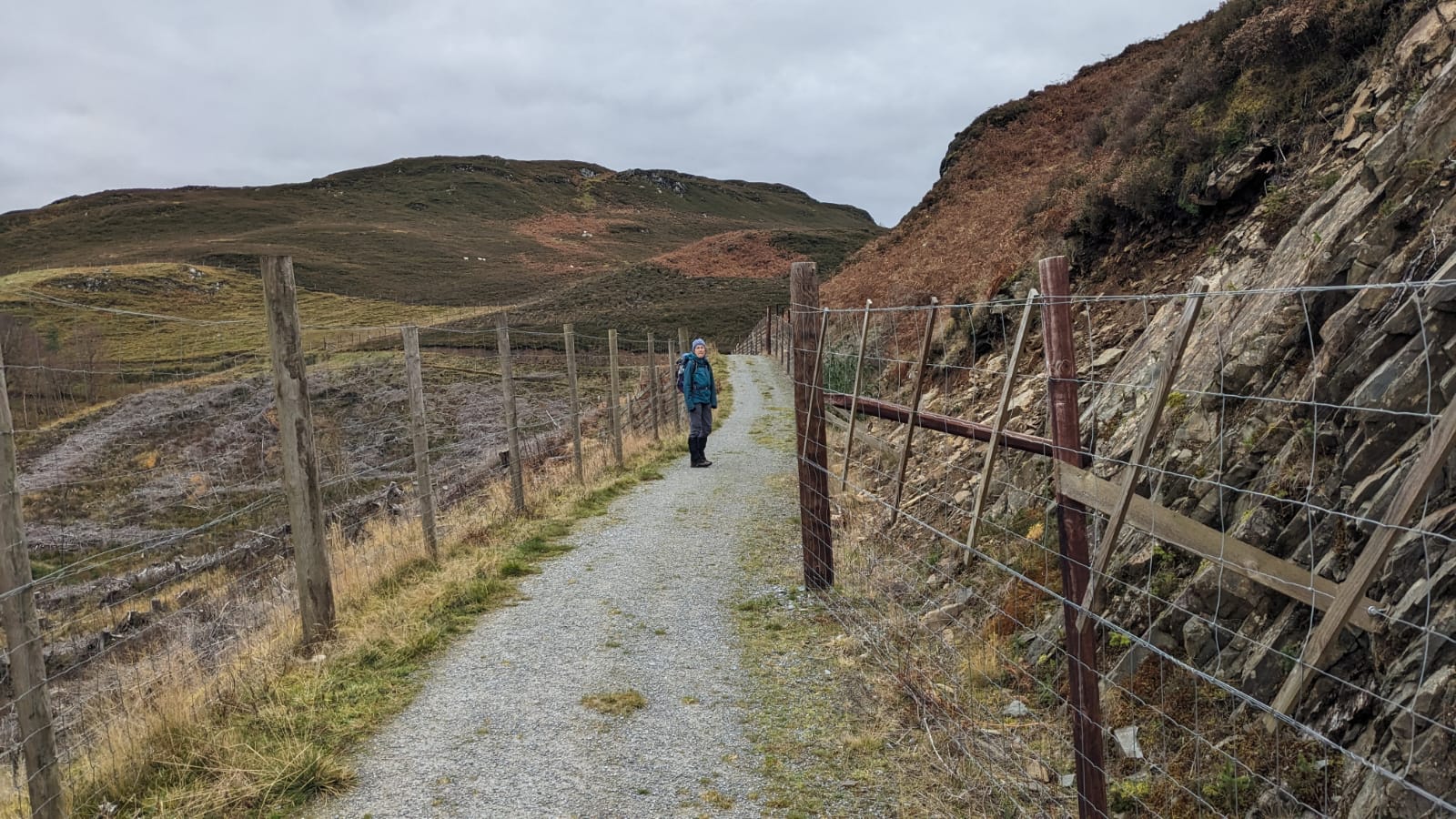
 Walking up to join the Glen Doe hydro track on Saturday (see here) the connecting path passed above a felled plantation and below an area of new native woodland planting. Both had their own deer fences, one old (left), and one new (right). We were channelled between the two. In theory access rights apply to all land but the only way out of this fenced corridor was at either end.
The erection of the new fence above the path was completely unnecessary to keep deer out, despite the apparentlynhigh numbers in the area. Scottish Forestry, as the regulator, could simply insist all native woodland developer make use of old fences and renew them when necessary.
The batons on the new deer fence, intended to reduce bird strike, are a bad joke. The chances of any grouse being able to fly into the fence from above, where it is up against the steep bank, must be negligible. And if flying up from below any grouse will hit the unmarked old fence first. The sensible thing to have done was mark the old fence but that is not how Scottish Forestry works.
Prof Dougie MacMillan highlighted the impact of deer fences on access in a comment on my post on the Rural Affairs Inquiry into access rights (see here). What I saw on Saturday was merely an extreme example. The scandal is the public are effectively paying to curtail our public rights of access through funding the Forestry Grants System, which is responsible for many of these deer fences.

Yes, it’s likely the landowner was also using this fencing to restrict public access. As has been said on many occasions we have a totally broken Forestry Grants System, but as usual our Scottish Government is not listening. There is a public consultation (closing on 23 November) on access rights – see https://yourviews.parliament.scot/335/outdoor-access/. It’s examples like this that need highlighting. Yes, my view is that our opinions will be in the main disregarded, but if we don’t speak up, we have only ourselves to blame.