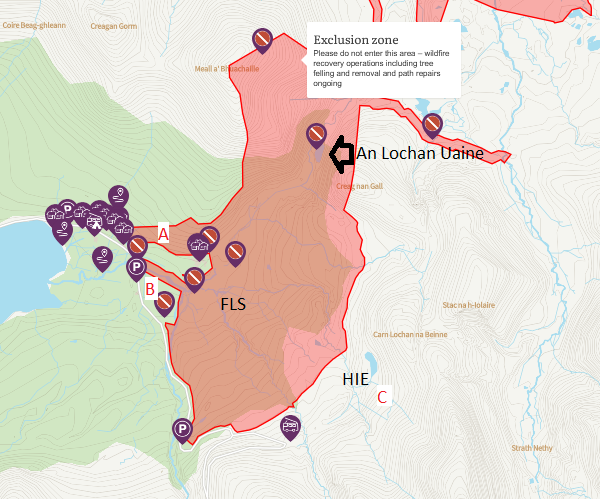
Yesterday afternoon the Cairngorms National Park Authority (CNPA) further reduced the overall area covered by their unlawful exclusion zone in Glenmore (see here) and (here). Once again there was no news release to announce the changes although the day before the CNPA had issued a news release about King Charles’ visits to An Lochan Uaine at the pass of Ryvoan and in the heart of their Exclusion Zone (see here).
If it was safe enough on Wednesday for the King to be driven in a landrover along the track to An Lochan Uaine and others to assemble there, clearly it is also now safe for the public to walk along that same track, a core path and a right of way.
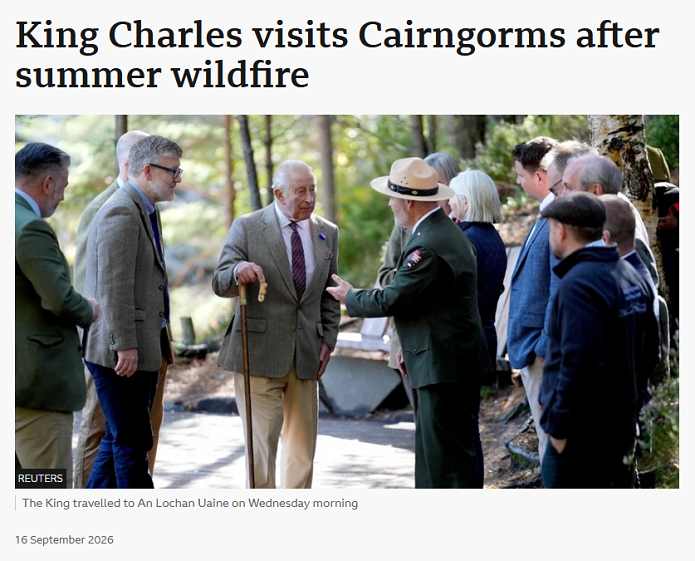
Initially, on hearing of the King’s visit to Ryvoan, I thought that the CNPA might have been keeping the “Exclusion Zone” in place until after his visit for security reasons. The area where they are still trying to exclude people, however, shows that is not the case. The CNPA are still advertising the track to Ryvoan and most of the forest owned by FLS in Glen More as very much closed.
The BBC’s article on the Royal Visit (see here) reported that “Charles arrived in a Land Rover shortly after 11:00 and for part of the visit walked with the assistance of a shepherd’s crook as he traversed the uneven ground through woodland above the loch.” Again, if it was safe enough for the elderly King to walk over the uneven ground above An Lochain Uaine, there can be no justification for continuing to try and exclude the public from this area or doing the same.
The CNPA’s statement in their news release that “those attending today were escorted at all times by Park Authority and Forestry and Land Scotland staff” appears to be an attempt to justify the unjustifiable: the King would have never been allowed to walk around An Lochain Uaine if the public authorities believed there was any risk of a burned tree falling on the royal crown.
What all of this shows is that in the Cairngorms National Park there is one law for the rich and powerful and the officials in their jackets and another for the rest of us. This represents a complete betrayal access rights which were for everyone.
This week’s changes to the CNPA “Exclusion Zone”
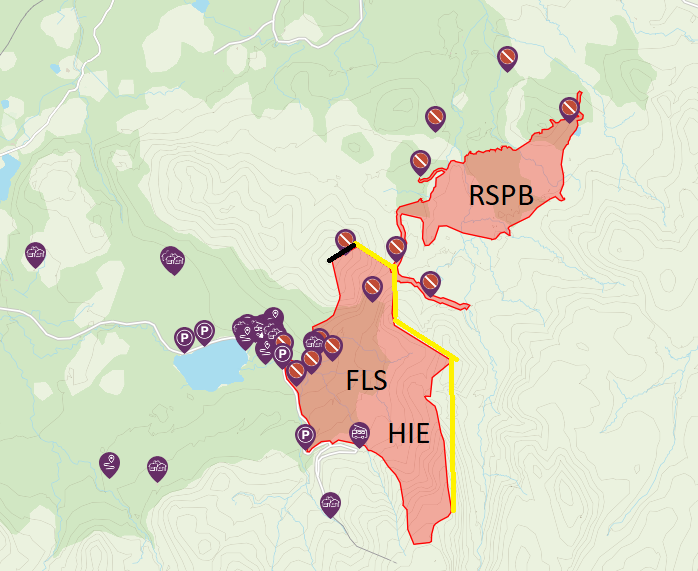
The main change made yesterday (see top map) was the “re-opening” of all the land on the Cairn Gorm estate owned by Highlands and Islands Enterprise and managed by Cairn Gorm mountain. After the RSPB re-opened all the montane and moorland areas on Abernethy last week, there was no justification left for keeping the ground above the Glenmore Forest on Cairn Gorm closed. It is nevertheless welcome that HIE and Cairngorm Mountain have now seen sense.
The same cannot be said for Forest and Land Scotland. The two main changes on their land are bizarre: the addition of an arm of land which was never burned and the opening up a small area of land by the ski road while keeping the Allt Mor car park, located within it, closed.
The CNPA’s news release quotes FLS’ North Regional Manager, Alex Macleod, as referring to “the efforts of the teams who are still working hard to deal with the hidden dangers to make the area safe again for the public.” That may be the case in some areas but is clearly not the case along the track to An Lochan Uaine or, it appears, in the area immediately around it. FLS are failing in their duty to manage access responsibly and keep any restrictions to the minimum possible.
One suspects one of the reasons that they are still trying to keep the track closed is it is still being used by vehicles and machinery. There was never any ustification for this as protocols were developed and agreed under the Scottish Outdoor Access Code between recreational organisations and the forest industry to deal with such circumstances, as this example, which even uses “Exclusion Zone” shows:
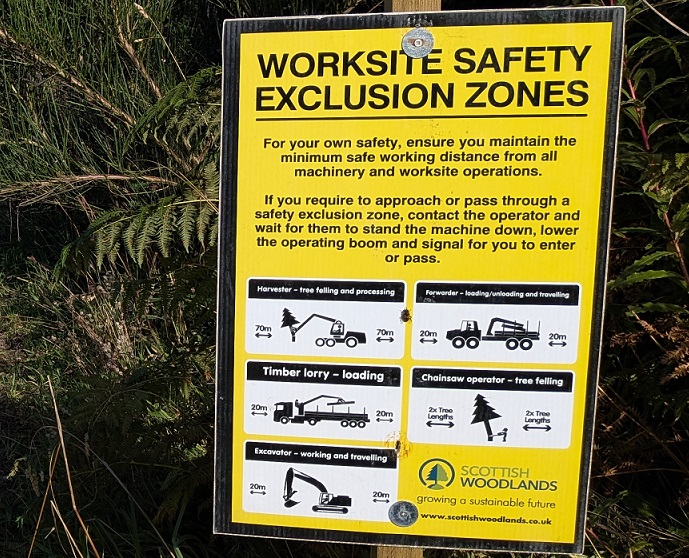
It says something about the way our public authorities are trying to manage risks following the Abernethy/Glenmore wildfire that neither FLS nor the CNPA appear aware of these protocols – which are now embedded in the practice of many private forestry companies – or, if they are, are ignoring them.
