In September 2021, the Scottish National Investment Bank (SNIB) announced it had committed £50m of taxpayer funds into Gresham House Forest Growth and Sustainability LP (Limited Partnership) as a ‘cornerstone investment’. The SNIB claimed 1.2 million tonnes of carbon would be sequestered over 20 years, with environmental benefits for biodiversity and ‘new jobs’ (see here).
The SNIB’s then CEO Eilidh Mactaggart, claimed ‘the new planting element and ability to generate carbon credits represents a novel investment proposition which mainstream investors have yet to fully embrace’ (see here).
The SNIB’s launch was overseen by Benny Higgins (see here), chairman of Oxygen Conservation (see here) who have upset communities through acquiring land such as at Invergeldie (see here) and are involved in other carbon offsetting projects such as Kinrara (see here) and Dorback (see here and here).
What is this ‘novel investment proposition’?
The SNIB’s claim that the ‘new planting element’ would have a higher native species composition is not supported by the evidence. For example, Gresham’s planting plan for Todrig farm in the Scottish Borders shows Sitka spruce is near the maximum (61%) permitted under the UK Forestry Standard (see here):
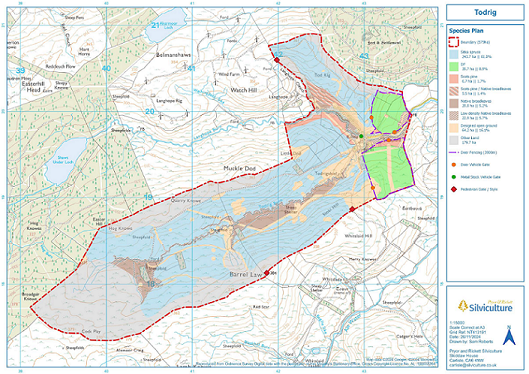 Even where schemes exceed the minimum percentage requirement of native broadleaves, deciduous trees are often, as at Todrig, concentrated along the main burns where conifers would normally not be permitted. This enables investors to harvest carbon credits and grants (if eligible). Gresham House Forest Growth and Sustainability LP has around eighty investors besides the SNIB (see here); it seems implausible they would forego higher returns by substituting commercial conifers with native trees, and for tax reasons (see here).
SNIB Chair Willie Watt told the Scottish Parliament Economy and Fair Work Committee on 24 September 2025 (see here after 09:57) that ‘Gresham House have a bit of a bad reputation because quite a lot of their investment is tax driven’.
Scottish Forestry determined that no Environmental Impact Assessment was required for Todrig but were then found to have broken the law in how it arrived at this decision (see here and here).
‘Bizarre prices’ paid by Gresham House Forest Growth and Sustainability LP
In 2024 the SNIB refused to disclose the locations of landholdings held by Gresham House Forest Growth and Sustainability LP. This prompted research by Andy Wightman (see here) which revealed they had paid extremely high prices (seemingly several times the market value) for various land holdings (see here and here). This included £12.2 million for 579 ha Todrig, a hill farm with a few disused buildings.
Intriguingly, the Title Sheet for Todrig at the Registers of Scotland shows a standard security was registered in March 2022 with the previous landowner.while the application to register this provided a value of £12.2 million.What was the basis for this standard security, and if Todrig was put back on the open market, would it still fetch around £12.2 million?
Other inflated land purchase prices appear to include £18.5 million for a 322 ha plantation and another £18.5 million for an adjacent, 147 ha plantation, both in the Eskdalemuir forest (a list of landholdings can be downloaded from Andy Wightman’s blog – link above).
The SNIB and the Woodland Carbon Code
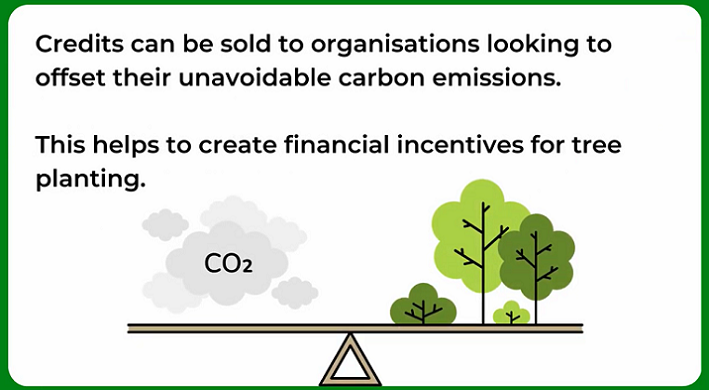
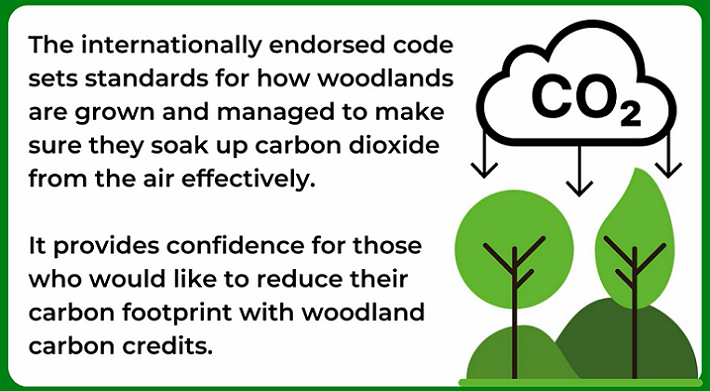
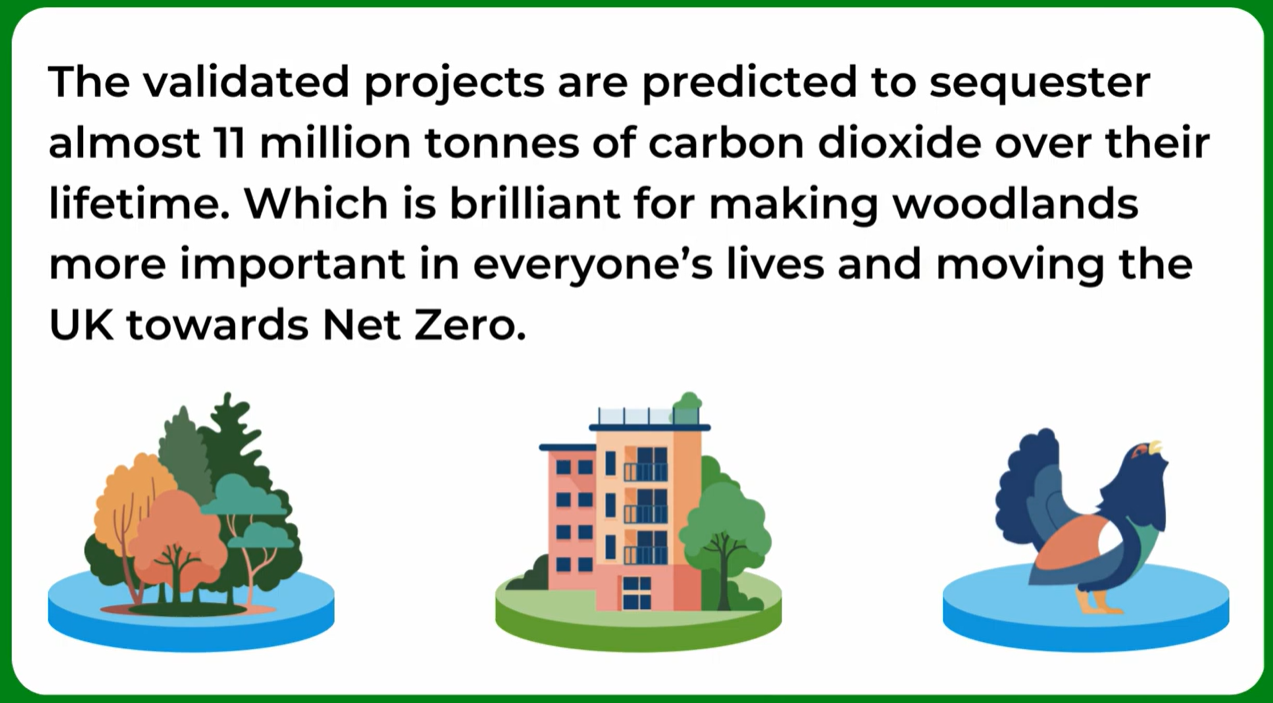
When the SNIB announced in 2021 that its investment would help sequester 1.2 million tonnes of carbon, observers thought this would be under the standards set out by the Woodland Carbon Code (WCC), run by Scottish Forestry. The WCC claim it ‘is the UK’s government-backed standard for creating new woodlands that generate high integrity carbon credits’, while questionably claiming to ‘help climate change, support nature and benefit communities’ through empowering landowners (see here). It is promoted using videos making puerile claims such as these (see here):
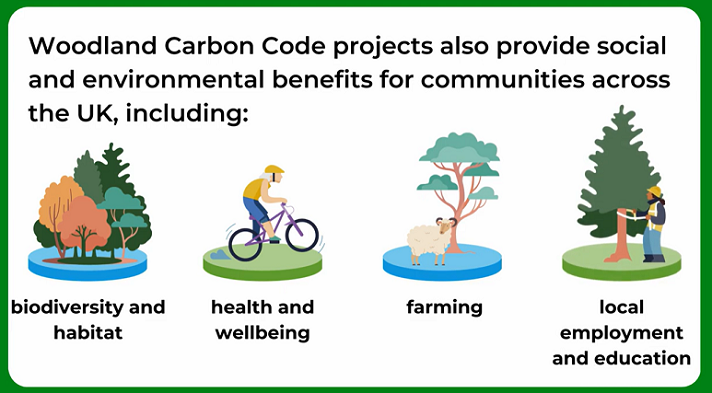
In practice, nature is being destroyed by many woodland creation schemes such as at Stobo Hope (see here), and communities are excluded, as at Kinrara (see here), with farms and local jobs disappearing. The claim that commercial forestry helps to tackle climate change is very dubious. The WCC calculator ignores long-term soil carbon losses (see here) and only accounts for the carbon sequestered in trees on site, ignoring off-site timber product lifecycle carbon emissions (see here).
Do Verra carbon credits represent a ‘novel investment proposition’?
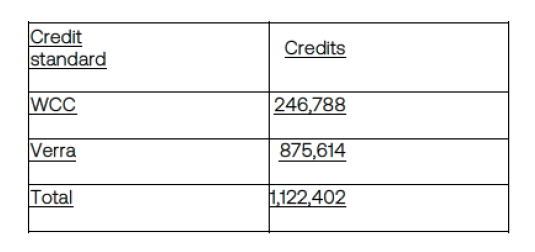
A response by the SNIB to a FoI request revealed that (as of 31 December 2024), of the estimated 1.2 million tonnes of carbon that were forecast to be sequestered, 246,788 (22%) would be under the WCC and 875,614 (78%) under Verra:
Verra was originally developed in 2005 by Cheyne Capital and a partner company (see here). The possible use of Verra carbon credits in the UK is highly unusual. Under the Verified Carbon Standard Programme on the Verra Registry, around 15 projects are listed in the UK (see here) compared to around 2,477 projects listed under the WCC (see here).
Like the WCC, Verra has image problems. In January 2023 the Guardian reported that an investigation into the Verra Carbon Standard found that 90% of its rainforest carbon offsets were worthless (see here).
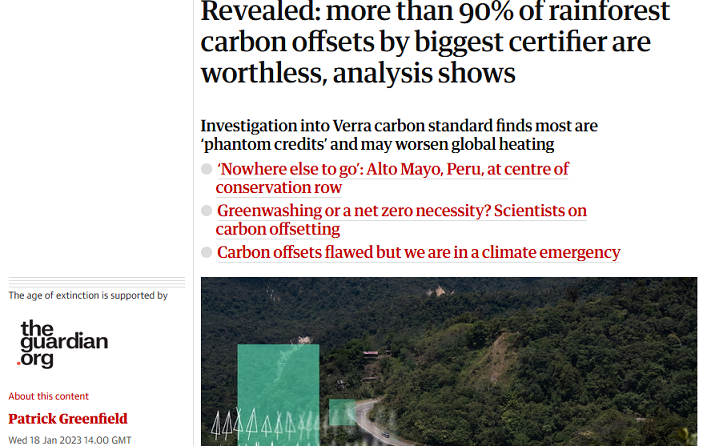
The Guardian then reported in March 2023 that Verra ‘will phase out and replace its rainforest offsets programme by mid-2025’ (see here). A different study (published in 2025) of 95 Verra registered projects found ‘systematic flaws within the auditing process’ resulting in credits being overvalued (see here). Researcher Benedict S. Probst suggested that ‘the voluntary carbon market is broken’, explaining that ‘even if you fixed the audits, you still often have flawed methodologies’.
Verra offer a range of methodologies (see here), raising questions about what methodology or methodologies are being considered by Gresham House for its landholdings; this is discussed later on.
Gresham House, Verra and the WCC
The SNIB have very limited involvement in how the Gresham House Forest Growth and Sustainability fund is managed. Nearly two years after Eilidh Mactaggart had described the ability to generate carbon credits as ‘a novel investment proposition’, the SNIB asked Gresham House about the use of different carbon standards. It should be noted that only new woodland creation schemes can be registered under the WCC, and they have to meet certain criteria (see here). In contrast, Verra carbon credits seem to have a different eligibility criteria, as shown by excerpts from email correspondence in May and June 2023 between Gresham House and the SNIB (provided in response to a FOI request dated 21 June 2024):
SNIB: ‘Noting the [redacted] case study states the use of the WCC, I wanted to ask Gresham’s current position and thinking around other carbon standards [e.g Verra], particularly in regard to the Scotland based sites’
Gresham House: ‘we provided a brief update on the WCC and how the change in additionality criteria impacts the partnership’
SNIB: ‘how many schemes within our investment are covered by the WCC and how many fall outwith/would be excluded from the WCC (and presumably then subject to Verra) so we have that information to hand?’
Gresham House: ‘we currently have 4 WCC projects which are either validated or undergoing validation, and 26 which are being considered for Verra’…….‘in the UK we will continue to develop projects using either WCC or Verra methodologies as appropriate’
SNIB: ‘of the 26 projects considered for Verra, are they all on sites that would be ineligible to be considered for the WCC e.g., is there existing planting on these sites that would make the site ineligible for WCC verification?’
Gresham House: ‘26 of the planting designs in their current iteration would be unlikely to be eligible for the WCC’
SNIB: ‘(Apologies if this is a daft lassie question) Is there potential to utilise different accreditation schemes across a single site e.g. pocket the site up so that areas of afforestation could be captured by WCC and any reforestation would be covered by Verra’…….‘is this something that Gresham would consider?’
Gresham House: ‘forests are generally managed as an unit and as such it would be difficult to separate, particularly as the WCC is part of Scottish Forestry and they are aware of these compositions and grant schemes’…….‘there may be some small scenarios where this is possible under broadleaf grant schemes’…….‘it is probably helpful to add that another part of the validation process is to check that the land in question is not already registered for another scheme, to prevent credits being double sold through multiple carbon standards’
It seems 26 sites were being considered for Verra with four sites either validated or undergoing validation under the WCC. From the information provided, it is unclear from whether the 26 sites comprised existing woodland or proposed woodland planting, or both.
The role of Scottish Forestry and the Woodland Carbon Code
In May 2023, the SNIB had explained to Gresham House that in ‘ongoing engagements with the Scottish Government and policy team, our insights team passed on a query around carbon standards and more specifically the use of the WCC’.
A further FOI request to Scottish Forestry obtained emails between Pat Snowdon (Head of Economics and the WCC), and the SNIB between May and August 2023:
Scottish Forestry: ‘and wonder whether the woodland creation that is planned under these investments will involve the generation of carbon credits’
SNIB: ‘we work closely with [redacted] and the wider team to ensure that any future projects we may fund are high quality and high integrity, which means using the correct standards and approaches’
Scottish Forestry: ‘Gresham House has told us they intend to be using a forthcoming carbon standard methodology for woodland creation being issued under Verra’……..‘ it is not clear exactly which woodland creation schemes in future they would wish to use the Verra standard for, but I think you should be aware of this’.
Do Scottish Forestry check registration of sites with other carbon standards?
Scottish Forestry claimed in another FoI response dated 19 June 2026 that the WCC carbon registry acts as a ‘single source of truth’, with ‘measures to prevent double counting arising from overlaps with other schemes’ (see here). Such measures included ‘weekly manual checks of the Verra and Wilder Carbon registries to ensure that WCC projects are not registered elsewhere’:
Further measures included ‘signed landowner declarations’ and ‘third party validation’. If a site has ‘been used for multiple carbon credit schemes, the WCC may take enforcement action. This can include disqualifying the project and cancelling all associated credits from the UK Land Carbon Registry’.
Where are potential Verra and WCC sites located?
The SNIB were asked by FoI request to provide locations of landholdings associated with Verra. They responded in November 2025, stating that ‘the Fund’s intention is to register and validate all qualifying schemes under either the WCC or Verra. It is important to note that not all sites generate carbon credits’.
The SNIB also clarified that they did not hold information about landholdings associated with Verra and ‘should any sites be registered under Verra in the future, information would be publicly accessible via the Verra registry’. In practice it appears very difficult for the public to identify these sites (if/when they appear on the Verra Registry), as the Verra registry may conceal the identity of landowners.
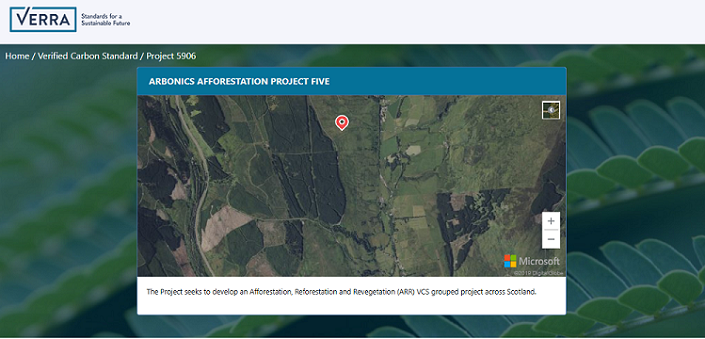
Concerns about the lack of transparency over the location of landholdings held by the fund seemed well founded, after a project called ‘Arbonics Afforestation Project Five’ (see first image in post) appeared on the Verra Registry, shortly after a ‘Deed of Representation’ was signed in January 2026. Estonian-registered company Arbonics OÜ appears to be a ‘Listing Representor’ as shown in the excerpts below:
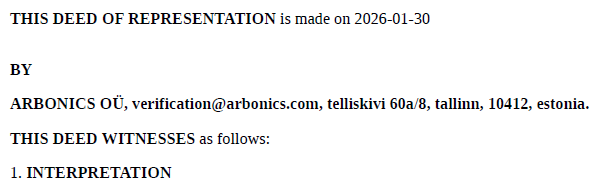

 Scottish Forestry provided a link to the Arbonics Afforestation Project Five (see here) in response to an FOI request on 4th June 2026, stating it had ‘identified one such site’ on the Verra registry (associated with Gresham House Forest Growth and Sustainability LP).
The Verra registry describes this project as a ‘pipeline listing (under development) approved’, giving an estimated project start date of 22 January 2023, but no registration date. Why did Gresham House use an Estonian registered intermediary as a ‘Listing Representor’ instead of providing their own name on the Verra registry so the public could identify the landowner?
The ‘Arbonics’ project is shown on the Verra registry with a red marker (screenshot below) on a site in Dumfries and Galloway, with methodology VM0047 – ‘Afforestation, Reforestation and Revegetation’ (see here). A ‘shapefile’ (for Geographic Information Systems) can be downloaded from the Verra webpage.
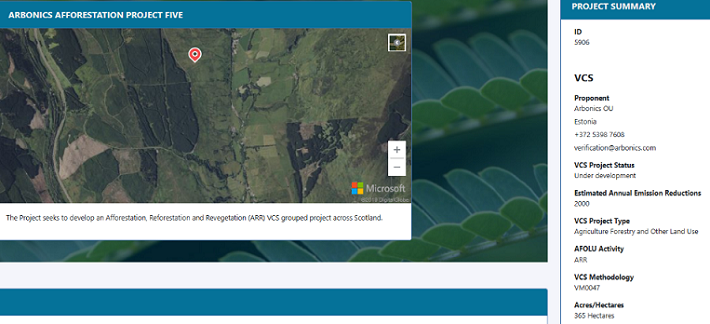
Scottish Forestry’s claim to have identified ‘one such site’ in its 19 June 2026 FoI response appears to be inaccurate. Arbonics Afforestation Project Five covers multiple sites, described on the Verra registry as a ‘VCS grouped project across Scotland’, with 365 ha as shown above.
The shapefile was downloaded earlier this year, and shows four locations. One lies within Ericstane South in Dumfries and Galloway, managed by Scottish Woodlands Ltd, who previously managed Brewdog’s dead forest at Kinrara, now owned by Oxygen Conservation (see here and here). A planting plan for Ericstane South is shown below:
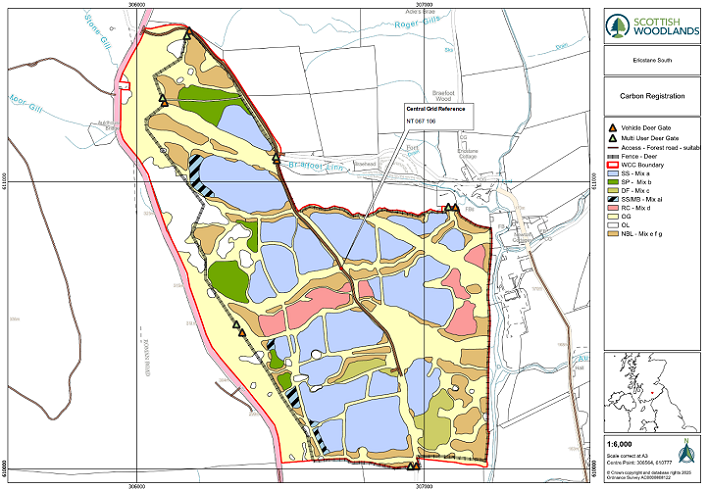
The remaining three polygons seem to lie within three other forestry sites: Knockgardner, Heriot Mill, and Ladyurd. The polygons seem to be small, arbitrary markers, rather than delineating a project area and boundary.
Of these four sites listed on the Verra registry (with a stated area of 365 ha), all are or were managed by Scottish Woodlands Ltd. According to Scottish Forestry registers (see here) the total area of afforestation for these same four sites is 378 ha.
Three of these four sites are also listed on the WCC registry (see here, here and here). Two are ‘under development’ and one is ‘verified’. It is unclear if Knockgardner is listed on the WCC registry, or if so, it may be under a different name. There are also other landholdings owned by the fund listed on the WCC register.
This raises the question of why these sites are listed on both registries. How can the public and investors be assured there is no double counting? Scottish Forestry mistakenly thought there was only one site listed on the Verra registry (when there are four sites). As the shapefiles do not provide the project area and boundaries for the Verra sites, how can Scottish Forestry determine if there is any overlap in project boundaries between Verra listed projects and WCC listed projects?
The Verra registry estimated annual emissions reductions of 2,000 tonnes for Arbonics Afforestation Project Five. Will further sites (owned by the fund) be listed on the Verra registry to meet the 2024 estimate of 875,614 tonnes sequestered over 20 years? Will Todrig be eligible for Verra carbon credits?
What is Verra’s Afforestation, Reforestation and Revegetation (VM0047) methodology?
Scottish Forestry’s FOI response of 4 June 2026 also confirmed that in summer 2023 Gresham House ‘were considering the use of Verra’s VM0047 methodology’, adding ‘we note that this methodology was not launched until October 2023’:
VM0047 ‘provides two quantification approaches: area-based and census-based’:
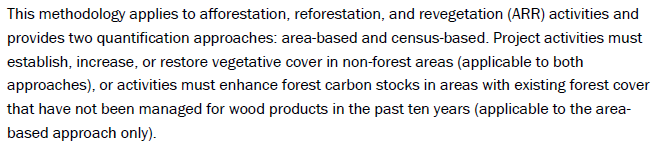
The area-based approach refers to afforesting non-forest areas. While this approach includes new woodland creation schemes it also refers to ‘activities increasing carbon stock in areas with existing forest cover that have not been managed for wood products in the past ten years’. This appears to open the door to obtaining carbon credits for existing commercial woodland where there has no timber harvesting for ten years.
The census-based approach seems to apply to projects which increase or restore vegetative cover, but with a continuation of the previous land use, such as agriculture.
Will Scottish Forestry encourage others to ‘embrace’ this ‘novel investment proposition’?
The prospective use of Verra by the SNIB raises legitimate questions, especially given the use of £50 million of taxpayer funds. It would be in the public interest for independent researchers to be able to evaluate the Verra methodology, requiring disclosure of all sites being considered under either the Verra or WCC (or both) standards. Detailed, site-specific information such as planting/‘revegetation’ maps, project area/boundary maps, soil type maps and carbon sequestration forecasts would also be required.
The WCC’s questionable calculations (see here and here), makes investments in commercial conifers more attractive by nonsensically awarding carbon credits while ignoring timber product lifecycle emissions. It would be useful for researchers to determine why the Verra carbon standard is being used instead of, or in addition to, the WCC for various sites. Could the Verra methodology be even weaker than the WCC methodology?
The SNIB’s claim in 2021 that ‘the new planting element and ability to generate carbon credits represents a novel investment proposition which mainstream investors have yet to fully embrace’ was based on implausible native species composition claims, omitting to mention the payment of highly inflated prices for land and the use of questionable carbon standards. The investment may be novel but also appears to have significant risks.
The apparent lack of regulatory oversight for other carbon standards in the UK by the WCC seems consistent with Scottish Forestry’s predilection for satisfying vested interests in forestry, often under the pretext of meeting tree planting targets and ignoring adverse environmental impacts. The use of WCC calculations to pretend no long-term carbon losses occur from planting on organic soils and ignore timber product lifecycle emissions are examples of Scottish Forestry and the WCC misusing science. to satisfy financial interests.
It seems likely therefore, that without outside intervention Scottish Forestry will continue to take a lax approach to ‘novel investment propositions’ by financial interests. There needs to be an independent inquiry into the use of carbon standards in the UK, which if properly conducted, should further expose deficiencies in the methodologies used.
[Note from Nick Kempe: the author of this post wishes to remain anonymous but I have had sight of and checked all the references in the post].

Pleased to see an article like this on this subject, and I am wondering how many red flashing lights do there need to be on something for people to pay attention. I found it interesting when some-one referred to their own enquiry as a “daft lassie question”. This is the problem. People who should know better think they will look stupid or come across as not being able to understand something which everyone else seems to understand fully. In reality, they are almost certainly just going along with it as well. There are several names which can be used for this sort of setup, none of which are very good. If we stopped feeding in taxpayer money for something that is “novel” (ie not properly tested or understood), the whole thing would collapse very quickly. If a few hundred Ha of conifer plantation is apparently worth £18 million, and that does not cause you to stop and think, then obviously, nothing will. And obviously, all of this happening in plain sight……
This publicly funded gambling process, branded as “carbon credits”, should come to an end in the near future as the Scottish Parliament considers legislation on the roles and structures of public bodies. Under the Scottish Government’s Programme for Government, on page 46, is a plan to make fundamental changes to the way that public bodies, including SEPA, NatureScot and Scottish Forestry discharge their responsibilities. Top priority should be given to the abolition of SF and thereby terminate the conflict of interest between its regulatory and grant aiding role in forestry. The former should be absorbed into SEPA and the latter into NatureScot. We already have one public body dealing with forestry matters, namely Forestry and Land Scotland, which is perfectly capable of managing all of our publicly owned forest land and, with a relatively minor change in its role, could also grant aid tree planting in our agricultural and urban environments. So it will be good bye to the carbon credit scam and all those investors from far away places who are treating Scottish land and its people as playtime in the world’s gambling dens.
The problem with this is that the ScotGov themselves are adding carbon credit chips to the table and therefore it doesn’t really matter what the structure is because that ethos is entrenched higher up. Scottish Forestry has its faults, but it is still the most practical of our land use agencies. Properly directed (ie properly funded and given instruction not to double fund any carbon schemes through FGS), they are still our best bet. Without them, you can kiss goodbye to any more significant woodland creation or regeneration over the next 20 years or so. As it is, we will now have to spend the next 3 years discussing restructuring, and then the next 10-15 years regretting whatever decision has been arrived at.
Very useful and concerning article, and highly relevant comments on it by Victor Clements and Dave Morris.
This entire area of strategic operation and possible modifications to environmental regulation and governance should be far more exposed to public consultation and open debate before the sweeping organisational changes currently being proposed by SG progress any further.
Exactly so!
The problem is that if you remove BNG as a funding method, how are upland/wild land conservation projects to be viable without total reliance on the goodwill of the super-wealthy like the Povlsens and the Rausings?
Despite Rich Stockdale’s annoying “billion dollar” bluster about what he might achieve at Oxygen Conservation (much of which has dissipated now that it’s clear it is not that simple) he is correct that a funding method which is not reliant on super-rich philanthropy is necessary, whether the money is drawn down by a commercial landowner, a long term institutional investor, a charity or trust, or a semi-state body.
Currently available carbon offsetting options are far from perfect but if a proper mechanism for assessment can establish project quality ratings, we will be close to establishing a working market to provide this funding. In this market, people and companies who undertake and document high-quality projects and submit them for independent quality assessment will receive funding for their work, which will enable and encourage them to undertake more similar projects. Screw up and there is no value until you put it right.
What is clear is that the traditional sporting estate model for upland management has had its day and the traditional land managers (Buccleuch, Duke of Westminster) are downscaling/cashing out. Less well managed/funded estates will follow. Proper funding presents an opportunity to manage the landscape for the national benefit, rather than relying on the whims and land management/sporting preferences of owners who are often absent or only occasional visitors.
The only sustainable long term funding model is one that concentrates on a mixture of production and environment, working to an upland vision that is part wooded and part open to have maximum biodiversity overall. We can debate what that balance is, but carbon based funding models in particular are for the birds, whatever way they are packaged or presented.
Indeed!
We should certainly be moving away from the sporting estate model. There is strong evidence that community and NGO-led projects deliver far better environmental and social outcomes than those driven by land speculation and carbon credits. If the Scottish Government were serious about land reform and taxation, we could achieve very different patterns of land ownership and upland management in rural Scotland.
We have to be aware that what some people might regard as being “sporting estates” are increasingly becoming involved with environmental projects as well, and that the “us vs them” distinction that many are comfortable with is increasingly breaking down in practice. The vast majority of land in Scotland is taken up by smaller and medium sized estates and farms who will view themselves as having mixed objectives, including environmental ones, but with some element of income from farming or sporting to try and make the overall financial equation work.
I have seen some of that myself and, though I am not a fan of blood sports or the subcultures associated with them, I am relaxed about sport shooting as an element of a mixed land management regime. That’s common across Europe and I like a bit of venison.
Scottish Natural Heritage (now re-branded as NatureScot) have had the powers to solve most of the ecological restoration problems in the Scottish Highlands since the mid 1990s through the Deer (Scotland) Act 1996 with its section 7 (voluntary) and section 8 (compulsory) deer population control powers. This was explained in the Deer Working Group report to the Scottish Government, published in Jan 2020. That report identified Balmoral and its neighbouring estates as the worst area in Scotland for repeated failure of section 7 schemes to effectively control deer numbers. SNH’s efforts to use section 8 powers in various parts of Scotland ran into a brick wall – civil servants in the Scottish Government refused to allow SNH to proceed to section 8 implementation. We do not need loads of money from corporate interests or from rich philanthropists to get our uplands regenerating. We just need the Scottish Government to apply the existing legislation, starting with Balmoral estate, without any further delay.
Absolutely!