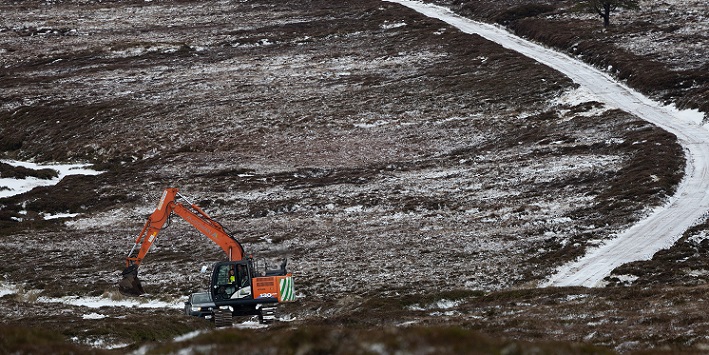
Last week Severin Carrell in the Guardian revealed that BrewDog had sold their “Lost Forest”, the Kinrara Estate, to Oxygen Conservation for £8.85m, £350k much more than the £8.5m they had paid for it five years previously (see here). This post considers some of the issues this raises including: why BrewDog sold the land for a “knockdown” price; Oxygen Conservation’s claims about delivering premium carbon credits; and the wider implications for the Woodland Carbon Code and carbon markets.
Kinrara’s sale price
The Oxygen Conservation group of companies (OC), as Andy Wightman recently explained, has been using a loophole in Land Register Rules, known as “Implementation of Missives”, to avoid openly declaring the price they are paying for land (see here). Andy had to pay the Registers of Scotland £60 to establish that in 2024 OC paid £28,495,220 for Dorback in the Cairngorms National Park and £14,250,000 for Blackburn & Hartsgarth in the Borders. It will have cost the Guardian another £30 – and no doubt a wait – to find out that OC paid £8.85m to BrewDog for the Kinrara Estate.
OC have chosen to make it as difficult as possible for the public to find out basic information like how much they have paid for the land. Had this information been public at the time, it might have cast further serious doubt on the heady claims Oxygen Conservation and BrewDog had made in their news release announcing the sale in early October 2025 (see here).
While BrewDog had sold off some buildings they had bought with the Kinrara Estate, which will have reduced its value, they had also received significant amounts of public grant. It is still unclear exactly how much of the £2,688,050 in forestry grants awarded to them for Phase I and Phase 2 of the Lost Forest had been paid by Scottish Forestry at the time of the sale, but a Freedom of Information request established that d £1,107,420.88 had been paid by April 2025 (see here).
The amount of grant that was awarded to BrewDog by NatureScot for Peatland Restoration also does not appear to have been made public, but the MDMG Kinrara 21 Project validated under the Peatland Carbon Code in 2022 covered 291 hectares. If that project cost the Scottish mean of £1712 per ha in 2022 (see here) that would represent another £498,192 in public grants. It seems likely that BrewDog had received a total of more than £1.6m in public funds by the time it sold Kinrara.
On top of these public investments, the outstanding balance of £1,580.629 in forestry grants and the “Pending Issuance Units” which had been registered on the back of them (PIUs is jargon for “Future Carbon Credits”) should have added further to the value of the land. The Guardian estimated the PIUs could be worth £4.5m on the carbon markets at current prices. This information suggests that if BrewDog had “delivered the schemes to a high standard”, as OC had claimed in their news release, OC should have paid significantly more for Kinrara. So why the knockdown price?
BrewDog’s shareholders left out of pocket
BrewDog had owned Kinrara through its subsidiary, the Lost Forest Ltd, but sold the land, not the company, to OC. The Lost Forest Ltd had taken out three loans from HSBC, the most recent in May 2025, which were secured on Kinrara. Records at Companies House (see here) show that one of the loans (“charges”) was “satisfied”, i.e paid back, on 6th November 2025 soon after the sale.
The other two charges made by HSBC, however, have been varied but are still in place and there is new floating charge over the assets of the Lost Forest Ltd taken out by a company in the Cayman islands. It is unclear why these companies would bother doing this when the last accounts of the Lost Forest Ltd, which cover the year to 31st December 2024, show that apart from the land its only assets were £6k in equipment. Perhaps that changed in 2025?
What these outstanding charges suggest, however, is that the price BrewDog received from OC for Kinrara did not even cover the cost of the outstanding loans and accumulated interest that had been secured over the property. That raises the question of why the two Directors of the Lost Forest Ltd agreed to sell Kinrara at a loss to the parent company, which by then was in serious financial difficulties, if they really had managed it to a high standard?
BrewDog’s carbon credits for Kinrara
In 2024 BrewDog announced they were pulling out of the carbon credits market, saying many schemes were highly questionable (see here). It appears, however, they did not de-register their own poor quality scheme at Kinrara, the Lost Forest Phase 1 where over 50% of the trees they planted died (see here), but left it on the Carbon Registry as “under development”:

Just a few weeks before the sale to OC, the Kinrara NWC Phase 1 scheme was validated and both it and Phase 2, which is still described as being “Under Development”, are now listed under the account of Oxygen Conservation.
 This suggests the Directors of the Lost Forest Ltd did try to use the WCC to maximise the value of Kinrara before selling it and had not just decided to cut and run.
Before the Lost Forest Phase 1 was validated, Scottish Woodlands revised their original calculations of the impact of the scheme on CO2 in the atmosphere. I will consider the difference between the two sets of calculations in detail in a further post, as they are quite revealing, but the key point for here is the number of PIUs that are now predicted to be generated by the scheme:
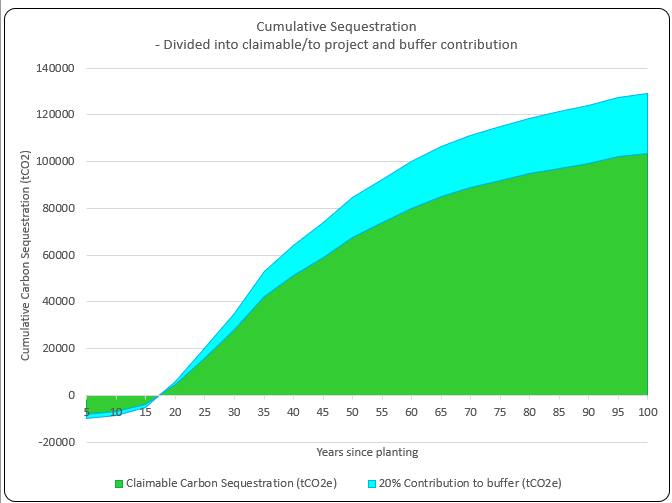
The most recent calculations ((see here) search under Projects, Kinrara) were lodged just before the Lost Forest Phase 1 Project was validated on 11th September 2025. The official start date of the project was the same as the earlier calculations, 30th June 2023. This was during the spring and summer when so many of the trees planted by Scottish Woodlands on behalf of BrewDog died. The latest graph shows a net loss of carbon for the first seventeen years and that just under 130,000 tonnes of CO2 (reported as PIUs in the Guardian article) should be absorbed from the atmosphere by 2123.
These outcomes, in terms of CO2, are significantly different to those predicted in the WCC calculator for the Lost Forest Phase 1 produced in 2022 (which are no longer on the WCC website):
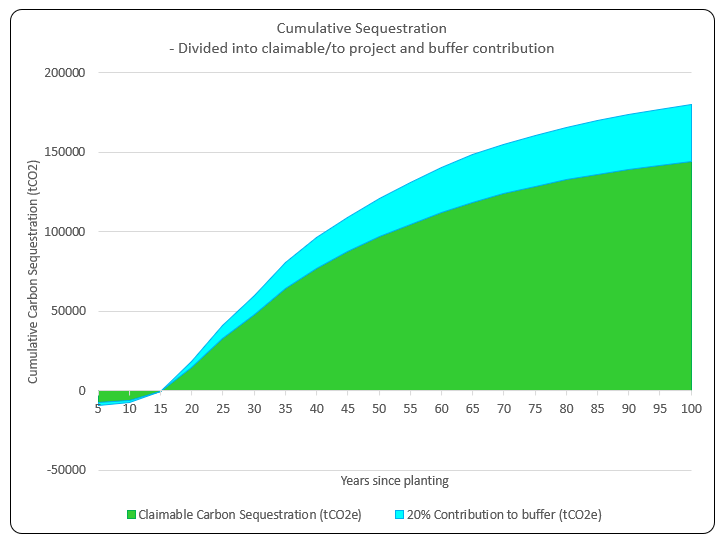
This graph shows the project as breaking even after 15 years but predicts that up to 180,000 tCO2 could be absorbed from the atmosphere by 2123. After so many trees died in 2023 and taking account of the time taken to re-plant them, one would expect the project to take a couple of more years to break-even now – whatever the assumptions in the WCC calculator – but NOT for the total number of PIUs generated to have dropped by almost a third.
Whatever the explanation for this massive drop in predicted carbon offsetting, it could help explain why OC paid £2,351 per hectare for Kinrara compared to the £4,687 per ha it paid for the nearby Dorback estate in December 2024. (These figures taken from the Guardian article).
Kinrara and Oxygen Conservation’s claims to be offering premium carbon credits
Richie Stockdale, the Chief Executive of OC, frequently promotes the view that the value of carbon credits will increase in future. Although he appears to share the views expressed by BrewDog, that many carbon offsetting schemes are very poor quality and it is very difficult for people to know what they are buying, he believes OC can deliver “premium quality” carbon credits which will be worth a lot. Mr Stockdale is very active on Linked-In and in the last week has published a post and a video setting out OC’s stall.
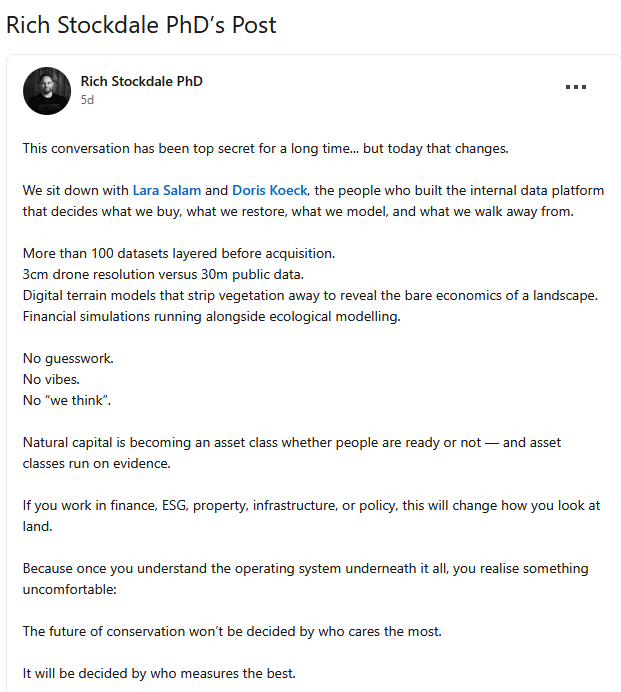
Here Mr Stockdate is basically arguing that OC are objective and that, unlike others, the carbon credits they sell are based on evidence..
The 1 hour 20 minute video (see here) features a discussion with OC’s data specialist and drone operator. Mr Stockdale starts with the provocative claim that OC is really a technology company, not the conservation company that has been promoted up until now. He went on to claim that “no-one is talking data in natural capital”, that he wanted to “know the value of every square metre in Scotland” and that OC were in the process of turning “landscape into digital evidence”.
The essence of Mr Stockdale’s argument appears to be that through detailed drone surveys OC can measure the impact they are having on the ground far more accurately. The example he gives is that by using drones, which can survey land down to 3 square cm, OC can now even measure how much carbon has been absorbed by each tree they had planted. Such detailed measurements will mean investors can be assured of the value of the carbon credits OC are selling.
Where Mr Stockdale is right is that detailed measurement would be better than the current guesstimates currently used to work out PIUs and tonnes of CO2 absorbed from the atmosphere, as exemplified by the two very different predictions for the number of PIUs which will be generated by Phase 1 of the Lost Forest. How far that is worth doing will depend in part on the carbon costs of the computing power required to do so, costs that OC now need to factor in to their carbon calculations.
Just how OC intends to provide and verify this evidence to investors was not explained. Nor why, without proper external oversight and regulation, anyone should trust electronic data any more than what can be seen on the ground?
From a “natural capital” perspective the advantage of OC turning information about landscape into digital data is that it makes the management of the countryside easier to monetise: X more wood = X more financial value or, though Mr Stockdale did not mention it, Y less wood = Y less value, as should happened at Kinrara when BrewDog’s trees died. Mr Stockdale’s focus appears to be on the potential gains, not the potential losses. An example he gave was that vegetation other than trees also contains carbon and that by measuring changes in this vegetation would help record the full (carbon and financial) value of what OC is doing.
This points to a fundamental flaw in OC’s approach. Vegetation absorbs CO2 from the atmosphere through photosynthesis but what is above ground is temporary and much of this carbon is released back into the atmosphere as CO2 each winter or when plants die. Some carbon, however, is transported below ground, either by the plant itself or by other organisms to form organic soils, or preserved as peat. It is these organic soils, rather than vegetation above ground, which are in carbon terms important since they store far more carbon and for much longer periods of time. Measuring vegetation to the 3 cm level with drones, therefore, while potentially interesting from a biodiversity perspective, has limited importance for carbon offsetting. It is what happens below ground and the impact which tree planting has on this which matters.
At present OC appear to accept and operate the framework set out by the Scottish Government and the Woodland Carbon Code. This allows planting of trees on peaty soils, so long as they are less than 50cms deep, and the use of methods such as mounding which expose these soils to the atmosphere where the carbon reacts with oxygen forming CO2.
Dave Morris, Ron Summers and I were pleased to meet with representatives of OC and Tree Story, their tree planting consultants, at Dorback last year, a few months after they had bought that estate. The initial purpose of the meeting was to ask OC to remove the deer fence with Abernethy, to help capercaillie (see here), and to put the case that they had a great opportunity to enable the Caledonian pinewood at Abernethy to expand onto Dorback through natural regeneration.
Unfortunately, OC appeared set on tree planting, as only this could potentially generate the returns necessary to pay back their investors. (I had wrong thought Triodos Bank had financed the purchase but it was private investors). We referred them to the research by Friggens et al from Stirling University and the James Hutton Institute (see here) that shows that when certain species like downy birch are planted on peaty soils CO2 emissions can increase for a period of at least forty years. To their credit OC followed this up after the meeting but then informed us they had been told the evidence is not conclusive. That is unsurprising, since to undertake scientific research you need to set parameters and there is always the potential that something has not been considered affect the result. Good scientists are never 100% certain but OC used this to say they have chosen to accept the parameters set by the Scottish Government.
The problem for OC is that they can make all the claims they wish about being able to measure what is happening above ground (and the trees they are planting in places like Dorback and Kinrara) but if the Scottish Government’s and Scottish Forestry’s assumptions about planting on peaty soils are wrong, their whole model collapses.
Last October saw the publication of a very interesting research overview, written by researchers at Oxford University and the USA, under the title “Are Carbon Offset fixable?” (see here). It covers a huge amount of ground, including why so many carbon offsetting schemes are of such poor quality. In relation to what has been happening in Scotland, including Kinrara under the ownership of first BrewDog and then OC, I was particularly struck by this:
“Many factors can complicate calculation of the correct number of credits to award a project,
especially forestry projects. For example, a 2021 article in Nature reviewed 108 experiments in-
volving elevated CO2 to determine the impact on carbon storage in plants versus soils (49). The
analysis suggests that forests will store less carbon in soil as CO2 levels rise than models suggest—
while grasslands will store more—reducing the net CDR [Carbon Dioxide Removal] benefit of planting trees in grasslands and savannas. Also, in 2019 the National Academy of Sciences noted that planting trees “in boreal zones [which include much of Highland Scotland] will have a warming effect that exceeds the cooling effect of reducing GHGs”(50, chapter 3) and that, above the snow line, “an increase in forest cover reduces surface reflectivity causing more surface warming.” This albedo effect limits the benefit to the climate of planting trees in northern regions, as does the fact that “tree planting disturbs pools of soil carbon, which store most of the carbon in cold ecosystems” (51, p. 1087).
OC can measure all they want but if they continue to measure the wrong thing, there is no reason to have any more confidence in what they are doing than any WCC scheme.

If Mr Stockdale likes uncomfortable truths, I will give him two: (1) Our scientific understanding of the relative carbon balance between trees, organic rich soils (> 5 cms deep) and the atmosphere is actually very poor. The Friggens et al report is notable for being virtually the only long term and independent report we have on the subject in Scotland. Its detractors all have something to lose by recognizing it. An economic asset based on non- existent science (& going against the best science that does exist) is always going to be very shaky, no matter how much you try to blind people with big data. (2) There is no such thing as an asset which only ever appreciates in value. To me, a tonne of carbon is a tonne of carbon is a tonne of carbon. If some tonnes are more desirable than others, that can only be because of the story built around them. ie Presentation is a big part of the story. That should set the alarm bells ringing in itself. There are various words that can be used for the economic/ asset model being pursued here, none of which are very good.
Carbon credits based on growing trees appears to be a gambling on a massive scale, stimulated by £millions of public money kindly provided by the Scottish Government through their forestry planting grants. It is resulting in vast tracts of Scotland passing into the hands of financial institutions and speculators in far away places. In May those elected to the new Scottish Parliament need to press for a total suspension of these planting grants. The whole system needs fundamental reform before any more public money is wasted on this 21st Century version of the Highland clearances.