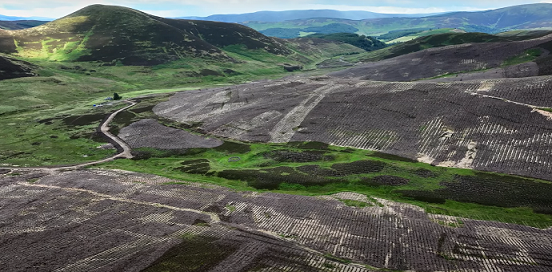
A video from July 2024 of the site can be seen here.
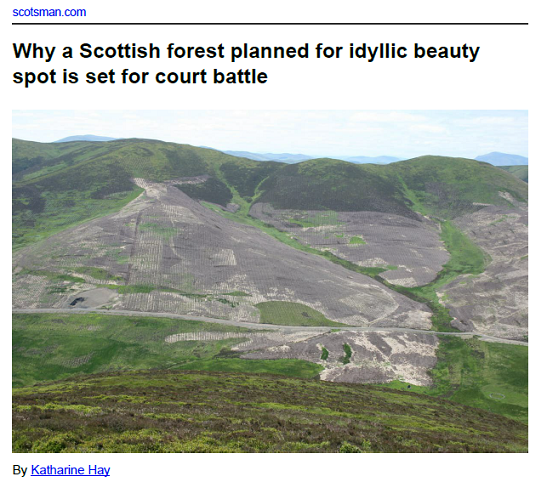
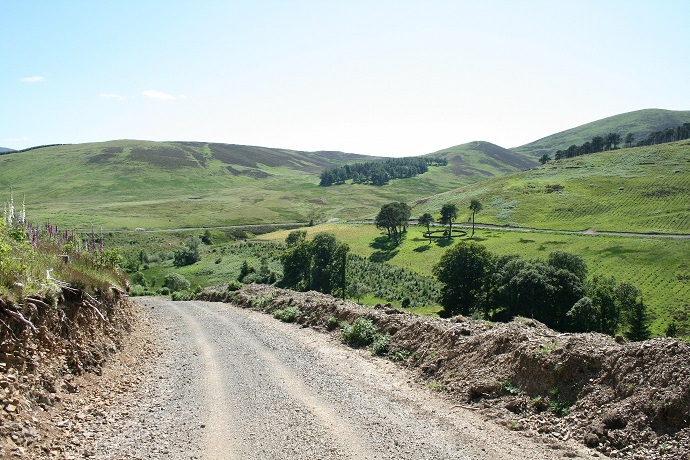
Readers may be familiar with Stobo (see here and here) perhaps one of Scotland’s most environmentally destructive forestry schemes this century. In February 2024, Scottish Forestry awarded a £2 million taxpayer funded contract to the Forestry Carbon Sequestration Fund, a ‘registered collective investment scheme’ in the tax haven of Guernsey (see here), for a giant, 1980s style Sitka spruce plantation, threatening to destroy vast areas of semi-natural moorlands, home to black grouse and many raptors. Forestry work started in February 2024.
Scottish Forestry’s claims about the alleged benefits of these type of schemes are extremely dubious (see here), and NatureScot said there would be significant and adverse landscape impacts on Stobo Hope. NatureScot later dismissed a licence application by Stobo forestry managers to hunt foxes with nineteen dogs (supposedly to reduce black grouse predation) (see here and here), as pointless because the black grouse would disappear as the plantation grew, contradicting Scottish Forestry’s claim black grouse would remain on site. The local community lodged a petition for judicial review (for updates see here) with the Court of Session in April 2024 to challenge Scottish Forestry’s decision to approve the scheme without an Environmental Impact Assessment (EIA).
Why did Scottish Forestry claim to be unaware of the herbicide application?
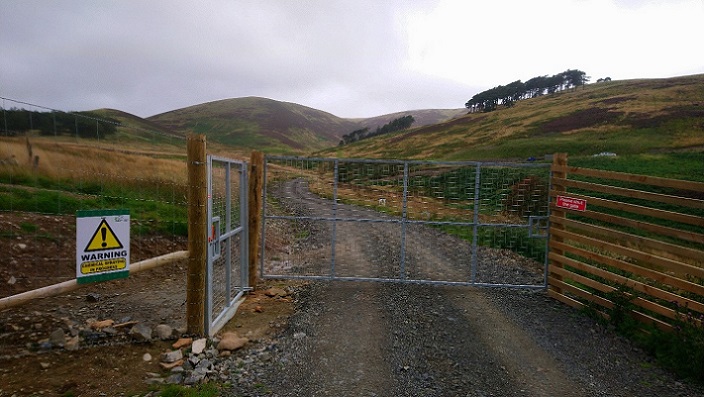
As part of the judicial review the petitioners had in mid-August 2024 provided pictures of extensive damage caused by the blanket application of herbicide at Stobo. In September Brendan Callaghan (Scottish Forestry’s Director of Operational Delivery) claimed (see here) Scottish Forestry were unaware of this damage until receiving these pictures, cancelled the £2 million contract as ‘a material piece of information was not disclosed by the applicant as we started the screening process’ and an enforcement notice was issued to stop the forestry work.
However, a blog on Raptor Persecution in July 2025 (see here) has shown senior Scottish Forestry staff were aware of the blanket herbicide spraying much earlier in the summer of 2024 , but did nothing about it, despite this being a significant breach of forestry regulations. Scottish Forestry had been forced to release documents showing what they knew about the herbicide, due to a decision by the Scottish Information Commissioner (see here).
A Scottish Forestry staff member stated ‘it looked like someone has napalmed the site’. Perhaps in not acting on this damage, Scottish Forestry put the financial interests of investors and tree-planting targets before communities and enforcing forestry regulations?
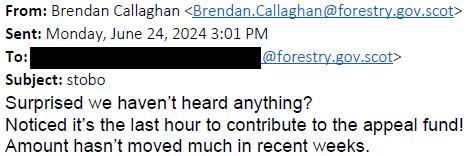
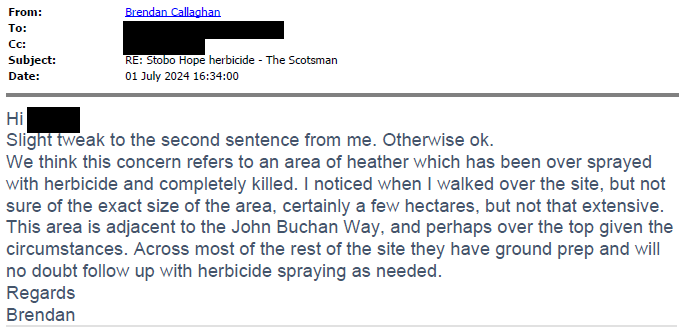
In June 2024, however, it appeared the petitioners did not have the funds to go to court, and the documents in the FOI response show Scottish Forestry were following this closely. For example, Brendan Callaghan sent this email when the crowdfunder for legal fees only had one hour left (it was later extended):
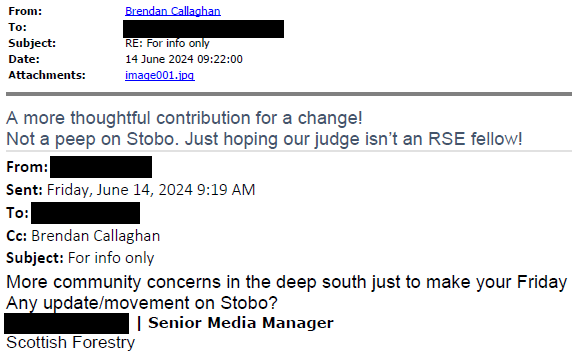
Brendan Callagahan joked about the possibility of the judge being an RSE fellow in response to an email seemingly pejoratively referring to ‘community concerns in the deep south’ . The Royal Society of Edinburgh (RSE) had recommended public funding for commercial coniferous forestry be discontinued (see here).
 However, by August 2024, Scottish Forestry may have realised the petitioner had sufficient funds through further crowdfunding, with a final hearing in the Court of Session due. In an email on 22 August 2024 sent by Scottish Forestry’s CEO Paul Lowe to other staff, he said that ‘getting a poor outcome in this case would be highly reputationally difficult for SF’. Earlier that month on 8 August 2024, Paul Lowe had suggested that Brendan Callaghan should brief the Cabinet Secretary by early September on the ‘high level implications if found against’.
How did Scottish Forestry cancel the £2 million grant and contract?
The documents released due to the investigation by the Scottish Information Commissioner (see here) reveal more about the cancellation of the contract with the Forestry Carbon Sequestration fund.
In late August 2024, Scottish Forestry discussed three options in response to the application for a judicial review. The first option was enforcement action for the herbicide spraying, but Scottish Forestry thought the Forestry Grant Scheme contract provisions were ‘not sufficiently strong to be relied upon’ (so perhaps could not claim a breach of contract had occurred). The second option was to issue a ‘written warning letter’ with possible financial penalties but this ‘would have no direct bearing on the status of the EIA [Environmental Impact Assessment] screening opinion’.
The third option was to issue an enforcement notice with two sub-options:
(i) the applicant stops work and applies for EIA consent, or
(ii) remedial work through ‘mitigating actions’ to address the herbicide damage.
Scottish Forestry observed that sub-option (ii) would not affect the judicial review but for sub-option (i), this ‘decision would deliver a similar outcome to that being sought by Judicial review’.
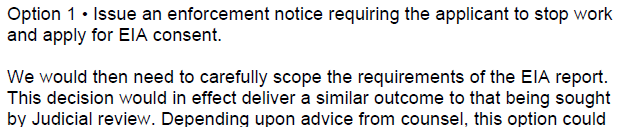 Scottish Forestry chose sub-option (i), the only choice that cancelled the £2 million grant, contract and consent, thus avoiding any ‘high level implications’ from having to appear at the Court of Session but still needed to provide grounds for the herbicide spraying requiring EIA consent for the enforcement notice.
At that time, Scottish Forestry appeared to consider that requiring an EIA was neither possible on biodiversity grounds, as the Sitka spruce would kill the vegetation anyway, or landscape grounds as vegetation (albeit course grasses and weeds) could grow back without Sitka spruce. Scottish Forestry then considered the environmental impact on ‘public access’.
Scottish Forestry suggested the public had a limited understanding of herbicide impacts, stating that their ‘emotional response may be irrational’ and the public may ‘dissuade others from accessing the site’. This was supposedly used to justify the need for an EIA:
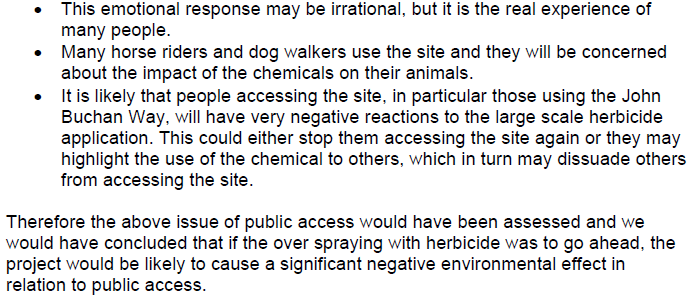 The hypocrisy of this claim by Scottish Forestry is extraordinary. If the public’s allegedly ‘irrational’ response to herbicide spraying justifies an EIA, then what about the reaction of people to Sitka plantations? Local people and the wider public will be massively dissuaded from visiting the site due to the (Scottish Forestry approved) destruction of up to fourteen square kilometres of moorland with spruce (there are adjacent new forestry schemes), hinge mounding, drains, miles of industrial lorry roads and grouse killing deer fences. Prospective tourists from further afield are always ‘dissuaded’ from visiting giant Sitka plantations with their degraded landscapes devoid of moorland birds, flowers and wildlife, instead choosing to visit somewhere where suitable habitats still exist.
The second judicial review – petition lodged by the Forestry Carbon Sequestration Fund
In December 2024 the landowners, the Forestry Carbon Sequestration Fund, lodged a petition for judicial review to try and overturn Scottish Forestry’s enforcement notice and to resume forestry work (see here). This fund is managed by True North Real Asset Partners Ltd (see here), who own tax haven registered True North European Real Estate Partners (Guernsey) Ltd (see here).
The petitioners appear to have argued that Scottish Forestry failed to provide a ‘Statement of Reasons’, supposed to be provided to justify the enforcement notice, and also argued Scottish Forestry were unable to decide if the project should now require an EIA. True North’s CEO Harry Humble rejected ‘any suggestion that Scottish Forestry was unaware of the need to use herbicide in limited parts of the site before making its screening decision’ (see here). The petitioners also pointed out that Scottish Forestry made various site visits between issuing the screening opinion and enforcement notice.
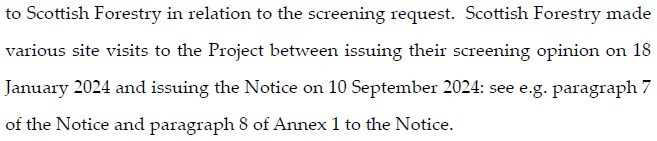 For the herbicide spraying in August and September 2023, the petitioners claimed that ‘the environmental effect of such overspraying were evident at that time and at the time that Scottish Forestry made their site visits in 2024’.
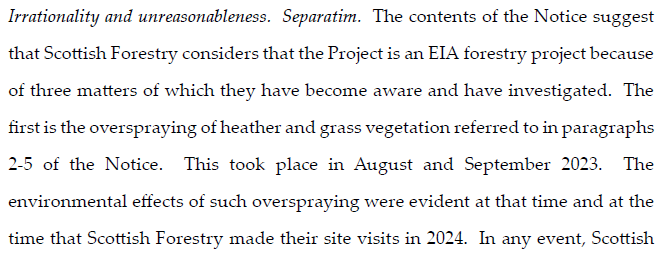
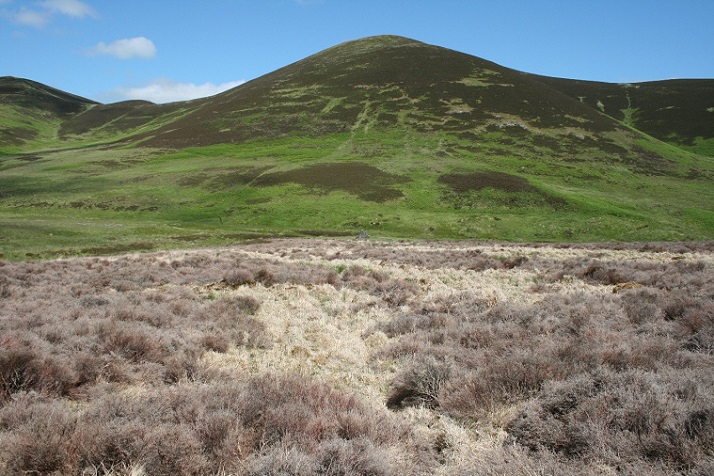
The glyphosate was applied when the heather was in flower and there was green vegetation. It seems obvious that the effects of the herbicide would be apparent in September and October 2023 to site visitors, less so in winter and then more noticeable in spring 2024, as surviving vegetation turned green compared to the sprayed areas.
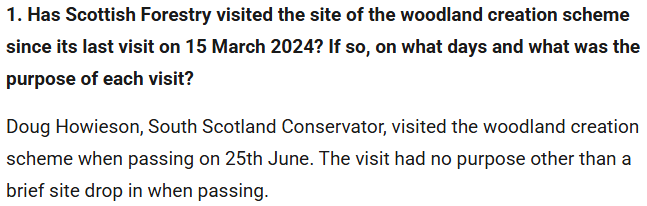
An earlier FoI request made on 1 July 2024 asked when Scottish Forestry’s staff had visited Stobo since 15 March 2024 and the response was that the South Scotland Conservator, then Doug Howieson, made a ‘brief’ visit on the 25 June 2024 (see here).
 However, new emails obtained as a result of the Scottish Information Commissioner’s decision show Brendan Callaghan also visited Stobo between 15 March 2024 and 1 July 2024. In an email dated 21 August 2024 Brendan Callaghan claimed the herbicide damage wasn’t visible when he visited ‘in May/June’, while an earlier email dated 1 July 2024, states he ‘walked over the site’, acknowledges some over-spraying had occurred and most of the rest of the site ‘will no doubt follow up with herbicide spraying as needed’.
 A follow up FOI request asked Scottish Forestry the date(s) when Brendan Callaghan had visited Stobo between 15 March and 21 August 2024. Scottish Forestry said Brendan Callaghan visited once in a work capacity on the evening of 21 August 2024 (after photographs of the herbicide damage were provided by the Stobo campaigners). It appears therefore, the earlier site visit was unrecorded and in a private capacity.
 In addition to visiting Stobo, Scottish Forestry staff had received emails with links showing herbicide damage (see here). For example, on 3 July 2024, Brendan Callaghan and Paul Lowe were informed that ‘the Stobo campaigners have posted the following video – Stobo Hope, Scottish Borders: Landscape scale destruction of heather moorland with herbicide’.
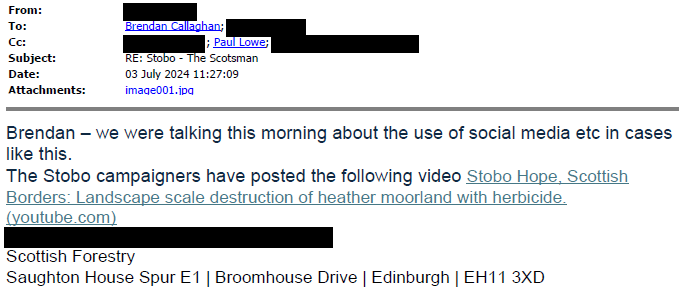
Do Brendan Callaghan, Paul Lowe and other Scottish Forestry staff (whose names are redacted in the FOI response) read their emails?
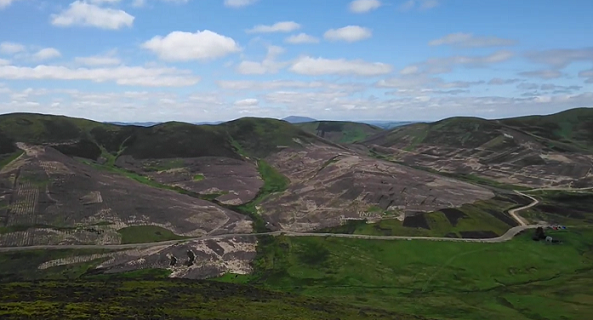
If senior Scottish Forestry staff are reading this blog, this video link (see here) may jog their memory.
On 21 February 2025, nearly three months after the Forestry Carbon Sequestration Fund lodged their petition for judicial review, the Scotsman reported that Scottish Forestry had decided an EIA was required for Stobo Hope (see here). In spite of EIAs generally being opposed by forestry managers, Harry Humble claimed this was ‘a positive move’, and ‘we adhered to everything Scottish Forestry stipulated during our extensive, diligent and rigorous design and consultation process’.
Sometime in late February 2025, Scottish Forestry provided the forestry managers, True North, its Statement of Reasons (dated 18 February 2025) for the enforcement notice, now requiring an EIA. Scottish Forestry had shifted its stance from August 2024, stating the herbicide spraying ‘has caused, and continues to cause significant adverse impacts on a number of receptors, including landscape and visual amenity and biodiversity’.
As a result, it is understood that forestry managers for Stobo have chosen and commissioned their own environmental consultants, Stantec UK Ltd, to carry out the EIA, with a report due to be submitted to the community and Scottish Forestry in the future.
(On a separate, unrelated matter, Stantec UK Ltd had previously been commissioned by Scottish Forestry to write a report called ‘Economic Impact of Forest Based Activities in Scotland’ (see here), published in 2024. The Scottish Government claimed ‘the findings underline the importance of Scotland’s natural economy’. Forest Based Activities’ included the stationing of release pens and feeding stations in woodlands for non-native pheasants).
The planting plan for the EIA so far seems virtually unchanged, in spite of overwhelming public opposition to the Stobo scheme (see here) and previous objections in 2023 by NatureScot and the RSPB, which led to the first judicial review on landscape and other grounds:
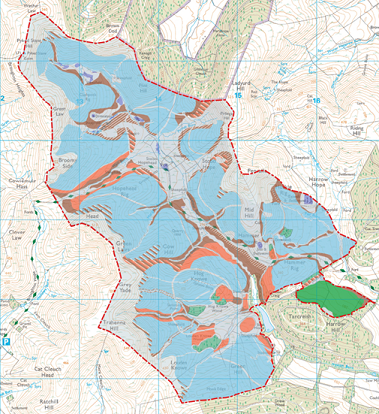
Does this indicate Stobo Hope’s forestry managers believe that Scottish Forestry will (a second time round) ignore the environmental destruction at Stobo and the inevitable loss of moorland species such as black grouse (approaching extinction in South Scotland) by giving consent to the scheme?
Conversations with others suggest some people in the commercial forestry sector disagree with the Stobo scheme due to the devastating impact on black grouse, scenery and loss of moorlands, and would like this area be left alone with a little native woodland. Many genuine foresters are fed up with the industry’s reputation being tarnished by Scottish Forestry’s obsession with pleasing investors and absentee landlords in tax havens through tree planting targets.
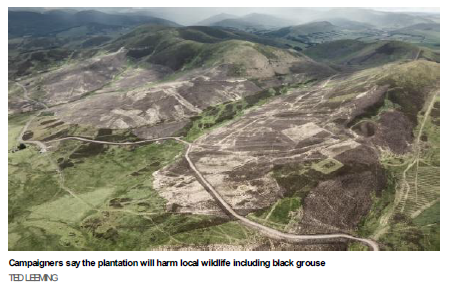
Scottish Forestry staff kept a record of this 14 July 2024 Times article, showing an aerial picture of Stobo with herbicide damage (see here).
Did Scottish Forestry mislead the Court of Session?
Around April 2025, Scottish Forestry provided the Court of Session with its Answers to the petition lodged by the Forestry Carbon Sequestration Fund. Scottish Forestry stated they conceded the petition lodged by the Stobo Residents Action Group Ltd (SRAGL) ‘upon discovering that the petitioner had applied herbicide in a blanket manner’ (from photographs provided in August 2024):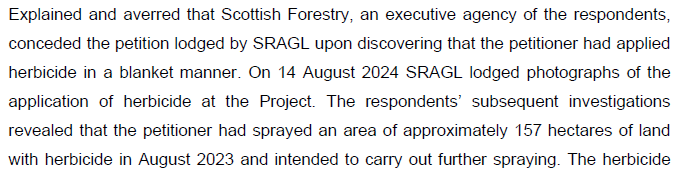
The second petition was discontinued in May 2025. Why did Scottish Forestry tell the Court of Session it was unaware of the application of herbicide in a blanket manner prior to 14 August 2024? Could the petitioners for the second judicial review have done more to discredit this claim by Scottish Forestry?
The evidence seems to suggest that Scottish Forestry has not only tried to cover up its failures at Stobo Hope, but did so through the Court of Session. This case has far broader implications for public confidence in Scottish Forestry, who advise Scottish Ministers and are responsible for forestry support, regulations and policy.
[Ed note. The main author of this post wished to remain anonymous, I have respected that and checked the main sources of information quoted in this post]

The Stobo disaster is yet another example of Scottish Forestry’s incompetence in spending excessive amounts of taxpayers money on planting schemes in our uplands. Look no further than the Cairngorms National Park to see how BrewDog, Oxygen Conservation and Aberdeen (formerly Standard Life) are able to run rings around senior SF staff as they approve yet more ridiculous planting schemes, ignoring all the advice from other stakeholders. When we elect the politicians to serve in the Scottish Parliament next `May we should only elect MSPs who are totally committed to the abolition of SF. We have no need for such a wasteful and ignorant organisation whose sole purpose is to cosy up to the corporate interests who are buying up our uplands at breakneck speed. All the public money being spent by SF should be diverted instead to the state forestry service, Forestry and Land Scotland, to better manage OUR forests, to NatureScot to better manage OUR deer and to the Scottish Environment Protection Agency to regulate all OUR forestry on private land.
Great article – well done!
I may be out of touch with regard to my environmental law and litigation knowledge but based on this, are the owners of the land and the senior staff at Scottish Forestry possibly guilty of an environmental crime?
Hi Douglas, the herbicide spraying would be very likely to be an offence under agricultural (EIA) regulations 2017, but the enforcement notice on Scottish Forestry’s website claims the herbicide use was under forestry (EIA) regulations 2017. The trouble with this claim, is that spraying occurred five months before the forestry contract was signed and the land only eventually came under forestry regulations because Scottish Forestry probably broke the law in approving the scheme without an EIA. This resulted in a situation where Scottish Forestry awarded £2 million of public money, our money, to a fund in the Channel Islands and no action being taken for any offences under agricultural regulations.
It’s enough to make you wonder if Brendan Callaghan is still in post, and if he is, why?
Indeed.