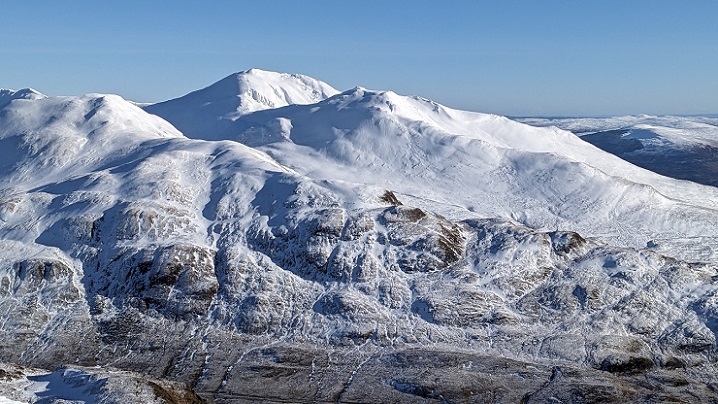
Yesterday, like many others I took advantage of the break in weather, and headed for the hills. Along with two friends we traversed the Meall nan Tarmachan ridge above Loch Tay from the main car park in fantastic winter conditions, hard snow, almost no wind and clear skies.
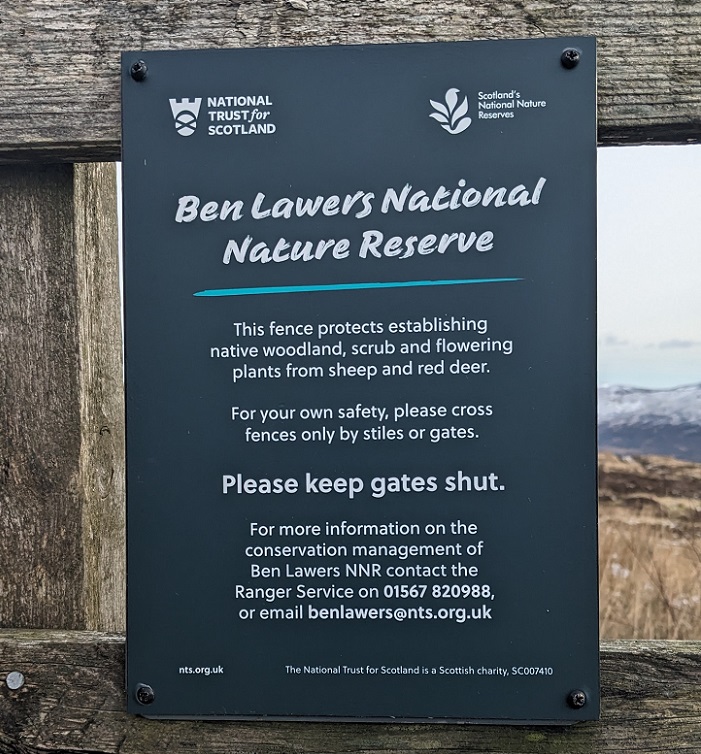
Returning along the track on the south side of the hill we pass through a deer fence (with an electric fence running alongside it) on the boundary of the National Nature Reserve (NNR). The main part of the Ben Lawers NNR, famous for its Arctic-Alpine plants, was created in 1964 but in 2005 extended to include all the land the National Trust owns on the eastern and southern slopes of Meall nan Tarmachan.
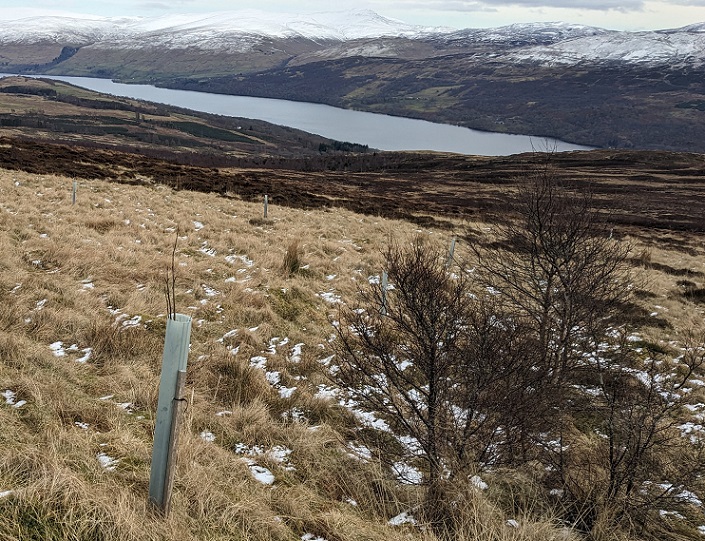
Much of this large enclosure on Meall nan Tarmachan has been planted with native trees by NTS as part of its attempts to improve the ecological condition of the NNR. That was done more sensitively than many other such schemes (no mounding of soils etc). A little further along the track, however, we came across a number of trees more recently planted in plastic tree tubes. Why?
If these trees wouldn’t grow here in the current conditions without a shelter, plastic or otherwise, then that is a strong indication they should never have been planted in the first place. It is one thing to claim that planting trees can benefit nature, quite another to create new artificial environments by cultivating soils, applying herbicides and pesticides or using plastic tree tubes.
The original purpose of NNRs was they should areas where natural processes predominated. That should have created a presumption in favour of natural regeneration against planting and use of commercial forestry practices. This purpose was then changed so that a second primary purpose ofNNRs was as places for people to enjoy.
I am sure that I am not the only person who finds the use of plastic tree tubes an affront to my enjoyment. That is not just because they interfere with natural processes, it is also because they pollute. In this case water, carrying particles of plastic, drains down into Loch Tay, which is part of what is supposed to be one of Scotland’s most highly protected river systems. While NTS has not planted that many trees in plastic tubes, one should have been more than enough.
The wider problem is that the Scottish Government is still not taking plastic pollution seriously. This last week it announced (see here) that it was banning the sale of wet wipes with plastic in them to the public from August 2027. The ban is UK wide (see here) and comes into effect in Wales in December 2026 and England and Northern Ireland in April 2027. Far from world beating, lagging the rest of the UK. The ban does not apply to businesses or the voluntary sector, including those that provide care, from nurseries and older people’s homes, or to the NHS, despite the efforts of NHS front-line staff to reduce plastic (e.g see here).
If the Scottish Government finds it so hard to ban some plastic in wet wipes, what hope of it banning plastic tree shelters especially when large land-owning NGOs, like NTS, continue to use them? If wet wipes are a precedent, the Scottish Government is more likely to ban the public using plastic tree tubes in their own gardens, than they are to band businesses and the voluntary sector using them in the countryside.

Tree tubes are a perfectly legitimate way of doing some enrichment planting with species that might not occur naturally for many decades or even hundreds of years, and this can add a lot of value of more fertile soils like those that we have in Breadalbane. The tubes make them easier to find, and therefore easier for the higher value trees to be maintained. The trick is not to plant so many that you cannot subsequently easily remove them, which NTS are probably in a stronger position to do than anyone else. What we should not be doing is planting many thousands of them,, especially at high density, and then forgetting about them, which we often see on conifer restocks sites, or along roadsides. A proportion of this will certainly end up as plastic pollution in Tay. Over use of tubes is bad economics, bad silviculture and bad practice overall. Small numbers used for strategic purposes to add value are fine in my opinion.
Tubes are supposed to be bio-degradable?
some so called bio degrading – not disappearing- plastics might degrade in micro pollutants which collect in the lower environment and then emerge back in the food chain. Being out of sight is not a solution.
All these comments about the environment are fine. Sometimes, as in the case here of tubes, there is a trade off in liited situations where there is a need to restore certain indigenous planting.
But all of the conservation in so many ways is knocked into a cocked hat when you look at the commercial development of the south end of the loch with its boating marina, boat sales, chalet village, Lomond shore shopping mall and 5,000 car carpark, and possible commercial Flamingo Land development.
The loch and especially the southern end has become a magnet for commercial development. The Lomond Shores and is privately and was recently owned by an off shore Isle of Man company. Who sold them the land. Who approved the building of the shopping mall.
Similarly Cameron House whilst a nice hotel and leisure centre has hundreds of chalets, a marina and bat sales. The roads are also closed off with electronic barriers. Not exactly a dear green space. Moreover, it is understood that the ultimate holding company of the hotel is in an offshore tax haven.
And so it goes on. No one disputes that folks live and work in the area of the national park but the southern end of the loch is very much become not a national park but a national development of commercial property. Fun fair rides if it makes money – well the Flamingo Land proposal contains provision for a train ride, and of course in the Lomond Shores concrete jungle there is already a fun fair choo choo that travels from the cinema complex to the pier and back.
So yes, I understand well the issues of conservation but I truly question whether the authority and Scottish Enterprise have any interest in conservation.
Las Vegas on the Loch might be a descriptor of the southern end of the loch. It certainly seems to be very much going that way.
It is disappointing to see the NTS putting up signs which are not compliant with the public access rights established by the Land Reform (Scotland) Act 2003. These rights and responsibilities, for those exercising access rights and for landmanagers, are explained in the Scottish Outdoor Access Code. In areas such as Ben Lawers and Meall nan Tarmachan it is not appropriate for signs to say “For your own safety, please cross fences only by stiles or gates.” Page 95 of SOAC explains that a gate should be used if it is available but otherwise “if you have to climb over a fence, avoid causing any damage by doing so near to a post.” It is incorrect to suggest that “for your own safety” fences should only be crossed at stiles or gates.
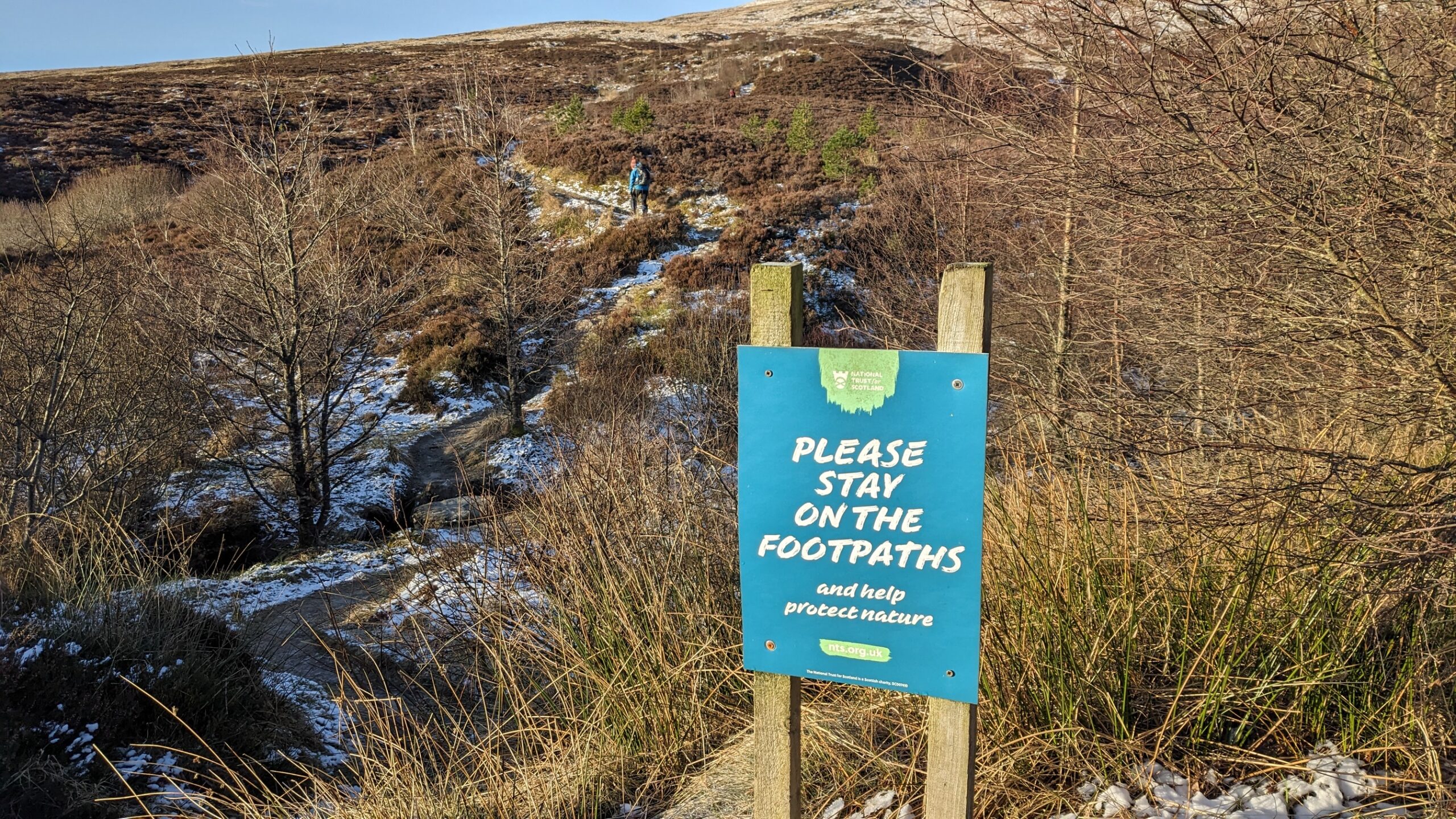
Page 107 of SOAC deals with paths and tracks and explains that “access rights apply off-path, but when you are close to houses or in fields of crops or in places where the environment is particularly vulnerable to damage, it may be sensible to follow paths and tracks where they exist”. Such constraints as regards privacy and vulnerability do not apply to most NTS land in the uplands and it is therefore wrong of NTS to erect signs which say “Please stay on the footpaths and help protect nature”. Anyone has the right to step off the path if they so wish and explore nature. NTS should be much more focussed on controlling excessive deer and sheep grazing on their land, to protect nature, than incorrectly advising people to stick to the path.
The planting up the A9 is an eyesore. What’s the policy for removal of these? I’ve tried asking various organisations but no one has responded.
Lesley Riddoch has an excellent report on natural rewilding up the A9.
What do these hideous tubes actually do that careful planting of bushes couldn’t?
Aye indeed S Paterson. The A9 tree regen without much assistance is indicative and inspirational. As well as the Lesley Riddoch’s film see also ‘Too Many Deer’ by Lettoch Films on youtube.
I remember the days when these were referred to as ‘Tuley Tubes’ and I remember the laugh I had with their progenitor at Loch Garry after the disparaging them before I knew to whom I was talking . He agreed that they were not universally applicable in conservation projects. We never used them in this project.
Tully Tubes was indeed the name for plastic tubes. I thought they were still called that.
But tubes aside, of which there are many, how many folks are aware of the 5.9 million landfill dump just above the village of Balloch. Effectively hidden from sight this dump is egressing not just the decomposition gases from every conceivable type of waste but also toxic leachate in the surrounding watercourses that feed into River Endrick, Loch Lomond and the River Leven.
Water courses that once teemed with salmon ( and water bailiffs) are now devoid of fish. SEPA know about the issue. They are aware of the operators self testing which revealed year after year the extent of toxic discharges but took no formal action.
SEPA are also aware of the Tax Tribunal case in respect of £99.6 million claim for unpaid landfill tax and where the First Tax Tribunal finding in favour of Revenue Scotland before it was thereafter appealed in the Upper Tax Tribunal where after the parties in 2023 reached a ” confidential out of court settlement ” .
All in an extremely concerning legal case in which a judge observed of ” Conduct ” that was “reprehensible and reckless ”
But court cases and tax avoidance aside what country locates a 5.9 million tonne landfill waste site immediately adjacent to Balloch loch Lomond, a national park and in less than a mile away from the National Park’s very own head quarters! I
Utterly incredible and especially more so since waste was transported from ALL over Scotland to the site!!
And we worry about tubes.