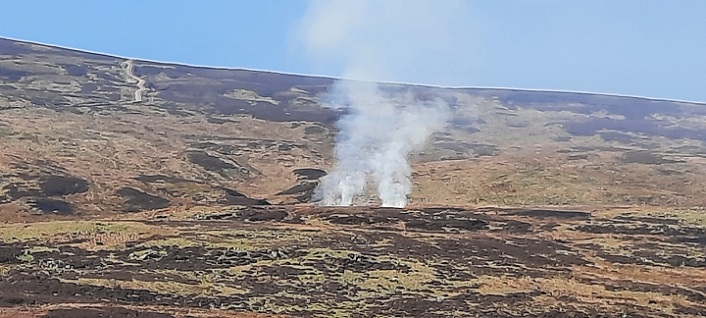
[The post first appeared on Prof Douglas MacMillan’s Linked-In feed. Our apologies, the original caption to this photo said it was taken from A9 at Drumochter – ed. Photo taken same day at Drumochter is now included below]
Last week Scottish Ministers approved a ban on recreational fires and barbecues in the Cairngorms National Park between 1 April and 30 September to reduce the growing risk of wildfire.Now I have come close enough to fire (both controlled and wild) in my forestry career to know that fires are not nice – they destroy biodiversity, release carbon from the soil, kill plants and animals, pollute the air and threaten lives and property. Also, unlike other parts of the world, fire is not part of the natural ecological cycle here (as we generally don’t have dry lightening). So yes, I am broadly in support of any measure to prevent wildfires, but why pick on campers when they are not the main cause of fire in the Cairngorms National Park (CNP)?
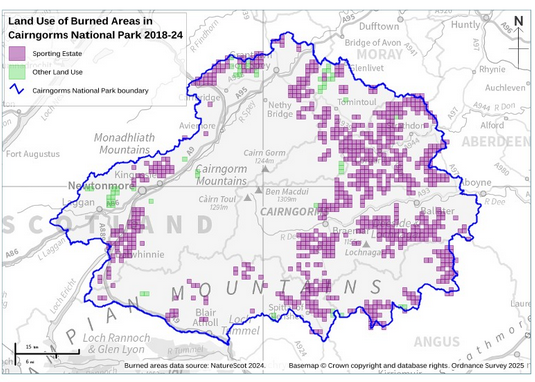
My colleague Euan Stevenson and I analysed the most recent satellite derived data from NatureScot that maps all discreet fires in CNP from late 2018 to early 2024. Almost 3000 fires are recorded, covering an area of 21 million square meters. By apportioning each 1 km square to either sporting or non-sporting ownership we found that 98% of all fires (and 92% by area) begin on sporting estate land, with the maximum number of fires in any km square a staggering 30 in only 5 years.
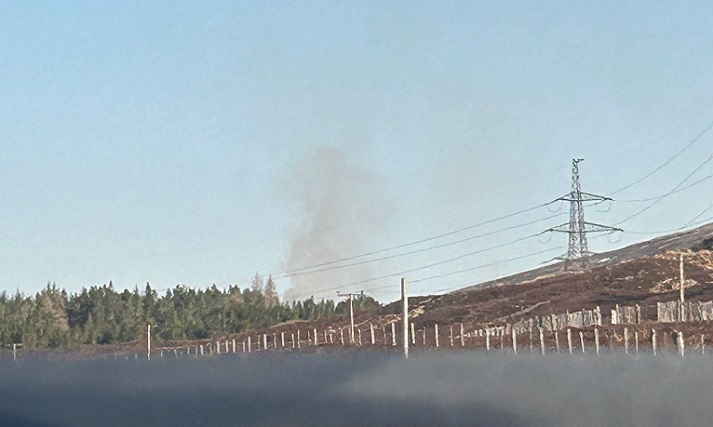
Many of these deliberate muirburns are started very close to protected native woodlands, commercial forests and main roads such as the A9 so even if one of these fires gets out of control the risk of catastrophic damage is high.
Intensively burning moorland in narrow strips is considered normal practice for promoting habitat for red grouse. Although the red grouse shooting season lasts for only a few weeks, it generates significant profit to landowners and some seasonal employment. Supporters of grouse shooting argue that muirburn, because it is an important recreational activity and is carefully controlled, should not also be banned. Also, landowners say because it reduces the ‘fuel-load’ in the landscape, it can prevent dangerous wild fires from developing.
However, there is little evidence to back up these claims and previous research by the National Trust for Scotland (see here) found that around 60% of all wildfires in Scotland were attributable to ‘muirburn gone wrong’. Furthermore, the Scottish Fire and Rescue Service in their submission to the CNP last year found that 19% of fires they attended in the CNP arose from intentional muirburn, with only 13% originating from campfires.
I am not aware of any analysis the CNP Authority used to determine a ban on camp fires, but logic would surely lead us to question why the ban affects only campers and not grouse shooting? Both are important recreational activities that create seasonal jobs in the tourism sector locally.
The answer, of course, does not lie with science or economics, but in the realm of Park politics. I am guessing that campers are not an affluent, highly organised group with excellent lobbying skills and with direct access to CNP senior management and Board!

really glad you managed to access this not only for this platform, but others that will become available down stream
I’m completely in agreement with what you say about muirburn. I’d take if further, and want no muirburn at all.
On the same subject, I’ve been worrying over the years about campfires and responsible access. Sadly (sadly for myself as well as others), i’ve come to the conclusion that camping as part of responsible access should be “no-trace” camping, and that lighting a fire can’t be done without leaving a trace. I’ve tried, and watched other responsible people try – but it always leaves a scar.
The only place that it looks OK to me is below tide level on stones or on a beach. But I may be just indulging myself, as a sea kayaker.
What an astonishingly poor piece of work, lacking in any rigour or context, and written by some-one who is an academic to boot. The NTS report is not dated, but the oldest reference I see in it is 214, and Richard Luxmore is long retired from NTS. So, this report is probably 10 years old. This should be stated. One of the significant things to have changed over the last 20 years or so is the availability and effectiveness of mobile fire fighting equipment, and the training of those using it. Having been familiar with the South Grampian Forest Fire Protection Group since 1997 or so, the Fire Brigade used to come to come to meetings and quote their favourite statistic that 90% of wildfires in the area were started by “controlled burning” that got out of control, and that was my experience at the time as well, having attended many to help out. But over time, the equipment and ways of working changed, and I believe the statistic from SFRS is now 10% of fires started by controlled burning. The issue we all have to face is this: Lets say all heather burning in the CNPA area is banned. “hurrah” some will say. But, if heather cannot be burned, grouse moor management will go with it (Hurrah! again), the employees will go too, and with them all the equipment and experience that they have gained over many years. So, next time there is a wildfire in the park, the public sector will be left to put it out by themselves, and let me tell you this…. SFRS apply a risk assessment to all wildfires, if lives or property are not at risk, they stand well back out of the way and let it burn, and you have to accept the outcome of that. No-one is going to travel off road to nip it out. The other very important thing about burning for grouse moors is that if people are doing this on a regular basis, then they are well practiced and fire ready, as is their equipment. SFRS cannot get up to the same standard quickly if they are not practicing on a regular basis. The final thing I would like to say is that the grouse moors support a higher density of keepers that any other form of upland sporting management, most upland sheep farms and certainly more than forestry, and many of these jobs are integrated with other core functions that we expect to be delivered in our upland areas. This article is easily the worst I have seen published on this blog site. I hope others tear it apart as well.
Actually Victor, this post is based on a very scientific piece of work, analysis of data about fires held by NatureScot and what it shows is that most of the land that is burned in the Cairngorms National Park is a result of intensive grouse moor management. NTS unfortunately did not put a date on the research by Richard Luxmoore but it took place in 2018 and was based on SRFS records. Unfortunately, since then, SFRS appears to have been recording less information about the causes of wildfires across Scotland because where they to do so they would get drawn into providing information for insurance claims, police prosecutions etc and they don’t have the resources to do this. They are facing huge further cuts at present. Despite that SFRS still provided information to the CNPA which showed that outdoor recreation is not as great a source of wildfire as landmanagement activities and in terms of the total area burned this is negligible compared to the amount of land subject to muirburn. Hence, the question in the title of the post, within the context of the fire byelaws, in my view asks the key question. How to put out wildfires, however, caused is a completely different question and in my view it is not helpful to muddle the two. You are quite right of course that SFRS (because of all these cuts) no longer have either the expertise or the equipment to respond to increased risk of fire in period of drought but choose to answer that by suggesting the only solution is intensive grouse moor management and even more burning in the course of which you make some claims about grouse moors creating more jobs which does not fit with all the abandoned buildings you can see on grouse moors…………….
Very well said. I can also add that the photograph of Muirburn used in the article certainly isn’t Drumochter and the true location isn’t even in Cairngorms National Park!
Hi Ken, thanks for alerting me to this. I had asked Douglas if he could send a photo of muirburn in the Cairngorms to supplement his piece on linked-in and he accidentally sent me this photo, taken on a day when he was travelling north and took several photos, saying it was off A9 and I then mistakenly assumed it must have been from Creagan Mor at the Drumochter (I should have checked my photos). There were fires that day within the Cairngorms National Park and I hope we can replace the photo currently shown – have amended the caption. Nick
Yes Mr Campbell the photo caption was a mistake. Well spotted. I took lots of photos that day of muir burn on my way North – all started on a day of the highest fire risk. I have some in the CNP, but they are poorer quality as they were taken from a moving car on A9. Happy to share if you don’t think there was any burning that day.
Criticism is an important and positive element of research and I embrace it. But what exactly is you criticism? Despite this ‘being the worst article ever published’ …. your comment does not even begin to make any meaningful criticism of its methodology, contents or aims. Instead you seem to be outraged that the article raises questions about sporting estate management, especially grouse in the context of fire. Sorry to upset you but I have another one coming that might in your head be even ‘worser’!
Douglas….. I dont do upset or outrage. My criticism is that you quote a publication that appears to be 10 years old, and you dont appear to consider issues around capacity and manpower which are important when wildfire situations arise. Gamekeepers come to these incidents trained and equipped and fire ready, and that is difficult to duplicate in any other way. It is, in my opinion, not a good article. Interesting to see something worser if you have it.
Extremely useful information, which should be acted on in terms of changing the regulations.
Just so!
An excellent article with significant real evidence to counter the statements repeated time after time by those who support muirburn, but who don’t provide convincing evidence to support their claims.
An interesting article but fails to take account of recent reports from what has been billed as Scotland’s largest ever wildfire on Dava Moor which could have been much worse had it not been for the existence of some muirburn breaks and the efforts of the many gamekeepers and other land managers who stepped in to help the emergency services. I dread to think how much worse it could have been if more areas had been planted up and connected with trees. If muirburn activity goes completely as part of the new drive for nature restoration and recovery and connecting extensive areas of woodland what plans are there prevent potential devastating fires on an even grander scale than the recent Dava fire?
Also I would question the Prof’s assertion that ” fire is not part of the natural ecological cycle here (as we generally don’t have dry lightening)” as there are a number of examples of natural fires including a very large one in my youth which took out a large swathe of woodland in the Loch Garten forest and nearly engulfed a number of properties on the edge of Nethy Bridge which were saved by the effective intervention of Seafield estate workers and other volunteer firefighters. Not all fires are as a result of poorly managed muir burning activities or campfires.
Natural burns do occur but they are very rare and the substantive point is that we do not have a ‘burn ecology’ for this reason.
Muirburn is often undertaken next to woodland and scrub. Not necessarily to create fire breaks but more often to remove natural regeneration…. which is against the code they claim to follow but rarely do.
SNH ran a consultation on the code a few months back…..then went silent.
Interesting article and the resulting comments. I didn’t get a message that the article was against the ban on campfires, only raised the question on why this is as far as a ban went.
The point that the SNH study was old is useful but this helps to update the data. To question the methodology – perhaps a square km resolution is too broad? Of course it is just a study on land use and fire occurance, it doesn’t look at source of ignition.
In a changing climate we need good data. This article and discussion certainly demonstrates this. There needs to be many more studies on wildfire as it is an issue we need to look at seriously regardless of what side of the grouse debate we sit on.
Of course we also need good decisions!
How we manage fire and who’s this will evolve. It is time more were trained and equipped. We should think about firebreaks and how we do this, including the use of prescribed burning if the evidence takes us there.
Personally I cannot see how the maintaining large areas of flammable monoculture heath, justified on the basis that it maintains the skill set to extinguish wildfire on large areas of flammable monoculture heath, is the solution,. There must be a more balanced solution to our land use conundrum other than the current polarised debate.
Living in a region which suffers periodic wild hillfires , – some 1000 Ha burned within view of this house in 2025 springtime. -.the thing which staggers me most is the absence of critical judgement at the head of SFRS. It seems clear little willpower is ever devoted to ‘educating’ Scot Gov and other decision makers, to follow the fire control lead seen in other countries. IN recent years deadly large-scale fires also occur with increasing frequency all over the world.
The large fires in Portugal recently, Vast regions across Canada these past summers and regular blazes all along the south coast of France: also tourist regions of Greece. So many fires have been brought under control through state funded deployment of water bombing aircraft. During the cataclysmic California fires recently a whole flight of former cargo and passenger jets and float planes were airborne. These with trained crews were equipped to drop fire suppressant aerosols.
In Scotland it is obvious large bodies of fresh water do exist within a short flight radius of many of the recent fire events. (Here we have 22 miles of Loch Shiel).. Yet only on day 3 ..or was it day 4 ..during the most recent hill fire on Ardnamurchan did a single helicopter appear. I am not sure how the second major hillfire in 4 years near Glenuig was extinguished. When the helicopter did finally appear here, this came only after days of costly effort by small volunteer SFRS crews on the ground. Within 90 minutes the fire had been “turned” by this aircraft, then pocket by pocket the flame was extiguished by volunteer crews on the ground.
The problem of wild fires in highland Scotland is not going away. We must ask… should Fire control across Scotland – and elsewhere in UK – really have to rely on volunteer farmers risking their tractors to deploy water-filled slurry tanks, risking the health of volunteer estate workers with backpack spray nozzles walking through the smoke and flames, and so on? In distant command “bunkers” ! well paid staff will claim that until property is at risk the nation can only afford to “let it burn”?
Again it is a basic question of political will.
By the time the willpower eventually shows itself and the slight buzz of a small ‘chartered’ helicopter can be heard, so much avoidable damage to wildlife, fencing and trees has already been sustained. This tardy penny-pinching attitude – to put it very simply – is not good enough. Things need to modernise.
I agree with you Tom. I worked on a fire team in British Columbia as a summer job. They had an entire team on standby including a helicopter when a fire was called in. Jumping out of a helicopter on a mountain top carrying a 20 litre water sprayer remains the most scary and thrilling thing I have ever done. They had a great system and it worked even in the most remote and challenging places.
When commenting on fires in forest and moorland areas could we please learn something from other countries? A few years ago, while staying with friends in Alaska, I discovered that the head of the household worked for the state forestry service. He spent most of his summer days flying in a light aircraft across northern Alaska with one simple task – to spot any wildfires as soon as they became visible and to initiate the the essential follow up of the ground and air fire control procedures. Compare this to Scotland, where air surveillance and preventive action appears to take days, not minutes.
And is not time we learnt from Scandinavia? If muirburn is such a super management tool why are land managers in Norway, Sweden and Finland not spending many happy hours setting fire to their moorlands? They have a climate, geology, soils and vegetation much like the Highlands of Scotland, as well as a fine sporting culture based on grouse and other game birds. But you never see muirburn across thousands of Scandinavian hectares.
Also, let us remember that across all the uncultivated land of Scandinavia there is an absence of one thing that is common in Scotland – hill drainage ditches. On a recent outing to discuss river erosion problems on Pitmain estate above Kingussie we were told, yet again, about the incredible generosity of our state forestry service to their pals in the private sector. In the 1960’s the Forestry Commission drove huge caterpillar tractors pulling equally huge ploughs up and down many hillside tracts in Badenoch and probably elsewhere in the Highlands. This free service to the private landowners was to encourage them to plant trees on the dried out moorland. And today we wonder why the water runs of these same hills so fast that flooding in local communities along the River Spey is increasingly common. The solution is very simple – a commitment by every politician elected to the Scottish Parliament in 2026 to block all these hillside drains across the whole of Scotland, along with compulsory powers of access for the drain blocking teams so that no landowner can block such progress. And let us also remember that the increased re-wetting of the moorlands that will follow this drain blocking is the most effective and cost efficient way of spending public money to deal with wildfires.