
Ten days ago the Shared Rural Network (SRN) programme announced (see here) that they were scaling the £500m UK Government funded programme to erect telecommunications masts in Total Not Spots, areas without 4G mobile phone coverage. Instead of aiming to erect c260 masts across Scotland, many in Wild Land and National Scenic Areas, the SRN are now hoping to install just “44 new shared masts” under the Total Not Spot element of the programme. This is welcome news for campaigners against these eyesores and for planning staff have been overwhelmed with applications particularly in the Highland Council area.
The SRN’s news release, however, is not very informative. The sudden withdrawal of 35 current planning applications for masts in the Highland Council area, as reported in the Strathy (see here) appears linked to the announcement but is not mentioned and no indication is given about how many of the live planning applications for masts in the rest of Scotland will now be withdrawn. Even more importantly nothing is said about how many of the masts which have been granted planning consent may still go ahead.
An optimistic reading of “new shared masts” is that it could means only 44 mast, besides the one already operational on South Uist, will now be built in Total Not Spots. However, if “new masts” excludes some of the masts that have been through the planning system it could still be more than that.
The rationale for new masts in Total Not Spots
Whatever the exact number of new masts, the SRN is still trying to justify them as benefiting walkers and tourists:
“the Government and the operators have agreed to prioritise new mobile infrastructure for areas where it will have the biggest positive impact, primarily where people live, work, or travel, including walking and hiking routes. This includes parts of the West Highland Way and Munros Ben Lawers and Ben Vorlich where there is no 4G signal at all, yet walkers and tourists regularly need it – especially in emergency situations.
This is complete rubbish. The truth is that satellite technology is going to make such masts completely redundant before most can ever be built (see here) and (here).
While the map accompanying the news release (see above) appears more informative, it does not appear to be accurate accurate. For example, the news release refers “to new mobile coverage to areas such as Glen Coe.…………….” but there is no dot in the Glen Coe area on the map.
The news release explains that “Mobile masts may be built as part of a ‘cluster’ but the rationale for the two clusters I have outlined on the map above is far from clear. The top one runs from Loch Maree, apparently by Loch Fannich then up to near Loch Glascarnoch on the A835 between Ullapool and Garve. The second appears to run from Bridge of Orchy to Loch Tulla then down Glen Kinglas to Glen Etive. Why have the SRN chosen these areas when not a single new mast is proposed for the vast area from Moidart to north of Loch Mullardoch?
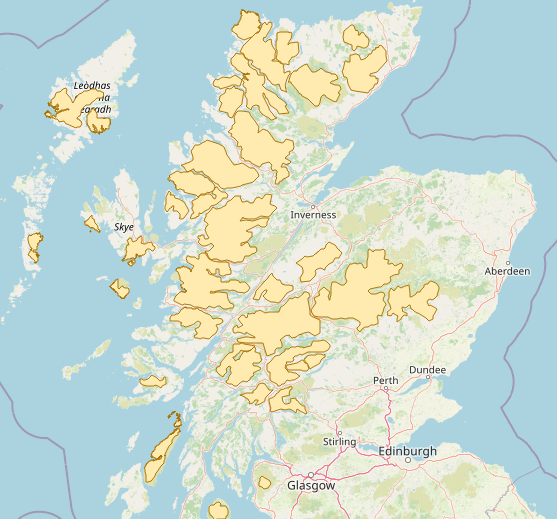
Whatever the explanation, it is not about protecting Wild Land areas. The top mast cluster, highlighted above, lies mostly within the Letterewe-Fannich Wild Land Area while the lower mast cluster lies within the Glen Etive Wild Land Area. A significant proportion of the more scattered masts also appear to be in Wild Land Areas.
What is interesting, following the controversies of the masts proposed for Ryvoan and its repeater mast in Glen More (see here) and (here) and Luibeg (see here), is that no new masts are now proposed for Total Not Spots in the Cairngorms National Park (unlike the Loch Lomond and Trossachs National Park). While the Cairngorms National Park Authority (CNPA) failed to use its statutory duty to protect the landscape to advocate publicly for a re-think of the SRN, as a result of correspondence in which I suggested it should issue supplementary planning guidance for mast developers I learned it was lobbying behind the scenes. While the CNPA will no doubt now view those efforts as a success, unfortunately it has not stopped the SRN proposing new masts in areas of similar landscape importance.
Finance and vested interests are still key to understanding what is going on
While there is no longer any justification for destroying any of Scotland’s finest and wildest landscapes for alleged safety purposes, it is not in the interests of the SRN programme and those who work for it to admit to any failure. The news release started by claiming that it had met its target that 95% of the UK should be “within range of a 4G signal” – not the same as being able to use it – ahead of schedule. It also referred to 50 government-funded mast upgrades (which enable operators to share masts) delivered as part of another project, SRN’s Extended Area Service (EAS) project (see here) before claiming:
“The programme is now focusing on addressing the connectivity challenges in more hard-to-reach areas of Great Britain that are total not-spots”
That is highly misleading. The work to eliminate Total Not Spots started in 2020 and in Scotland has so far delivered just one mast, on South Uist but to admit that would not look good. Those involved in managing the Total Not Spot programme need to be seen to have delivered something, hence the 44 new masts.
With the UK Government funding the cost of erecting masts in Total Not Spots, it is worth considering why the mobile operators responsible for the programme have delivered so little. While part of the explanation lies in the level of public opposition, which has brought the programme into disrepute and helped slow down the planning system, the programme never made financial sense from the mobile operators perspective.
The UK Government may have funded the capital costs of the masts but the ongoing costs of maintaining these masts (rent to landowners, fuel for generators and other costs of servicing them in remote areas) are likely to have been considerably more than any extra income which would result from providing such masts. With satellite coverage on the horizon, erecting these mast never made any financial sense from the mobile operators perspective and risked creating new financial liabilities, including the costs of removing redundant infrastructure. Hence, while proclaiming their commitment to the SRN programme, in practice the mobile operators have been very happy to drag their feet and behind the scenes will be pleased that the number of new masts they are now expected to deliver in Total Not Spots has reduced from c260 to 44.
Some of the locations now being proposed for new masts would appear to make sense from a mobile operator perspective. Those in Total Not Spots in the Loch Lomond and Trossachs National Park (the lower green shaded area on the map above), for example, all appear to be in areas by the road (if the middle one is at Stronachlachar by Loch Katrine). Erecting masts in these locations would help meet other targets to provide mobile coverage to the entire road network. By contrast, the two clusters referred to above appear to make no sense from a mobile operator perspective and may have just been agreed to appease the vested interests of those working for the SRN programme. Whether they ever get built is another matter and I suspect the mobile operators won’t be too upset if organisations like the John Muir Trust and Mountaineering Scotland were to lead campaigns to stop them.
The other financial factor which needs to be considered here is what landowners are likely to earn by renting out mast sites to mobile operators. There is a long-standing dispute between landowners and mobile operators over rent levels, with landowners wanting more and mobile operators wanting to pay less. In 2022, for example, the then UK Government introduced new rules which allowed rent levels for masts reduce by 90% (see here) and the reduction in rents is now being blamed for the delays in roll-out of 5G coverage, with thousands of legal disputes and landowners threatening to withdraw from the market (see here).
While a Tribunal at the end of last year increased the rent for “unexceptional rural sites” from £750 to £1750 (see here), mobile operators are likely to want to pay considerably less for Wild Land Areas where they are unlikely to make any profit. It is questionable whether this would even cover the legal costs to the landowner of negotiating an agreement for the use of the land which protects their interests (e.g access by vehicles, removal of the infrastructure if abandoned etc). The amounts are piddling compared to potential rents from renewable energy developments. It is possible therefore that the explanation for the two mast clusters in wild land areas referred to above is that these are the only areas in Scotland where landowners have indicated they might be prepared to accept the rents on offer.
While the general public values landscape, those that govern us put financial interests before landscape. I doubt Scotland’s new landscape charter (see here), endorsed by the Scottish Government, will make any difference. A good test of its bite will be whether the National Trust for Scotland, which has led the development of the charter, can use it to prevent the proposed new mast at Ben Lawers which it owns.
