The Loch Lomond and Trossachs National Park Authority (LLTNPA) Board meeting on Monday (9th March) considered a paper on the Standards Commission for Scotland (SCS) decision to suspend Sid Perrie, the locally elected member of Balloch, for six months for sending six emails (see here). Public bodies which come under the aegis of the SCS are legally required to consider the findings of SCS hearings within three months.
The short paper to the board (Item 7 see here) recommended members “consider and note the decision of the SCS Hearing”. It was accompanied by a copy of the SCS decision, which was published on 18th) (see here) and a copy of the version of the LLTNPA Code of Conduct agreed by the board in June 2024..
Heather Reid, the Convener of the LLTNPA and the complainant in this case, asked board members present if they had any comments on the complaint process and the decision. Not a single member did.. After a short period of silence, Heather Reid then commented – and I managed to record part of what she said verbatim – that it had been “a lengthy process, involving several National Park officers” designed to uphold the Code of Conduct for those involved in public life.
This was a public admission that Dr Reid, appointed by the Scottish Government, had used the staff resources available to her to pursue a complaint against another board member, the locally elected representative for Balloch. Sid Perrie had, in his six emails, been trying to raise concerns about the planning process behind the Flamingo Land planning application (see here), (here), (here) and (here), a matter of public interest, including how local residents he represented had been sidelined.
If any LLTNPA board member present had had concerns about staff involvement in the complaints process, it would have been very difficult for them to say so because (see here) the Code of Conduct forbids any criticism of staff in public:
Dr Reid’s presence as the complainant will have acted as a further deterrent to any board member wishing to offer a critical comment. I had missed the start of the meeting so I do not know if Dr Reid had declared a potential conflict of interest as regards this item – she should have done so – and if she did, why she thought it appropriate that she chair any discussion.
In addition Board Members had also been informed that the decision could be appealed and, as a result, a number of those who had supported the complaint against Sid (I will consider this in a further post) may have judged it best to remain silent.
Staff involvement in the complaint v Sid Perrie
My previous posts (links above) showed how Dr Reid had forwarded Sid Perrie’s first email on 26th August 2024, which had raised serious questions about the role of senior staff in the Flamingo Land planning process, to those senior staff within the hour. That information was obtained NOT from the Ethical Standards Commission’s report on their investigation into Dr Reid’s complaint but from information obtained by Sid Perrie through a Subject Access Request before he went off sick. The LLTNPA’s response to the SAR is 536 pages long and not in date order, making it very difficult to follow. As a result I had missed a number of key pieces of information, including these two emails sent by Dr Reid on 26th August after Sid had sent his first email at 9.03

In less than three hours of receiving Sid’s email detailing serious concerns about the Flamingo Land planning process (including the evidence from Parkswatch posts), Dr Reid had informed fellow board members that she met with senior officers, some of whom were subject of the allegation, and lawyers and decided these were unfounded. What Dr Reid did was akin to a police office receiving allegations of a crime, forwarding the allegations to the suspect/s, asking them if they did it and then telling their fellow police officers no crime had occurred.
It then took another 1 hour 45 minutes for Dr Reid to inform Sid Perrie what she and senior staff had decided:
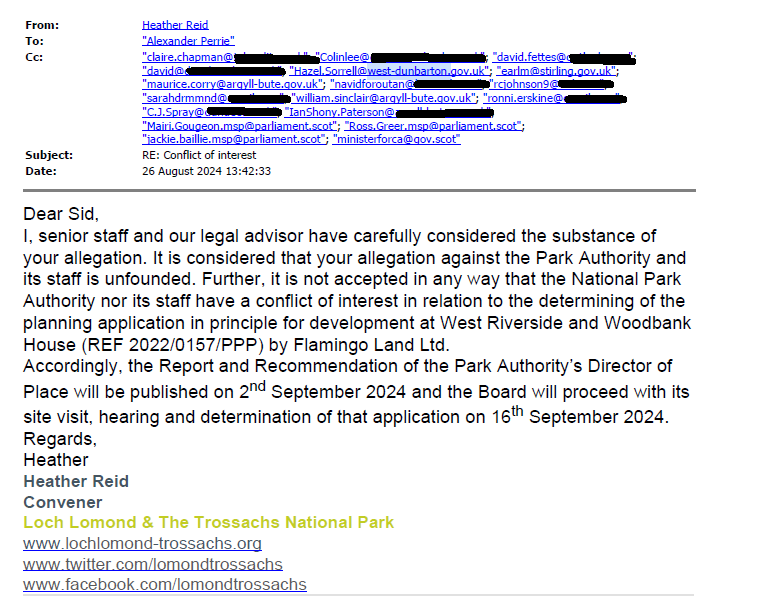
In February I decided to check out whether the Ethical Standards Commission (ESC), who investigated Dr Reid’s complaint, knew about this correspondence (I sent them a copy of the first email above) or had any information to counter the allegations Sid Perrie had made. I received this quick and very helpful reply:

What this response establishes is that when ESC conducted their investigation into the complaint against Sid Perrie they were unaware that Dr Reid had immediately involved staff in deciding how to respond to a complaint about them. (While I did not ask ESC explicitly whether they had seen a copy of Dr Reid’s second email, it is not in evidence they refer to). Nor were the ESC ever provided with any information to substantiate Dr Reid’s claims that Sid Perrie’s allegations were unfounded.
The evidence therefore suggests that Dr Reid not only used LLTNPA staff resources to pursue her complaint against Sid Perrie but also that both she and the staff concerned were selective with the evidence they presented to the ESC. It appears they manipulated the complaints process to suit their interests. This raises the question why the ESC is not more pro-active in trying to establish the truth? Why for example does the ESC not ask complainers like Dr Reid as a matter of course whether they have provided ALL the information relevant to a complaint and then sign a declaration to that effect. If the ESC had done that in this case, my belief is Dr Reid’s complaint, backed by LLTNPA officers, would have collapsed.
If the Code of Conduct for those in Public Life meant anything, it should have been Dr Reid and not Sid Perrie who was up before the Standards Commission for her unethical behaviour and for failing to hold her senior staff to account. As it is I am hopeful that the corruption at the heart of the LLTNPA will now be exposed. An appeal against the Standards Commission for Scotland decision in Sid Perrie’s case was lodged with the Sheriff Court yesterday.

Happy to contribute to any crowdfunder that aims to increase transparency, accountability and honesty of those who hold positions of power in agencies that are supposed to serve the public good.
Mr Perrie should not have been censured for taking seriously his role as a guardian of the common good and for acting with integrity.