I was taken by surprise by the Scottish Government’s announcement on Tuesday that it had decided to reject Flamingo Land’s current planning application to build a holiday resort at Balloch five months after the Reporter, Mr Buylla, had submitted his second report on the proposed development (see here). I had thought the Scottish Government had decided to delay a decision until after the Holyrood elections and that, after the convoluted appeal process biased in favour of Flamingo Land (see here), they might then approve the planning application. Thankfully I was wrong but, as this post explains, the Scottish Government’s decision still leaves leaves the door open to Flamingo Land Mark IV (see here for Flamingo Land Mark III) and the future of Balloch, as a “gateway” to the National Park, is therefore at present still far from decided.
Set against that uncertainty there are other planning factors which could now shift the balance of power to the local community and wider public and allow a major re-think of what type and intensity of development, if any, is appropriate for Balloch.
How robust is the Scottish Government’s decision?
Scottish Ministers decision letter and Mr Buylla’s second report, which is referred to throughout, have been published on the Department of Planning Enforcement and Appeals (DPEA) website (see here).
Mr Buylla’s first report considered the Loch Lomond and Trossachs National Park Authority (LLTNPA)’s weak refusal (see here) to grant Planning Permission in Principle (PPiP) and recommended Flamingo Land’s appeal be allowed, subject to certain conditions at the detailed planning application stage (see here). Unsurprisingly, in the absence of any instructions from Ivan McKee, the Minister responsible, to reconsider aspects of that report, Mr Buylla reached the same conclusions in his second report. Mr McKee has now chosen to disagree with him on four issues, two of which were widely reported in the media, flood risk and loss of woodland, but also biodiversity and the proposed boathouse near the north west corner of Drumkinnon Bay:
“The Scottish Ministers consider that the proposed development is, at this stage, in conflict with NPF [National Planning Framework] 4 Policy 22 (Flood Risk and Water Management), Policy 6 (Forestry, Woodland and Trees), and Policies 3 (Biodiversity) and 4(a) (Natural Places), and LDP Open Space Policy 2 (in respect of the boathouse). The Scottish Ministers also identify conflict with National Park Aims 1 and 2.”
In ordinary language, “at this stage” could be taken as implying there is another “stage” to the planning process. In fact, it has a particular meaning in planning terms and appears in the decision letter to refer to the PPIP stage, mirroring usage by Mr Buylla in his two reports. It is used eight times in the decision letter and is highly significant, as this example at the end of the section on Flood Risk illustrates:
“The Scottish Ministers emphasise that this conclusion reflects the absence of sufficient evidence at this stage and is not a finding that the site could never satisfy the exception in principle.”
What this means is that Scottish Ministers have decided that the issues of flood risk and woodland loss cannot be left to the detailed planning application stage, as Flamingo Land had argued and Mr Buylla had accepted, but needed to be decided at the PPiP stage of the planning process. In the “absence of sufficient evidence” they have therefore decided to reject the appeal.
In law Scottish Ministers’ decisions in planning cases are final, whether the grounds they give are weak or strong. While Flamingo Land can appeal to the Court of Session within the next six weeks, this is on procedural points only, not to challenge the ministers’ judgement. While Flamingo Land’s lawyers may be able to find procedural flaws in the process, Ivan McKee’s decision letter appears to me, as a layperson, to have been phrased in such a way as to make that extremely difficult.
It appears therefore that there is little doubt that the Scottish Government has now, after an extraordinarily convoluted appeal process, finally decided to reject Flamingo Land’s planning application and, as their letter states, although the decision was “finely balanced” this decision is final. That is very good news and an important victory for the court of public opinion.
The planning implications of the Scottish Government’s decision
The less good news is there is nothing in the Scottish Government’s decision that would in principle prevent Flamingo Land or another developer submitting a revised planning application for Balloch. Indeed most of the letter consists of Scottish Ministers re-iterating the conclusions of Mr Buylla, that the proposed Flamingo Land development was compatible the policies set out in NPF4 and in the LLTNPA’s Local Development Plan. Effectively this means the Scottish Government has dismissed all the concerns the public had about traffic, parking, loss of open space, the implications for access etc and indicated that if a new planning application is submitted, with a better plan to avoid flood risk and protect woodland, then the WHOLE of the site covered by the existing planning application (with the exception of the boathouse) could still be developed for a Flamingo Land Mark IV.
All these conclusions are based on the assumption that the LLTNPA’s Local Development Plan and subsequent planning process were fit for purpose. In my view neither were, as I argued in the Flamingo Land story (see here), and as a consequence the Scottish Government’s decision is like a roof built on a house of cards, albeit one which would not favour Flamingo Land if it collapsed. To illustrate this, here is a (simplified) account of how the traffic and park requirements that would potentially be generated by the development have been considered:
- Stage 1 – West Dunbartonshire Council officers report Flamingo Land won’t cause local traffic and parking issues;
- Stage 2 – West Dunbartonshire Councillors decide to endorse officers report and not to challenge their assessment of traffic and parking issues despite the concerns of local residents.
- Stage 3 – The LLTNPA conclude that because WDC, as the local roads authority, hasn’t objected all parking and traffic issues can be satisfactorily addressed and are not a reason for rejecting the planning application;
- Stage 4 – Mr Buylla, in his first report, concludes traffic and parking issues can be addressed because the LLTNPA has said so;
- Stage 5 – Mr Buylla, in his second report, considers a new piece of evidence submitted by an objector about gridlock caused by a Road Traffic Accident but concludes one incident does not invalidate his previous conclusions;
- Stage 6 – Paragraph 33 of the decision letter on Sustainable Travel and Effects on Roads then states: “The Scottish Ministers agree with the Reporter that the site is well located for sustainable travel and that the proposed development includes appropriate measures to
encourage active and public transport (paragraphs 95–100; NoI [Notice of Intention – Mr Muylla’s first report] paragraphs 338–350). The Reporter notes that no objections were raised by Transport Scotland or the local roads authority and considers the appellant’s traffic modelling and mitigation proposals to be robust. The Scottish Ministers recognise the concerns raised about potential traffic congestion but are satisfied that transport-related matters have been appropriately considered.”
Through every stage of the planning process, the decision-makers have accepted what those responsible for the previous stage have said with no critical scrutiny. The Scottish Government’s conclusions therefore are based on the views of WDC officers whom most local residents believe got it badly wrong and helps show how Scotland’s planning system, from bottom to top, excludes the public from the decision making process.
To return to Scottish Ministers grounds for rejecting Flamingo Land’s application for PPiP, only one of the grounds, flood risk, is based on national policy as set out in NPF4. The other three are that aspects of the development (woodland loss, impact on nature and the boat house) are incompatible with the policies set out in the LLTNPA’s Local Development Plan 2017-21 and with the National Park’s statutory aims. While in my view the policy requirements in the LDP are quite weak and should not have been difficult for Flamingo Land to meet, for example by committing to plant more trees to offset woodland loss, they never did so and now face two new hurdles.
The first is the LDP is very out of date,is now in the process of being revised and is due to go out to full consultation. As part of this process there is nothing to prevent either the allocation of land like the Riverside Site for development being changed or the policies in the LDP being strengthened considerably. Given its numerous statements about the need to address climate change and restore nature, it is likely that the LLTNPA will have to strengthen some of its policies. But the consultation also provides an opportunity for the public to call for changes the plan, for example by recognising the importance of some or all of the Riverside Site remaining a public park or by redefining the meaning of the term “Visitor Experience” so it excludes tourist developments on the scale of Flamingo Land.
The second hurdle Flamingo Land faces is that under Section 39 of the Town and Country Planning (Scotland) Act 1997 planning authorities can refuse to consider a planning application which is similar to one Scottish Ministers have refused in the previous five years. Whether or not LLTNPA officers, who have been behind Flamingo Land from the start, recommend to their board they should use that power is a moot question. The public should demand it to allow time for a new LDP to be agreed democratically and alternative plans for the Riverside Site to be developed.
What next for Flamingo Land?
Flamingo Land unsurprisingly responded strongly to the Scottish Government’s decision claiming it “is dismissive of the reporter’s recommendation” (see here). That is nonsense. Scottish Ministers accepted almost all of the Reporter’s (often baseless) recommendations. Flamingo Land now, however, face a dilemma.
If they decide to appeal against the Scottish Government’s decision on procedural grounds, they need to do so within six weeks. While this could be financially costly, the political costs could be even higher. Lodging an appeal just before the Holyrood elections is unlikely to be popular with either the public or the Scottish Government. In 2024 Gordon Gibb, owner of Flamingo Land, switched his political donations from the Tories to Reform (see here) and any appeal could also have implications for their prospects on the West of Scotland.
On the other hand, if Flamingo Land don’t appeal, they face a high likelihood that they will not be able to submit a new application for some time, face it being evaluated against a new LDP and face losing their legal right to develop the land. Only limited parts of the conditional missives, the legal exclusivity agreement in which Scottish Enterprise agreed to sell the Riverside Site at Balloch to Flamingo Land if they obtained planning consent to develop it, have been released through Freedom of Information requests (see here). It appears, however, that if Flamingo Land fail to appeal their current agreement with Scottish Enterprise will end, opening up the possibility of the local community registering a bid to buy the entire site. That would scupper Flamingo Land for ever.
Whether or not Flamingo Land appeal will also be influenced by the extent to which the redacted clauses in the conditional missives contain provisions for Scottish Enterprise to pick up some of the development costs where planning permission is refused. If Scottish Enterprise has agreed to pick up some of the costs, it may make more financial sense for Flamingo Land to cut and run.
What next at Balloch?
The first AGM of the Loch Lomond South Community Development Trust is due to take place tonight (see here) and ensuring that whoever are elected as trustees register an interest for all the land at Balloch owned by Scottish Enterprise should be high on the agenda.
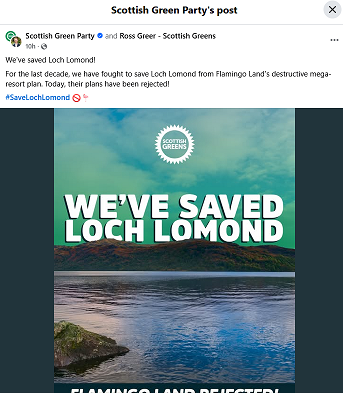
While it was premature for the Greens to claim earlier in the week that “We’ve Saved Loch Lomond”, all who care about Loch Lomond should be optimistic that with political will, organisation and some hard graft that can now be done over the next few years. People should be in no doubt, however, that that will mean tackling the corruption at the heart of the LLTNPA, that has led to the suspension of local board member Sid Perrie for six months for questioning the way Park officers had handled the Flamingo Land planning process (see here). That corruption is continuing in the way the Local Place Plan for Balloch and the Pierhead Action Plan are being developed – I will consider those again in future posts.

The whole issue of the development of Flamingo Land in the national park stimulates, in my mind, the simple words,” Here we go again!” The parallels with the development of Aviemore are notable. Ski development there was a notable stimulus as it was closely situated to that major recreational attraction and also mass access to environmentally sensitive areas of the Cairngorms.. The parallel with Flamingo Land is its siting directly beside Loch Lomond – a major recreational but environmentally sensitive resource. Sited within a National Park, the argument can be advanced that unwanted impacts both social and environmental impacts can be constrained. But a key point made by Molloy in his major paper on this issue was that what finally decided the effective sustainable management of such protected areas was not the level of environmental protection designations in place but the scale of development permitted tin and around them. The Swiss and other Alpine nations have done much research into this issue of of sustainable tourism development and I recall, in 1981, Dr Friz Schvarzenbach involved in much of this in Switzerland commenting on Aviemore being of international significance as a world classic of bad tourism development where all the principles had not been applied. The situation in Speyside has been much studied by Getz and others and one wonders if the lessons learned might be applied to Flamingo Land proposals at Loch Lomond
Pages 6-10 of the LLTNPA’s latest Development Plan Scheme https://www.lochlomond-trossachs.org/wp-content/uploads/2026/01/National-Park-Development-Plan-Scheme-Jan-2026.pdf , published last month, set out the current state of play in the preparation of the new Local Development Plan, as well as a proposed timeline of future steps. The first steps in preparing the new LDP have already been completed. Right now, the Call for Land, Sites and Ideas is ongoing. The Community Development Trust needs to engage with that too, before it closes on 23 April and the NPA starts the Site Assessment stage.
Looks like this particular parrot is dead, not resting. So well done to the citizens like Sid Perrie who spoke up before it was too late, rather than girning after the event.
Flamingo Land and its traffic could and perhaps should go elsewhere. I can see that unnecessary traffic will damage the National Park, but in planning terms I think the ‘traffic’ issue is whether the roads are wide enough. i.e. something that can be solved by building bigger roads.
If we still want to make an issue of it, SG say it “considers the appellant’s traffic modelling and mitigation proposals to be robust”; I suppose these docs are or would be available for dissection.
Planning is a farce. In this case it seems obvious, Gibb was assured when he bought the land, the planning process was just a necessary formality. The scale of opposition was unprecedented,, it didn’t deter the applicant or the planners, they continued to brassneck it., thinking the objectors would give up. . It’s by no means an isolated case but a lesson to the public. They would ultimately pick up the bill for infrastructure upgrade , not the wealthy applicant. They need to be more alert and assertive for their own sake. and the sake of Scotland . They have the power.
I’m still waiting to see the “£40 million” put on the table. You’ll have a long wait to see that, “boost to the local economy.” If there was one thing I would investigate on the subject of land use planning it’s the “economics.” You think what they’re doing is “local?” It’s a global junk bond, debt and rent money for nothing racket. ScotGov’s played like a violin. Don’t be surprised if FL are back after the elections.