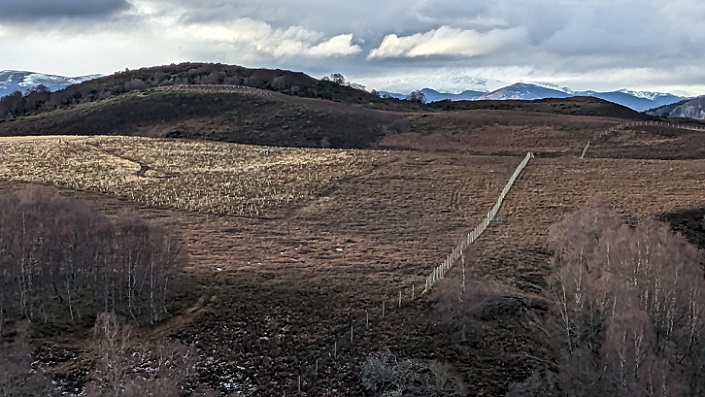
The woodland visible around the top of Creag Bheag was funded under the Woodland Grant Scheme 3 in 1999. Twenty years later the Balavil Estate engaged Trees for Life Woodland Services to design a new area of native woodland on the estate, around Creag Bhalg. This is about 3 km north east of Kingussie, was funded by Scottish Forestry in 2021 and involved the erection of new deer fences, including one along Balavil’s boundary with Pitmain.
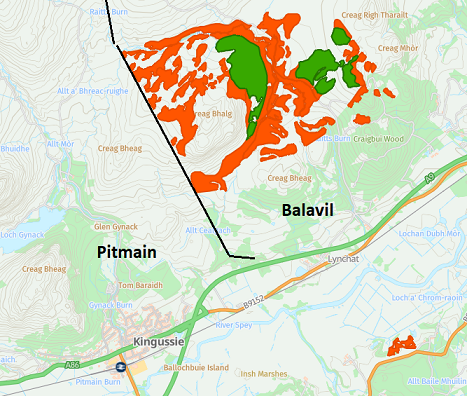
Scottish Forestry does not routinely publish what it has agreed with the landowner when it approves woodland creation schemes but the brochure for Balavil (see here), when it was put up for sale in 2023, contains this information:
“The current owners [the estate remains owned by Mr and Mrs Heerema] also embarked upon a substantial new native planting and natural regeneration scheme in 2021 on the Creag Bhalg and Creag Bhuide areas of the estate, planting a net area of 244 hectares (603 acres) of native Caledonian Scots pine and Birch woodland (NVC W17/W18) within a strategically positioned deer fence. This now encloses the two planting schemes as well as the adjoining mixed conifer woodland to allow natural regeneration to take place throughout the enclosed area.”
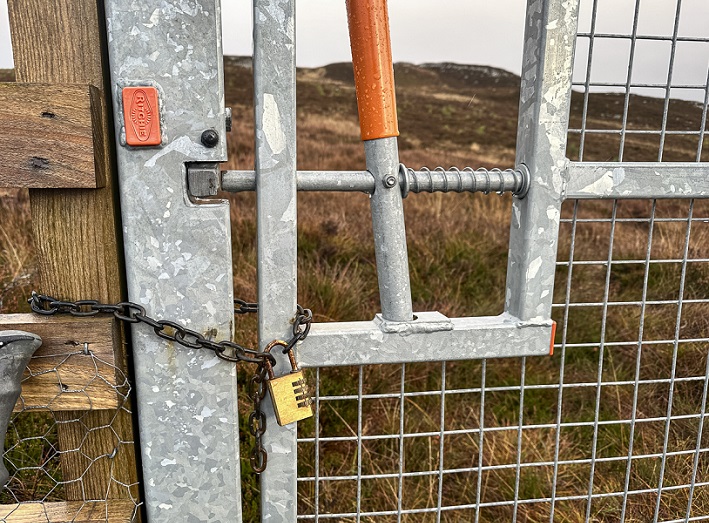
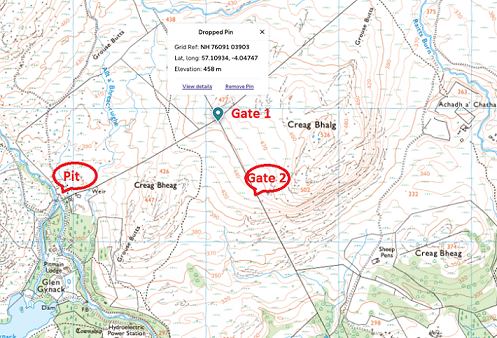
Two gates within that “strategically position deer fence” along the boundary with Pitmain, presumably funded by Scottish Forestry and intended to provide access to the public, are now locked:
My experience with landowners is that they can be quite reluctant to step onto the ground of neighbouring estates, unless invited. Doing so is seen as a breach of protocol and even those most sympathetic to the public haven’t become fully accustomed to the idea that access rights apply to them too.
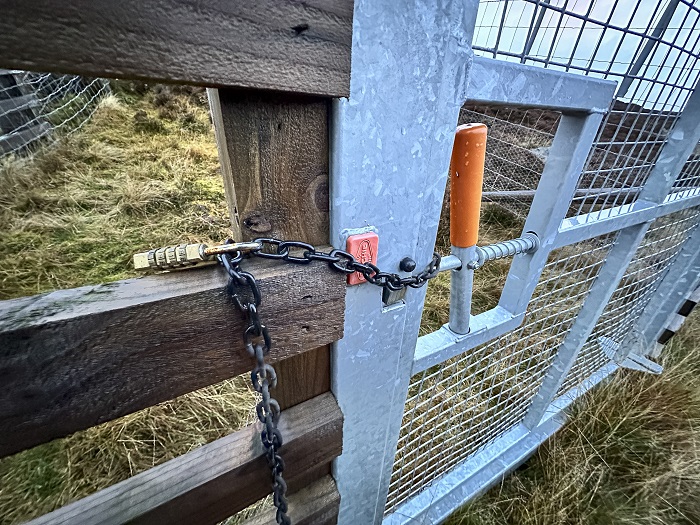
While the two gates in the deer fence may be occasionally used to enable staff from the two estates to help each other (shepherds for example often work together across estate boundaries), the primary purpose appears to have been to allow people to continue to exercise their right to roam after the deer fence was erected.
The Balavil Estate brochure did not report the total amount of Forestry Grant it has received to create this new native woodland but did in 2023 refer to “three further annually recurring grant payments of £74,816/year combined, totalling £224,448 of tax free grant income.” I will now be writing to Scottish Forestry asking for a full copy of the contract and requesting that the last of these grant payments is withheld until the Balavil Estate commits in writing to re-opening these gates and keeping them open.
I will also be reporting these locked gates to the Cairngorms National Park Authority (CNPA) as an obstruction to access rights, like the fenced over gate at Far Ralia (see here). The minutes of the CNPA’s Local Access Forum from March 2025 (see here) records that of the 24 access obstructions reported in the National Park in 2024/25 no less than 16 consisted of locked gates. That, in my experience, is likely to be an underestimate of the real scale of the problem.
Locked gates are not only classified as obstructions under the Land Reform (Scotland) Act 2003, they are also contrary to the requirement that landowners manage access rights responsibly. So why isn’t the CNPA calling for cross-compliance, that no public grants should be paid to landowners who are deliberately obstructing access?
These locked gates are just over a kilometre away from pit where Raptor Persecution recently reported that the Pitmain Estate had been dumping pheasant, red legged partridge and other unwanted birds and parts of animals which had been shot (see here):
Both Pitmain and Balavil have long been managed as sporting estates but increasingly the management focus of both estates on their lower ground in Strathspey has been on the creation of habitat for pheasant, partridge and duck shooting (hence the relevance of the pit to this post). Deer have been excluded from the area as a result and this should have made the lower section of deer fence between the two estates, along with the gates through it, completely redundant.
The underlying issue is that landowners, even if they share the same objectives, don’t entirely trust each other. These fears are real because statutory deer control is so ineffective that if one landowner decides to try and shunt the responsibility and costs of deer management onto its neighbour, there is nothing to stop them doing so. The easy solution from an individual landowner perspective therefore, so long as the public is paying for it, is to erect a deer fence around new woodland even if both estates are wanting to create woodland in the same area.
Having been funded with public money to erect these unnecessary deer fences, landowners like Balavil are adding public insult to public injury by locking what few gates there are through them. Through their failure to tackle the issues both Scottish Forestry and the CNPA are undermining the right to roam.
