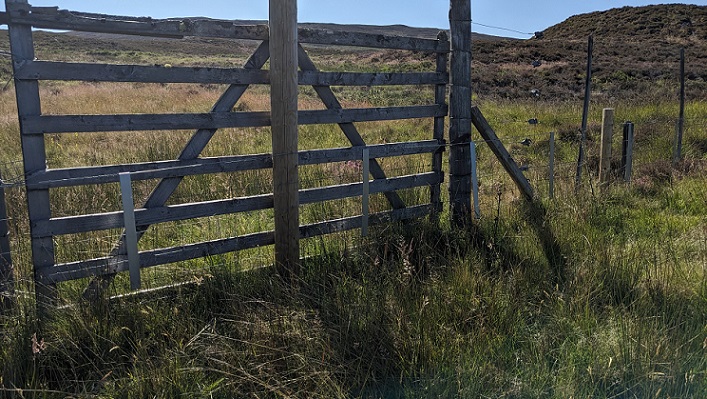
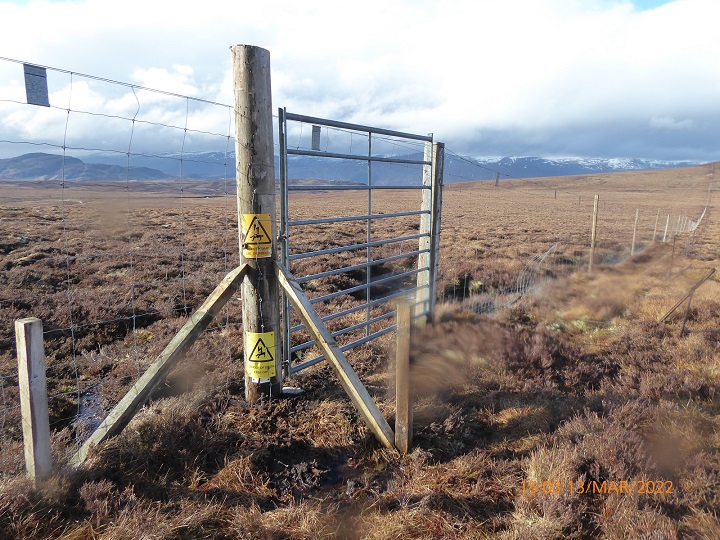
 My most recent post on Abrdn’s mismanagement of the Far Ralia estate for carbon offsetting purposes (see here) included this photograph of a new stock fence erected alongside an old deer fence and across this gate making it unusable. I then notified the responsible manager at Abrdn, who was not aware the gate had been blocked, and reported this to the Cairngorms National Park Authority (CNPA) as an obstruction to access rights.
The CNPA’s approach to the obstructed gate
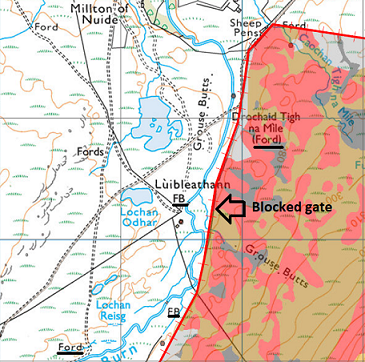
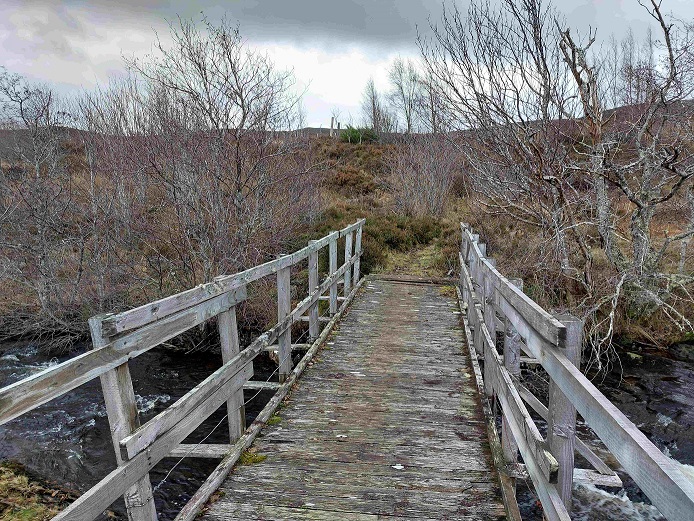
The Millton burn is deep and difficult to cross and sometime in the past the Ralia Estate had built footbridges across it at regular intervals. I had known about the one by Luibleathann long before the estate sold off Far Ralia and, as the most northerly crossing point marked on my old map, it provided the easiest obvious means of accessing the northernmost part of Far Ralia to look at the tree planting there. The footbridge has long been in poor condition but I crossed it and headed for what should have been a stock fence along the boundary of Far Ralia, only to find an old deer fence still in place and the gate through it blocked.
What I had not realised, until the CNPA Access Officer informed me in January after a site visit, was that there was also a footbridge at the ford where the Wade Road crosses the Millton Burn at Drochaid Tigh na Mile. This was not shown on my or the Scottish Forestry map:
Nor had I appreciated that the planting contractors for Ralia had used the ford and that a farm gate had been installed to enable diggers to get access through the new stock fence and old deer fence :
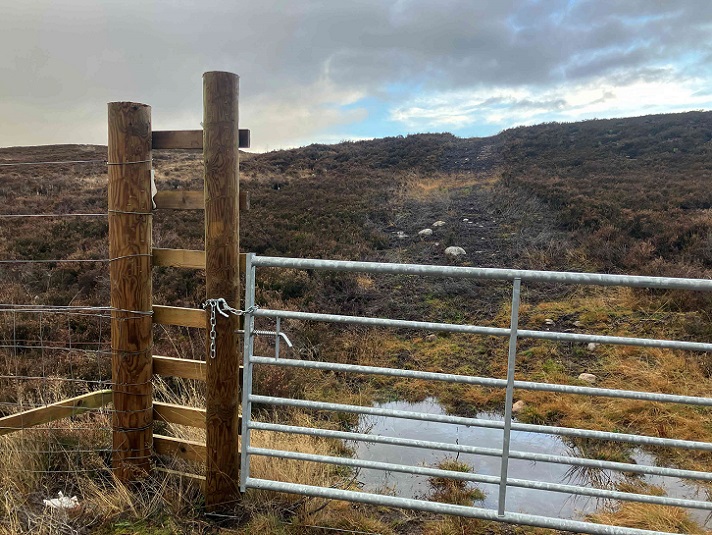
The CNPA then decided that because there was another bridge, in much better condition to the Footbridge by Luitleathann, and another gate, the blocked gate I had reported did not constitute an obstruction to access rights. Their reasoning was reported to a recent meeting of the CNPA’s Local Outdoor Access Forum (LOAF) (see here):
“Recent Notable Cases
1. Case no. 2025-111: Far Ralia obstructed forestry gate. [Comment: this is factually wrong, it never was a forestry gate but a gate through a deer fence].
A gate in a deer fence which had a stock fence placed across it as part of a new forestry planting scheme fence was reported to us as an obstruction to access. A site visit revealed a new field gate 500m from the reported gate, in our opinion the new gate was in a more appropriate location (near a footbridge, off a track) compared to the deer gate which was challenging to reach (across a broken
boardwalk and rough ground).
We concluded that although the deer gate had been fenced over this wasn’t an obstruction to access as; (a) the land manager had taken account of the needs of people seeking to exercise their access rights (b) as a new nearby gate was provided there was no deliberate intention to prevent or deter people from taking access.
We concluded that it was the case that the old gate had been superseded by a different nearby gate which was in a preferable location for access users”
The minute of the LOAF meeting has not yet been published, so I cannot report what questions were asked or what discussion took place. The report, however, fails to mention that the Forest Plan approved by Scottish Forestry:
a) showed a stock fence along the whole of the west side of Far Ralia and made no mention any deer fence being retained;
b) failed to show either the existing gate, which was then blocked, or the new gate.
Deer fences form obstructions to numerous recreational activities covered by access rights and also obstruct wildlife (sometimes lethally). The CNPA referred me to NatureScot’s “Deer management methods” webpage (see here) and the “Joint agency statement & guidance on deer fences” dating from 2004 (see here). These both contain similar messages:
“Fencing should be seen as part of a wider programme of deer management and fences should not be left erected for longer than necessary”.
In my view the CNPA should have treated this whole section of redundant deer fence as an unnecessary obstruction to access. Instead they have decided to narrow the issue down to access points and concluded one bridge and one gate is enough. Judged from this very narrow perspective, the bridge and gate by the Drochaid na Mile does offer an easier and convenient route for most people. However, one of the four statutory aims of the National Park to promote public enjoyment of the countryside. From this perspective it has a legal duty to defend the right of people to use a number of routes across burns and through obstructions like fences rather than focussing solely on specific routes and arguing, as in this case, that one route has superseded another.
Part of the CNPA’s argument, in an email sent to me, was that the footbridge by Luibleathann was unsafe and was unlikely to survive long. I don’t dispute their assessment of the state of that footbridge (sorry no photos). The issue is that the footbridges over the Millton Burn, which the Ralia Estate once saw as part of the infrastructure necessary for facilitating access for their staff and guests, is now implicitly judged by the CNPA as being too good for the general public.
The Ralia Estate received £7.5m from the sale of Far Ralia, a sum which was inflated by the promise of forestry grants paid for by the public, and Abrdn was then awarded £2,523,301.96 by Scottish Forestry (see here). Both landowners therefore were not lacking in money and could easily have afforded to maintain the footbridge, keep the gate open and remove the deer fence.
Fencing and the planting plan for Far Ralia
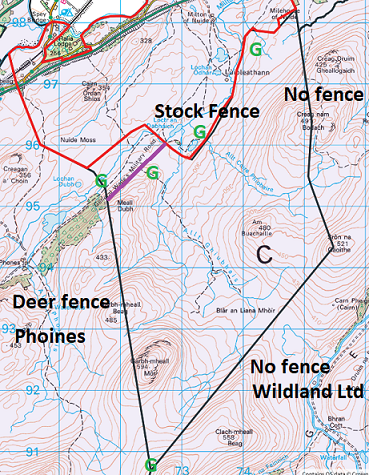
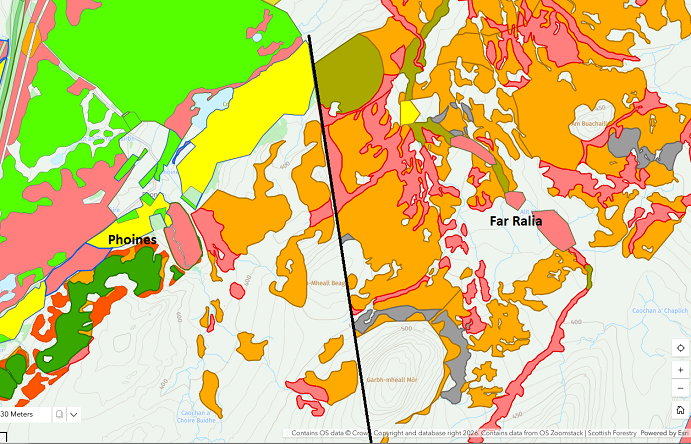
Scottish Forestry’s contract for the woodland planting at Far Ralia contains a detailed Forestry Grant Options map (extract above). This shows the fencing proposals in more detail but is too big to reproduce here. The essence of the final plan, however, was quite simple (left): there would be no fencing on the east and south-east boundaries of the estate; a deer fence would run along the western boundary with the Phoines estate; and a stock fence would run along the northern boundary.
The approved map shows three gates, two along the northern boundary and a third, an existing gate, where Wade’s Rd crosses from Far Ralia to the Phoines estate. Two further gates were not marked on the approved map: the one opposite the Drochaid na Mile and another at the very southern tip of Far Ralia giving access to the Phoines Estate
The original map, therefore, showed just three gates in over 10kms of fencing, half of which was supposed to be stock fence and half deer fence.
Stock fencing, unless topped with barbed wire, is far easier to cross than deer fencing so the fact that there just three gates installed in about 5km of fencing might not have mattered. The nature of the ground on either side of the Millton Burn makes access physically challenging, except along the Wade’s Rd and main vehicular access track into Far Ralia, and anyone doing so would likely to be able to hop across a stock fence.
The issue is that the redundant deer fencing was not removed. The CNPA’s report to their LOAF failed to report that fact.
In 2010 further guidance (see here) was produced to supplement the Joint Agency statement on Deer Fencing that contains this advice about Access and Recreation:
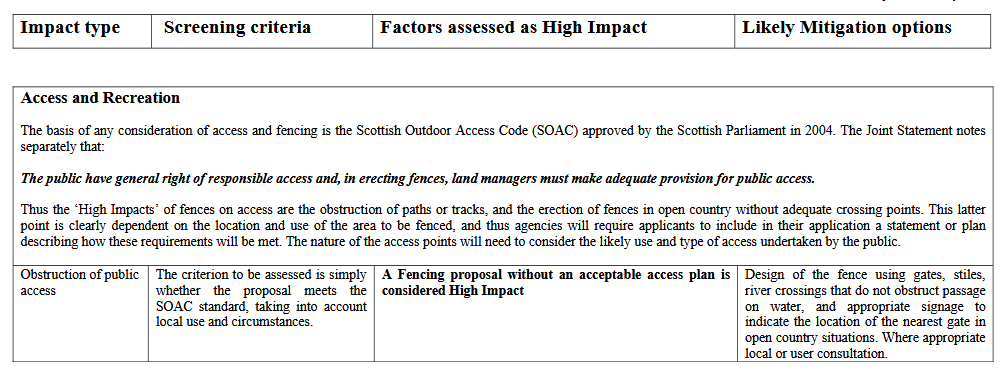
This Guidance emphasises that “A Fencing proposal without an acceptable access plan is considered High Impact”.
Besides the failure to remove the redundant deer fence along the stock fence, Abrdn, their agents AKRE, Scottish Forestry and the CNPA all failed to consider the impact of the 5km deer fence along the western boundary of Far Ralia as described in the plan.
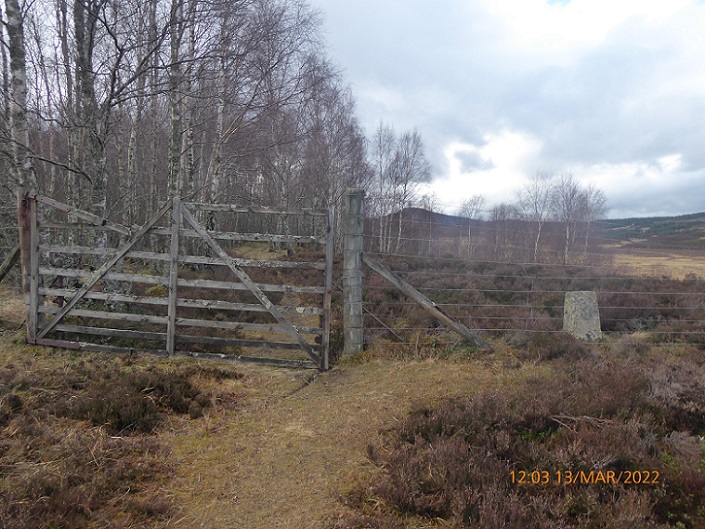
Scottish Forestry awarded part of their grant to replace/reinforce 2595m of the old deer fencing on either side of this crossing point. They did so without taking account of the plans of Phoines estate or the extensive natural regeneration that was taking place on the Far Ralia side: .
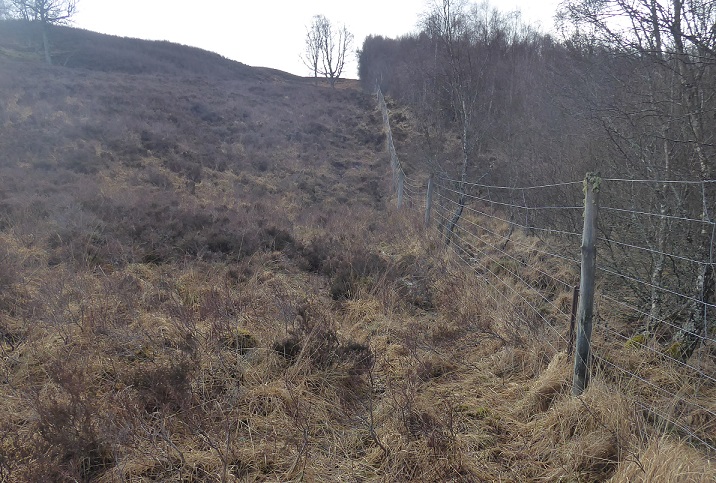
The birch woodland on the right was created in 1999 as part of the Woodland Grant Scheme (WGS) (see here) while the area on the left was earmarked for natural regeneration by Far Ralia. Scottish Forestry grant aiding a new/reinforced fence along this part of the boundary between the two estates never made any sense.
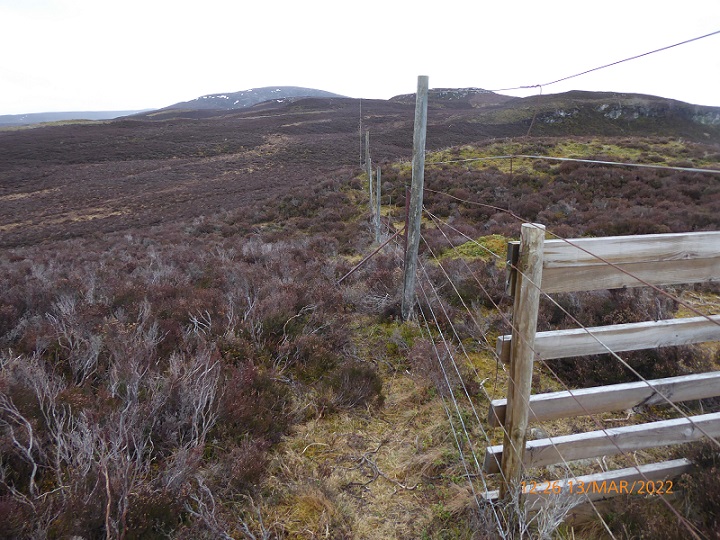
 Beyond the WGS birchwood and natural regeneration area, the deer fence continues all the way to the southern tip of Far Ralia, a distance of over 4 km. Four years ago at this point (photo left) there was was a stock fence on the Phoines side of the deer fence, perhaps intended to keep sheep out of the birchwood, together with a farm gate through it but no way of getting to it from Far Ralia.
After the Far Ralia planting scheme was approved in 2023, Phoines submitted their own Forestry Grants Scheme application which was approved last year. The result is that the land on both sides of the newly reinforced section of deer fence is now being used for woodland creation:
This begs the question why Scottish Forestry ever grant-aided a section of new deer fence between two estates which were both planning to create new woodland? The answer appears to be that Abrdn had appointed AKRE trees, part of the same family which had owned the Ralia Estate, to develop and manage their project and that, for whatever reason, the two families did not communicate with each other on their plans. Hence in part the now completely redundant deer fence and the waste of public money. If there was any proper governance around forestry grants Scottish Forestry would now be reclaiming that money.
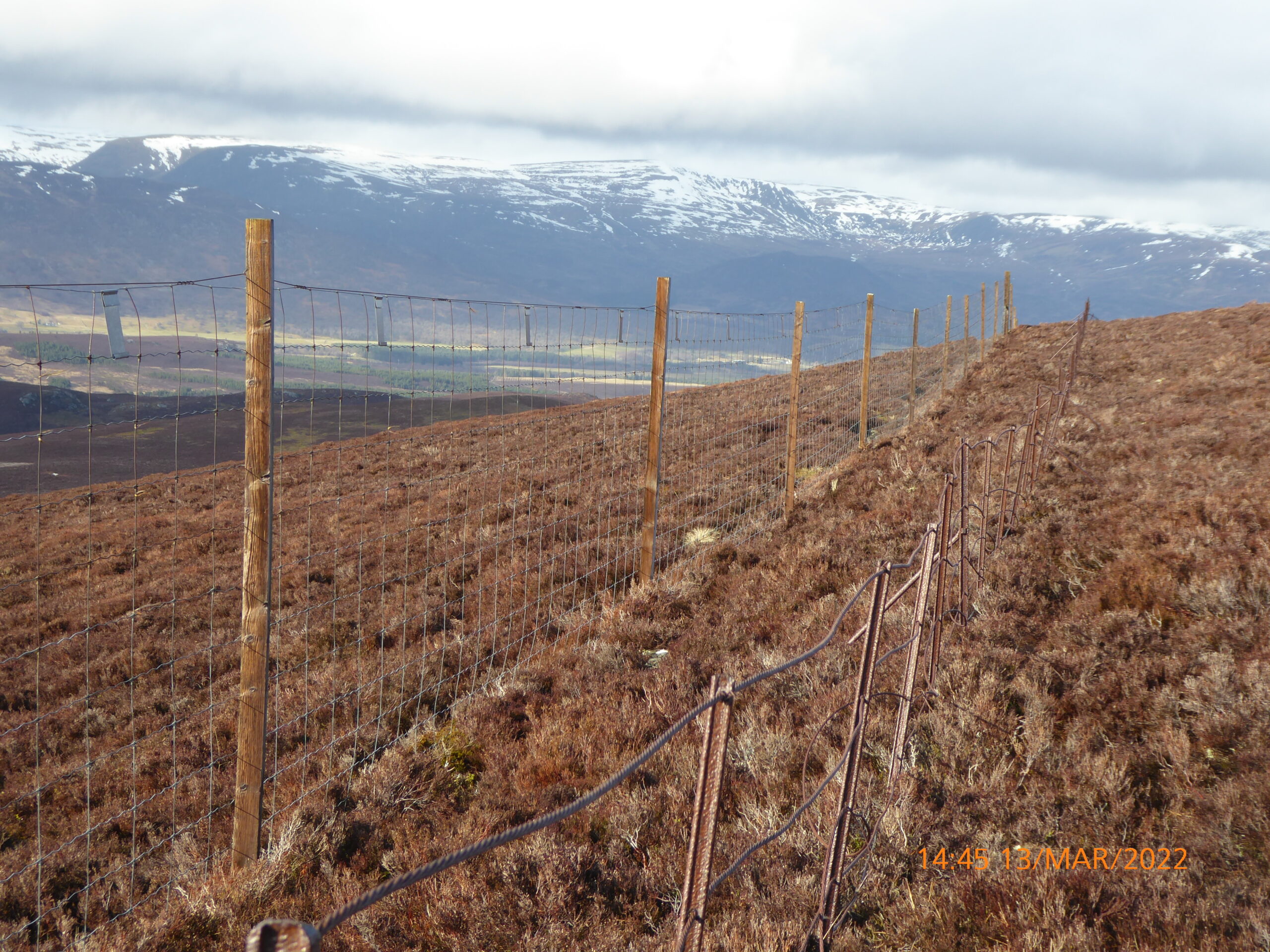
The wider problem is how to make neighbouring landowners co-operate with each other on deer control. Even if both Phoines and Far Ralia now ostensibly share the same objective, woodland creation on what was moorland managed for grouse, getting them to work together is another matter. Deciding who is responsible for what, where deer range over several landholdings, is complex and there is always the temptation for each estate to try and shunt the costs of deer management onto their neighbours. This helps explain why so many deer fences follow estate boundaries.
Without external pressure, this deer fence – which made it much harder for me to wander over onto Phoines and enjoy my access rights there – is unlikely to be removed.
Near the southern tip of Far Ralia, where the deer fence veers off across the Phoines Estate towards Loch Quoich, there is a gate. That is the first crossing point in 5km. The original proposal for Far Ralia was to extend this deer fence along their south-eastern and northern boundary with Wildland Ltd a distance, according to the plan, of about 8720m. Dave Morris and myself objected, pointing out that Wildland Ltd had reduced deer numbers in Glen Tromie to very low numbers so there was no justification for any deer fence between the two estates. After our objection the proposal was changed. The final plan approved by Scottish Forestry states:
“With no fencing on the Wildland boundary, access to hills will be maintained”.
Success! Nothing was said in the plan, however, about access along the 5km boundary with Phoines. Here, the gateless deer fence formed a serious obstruction to people exercising their right to roam.
Discussion
Primary responsibility for the failures I have described above lies with Scottish Forestry. However, they are accountable only to Scottish Ministers, not the general public, and are focussed purely on meeting Scottish Government planting targets. The easiest way for them to do that is by planting as many trees as possible in enclosures surrounded by deer fences, whatever the consequences for people, wildlife, the landscape or indeed carbon emissions. Unless other public authorities start to challenge that approach it is unlikely to change.
The CNPA, with its statutory duties to conserve landscape and wildlife and promote public enjoyment of the countryside is in a key position to do this. As part of my correspondence with the CNPA about the fenced over gate opposite Leableathann, I asked them whether they have any policy on access rights and deer fencing. They have none.
This helps explain the failures of the CNPA as a National Park not just at Far Ralia, where they failed to challenge publicly the 5km of gateless deer fence along the boundary with Phoines, but elsewhere such as at BrewDog’s Lost Forest (see here).
The underlying explanation for what has gone wrong, however, which I will pick up in further posts, is that the CNPA has become increasingly aligned with the interests of landowners and motivated like Scottish Forestry by Scottish Government targets. Hence its failure to challenge deer fencing and its failure to promote access rights.
